Artificial Urinary Sphincter (AUS): Procedure and Recovery

Updated: 3 days ago
Medically reviewed by Dr. Baraa Alnahhal, MD · Last reviewed: October 2026
Quick Answer
An artificial urinary sphincter is an inflatable medical device that treats stress urinary incontinence by mimicking a healthy urinary valve. It has a pressure balloon, a urethral cuff and a manual pump; squeezing the pump deflates the cuff for urination, then it reinflates automatically. [1] It is highly effective for people who have not responded to medications or bladder training. [1]
What the research says
Pooled data show AUS cuts daily pad use by about four pads and improves quality of life. A meta-analysis of 1,271 patients from 19 studies (mostly cohort studies) found a dry rate (no pads) of about 52% and a "social dry" rate (0 to 1 pad per day) of about 82%. The authors graded the certainty of the evidence as very low for dry rate and moderate for pad use (PubMed: Li et al., PLoS One, 2023 [2]).
Complications and repeat surgery are real trade-offs. In a systematic review of 12 reports covering 623 men followed for at least two years, infection or erosion occurred in 8.5% of cases, mechanical failure in 6.2%, and urethral atrophy in 7.9%, with a reoperation rate of 26.0%. The authors rated the overall quality of evidence as low (PubMed: Van der Aa et al., Eur Urol, 2013 [3]).
For moderate male stress incontinence, AUS outperformed slings without a significant difference in complications. A meta-analysis of five studies (509 patients: 214 AUS and 295 slings) found a higher success rate with AUS (odds ratio 0.57; 95% CI 0.36 to 0.90), defined as 0 to 1 pad per day, while overall complication rates did not differ significantly (odds ratio 1.06; 95% CI 0.58 to 1.92). The authors called for higher-quality evidence (PubMed: Lin et al., Front Surg, 2022 [4]).
What is an artificial urinary sphincter (AUS)?
The artificial urinary sphincter (AUS) is a specialized surgical implant used to restore urinary control. In a healthy body, the urinary sphincter acts as a valve, remaining contracted to hold urine in the bladder and relaxing only during urination. When these muscles weaken, often due to prostate surgery or other medical conditions, stress incontinence occurs, leading to involuntary leakage during physical activities like coughing, sneezing, or exercising.
The AUS device provides a mechanical solution to this muscle failure. It is primarily recommended for men who suffer from persistent leakage despite trying non-surgical interventions. Although less common, the device can also be used to treat stress incontinence in women. [1]
What are the parts of an artificial urinary sphincter, and how does it work?
An artificial urinary sphincter has three parts that work together to manage urine flow, opening the urethra when the user squeezes a pump and closing it again automatically.
Component | Location | Primary Function |
Pressure Balloon | Abdomen (under muscles) | Maintains constant fluid pressure to keep the cuff closed. |
Urethral Cuff | Around the urethra | Squeezes the urethra shut to prevent urine from leaking. |
Manual Pump | Scrotum or labia majora | Controls the movement of fluid to open or close the cuff. |
To urinate, the user manually squeezes the pump located in the scrotum or labia. This action shifts fluid from the urethral cuff into the pressure balloon, causing the cuff to expand and open the urethra. After approximately three minutes, the balloon automatically pushes the fluid back into the cuff, closing the valve and restoring continence. [1]

How is artificial urinary sphincter surgery done, and what are the risks?
During the procedure, a urologist makes small incisions to place the various components of the device. The surgery is typically performed under general anesthesia. While the AUS has a high success rate, often cited as over 90%, it is a surgical intervention that carries specific risks. [1]
Potential complications include:
Device failure: The mechanical parts may break down over time, typically requiring replacement after 10 years.
Urethral erosion: The cuff may gradually wear away the tissue of the urethra. [1]
Infection: As with any implant, there is a risk of bacterial infection at the surgical site. [1]
Urinary issues: Some patients may experience worsening urge incontinence or difficulty using the manual pump. [1]
What does recovery and long-term care after artificial urinary sphincter surgery involve?
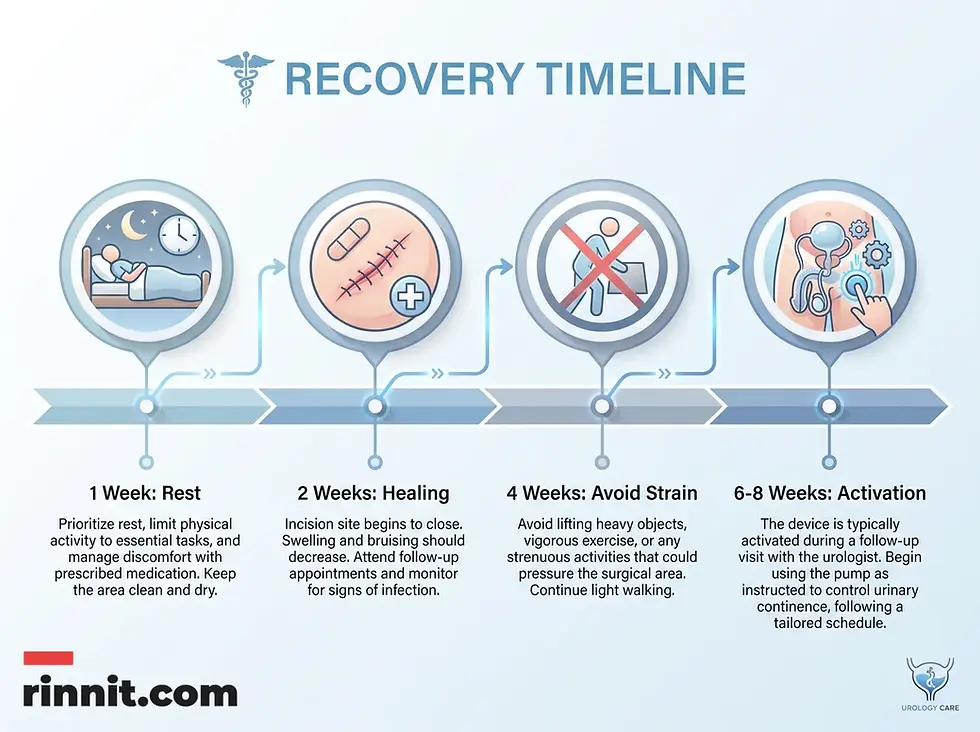
Recovery from AUS surgery occurs in stages. While initial incisions usually heal within two weeks, the device remains inactive for six to eight weeks to allow the urethral tissue to heal completely. [1] During this time, patients will continue to experience incontinence until a healthcare provider activates the system.
Post-Operative Guidelines
Patients are advised to follow strict activity restrictions for at least four weeks following surgery. [1] This includes avoiding strenuous physical activity and sexual activity to prevent complications such as ripped stitches or increased bleeding.
Activity | Recommended Timeline |
Return to work or school | 5 to 7 days (longer for physical jobs) |
Incision healing | Approximately 2 weeks |
Strenuous activity | Avoid for at least 4 weeks |
Device activation | 6 to 8 weeks after surgery |
When should you seek medical attention after artificial urinary sphincter surgery?
Regular follow-up appointments after artificial urinary sphincter surgery help monitor healing and device function, and certain warning signs call for prompt medical attention. Patients should contact their healthcare provider immediately if they experience any of the following warning signs:

Conclusion
The artificial urinary sphincter is a highly effective, long-term solution for those living with severe stress incontinence. By providing mechanical control over urinary flow, the device allows individuals to return to their daily activities without the fear of embarrassing leaks. If you are struggling with incontinence that has not responded to other treatments, consult a specialist to determine if an AUS is the right choice for your health needs.
Frequently Asked Questions
1. What is the primary purpose of an artificial urinary sphincter?
The primary purpose is to treat stress urinary incontinence by providing a mechanical valve that keeps the urethra closed until the user manually opens it to urinate.
2. Who is the ideal candidate for an AUS?
The ideal candidates are typically men who suffer from severe stress incontinence, often following prostate cancer surgery, and who have not found relief through medications or bladder training.
3. How long does the artificial urinary sphincter device last?
An artificial urinary sphincter typically lasts for about 10 years, after which the mechanical components may need to be surgically replaced.
4. How is the device activated during urination?
The user manually squeezes a small pump located in the scrotum or labia, which moves fluid away from the urethral cuff to allow urine to flow.
5. Does the device close automatically after urination?
Yes, the device is designed to automatically move fluid back into the urethral cuff approximately three minutes after the pump is squeezed, closing the urethra.
6. What is the success rate of AUS surgery?
Clinical studies indicate a high success rate, with over 90% of patients experiencing significant improvement in their urinary control.
7. When can I start using the device after surgery?
The device is typically activated by a healthcare provider six to eight weeks after surgery, once the surgical site and urethra have sufficiently healed.
8. What are the main risks associated with the procedure?
Specific risks include device failure, urethral tissue erosion, infection, and the potential need for future surgical revisions or replacements.
9. Are there any activity restrictions during recovery?
Yes, patients should avoid strenuous exercise and sexual activity for at least four weeks post-surgery to ensure proper healing of the incisions and internal tissues.
10. Can women receive an artificial urinary sphincter?
While the device is primarily used in men, it can be used to treat stress incontinence in women, though this application is much less common.
Related Reading
Stress Incontinence: Symptoms, Causes, and Treatment Options Explained explains leaks with coughing or lifting and how they are treated.
Prostatectomy: Types, Surgery, Risks and Recovery covers prostate removal surgery, a common cause of male incontinence.
Urinary Incontinence: The Complete Guide to Regaining Bladder Control reviews the types of bladder leakage and ways to regain control.
Condom Catheters for Urinary Incontinence explains how external catheters manage leaks without surgery.
References
Cleveland Clinic. Artificial Urinary Sphincter: Placement & Success Rate. Cleveland Clinic. Jul. 3, 2024. https://my.clevelandclinic.org/health/treatments/artificial-urinary-sphincter
Li Y, Li X, Yang Q. Effectiveness of artificial urinary sphincter to treat stress incontinence after prostatectomy: A meta-analysis and systematic review. PLoS One. 2023;18(9):e0290949. PMID 37656677. https://doi.org/10.1371/journal.pone.0290949
Van der Aa F, Drake MJ, Kasyan GR, et al. The artificial urinary sphincter after a quarter of a century: a critical systematic review of its use in male non-neurogenic incontinence. Eur Urol. 2013;63(4):681-689. PMID 23219375. https://doi.org/10.1016/j.eururo.2012.11.034
Lin L, Sun W, Guo X, et al. Artificial urinary sphincter is better than slings for moderate male stress urinary incontinence with acceptable complication rate: a systematic review and meta-analysis. Front Surg. 2022;9:841555. PMID 35223981. https://doi.org/10.3389/fsurg.2022.841555
Medical Disclaimer
This article is for informational purposes only and does not constitute medical advice. Always seek the advice of your physician or other qualified health provider with any questions you may have regarding a medical condition. Never disregard professional medical advice or delay in seeking it because of something you have read here.



Comments