ACTH Stimulation Test (Cosyntropin Test): What It Is, How It's Done and What Results Mean

Written and medically reviewed by Dr. Baraa Alnahhal, MD · Last reviewed: November 2026 · How we review
Quick Answer: What is an ACTH stimulation test?
An ACTH stimulation test, also called a cosyntropin stimulation test, checks how well your adrenal glands make cortisol when they are signaled to. You get a shot of synthetic ACTH (cosyntropin), and blood samples taken before and after, usually at 30 and 60 minutes, measure your cortisol. It is the main test used to diagnose adrenal insufficiency. [1]
What the research says
The test is very good at confirming primary adrenal insufficiency. In a review of studies, the high-dose (250 mcg) test correctly identified 92% of people with primary adrenal insufficiency. For secondary adrenal insufficiency, both high- and low-dose tests were better at ruling it in than ruling it out. (Ospina et al., The Journal of Clinical Endocrinology & Metabolism, 2016) [2]
The low-dose version may be more accurate for pituitary-related cases. Pooled patient-level data from 13 studies (679 people) found the 1 mcg low-dose test had an accuracy score (area under the curve) of 0.92, compared with 0.79 for the standard-dose test, for diagnosing chronic hypothalamic-pituitary-adrenal insufficiency. (Kazlauskaite et al., The Journal of Clinical Endocrinology & Metabolism, 2008) [3]
Key takeaways
The test checks whether your adrenal glands respond to ACTH by making cortisol. [1]
It is the main test for diagnosing primary, secondary and tertiary adrenal insufficiency. [1]
You get a cosyntropin shot, plus blood draws before and usually 30 and 60 minutes after. [1]
You may need to fast for six hours and have the test in the morning. [1]
A normal result is a cortisol level above 12.6 mcg/dL after the shot, though ranges vary by lab. [1]
Recent steroid use is a common cause of a false-positive result. [1]
What is an ACTH stimulation test?
ACTH (adrenocorticotropic hormone) is made by your pituitary gland and plays a big role in how your body handles stress. It tells your adrenal glands to make cortisol, the "stress hormone," which affects almost every organ and tissue in your body. The ACTH stimulation test is a dynamic test: it gives your adrenal glands a signal and measures how they respond. [1]

Types of adrenal insufficiency
Type | Where the problem is | Common cause |
Primary | The adrenal glands are damaged and cannot make enough cortisol | Addison's disease, an autoimmune disease, is the most common cause |
Secondary | The pituitary gland does not release enough ACTH | A pituitary problem |
Tertiary | The hypothalamus does not make enough corticotropin-releasing hormone (CRH) | A hypothalamus problem |
Sources: [1]
Why is an ACTH stimulation test done?
The test shows whether your adrenal glands and pituitary gland are working properly to make cortisol. Your provider may order it: [1]
If a cortisol test result was low
If you have symptoms of adrenal insufficiency
To check whether your pituitary and adrenal glands have recovered after long-term use of glucocorticoid medicines such as prednisone
Who performs the test?
A nurse gives the cosyntropin shot, and a phlebotomist usually draws the blood. A lab scientist then runs the samples on machines called analyzers. Because it involves both a shot and several blood draws, you may have it in a hospital or an endocrinologist's office. An endocrinologist specializes in hormone conditions. [1]
How do you prepare?
You may need to limit activity and eat high-carbohydrate foods for 12 to 24 hours before the test. [1]
You may need to fast for six hours beforehand, drinking only water. [1]
Your provider may have you pause certain medicines that can affect cortisol results. [1]
You may be asked to come in the morning, because cortisol naturally peaks then and this lowers the chance of a false-positive result. [1]
Your provider will give you specific instructions. Be sure to follow them. [1]
What happens during the test?
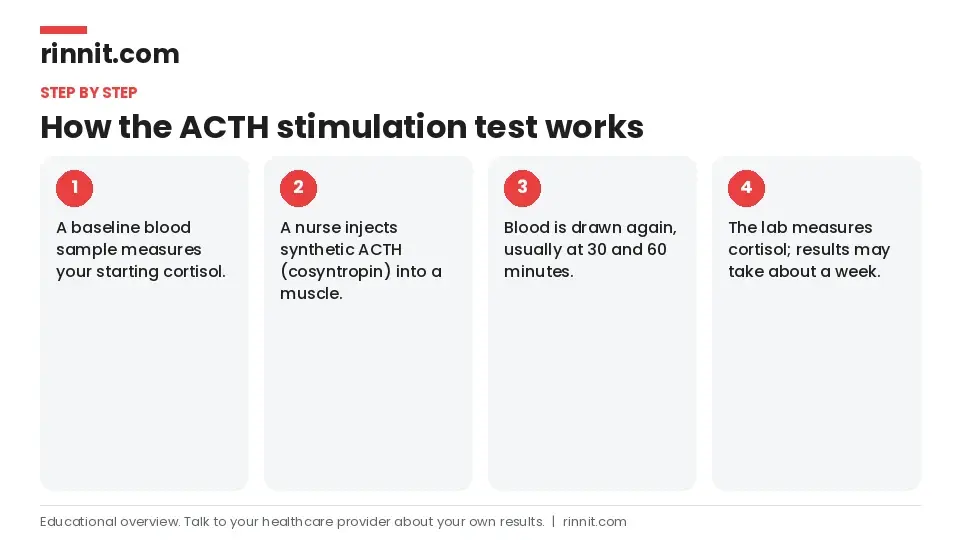
A phlebotomist draws a baseline blood sample from a vein in your arm to measure your starting cortisol level. [1]
A nurse gives you a shot of synthetic ACTH (cosyntropin) into a muscle, usually your upper arm near the shoulder. It acts like your own ACTH and tells your adrenal glands to make cortisol. [1]
More blood samples are taken after a set time, usually at 30 and 60 minutes, to measure cortisol again. [1]
All samples are sent to a lab for testing. [1]
Each blood draw feels like a small pinch. The shot may cause moderate pain or stinging, but this passes quickly. [1]
Are there risks?
Blood tests carry very little risk. You may have slight tenderness or a bruise where the needle went in, which usually clears quickly. [1]
What do the results mean?
Results can take up to a week, because your provider needs to interpret them carefully once the lab finishes. Your report usually lists the test name, your result, the normal range and whether your result is normal, high or low. [1]
Result | What it may mean |
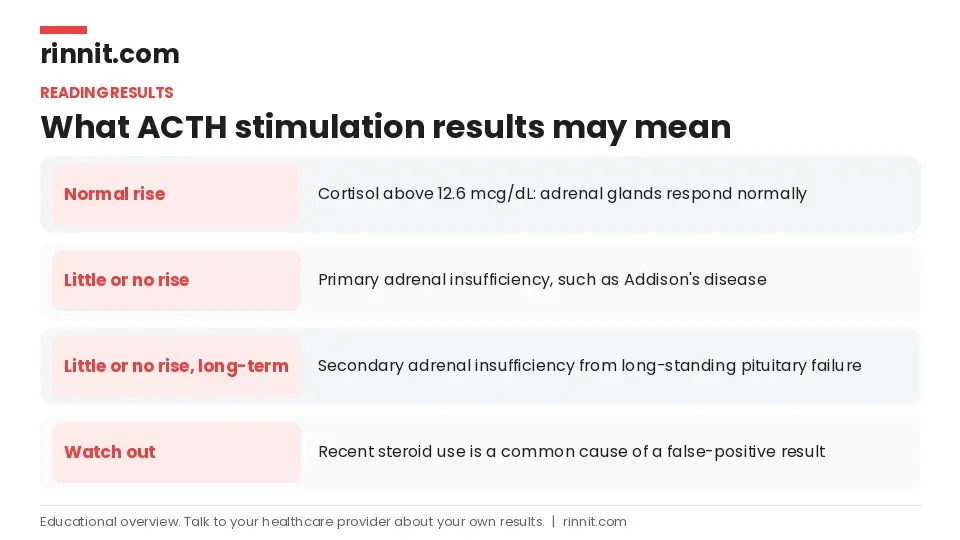
Cortisol rises above 12.6 mcg/dL after the shot | Normal adrenal response |
Little or no rise in cortisol | Primary adrenal insufficiency: the adrenal glands cannot respond to ACTH |
Little or no rise after long-standing pituitary failure | Secondary adrenal insufficiency: the adrenal glands have shrunk from lack of ACTH |
Normal or near-normal rise | Possible in partial or very recent pituitary failure, so more testing may be needed |
Sources: [1]
Normal ranges vary between labs, tests and people, so always check the range on your own report. Many factors affect accuracy. One of the most common causes of a false-positive test is recent use of corticosteroid (steroid) medicines. Your provider or endocrinologist will explain what your numbers mean. [1]
Conclusion
The ACTH stimulation test is the go-to test for diagnosing adrenal insufficiency. It is simple and low risk: a shot and a few blood draws over about an hour. [1]
Waiting for results can feel stressful. Your healthcare team is there to support you, so do not hesitate to ask questions about the test or your results. [1]
Keep learning: Read our guide to Addison's disease or our guide to the blood tests your provider may order. For more trusted, doctor-reviewed health guides, visit Rinnit.com.
FAQ
What is an ACTH stimulation test?
It is a test that measures how your adrenal glands make cortisol after a shot of synthetic ACTH (cosyntropin). [1]
What does an ACTH stimulation test diagnose?
It is the main test for adrenal insufficiency, including Addison's disease and pituitary-related forms. [1]
How is an ACTH stimulation test done?
A baseline blood draw, a cosyntropin shot, then more blood draws, usually at 30 and 60 minutes. [1]
Do I need to fast for an ACTH stimulation test?
You may need to fast for six hours and avoid some medicines. Follow your provider's instructions. [1]
Why is the test done in the morning?
Cortisol naturally peaks in the morning, so testing then lowers the chance of a false-positive result. [1]
What is a normal ACTH stimulation test result?
Cortisol above 12.6 mcg/dL after the shot is usually normal, though ranges vary by lab. [1]
What does an abnormal result mean?
Little or no rise in cortisol usually points to primary or long-standing secondary adrenal insufficiency. [1]
Can steroids affect the results?
Yes. Recent corticosteroid use is one of the most common causes of a false-positive result. [1]
Does the ACTH stimulation test hurt?
The blood draws feel like a pinch and the shot may sting briefly. [1]
How long do ACTH stimulation test results take?
It may take about a week, because your provider interprets them carefully. [1]
Related Reading
Addison's Disease: Complete Guide to Adrenal Insufficiency Symptoms, Causes & Treatment explains adrenal insufficiency in depth, the main condition this test diagnoses.
Addison's Disease Guide: Symptoms, Causes, Diagnosis, and Treatment covers Addison's disease, the most common cause of primary adrenal insufficiency.
Panhypopituitarism: Understanding the Total Lack of Pituitary Hormones explains pituitary failure, which can cause secondary adrenal insufficiency.
References
Cleveland Clinic. ACTH (Cosyntropin) Stimulation Test: What It Is & Results. Cleveland Clinic. Last updated September 12, 2022. https://my.clevelandclinic.org/health/diagnostics/24143-acth-stimulation-test
Ospina NS, Al Nofal A, Bancos I, et al. ACTH Stimulation Tests for the Diagnosis of Adrenal Insufficiency: Systematic Review and Meta-Analysis. J Clin Endocrinol Metab. 2016;101(2):427-434. PMID 26649617. https://doi.org/10.1210/jc.2015-1700
Kazlauskaite R, Evans AT, Villabona CV, et al. Corticotropin tests for hypothalamic-pituitary-adrenal insufficiency: a metaanalysis. J Clin Endocrinol Metab. 2008;93(11):4245-4253. PMID 18697868. https://doi.org/10.1210/jc.2008-0710
Medical disclaimer
This article is for general education only and does not replace advice from a qualified healthcare professional. Talk to your doctor about your own diagnosis and treatment, and seek emergency care right away for severe or sudden symptoms.



Comments