Zollinger-Ellison Syndrome: Symptoms, Causes, Diagnosis and Treatment — What You Need to Know

Updated: 2 days ago
Medically reviewed by Dr. Baraa Alnahhal, MD · Last reviewed: October 2026
Quick Answer
Zollinger-Ellison syndrome is a rare condition in which tumors called gastrinomas grow in the pancreas or small intestine and release large amounts of gastrin, making the stomach produce too much acid. [2] [4] This causes peptic ulcers, diarrhea and belly pain. About 25% of cases are linked to MEN 1. [2] Proton pump inhibitors control the acid, and tumors may need surgery. [3]
What the research says
A fasting gastrin blood test is the key first step, and it is very sensitive. A comprehensive review reports that fasting serum gastrin measurement has a sensitivity of 99%; people with gastrinoma have gastrin levels above 100 pg/mL, and a level above 1,000 pg/mL with stomach pH below 2 is considered diagnostic (Chatzipanagiotou et al., Journal of Neuroendocrinology, 2023) [1].
Acid-reducing medicines can distort the test, so timing matters. The same review notes that, to diagnose the syndrome by laboratory testing, people taking antacid medicine must stay off proton pump inhibitors for at least one week and H2 receptor blockers for 48 hours, which should only be done under a care professional's direction (Chatzipanagiotou et al., Journal of Neuroendocrinology, 2023) [1].
Endoscopic ultrasound finds most pancreatic tumors, but is less sensitive for duodenal ones. Endoscopic ultrasound showed sensitivity as high as 83% for pancreatic gastrinomas, with substantially lower detection rates for tumors in the duodenum, while gallium-68 DOTATOC PET is now setting the standard for locating tumors (Chatzipanagiotou et al., Journal of Neuroendocrinology, 2023) [1].
When should you see a doctor about Zollinger-Ellison syndrome?
See a healthcare professional if you have a burning, aching pain in your upper belly that doesn't go away — especially if you also have nausea, vomiting, and diarrhea. [2]
Also tell your care professional if you've been using over-the-counter medicines to reduce stomach acid — such as omeprazole, cimetidine, or famotidine — because these medicines may mask your symptoms, which could delay your diagnosis. [2]
A note on severity: Zollinger-Ellison syndrome is rare, but the symptoms overlap heavily with ordinary indigestion and reflux — which is exactly why persistent upper-belly pain deserves a proper look rather than another bottle of antacids. Bleeding in the digestive tract and unexplained weight loss are signs that should never be ignored.
What Is Zollinger-Ellison Syndrome?
Zollinger-Ellison syndrome is a condition in which one or more tumors grow in the pancreas or small intestine. The tumors, called gastrinomas, produce large amounts of the hormone gastrin. Gastrin causes the stomach to produce too much acid, which leads to peptic ulcers. [2] High gastrin levels also can cause diarrhea, belly pain, and other symptoms.
To understand the mechanism, it helps to know the anatomy involved. The pancreas is a large organ that lies across the upper abdomen behind the stomach. It makes enzymes needed for digesting food and many hormones, including insulin, which helps control blood sugar. [2] Digestive juices from the pancreas, liver, and gallbladder mix in the duodenum — the section of the small intestine connected to the stomach — where most of digestion happens.
Zollinger-Ellison syndrome is rare. Though it may happen at any time in life, people usually find out they have it sometime between ages 20 and 50. [2] [4] Medicines to cut down stomach acid and heal the ulcers are the usual treatment. Some people also may need surgery to remove tumors. [2]

Question | Answer |
|---|---|
What is Zollinger-Ellison syndrome? | Tumors (gastrinomas) in the pancreas or small intestine that release excess gastrin, driving overproduction of stomach acid |
What does it cause? | Peptic ulcers, diarrhea, belly pain |
How rare is it? | Rare |
When is it usually found? | Between ages 20 and 50, though it can happen at any age |
Are the tumors cancerous? | Often, yes — they grow slowly but can spread to lymph nodes or the liver |
Can the acid be controlled? | Excess acid production can almost always be controlled |
What Are the Symptoms of Zollinger-Ellison Syndrome?
Symptoms of Zollinger-Ellison syndrome may include stomach pain, diarrhea, burning, aching or discomfort in the upper belly, acid reflux and heartburn, burping, nausea and vomiting, bleeding in the digestive tract, losing weight without trying, and loss of appetite. [2]

Because several of these symptoms — burning, reflux, burping — mirror ordinary heartburn, the syndrome is easy to miss. What separates it from everyday indigestion is persistence, severity, and the combination of upper-belly pain with diarrhea or unexplained weight loss.
Symptom | Notes |
|---|---|
Stomach pain | Often persistent |
Diarrhea | Linked to high gastrin levels |
Burning, aching or discomfort in the upper belly | The hallmark warning sign |
Acid reflux and heartburn | Mimics ordinary reflux |
Burping | Common upper-GI symptom |
Nausea and vomiting | Escalation signals in the "when to see a doctor" guidance |
Bleeding in the digestive tract | Serious sign — seek care |
Losing weight without trying | Serious sign — seek care |
Loss of appetite | Common in chronic digestive illness |
What Causes Zollinger-Ellison Syndrome?
The exact cause of Zollinger-Ellison syndrome isn't known. [2] But the pattern of events typically follows the same sequence: the syndrome begins when one or more tumors form in the pancreas or the duodenum (the part of the small intestine connected to the stomach). Sometimes the tumors form at other sites, such as the lymph nodes next to the pancreas. [2]
The tumors that form with Zollinger-Ellison syndrome are made up of cells that secrete large amounts of the hormone gastrin — which is why they're called gastrinomas. Increased gastrin causes the stomach to make far too much acid. The excess acid then leads to peptic ulcers and sometimes to diarrhea. [2]
Beyond causing excess acid, the tumors are often cancerous. Although the tumors tend to grow slowly, the cancer can spread elsewhere — most commonly to nearby lymph nodes or the liver. [2]
Is Zollinger-Ellison syndrome inherited?
It can be. Zollinger-Ellison syndrome may be caused by an inherited condition called multiple endocrine neoplasia, type 1 (MEN 1). People with MEN 1 also have tumors in the parathyroid glands, and they may have tumors in their pituitary glands as well. [2]
About 25% of people who have gastrinomas have them as part of MEN 1. [2] They also may have tumors in the pancreas and other organs.
Cause or risk factor | Detail |
|---|---|
Exact cause | Not known |
Mechanism | Gastrinoma tumors → excess gastrin → excess stomach acid → peptic ulcers, diarrhea |
Tumor locations | Pancreas, duodenum; sometimes lymph nodes next to the pancreas |
Cancerous? | Often — grow slowly; can spread to lymph nodes or liver |
MEN 1 (inherited) | About 25% of gastrinoma cases; MEN 1 also involves parathyroid and possibly pituitary tumors |
Family risk | A first-degree relative (sibling or parent) with MEN 1 raises your likelihood of Zollinger-Ellison syndrome [2] |
How Is Zollinger-Ellison Syndrome Diagnosed?
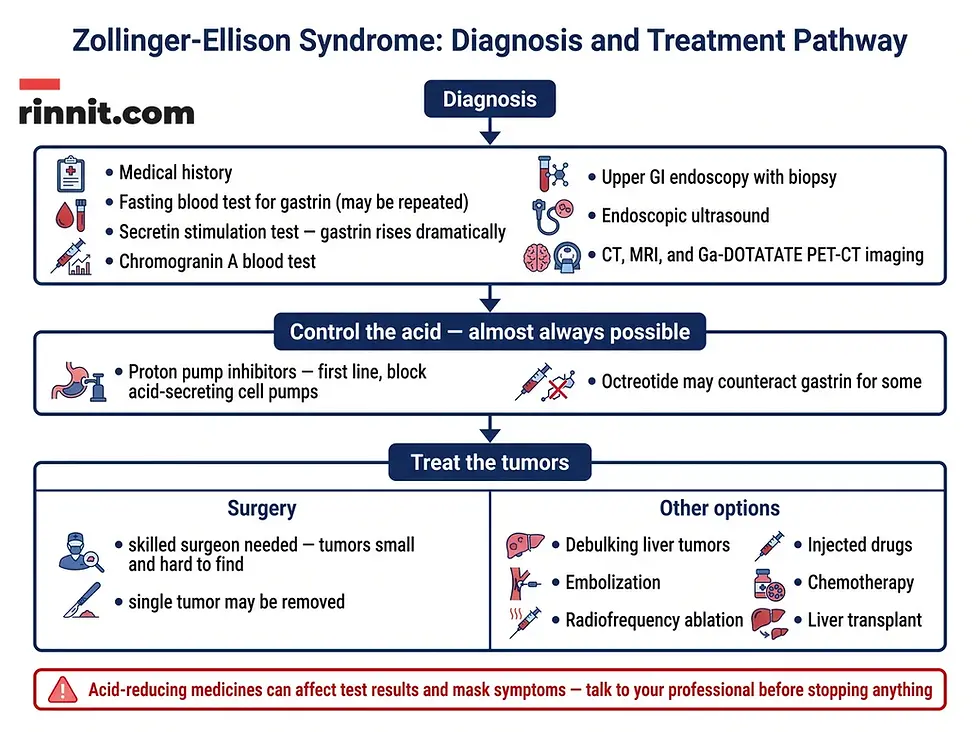
A healthcare professional usually bases a diagnosis on medical history, blood tests, endoscopy, endoscopic ultrasound, and imaging.
What do the blood tests show?
A blood sample is examined to check for high gastrin levels. While high gastrin may suggest tumors in the pancreas or duodenum, high gastrin also can be caused by other conditions — for example, if the stomach isn't making acid, after gastric surgery, or from taking acid-reducing medicines. [3]
You need to fast before this test, and you may need to stop taking acid-reducing medicine. Because gastrin levels can vary, the test may be repeated a few times. [3]
You also may have a secretin stimulation test. Secretin is a hormone that regulates gastric acid. The professional first measures your gastrin levels, then gives an injection of secretin and measures them again. If you have Zollinger-Ellison, your gastrin levels will rise dramatically. [3]
Your blood also may be tested for a protein called chromogranin A, which is high in most people with gastrinomas. [3]
What do the scopes and scans do?
An upper gastrointestinal endoscopy — with sedation — passes a thin, flexible instrument with a light and camera down the throat into the stomach and duodenum to look for ulcers. Tissue samples (a biopsy) may be removed and examined for gastrin-producing tumors. [3] If the stomach is making acid and the gastrin level is high, the diagnosis of Zollinger-Ellison can be established.
An endoscopic ultrasound uses an endoscope fitted with an ultrasound probe, making it easier to spot tumors in the stomach, duodenum, and pancreas. [3]
Imaging techniques may be used to look for tumors, such as CT scans, MRI imaging, and Ga-DOTATATE PET-CT scanning. [3]
Diagnostic step | Purpose and key details |
|---|---|
Medical history | Reviews symptoms and medical history |
Fasting blood test for gastrin | Checks for high gastrin; requires fasting; may need to stop acid-reducing medicines; may be repeated since levels vary |
Secretin stimulation test | Gastrin measured, secretin injected, measured again — a dramatic rise indicates Zollinger-Ellison |
Chromogranin A blood test | A protein high in most people with gastrinomas |
Upper GI endoscopy | Finds ulcers; biopsy checks for gastrin-producing tumors; acid production plus high gastrin can establish diagnosis |
Endoscopic ultrasound | Probe spots tumors in stomach, duodenum, pancreas; may take tissue samples |
Imaging (CT, MRI, Ga-DOTATATE PET-CT) | Locates tumors, including in the liver and lymph nodes |
How Is Zollinger-Ellison Syndrome Treated?
Treatment focuses on the hormone-secreting tumors as well as the ulcers they cause.
How is the excess acid treated?
Excess acid production can almost always be controlled. [3] Medicines known as proton pump inhibitors are the first line of treatment — they're effective for controlling acid production in Zollinger-Ellison syndrome. These powerful acid-reducing medicines work by blocking the action of the tiny "pumps" within acid-secreting cells. [3]
Commonly prescribed proton pump inhibitors include lansoprazole, omeprazole, pantoprazole, rabeprazole, and esomeprazole. [3] Talk with your care professional about the risks of taking these medicines long term.
Octreotide, a medicine similar to the hormone somatostatin, may counteract the effects of gastrin and be helpful for some people. [3]
How are the tumors treated?
An operation to remove the gastrinomas requires a skilled surgeon because the tumors are often small and difficult to find. [3] If you have just one tumor, a professional may be able to remove it surgically. But surgery may not be an option if you have many tumors or tumors that have spread to your liver — though even with multiple tumors, a surgeon still may recommend removing a single large tumor. [3]
When surgery isn't possible or enough, providers may recommend other treatments to control tumor growth: debulking (removing as much of a liver tumor as possible), embolization (attempting to destroy the tumor by cutting off its blood supply), radiofrequency ablation (using heat to destroy cancer cells), injecting drugs into the tumor to relieve cancer symptoms, chemotherapy to try to slow tumor growth, or having a liver transplant. [3]
Treatment focus | Options |
|---|---|
Excess acid (first line) | Proton pump inhibitors — lansoprazole, omeprazole, pantoprazole, rabeprazole, esomeprazole; discuss long-term risks with your professional |
Excess acid (alternative) | Octreotide, similar to the hormone somatostatin, may counteract gastrin's effects for some |
Tumors (surgery) | Remove a single tumor when possible; requires a skilled surgeon; even with multiple tumors a single large one may be removed |
Tumors (other) | Debulking, embolization, radiofrequency ablation, injected drugs, chemotherapy, or liver transplant |
What the sources say: "Excess acid production can almost always be controlled." — Mayo Clinic, Nov. 5, 2024
How Should You Prepare for an Appointment?
Symptoms may first bring you to your primary healthcare professional, who will likely refer you to a gastroenterologist (a doctor who specializes in diseases of the digestive system) and possibly an oncologist (a doctor who specializes in treating cancer). [3]
Be aware of pre-appointment restrictions: certain acid-reducing medicines — proton pump inhibitors or H-2 blockers — can affect the results of some diagnostic tests. [3] However, don't stop taking these medicines without asking your care professional first.
Before your visit, write down your symptoms (including any that seem unrelated), key personal information such as stresses and family medical history, and a list of all medicines, vitamins, or supplements.
Useful questions to ask include the most likely cause of your symptoms, what tests are needed and how to prepare, which treatments are recommended, any dietary restrictions, follow-up frequency, your prognosis, and whether other medical problems are more likely because of the syndrome.
Expect your doctor to ask when symptoms began, whether they come and go, how bad they are, what makes them better or worse, whether you've ever been told you have a stomach ulcer, and whether you or anyone in your family has MEN 1, parathyroid, thyroid, or pituitary problems, or high blood calcium.
Conclusion
Zollinger-Ellison syndrome is rare, serious, and frequently mistaken for run-of-the-mill heartburn — but it is also a condition with a clear diagnostic path and real treatment options. The acid overproduction that drives the ulcers can almost always be brought under control with proton pump inhibitors, and the tumors themselves have a full menu of management strategies, from precise surgery to embolization, ablation, and beyond. The decisive factor is timing: because the tumors are often cancerous and can spread to the liver, catching the syndrome early — rather than treating it away with antacids — changes everything.
What are the next steps for Zollinger-Ellison syndrome?
If burning upper-belly pain keeps returning despite acid-reducing medicines — especially with diarrhea, nausea, or unexplained weight loss — see a healthcare professional and mention that the pain doesn't go away. Tell them about every over-the-counter acid medicine you take, since these can mask the symptoms and delay diagnosis. And if multiple endocrine neoplasia, type 1 runs in your family, say so at the very start of the conversation.
Frequently Asked Questions
1. What is Zollinger-Ellison syndrome?
Zollinger-Ellison syndrome is a rare condition in which one or more tumors — called gastrinomas — grow in the pancreas or small intestine and produce large amounts of the hormone gastrin, causing the stomach to make far too much acid, which leads to peptic ulcers, diarrhea, and belly pain.
2. Is Zollinger-Ellison syndrome cancer?
The tumors are often cancerous. They tend to grow slowly, but the cancer can spread elsewhere — most commonly to nearby lymph nodes or the liver.
3. What causes Zollinger-Ellison syndrome?
The exact cause isn't known. The condition begins when tumors form in the pancreas or duodenum (sometimes in nearby lymph nodes) and secrete excess gastrin.
4. Is Zollinger-Ellison syndrome inherited?
Zollinger-Ellison syndrome can be. About 25% of people who have gastrinomas have them as part of an inherited condition called multiple endocrine neoplasia, type 1 (MEN 1).
5. What is MEN 1?
Multiple endocrine neoplasia, type 1 is an inherited condition that also causes tumors in the parathyroid glands and may cause tumors in the pituitary gland, pancreas, and other organs.
6. Who is at risk for Zollinger-Ellison syndrome?
Anyone, though it is rare and usually discovered between ages 20 and 50. Having a first-degree relative (sibling or parent) with MEN 1 makes it more likely.
7. What are the symptoms?
Stomach pain, diarrhea, burning or aching in the upper belly, acid reflux and heartburn, burping, nausea and vomiting, bleeding in the digestive tract, unexplained weight loss, and loss of appetite.
8. How do I know it isn't just heartburn?
Persistent burning, aching upper-belly pain that doesn't go away — especially with nausea, vomiting, and diarrhea — is the key warning sign. Unexplained weight loss and digestive-tract bleeding should always prompt medical care.
9. Can over-the-counter antacids hide Zollinger-Ellison syndrome?
Yes. Acid-reducing medicines like omeprazole, cimetidine, and famotidine may mask symptoms, which could delay your diagnosis — tell your care professional if you use them.
10. How is Zollinger-Ellison syndrome diagnosed?
Through medical history, blood tests (fasting gastrin, secretin stimulation test, chromogranin A), upper GI endoscopy with biopsy, endoscopic ultrasound, and imaging such as CT, MRI, or Ga-DOTATATE PET-CT scans.
11. What is the secretin stimulation test?
Gastrin levels are measured, then secretin (a hormone that regulates gastric acid) is injected, and levels are measured again. In Zollinger-Ellison syndrome, gastrin levels rise dramatically.
12. Why might the gastrin blood test be repeated?
Gastrin levels can vary, and high gastrin can also be caused by other conditions — such as a stomach that isn't making acid, gastric surgery, or acid-reducing medicines — so the test may be run a few times.
13. How do proton pump inhibitors work?
Proton pump inhibitors block the action of the tiny "pumps" within acid-secreting cells, and they are the first-line, effective treatment for controlling acid production in this syndrome.
14. Is the excess acid always treatable?
According to the sources, excess acid production can almost always be controlled.
15. Can the tumors be removed?
If there is just one tumor, a skilled surgeon may be able to remove it — but the tumors are often small and difficult to find. Surgery may not be an option with many tumors or tumors spread to the liver, though a single large tumor may still be removed.
16. What if surgery isn't possible?
Other tumor-control options include debulking liver tumors, embolization (cutting off the blood supply), radiofrequency ablation (heat), injecting drugs into the tumor, chemotherapy, or a liver transplant.
17. What is octreotide used for?
Octreotide, a medicine similar to the hormone somatostatin, may counteract the effects of gastrin and be helpful for some people.
18. Do I need to see a specialist?
Likely — a gastroenterologist (digestive system specialist) and often an oncologist (cancer specialist).
19. Can I keep taking my acid-reducing medicine before testing?
Don't stop without asking your care professional first — but be aware these medicines can affect diagnostic test results, and you may need to fast before testing.
20. Will I need dietary restrictions?
Ask your healthcare team — dietary restrictions are one of the recommended questions to bring to your appointment, as individualized advice depends on your case.
Related Reading
Acid Reflux & GERD: Symptoms, Causes, Diagnosis, and Treatment
Pancreatic Cancer: Symptoms, Causes, and Treatment — A Clear Guide for Patients and Families
Liver Cancer: A Comprehensive Guide to Symptoms, Causes, and Treatment
Craniosynostosis: Symptoms, Causes, Diagnosis, and Treatment Explained
Dry Mouth: Symptoms, Causes, Diagnosis and Treatment — What You Need to Know
Ulcerative Colitis: Symptoms, Causes, Diagnosis, and Treatment Explained
Trusted External Resources
National Institute of Diabetes and Digestive and Kidney Diseases (NIDDK): Zollinger-Ellison Syndrome — a federal health overview of the condition, including how common it is and how it is treated.
NIDDK: Upper GI Endoscopy — what to expect from the procedure used to diagnose the syndrome.
References
Chatzipanagiotou O, Schizas D, Vailas M, et al. All you need to know about gastrinoma today | Gastrinoma and Zollinger-Ellison syndrome: A thorough update. J Neuroendocrinol. 2023;35(4):e13267. PMID 37042078. https://doi.org/10.1111/jne.13267
Mayo Clinic Staff. Zollinger-Ellison syndrome — Symptoms and causes. Mayo Clinic. Nov. 5, 2024. https://www.mayoclinic.org/diseases-conditions/zollinger-ellison-syndrome/symptoms-causes/syc-20379042
Mayo Clinic Staff. Zollinger-Ellison syndrome — Diagnosis and treatment. Mayo Clinic. Nov. 5, 2024. https://www.mayoclinic.org/diseases-conditions/zollinger-ellison-syndrome/diagnosis-treatment/drc-20379046
National Institute of Diabetes and Digestive and Kidney Diseases. Zollinger-Ellison syndrome. NIDDK. Last reviewed August 2021. https://www.niddk.nih.gov/health-information/digestive-diseases/zollinger-ellison-syndrome
Medical Disclaimer
This article is for education only and is not a substitute for professional medical advice, diagnosis, or treatment. Always consult a qualified healthcare professional about your individual health situation.



Comments