X-linked Agammaglobulinemia (XLA): Symptoms, Causes, Diagnosis and Treatment — What You Need to Know

Updated: 3 days ago
Medically reviewed by Dr. Baraa Alnahhal, MD · Last reviewed: October 2026
Quick Answer
X-linked agammaglobulinemia (XLA) is an inherited immune disorder [1], almost always in males, in which the body cannot make antibodies. Babies look healthy for a few months [1], then develop repeated bacterial infections of the ears, lungs, sinuses and skin. There is no cure [2]. Treatment is lifelong gammaglobulin replacement plus antibiotics, and live vaccines are avoided [2].
What the research says
XLA is usually diagnosed in infancy, while other antibody deficiencies are often found years later. In a retrospective study of 179 Australian adults receiving immunoglobulin replacement for a primary antibody deficiency, 21 (11.7%) had XLA, and their median age at diagnosis was under 1 year. By contrast, people with common variable immunodeficiency had a median symptom onset at age 20 and a median diagnosis at age 35 (PubMed: Slade et al., Front Immunol, 2018) [3].
Brain and spinal cord infection is an uncommon but serious complication of antibody deficiency. In a cohort of 135 children with primary antibody deficiency in northwest India, meningoencephalitis developed in 13 (10.4%), including 5 with XLA. Eight of the 13 died. The authors noted that early diagnosis and starting immunoglobulin replacement may prevent neurological complications (PubMed: Jindal et al., J Neuroimmunol, 2022) [4]. This study covered several antibody deficiencies, not XLA alone.
When Should You See a Doctor?
XLA infections can be life-threatening. Because babies with XLA usually look healthy for the first few months, the warning signs appear once maternal antibodies leave their system [1]. Repeated bacterial infections of the ears, lungs, sinuses, and skin in a male infant need prompt medical evaluation.
A note on severity: If a child has repeated infections, or infections that are unusually severe, slow to respond, or recurrent in the bloodstream or internal organs, do not wait it out. Early diagnosis and treatment protect the lungs and other organs from damage, and untreated infections can be life-threatening.
What Is X-linked Agammaglobulinemia (XLA)?
X-linked agammaglobulinemia (a-gam-uh-glob-u-lih-NEE-me-uh), also called XLA, is an immune system disorder that is passed through families, which means it is inherited [1]. XLA makes it hard to fight infections [1]. People with XLA might get infections of the inner ear, sinuses, respiratory tract, bloodstream, and internal organs.
XLA almost always affects males, but females can carry the genes linked to the condition. Most people with XLA are diagnosed in infancy or early childhood [1], after repeated infections. Some people are not diagnosed until they are adults. XLA is a rare condition [1].
Question | Answer |
What is XLA? | An inherited immune system disorder that makes it hard to fight infections [1] |
Who gets it? | Almost always males; females can carry the gene |
When is it diagnosed? | Usually in infancy or early childhood, after repeated infections; sometimes in adulthood |
What causes it? | A change in a gene [1] that stops the body from making infection-fighting antibodies |
Is there a cure? | No. Treatment aims at boosting the immune system and preventing infections [2] |
Can people live typical lives? | Yes. People with XLA can live mostly typical lives [1] with careful, ongoing treatment |
What Are the Symptoms of XLA?
Most babies with XLA look healthy for the first few months. They are protected by antibodies they received from their mothers before birth [1]. When these antibodies leave their systems, the babies begin to get repeated bacterial infections. The infections can be life-threatening and might involve the ears, lungs, sinuses, and skin.

What Physical Signs Appear in Male Infants?
Male infants born with XLA have very small tonsils [1] and small or no lymph nodes. These findings are important diagnostic clues, because tonsils and lymph nodes are made largely of the antibody-producing cells that are missing in XLA [1].
Symptom or sign | When it appears |
Appears healthy | First few months, protected by maternal antibodies [1] |
Repeat bacterial infections | After maternal antibodies leave the system |
Ear, lung, sinus, and skin infections | Recurrent; can be life-threatening |
Very small tonsils [1] | Present from birth |
Small or no lymph nodes | Present from birth |
What Causes XLA?
XLA is caused by a change in a gene [1]. People with the condition cannot make the proteins called antibodies that fight infection. About 40% of people with the condition have a family member who has it.
How Is XLA Inherited?
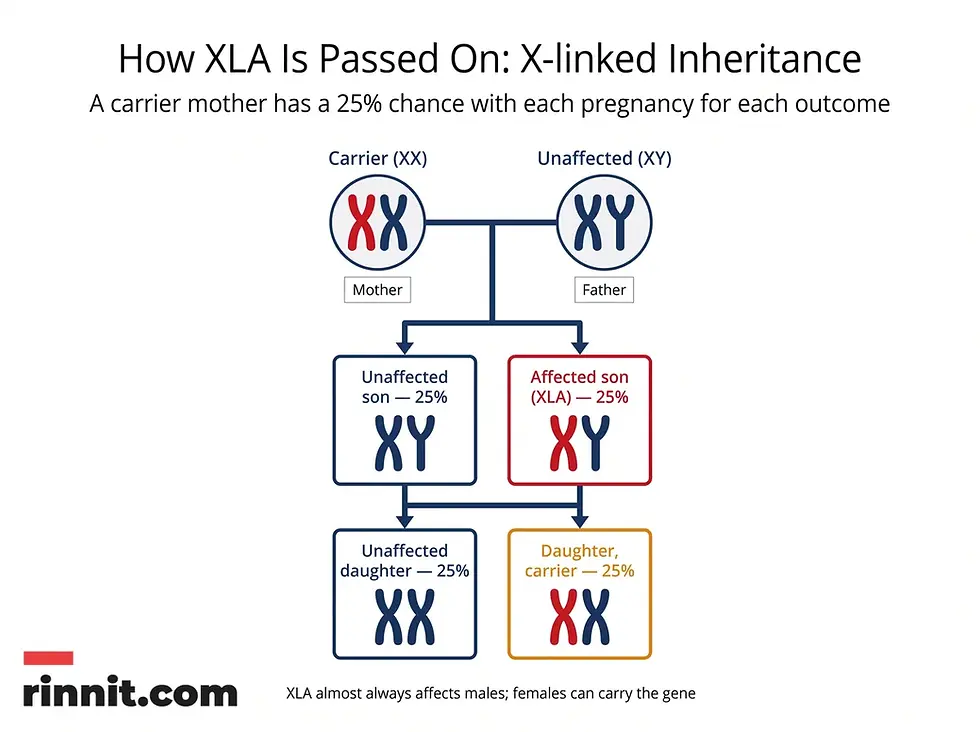
XLA follows an X-linked recessive inheritance pattern [1]. Women can pass down X-linked recessive disorders such as XLA. A woman who is a carrier has a 25% chance of having an unaffected son, a 25% chance of having an affected son, a 25% chance of having an unaffected daughter, and a 25% chance of having a daughter who is also a carrier [1].
What Complications Can XLA Cause?
People with XLA can live mostly typical lives [1] and should try to take part in regular activities for their ages. But repeat infections linked to XLA need careful watching and treatment, because they can damage organs and be life-threatening.
How Is XLA Diagnosed?
Diagnosis involves a medical history of repeat infections and a physical exam [2]. Blood tests, and possibly genetic testing, can confirm the diagnosis.
How Is XLA Treated?
X-linked agammaglobulinemia (XLA) has no cure [2], so treatment boosts the immune system to prevent infections, mainly with gammaglobulin, and treats infections quickly. Treatment aims at boosting the immune system to prevent infections, and infections are treated quickly when they happen [2].

What Is Gammaglobulin Treatment?
Gammaglobulin is a type of protein found in blood that contains antibodies against infections. It is given into a vein (infusion) every 2 to 4 weeks [2], or as weekly shots. Reactions can include headache, chills, backache, and nausea. Reactions are more likely to happen during a viral infection, such as a cold.
Are Antibiotics Used?
Yes. Some people with XLA take antibiotics all the time to prevent infections [2]. Others take antibiotics for bacterial infections for longer than people without XLA.
What About Vaccines and Follow-Up?
A healthcare professional will likely advise against live vaccines [2], such as live polio, measles-mumps-rubella, or chickenpox vaccines. Follow-up visits every 6 to 12 months to screen for complications of XLA are also likely to be recommended.
Treatment component | Detail |
Gammaglobulin replacement | Infusion into a vein every 2 to 4 weeks [2], or weekly shots; possible reactions include headache, chills, backache, and nausea (more likely during a viral infection) |
Antibiotics | Continuous use to prevent infections [2], or longer courses for bacterial infections |
Vaccines | Avoid live vaccines [2] (live polio, measles-mumps-rubella, chickenpox) |
Follow-up | Visits every 6 to 12 months to screen for complications |
Conclusion
X-linked agammaglobulinemia is a lifelong, inherited immune disorder, but it is a manageable one. The missing antibodies can be replaced with gammaglobulin, infections can be prevented and treated quickly with antibiotics, and people with XLA can live mostly typical lives [1] and take part in regular activities. The keys are early diagnosis, consistent treatment, avoiding live vaccines, and regular checkups every 6 to 12 months to catch complications such as chronic lung disease before they cause lasting damage.
Your next step: If a child has repeated bacterial infections, or an infant has very small tonsils and small or absent lymph nodes, talk to a healthcare professional about testing for XLA. For families with a history of the condition, genetic counseling can clarify the inheritance odds before planning future pregnancies.
Frequently Asked Questions
1. What does X-linked agammaglobulinemia mean?
XLA is an inherited immune system disorder in which the body cannot make antibodies, the proteins that fight infection. This makes it hard to fight infections.
2. Is XLA genetic?
Yes. It is caused by a change in a gene and is passed through families. About 40% of people with the condition have a family member who has it.
3. Why is it called "X-linked"?
The changed gene is on the X chromosome. That is why the condition almost always affects males, while females can carry the gene.
4. Can girls have XLA?
XLA almost always affects males. Females can carry the genes linked to the condition, typically without symptoms themselves.
5. What are the odds a carrier mother passes XLA on?
A carrier mother has a 25% chance of an unaffected son, a 25% chance of an affected son, a 25% chance of an unaffected daughter, and a 25% chance of a daughter who is also a carrier.
6. When is XLA usually diagnosed?
Most people are diagnosed in infancy or early childhood after repeated infections, though some are not diagnosed until adulthood.
7. Why do babies with XLA seem healthy at first?
They are protected during the first few months by antibodies they received from their mothers before birth. Once these antibodies leave their system, repeat bacterial infections begin.
8. What infections are typical in XLA?
Infections may involve the inner ear, sinuses, respiratory tract, bloodstream, internal organs, ears, lungs, and skin. They can be life-threatening.
9. What physical signs point to XLA in a male infant?
Very small tonsils and small or absent lymph nodes.
10. Is there a cure for XLA?
No. Treatment aims at boosting the immune system to prevent infections, plus quick treatment of infections as they happen.
11. What is gammaglobulin treatment?
Gammaglobulin is a blood protein that contains antibodies against infections. It is given as an infusion into a vein every 2 to 4 weeks, or as weekly shots.
12. What side effects does gammaglobulin cause?
Reactions can include headache, chills, backache, and nausea. They are more likely during a viral infection such as a cold.
13. Do people with XLA take antibiotics?
Some take antibiotics all the time to prevent infections. Others take them for bacterial infections for longer than people without XLA.
14. Should people with XLA get all vaccines?
No. They are likely to be told to avoid live vaccines, such as live polio, measles-mumps-rubella, or chickenpox vaccines.
15. How often should someone with XLA see a doctor?
Follow-up visits every 6 to 12 months are recommended to screen for complications.
16. Can people with XLA live normal lives?
People with XLA can live mostly typical lives and should try to take part in regular activities for their ages, with repeat infections carefully watched and treated.
17. What complications can XLA cause?
Chronic lung disease, an increased risk of certain cancers, infectious arthritis, and an increased risk of central nervous system infection from live vaccines.
18. Can XLA infections be fatal?
Yes. Infections can be life-threatening, and repeat infections can damage organs if they are not carefully watched and treated.
19. What tests confirm XLA?
A medical history of repeat infections, a physical exam, blood tests, and possibly genetic testing.
20. Is XLA common?
No. XLA is a rare inherited condition. About 40% of affected people have a family member with it.
Related Reading
Trusted External Resources
References
Mayo Clinic Staff. X-linked agammaglobulinemia — Symptoms and causes. Mayo Clinic. Sept. 17, 2026. https://www.mayoclinic.org/diseases-conditions/x-linked-agammaglobulinemia/symptoms-causes/syc-20361635
Mayo Clinic Staff. X-linked agammaglobulinemia — Diagnosis and treatment. Mayo Clinic. Sept. 17, 2026. https://www.mayoclinic.org/diseases-conditions/x-linked-agammaglobulinemia/diagnosis-treatment/drc-20361639
Slade CA, Bosco JJ, Binh Giang T, et al. Delayed diagnosis and complications of predominantly antibody deficiencies in a cohort of Australian adults. Front Immunol. 2018;9:694. PMID 29867917. https://doi.org/10.3389/fimmu.2018.00694
Jindal AK, Chaudhary H, Tyagi R, et al. Meningoencephalitis in primary antibody deficiency: our experience from northwest India. J Neuroimmunol. 2022;371:577952. PMID 36030644. https://doi.org/10.1016/j.jneuroim.2022.577952
Medical Disclaimer
This article is for informational purposes only and does not constitute medical advice. Always seek the advice of your physician or other qualified health provider with any questions you may have regarding a medical condition. Never disregard professional medical advice or delay in seeking it because of something you have read here.



Comments