What Is Whipple's Disease? The Rare Infection That Affects Joints, Digestion, and the Brain

Updated: 2 days ago
Medically reviewed by Dr. Baraa Alnahhal, MD · Last reviewed: October 2026
Quick Answer
Whipple's disease is a rare bacterial infection caused by Tropheryma whipplei that damages the small intestine's lining, keeping food from being properly absorbed. [1] Symptoms include loose stools, cramps, weight loss and joint pain. [1] It is diagnosed with tests such as a small intestine biopsy. [2] Long-term antibiotics usually lead to full recovery, though it can return. [2]
What the research says
Oral-only antibiotics worked as well as IV-then-oral treatment in a randomized trial. Among 60 adults with confirmed Whipple's disease in Germany, 28 of 29 people (97%) who took oral doxycycline plus hydroxychloroquine for 12 months and 25 of 31 (81%) who had 14 days of IV ceftriaxone followed by oral trimethoprim-sulfamethoxazole for 12 months were in complete clinical remission without recurrence over 24 months. The researchers concluded that oral-only treatment was non-inferior to the IV-first approach. No participant relapsed, but two people in the IV group died from infections caught in hospital. (Moos et al., Lancet Infect Dis, 2025) [6]
Memory and thinking problems are among the most common brain effects of Whipple's disease. A systematic review of 114 published case reports and case series found 147 people with Whipple's disease and cognitive impairment. It was rarely the only symptom; it often came with psychiatric disturbances, paralysis of eye movements (supranuclear ophthalmoplegia), and disorders of consciousness. The authors stress that suspecting Whipple's disease in anyone with rapidly worsening thinking and memory is crucial, because the right antibiotics may reverse the decline. (Manini et al., Neurol Sci, 2022) [7]
If you have ever experienced joint pain that seemed to come from nowhere, or unexplained weight loss that made no sense, you know how unsettling those symptoms can be — especially when they are blamed on something else first. Whipple's disease is one of those conditions that rarely appears in conversation, because it is genuinely rare and its symptoms mimic far more common problems. [1] [2] But its story is worth knowing: a single germ can quietly damage the gut, then travel to the joints, the heart, the eyes, and even the brain — and the difference between a full recovery and lasting harm often comes down to how quickly it is caught. [1] This guide explains what Whipple's disease is, how it develops, how doctors diagnose it, and what treatment looks like from start to finish.
What is Whipple's disease?
Whipple's disease is a rare infection caused by bacteria that keeps food from being digested well. [1] It affects the breakdown of food and keeps the body from taking in nutrients — a problem doctors call malabsorption. [1] [5]
Whipple's disease most often affects the joints and digestive system. [1] The bacteria that cause it can also infect other organs, including the brain, heart, and eyes. [1]
The small intestine does most of the work of absorbing nutrients. It has a ridged lining covered with tiny structures that look like fingers, called villi. [1] These villi are where the body takes in nutrients from digested food. [3]
Without treatment, Whipple's disease can be serious or even deadly. [1] But antibiotics can treat it. [1]
What are the symptoms?
The main symptoms of Whipple's disease often include loose stools, stomach cramping and pain that may get worse after meals, weight loss due to the body not taking in nutrients, and joint pain. [1]
Joint pain may be one of the first symptoms. [1] Digestive symptoms often don't start until later. [1]
Main symptom | What you might notice |
Loose stools | Stools that are looser than usual [1], without a clear cause |
Stomach cramps and pain | Cramping that may get worse after meals [1] |
Weight loss | Losing weight [1] even though eating habits haven't changed |
Joint pain | Pain in the joints [1], sometimes starting years before other symptoms |
Other symptoms linked with Whipple's disease include fever, cough, and large lymph nodes. [1] Skin may darken in scars and in areas that get sun — this darkening may be harder to see on Black or brown skin. [1] People may also have chest pain, tiredness, weakness, and anemia, which means not having enough healthy red blood cells to carry oxygen through the body. [1]
Brain and nervous system symptoms, also called neurological symptoms, may include trouble walking, vision issues — including not being able to control eye movements — confusion, and memory loss. [1]
Symptoms tend to happen slowly over years in most people with this condition. [1] In some people, symptoms such as joint pain and weight loss happen years before the digestive symptoms that lead to diagnosis. [1]

What causes Whipple's disease?
A type of bacterium called Tropheryma whipplei causes Whipple's disease. [1] These germs affect the lining of the small intestine first. [1] They form small sores, also called lesions, in the wall of the intestine. [1] The bacteria also harm the fine, hairlike villi that line the small intestine — and damaged villi can't absorb nutrients the way they should. [1] [3]

Experts don't know how the bacteria spread to humans. [1] Not all people exposed to the bacteria get Whipple's disease. [1] Some researchers believe that people with the condition may have a genetic change that affects their immune system and makes them more likely to get sick from the bacteria. [1]
Who is at higher risk?
Whipple's disease has no clear risk factors because little is known about the bacteria behind it, though it seems more likely to affect certain groups. [1] It seems to be more likely to affect certain groups:
It is worth saying plainly: these are patterns doctors have noticed, not proven causes. Many people with these characteristics will never develop the disease, and people without them still can.
Why is it important not to ignore the symptoms?
Whipple's disease can be life-threatening, but most often it's treatable. [1] Call your healthcare professional if you are losing weight without trying or have joint pain. [1]
Whipple's disease gets worse over time, and it can be deadly. [1] Late diagnosis and treatment can allow the infection to spread to the central nervous system — the brain and spinal cord — which can cause lasting harm. [1] That is why the slow, years-long buildup of symptoms matters: the disease is most dangerous when it goes unnoticed.
How is Whipple's disease diagnosed?
Diagnosing Whipple's disease most often involves a physical exam. [2] Because symptoms are like those of other conditions, a healthcare professional first rules out other, more common causes. [2]
Tests for Whipple's disease may include a biopsy, a lumbar puncture, or blood tests. [2]
Test | What it does |
Biopsy | A thin tube with a camera, called a scope, is passed through the mouth into the small intestine. Tissue samples are taken for study under a microscope. If these samples don't confirm the diagnosis, a sample may be taken from an enlarged lymph node, or other tests may be done [2] |
Lumbar puncture (spinal tap) | A thin needle is put into the back to take a small amount of fluid from the spine, called cerebrospinal fluid. The sample goes to a lab for study [2] |
PCR test | A DNA-based test that can find the bacteria that cause Whipple's disease in spinal fluid or biopsy samples; some medical centers offer it [2] |
Blood tests | Tests such as a complete blood count can find conditions linked with Whipple's disease, such as anemia (too few red blood cells) [2] |
How is Whipple's disease treated?
Treatment of Whipple's disease is with one antibiotic or a mix of antibiotics. [2] These medicines kill the bacteria that cause the infection. [2]
Treatment is long-term. [2] It may take a year or two to kill the bacteria. [2] But symptom relief most often comes much quicker — within the first week or two. [2] Most people with no brain or nervous system complications recover fully after a course of antibiotics. [2]
Healthcare professionals often choose antibiotics that can wipe out infections in the small intestine and cross the blood-brain barrier — the layer of tissue around your brain. [2] [3] These antibiotics kill bacteria that may have gone into your brain and central nervous system. [2]
Because you take antibiotics for a long time, your healthcare professional watches your condition to see if it stops responding to the medicine. [2] If your condition gets worse during treatment, you may need to take another antibiotic. [2]
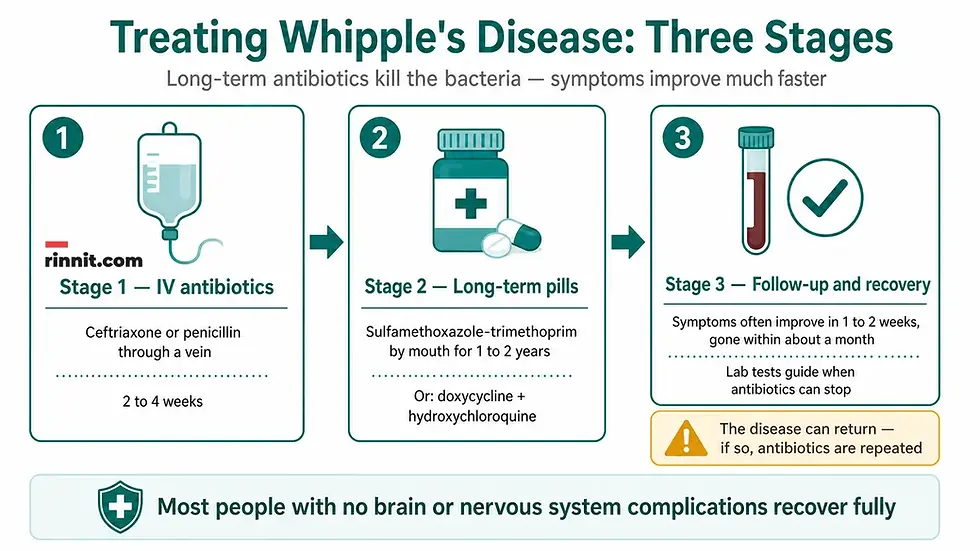
What does treatment look like step by step?
Most often, Whipple's disease therapy begins with 2 to 4 weeks of the antibiotics ceftriaxone or penicillin given through a vein in your arm. [2] After that, you may take sulfamethoxazole-trimethoprim (Bactrim, Septra) by mouth for 1 to 2 years. [2]
Possible side effects of ceftriaxone and sulfamethoxazole-trimethoprim include allergic reactions, loose stools or upset stomach, and vomiting. [2]
Other medicines a healthcare professional might prescribe include oral doxycycline (Acticlate, Doryx) with the antimalarial medicine hydroxychloroquine (Plaquenil, Sovuna). [2] [6] You may need to take these for 1 to 2 years as well. [2]
Medicine | How it is taken | Possible side effects |
Ceftriaxone or penicillin | Through a vein (IV) for 2 to 4 weeks [2] | Allergic reactions [2] |
Sulfamethoxazole-trimethoprim (Bactrim, Septra) | By mouth for 1 to 2 years [2] | Allergic reactions, loose stools or upset stomach, vomiting [2] |
Doxycycline (Acticlate, Doryx) | By mouth for 1 to 2 years [2] | Not wanting to eat, upset stomach, vomiting, sensitivity to sunlight [2] |
Hydroxychloroquine (Plaquenil, Sovuna) | By mouth, taken with doxycycline [2] | Not wanting to eat, loose stools, headache, stomach cramps, dizziness [2] |
What happens after treatment starts?
Your symptoms should improve within 1 to 2 weeks of starting antibiotic treatment and go away within about one month. [2]
Even though symptoms improve quickly, lab tests may show that you still have the bacteria for two or more years after starting antibiotics. [2] Follow-up testing helps your healthcare professional know when you can stop taking antibiotics. [2] If your symptoms aren't getting better, follow-up testing can show whether the medicine you take has stopped working. [2]
Even after treatment that works, Whipple's disease can come back. [2] If that happens, you need to repeat antibiotic therapy. [2]
Why might you need supplements?
Because Whipple's disease can keep your body from taking in nutrients, your healthcare professional may suggest that you take vitamin and mineral supplements to make sure you get the nutrition you need. [2] You may need to take vitamin D, folic acid, calcium, iron, and magnesium. [2]
How do you prepare for a doctor's appointment?
If you have symptoms that might be Whipple's disease, see your healthcare professional. An early diagnosis cuts the risk of serious health effects linked with not treating the condition. [2] A healthcare professional who isn't sure about the diagnosis may send you to a doctor who specializes in infectious diseases. [2]
Before your appointment, ask a family member or friend to go with you — someone who is with you can help you remember the information you get. Make a list of your symptoms, including when they began and how they may have changed over time; include symptoms that don't seem linked to the reason you made the appointment. List key medical information, including other conditions you have, and all medicines, vitamins, and supplements you take with dosages. Note any key personal information, including recent changes or stressors in your life, since these may be linked with digestive symptoms. [2] And write down questions to ask.
Some basic questions to ask include: What is the most likely cause of my condition? What tests do I need? What treatment do you suggest? I have other medical conditions — how can I manage them together? When might my symptoms get better with treatment? How long will I need to take medicines? How often will you need to see me during treatment? Should I take vitamins or supplements?
Your healthcare professional is likely to ask questions as well, such as: Do your symptoms get worse after a meal? Have you lost weight without trying? Do your joints hurt? Have you noticed issues with your eyes? Has anyone close to you had symptoms like yours recently? Do you have any family history of bowel conditions or colon cancer? Are you allergic to any medicines?
What is the bottom line on Whipple's disease?
Whipple's disease is proof that rare does not mean unimportant. A single, poorly understood germ can quietly damage the nutrient-absorbing lining of the small intestine, then travel far beyond the gut to the joints, the heart, the eyes, and the brain. [1] Its symptoms — loose stools, stomach cramps, unexplained weight loss, and joint pain — build slowly over years [1], which is exactly what makes it easy to miss and easy to explain away. But the two halves of its story are both worth holding onto. The first: without treatment, it gets worse and can be deadly. [1] The second: with antibiotics, most people recover fully, symptoms often improve within the first two weeks [2], and the medicines are well known and well used. For anyone who has been losing weight without trying or living with joint pain that has no clear answer, the best next step is simple — a conversation with a healthcare professional, because an early diagnosis is what keeps a rare disease from doing lasting harm. [1] [2]
Take the Next Step
Talk with a healthcare professional. If you are losing weight without trying or have joint pain that won't be explained, ask about what tests could find the cause — and whether a biopsy or a DNA-based PCR test is right for you.
Frequently Asked Questions
What is Whipple's disease?
Whipple's disease is a rare infection caused by the bacterium Tropheryma whipplei. [1] It keeps food from being digested well and stops the body from taking in nutrients. [1] It most often affects the joints and digestive system, and the bacteria can also infect the brain, heart, and eyes. [1] Without treatment it can be serious or deadly, but antibiotics can treat it. [1]
What are the main symptoms?
The main symptoms usually include loose stools, stomach cramping and pain (which may get worse after meals), weight loss because the body cannot take in nutrients, and joint pain. Joint pain may be one of the first symptoms, and digestive symptoms often don't start until later. [1] Other symptoms can include fever, cough, large lymph nodes, darker skin in scars and sun-exposed areas, chest pain, tiredness, weakness, and anemia. [1]
Why does it cause weight loss?
The bacteria harm the villi, the tiny, finger-like structures that line the small intestine and absorb nutrients. [1] [3] When the villi are damaged, the body can't take in nutrients from food, and weight loss follows [1] [3] even when eating habits stay the same.
How is Whipple's disease diagnosed?
Because symptoms look like those of other conditions, doctors first rule out more common causes. [2] Diagnosis most often involves a physical exam, a small intestine biopsy done through a scope passed through the mouth, and sometimes a lumbar puncture (spinal tap) or blood tests. [2] A DNA-based PCR test can find the bacteria in spinal fluid or biopsy samples at some medical centers. [2] Blood tests can find related conditions such as anemia. [2]
How is it treated, and how long does treatment take?
Treatment is long-term antibiotics, usually 2 to 4 weeks of ceftriaxone or penicillin through a vein, followed by 1 to 2 years of sulfamethoxazole-trimethoprim pills by mouth. [2] Other doctors may use oral doxycycline with hydroxychloroquine for 1 to 2 years. [2] The antibiotics are chosen because they can cross the blood-brain barrier and kill bacteria that may have entered the brain. [2] [3]
How quickly do symptoms improve with treatment?
Symptoms should improve within 1 to 2 weeks of starting antibiotics and go away within about one month. [2] However, lab tests may still show the bacteria for two or more years, which is why follow-up testing tells the doctor when antibiotics can be safely stopped. [2]
Can Whipple's disease come back after treatment?
Yes. Even after treatment that works, Whipple's disease can return. [2] If that happens, antibiotic therapy needs to be repeated. [2]
Who is most likely to get Whipple's disease?
Whipple's disease most often affects men ages 30 to 60 and white people in North America and Europe. [1] People who work with or near soil or animals, such as farmers and people who are often near sewage and wastewater, seem more likely to be affected. [1] Experts don't know exactly how the bacteria spread to humans, and there are no clear risk factors. [1]
Related Reading
References
Mayo Clinic Staff. Whipple's disease: Symptoms and causes. Mayo Clinic. Last updated December 22, 2025. Accessed October 15, 2026. https://www.mayoclinic.org/diseases-conditions/whipples-disease/symptoms-causes/syc-20378946
Mayo Clinic Staff. Whipple's disease: Diagnosis and treatment. Mayo Clinic. Last updated December 22, 2025. Accessed October 15, 2026. https://www.mayoclinic.org/diseases-conditions/whipples-disease/diagnosis-treatment/drc-20378950
Antunes C, Singhal M. Whipple Disease. In: StatPearls [Internet]. Treasure Island (FL): StatPearls Publishing; 2023 Jan-. Updated July 4, 2023. PMID 28722966. https://www.ncbi.nlm.nih.gov/books/NBK441937/
Cappellini A, Minerba P, Maimaris S, et al. Whipple's disease: A rare disease that can be spotted by many doctors. Eur J Intern Med. 2024;121:25-29. PMID: 38105122. https://doi.org/10.1016/j.ejim.2023.12.009
National Organization for Rare Disorders (NORD). Whipple Disease. NORD Rare Disease Database. Last updated April 8, 2009. Accessed October 15, 2026. https://rarediseases.org/rare-diseases/whipple-disease/
Moos V, Krüger J, Allers K, et al. Oral treatment of Whipple's disease with doxycycline and hydroxychloroquine versus intravenous therapy with ceftriaxone followed by oral trimethoprim-sulfamethoxazole in Germany: a phase 2/3, prospective, open-label, randomised, controlled, non-inferiority trial. Lancet Infect Dis. 2025;25(7):788-800. PMID: 39978372. https://doi.org/10.1016/S1473-3099(24)00797-7
Manini A, Querzola G, Lovati C, et al. Rapidly progressive dementia and intractable diarrhea: a teaching case report and a systematic review of cognitive impairment in Whipple's disease. Neurol Sci. 2022;43(2):907-926. PMID: 34981284. https://doi.org/10.1007/s10072-021-05844-5
Medical disclaimer
This article is for informational purposes only and is not medical advice. Always consult a qualified healthcare professional for diagnosis and treatment decisions.



Comments