What Is a Ruptured Spleen? A Plain-Language Guide to the Injury That Can Turn Serious Fast

Updated: 3 days ago
Medically reviewed by Dr. Baraa Alnahhal, MD · Last reviewed: October 2026
Quick Answer
A ruptured spleen is a medical emergency in which the spleen's surface breaks, potentially releasing a large amount of blood into the abdomen. [1] It most often follows a forceful blow to the left upper stomach or lower chest. [1] Symptoms include upper left stomach pain, left shoulder pain and dizziness. [1] Severe injuries need immediate surgery, while smaller ones may not. [2]
What the research says
Angioembolization helps high-grade injuries, but not low-grade ones. Across 23 studies and 6,684 adults with blunt splenic injury, adding angioembolization (blocking blood flow to the injured spleen) to nonoperative care did not change overall failure of nonoperative management (8.6% vs 7.7%) or mortality (4.8% vs 5.8%). It did reduce failure in grade IV and V injuries and had minimal effect in grade I to III injuries. (Crichton et al., J Trauma Acute Care Surg, 2017) [4]
For high-grade blunt injuries, preventive embolization beat observation alone. In a 16-study meta-analysis of adults with grade 3 to 5 injuries, prophylactic angioembolization lowered the odds of management failure (odds ratio 0.43, 95% CI 0.28 to 0.68) and of death (odds ratio 0.63, 95% CI 0.43 to 0.93) compared with clinical observation. The authors noted some risk of bias in most included studies. (Nann et al., JBI Evid Synth, 2025) [5]
Living without a spleen raises infection risk, and many people miss recommended vaccines. A meta-analysis of 24 studies reported that people without a spleen have a 10- to 50-fold higher risk of overwhelming post-splenectomy infection than the general population, yet pooled vaccination coverage was only 55.1% for pneumococcal, 48.3% for Hib, and 33.7% for meningococcal C/ACYW135 vaccines. (Bianchi et al., Expert Rev Vaccines, 2021) [6]
What Is the Spleen, and What Happens When It Ruptures?
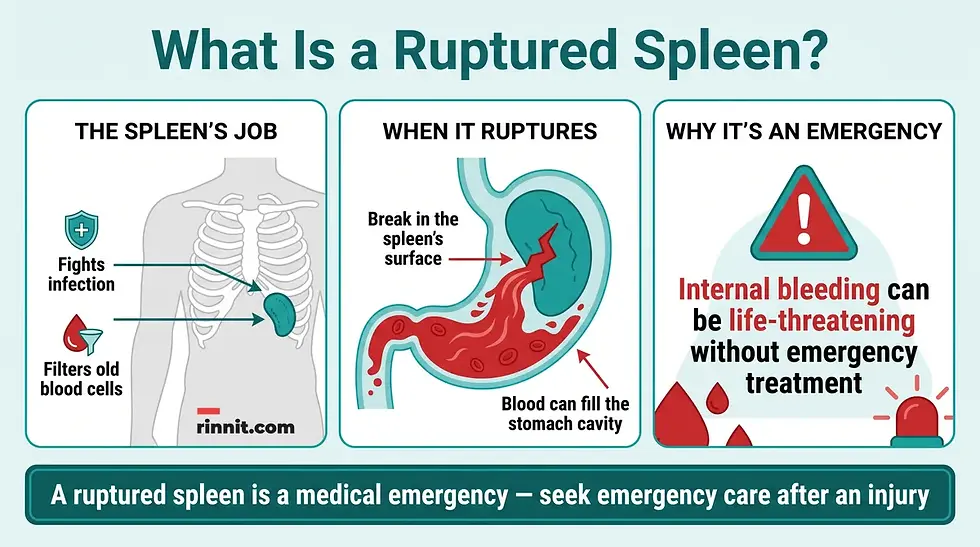
The spleen sits just under your rib cage on your left side. It helps your body fight infection and filters old blood cells from your bloodstream. [1]
A ruptured spleen is a medical emergency that happens when the spleen's surface breaks. When that break occurs, a ruptured spleen may release a large amount of blood into the stomach cavity. [1]
Without emergency treatment, the internal bleeding caused by a ruptured spleen can be life-threatening. [1] That is why the condition should always be treated as urgent rather than watched and waited.
What Are the Symptoms of a Ruptured Spleen?
A ruptured spleen can cause upper left stomach pain and tenderness, left shoulder pain, and confusion, lightheadedness or dizziness. [1]
Pain in the upper left stomach.
Tenderness when you touch the upper left stomach.
Left shoulder pain.
Confusion, lightheadedness, or dizziness.
The left shoulder pain is a clue worth remembering. A break in the spleen's surface irritates the nearby diaphragm, and that irritation can register as pain in the left shoulder — even when the injury is in the stomach area.
When Should You Get Emergency Care?
A ruptured spleen is a medical emergency. Seek emergency care after an injury if your signs and symptoms indicate that you may have a ruptured spleen. [1]
Symptom | What it looks like |
Upper left stomach pain | Pain in the upper left stomach |
Tenderness | The upper left stomach hurts when you touch it |
Left shoulder pain | Pain referred to the left shoulder |
Confusion, lightheadedness, or dizziness | Signs that blood loss is affecting the brain |
What Causes a Ruptured Spleen?
A forceful blow to the stomach — during a sporting accident, a fistfight, or a car crash, for example — is the usual cause of a ruptured spleen. [1]
A spleen can rupture due to two main pathways:
Cause | How it works |
Injury to the left side of the body | A blow to the left upper stomach or the left lower chest — such as in sporting accidents, fistfights, and car crashes. An injured spleen can rupture soon after the stomach trauma or, in some cases, days or weeks after the injury. [1] |
An enlarged spleen | The spleen becomes enlarged when blood cells accumulate in it. Causes include mononucleosis and other infections, liver disease, and blood cancers. If the spleen is already enlarged, a less forceful trauma might cause rupture. [1] |
The timing detail matters: a rupture isn't always immediate. An injured spleen can rupture soon after the stomach trauma, or in some cases, days or weeks after the injury. [1] [3] That delayed rupture is why anyone with left-side trauma who develops new pain later should be checked.
Who Is at Higher Risk?
If the spleen is already enlarged due to infection or another cause, there is increased risk that the spleen might rupture. [1] Contact sports that involve blows to the chest also increase the risk of a ruptured spleen. [1]
Risk factor | Why it matters |
An already enlarged spleen | Enlargement from infection or another cause increases the chance of rupture [1] |
Contact sports | Sports that involve blows to the chest raise the risk [1] |
Recent left-side trauma | An injured spleen can rupture days or weeks later [1] |
An underlying illness that enlarges the spleen | Mononucleosis and other infections, liver disease, and blood cancers can enlarge the spleen [1] |
What Are the Complications?
A ruptured spleen can cause life-threatening bleeding into your stomach cavity. [1]
How Is a Ruptured Spleen Diagnosed?
A ruptured spleen is diagnosed using a set of specific tests and procedures.
Test | What it shows |
Physical exam | The provider presses on your abdomen to determine the size of your spleen and whether it's tender [2] |
Blood tests | Evaluate factors such as platelet count and how well your blood clots [2] |
Checking for blood in the abdominal cavity | In emergency situations, the team might use an ultrasound or draw a sample of fluid from your stomach with a needle. If the sample reveals blood in your stomach, you might be referred for emergency surgery. [2] |
Imaging tests of the stomach | If the diagnosis isn't clear, the provider might recommend a CT scan of the stomach, possibly with contrast dye, or another imaging test to look for other possible causes of your symptoms [2] |

How Is a Ruptured Spleen Treated?
Treatment for a ruptured spleen depends on the seriousness of your condition. Severe injuries usually require immediate surgery. [2]
Many small or moderate-sized injuries to the spleen can heal without surgery. You're likely to stay in the hospital while your healthcare team observes your condition and provides nonsurgical care, such as blood transfusions, if necessary. You might have periodic follow-up CT scans to check whether your spleen has healed or to determine whether you need surgery. [2]
What Surgical Options Exist?
Surgery for a ruptured spleen can include:
Option | How it works |
Repairing the spleen | The surgeon might be able to use stitches or other techniques to repair the rupture [2] |
Removing the spleen (splenectomy) | People can live without a spleen, but it increases the risk of serious bacterial infections such as sepsis. The provider may recommend vaccinations against meningitis, pneumonia, and haemophilus influenza type b (Hib), and occasionally daily oral antibiotics to prevent infections. [2] |
Removing part of the spleen (partial splenectomy) | Depending on the rupture, it might be possible to remove only part of the spleen, which reduces the infection risk that comes with removing the entire organ [2] |
Spleen surgery is generally safe, but any surgery has risks, such as bleeding, blood clots, infection, and pneumonia. [2]

Can You Prevent a Ruptured Spleen?
You can't prevent a car crash or a collision in a sport, but you can lower your risk if you know your spleen is enlarged.
If you've been diagnosed with an enlarged spleen, ask your healthcare provider whether you need to avoid activities for several weeks that could cause it to rupture. These might include contact sports, heavy lifting, and other activities that increase the risk of stomach trauma. [1]
What is the bottom line on a ruptured spleen?
A ruptured spleen is a break in the surface of the organ tucked under your left rib cage — an organ that fights infection and filters old blood cells. The usual trigger is a forceful blow to the stomach from a sporting accident, a fistfight, or a car crash, and an already enlarged spleen can rupture from much less force. The warning signs are pain and tenderness in the upper left stomach, left shoulder pain, and confusion, lightheadedness, or dizziness — and because an injured spleen can rupture days or weeks after the trauma, new left-side pain after an old injury deserves attention too. The stakes are high: the internal bleeding can be life-threatening without emergency treatment. The good news is that diagnosis is straightforward — an exam, blood tests, and possibly an ultrasound or CT scan — and many small or moderate injuries heal without surgery through hospital observation and transfusions. Severe injuries call for immediate surgery, whether that means repairing the spleen or removing it in whole or in part. If you've been hit hard in the left side and the symptoms above appear, emergency care isn't something to put off.
Take the Next Step
If you've had a forceful blow to your left side or chest and develop pain in your upper left stomach, tenderness there, left shoulder pain, or confusion, lightheadedness, or dizziness, seek emergency care right away — a ruptured spleen is a medical emergency. If you've been diagnosed with an enlarged spleen, talk with your healthcare provider about whether you should avoid contact sports, heavy lifting, and similar activities for several weeks. And if you do end up needing your spleen removed, ask about the vaccinations against meningitis, pneumonia, and Hib, since living without a spleen raises the risk of serious bacterial infections such as sepsis.
Frequently Asked Questions
What is a ruptured spleen?
A ruptured spleen is a medical emergency caused by a break in the spleen's surface. The spleen, located just under the rib cage on the left side, fights infection and filters old blood cells, and a rupture may release a large amount of blood into the stomach cavity.
What does a ruptured spleen feel like?
Pain in the upper left stomach, tenderness when you touch that area, left shoulder pain, and confusion, lightheadedness, or dizziness.
Is a ruptured spleen life-threatening?
Without emergency treatment, the internal bleeding caused by a ruptured spleen can be life-threatening.
What causes a ruptured spleen?
Most often a forceful blow to the stomach during a sporting accident, a fistfight, or a car crash. An enlarged spleen — from mononucleosis and other infections, liver disease, or blood cancers — can rupture from less forceful trauma.
Can a ruptured spleen happen days after an injury?
Yes. An injured spleen can rupture soon after the stomach trauma or, in some cases, days or weeks after the injury.
How is a ruptured spleen diagnosed?
Through a physical exam (pressing on the abdomen), blood tests (platelet count and clotting), checking for blood in the abdominal cavity with ultrasound or a needle fluid sample, and — if the diagnosis isn't clear — a CT scan of the stomach, possibly with contrast dye.
Does everyone with a ruptured spleen need surgery?
No. Severe injuries usually require immediate surgery, but many small or moderate-sized injuries heal without surgery through hospital observation, blood transfusions if necessary, and periodic follow-up CT scans.
Can you live without a spleen?
Yes, but it increases the risk of serious bacterial infections such as sepsis. Your provider may recommend vaccinations against meningitis, pneumonia, and Hib, and occasionally daily oral antibiotics to prevent infections.
What are the surgical options for a ruptured spleen?
Repairing the spleen with stitches or other techniques, removing the entire spleen (splenectomy), or removing only part of it (partial splenectomy), which reduces the infection risk compared with removing the whole organ.
How can I reduce my risk of a ruptured spleen?
If you've been diagnosed with an enlarged spleen, ask your provider whether to avoid contact sports, heavy lifting, and other activities that increase the risk of stomach trauma for several weeks.
Related Reading
References
Mayo Clinic Staff. Ruptured spleen: Symptoms and causes. Mayo Clinic. Last updated February 1, 2024. Accessed October 14, 2026. https://www.mayoclinic.org/diseases-conditions/ruptured-spleen/symptoms-causes/syc-20352317
Mayo Clinic Staff. Ruptured spleen: Diagnosis and treatment. Mayo Clinic. Last updated February 1, 2024. Accessed October 14, 2026. https://www.mayoclinic.org/diseases-conditions/ruptured-spleen/diagnosis-treatment/drc-20352322
Van PY. Splenic injury. Merck Manual Professional Version. Last updated October 2025. https://www.merckmanuals.com/professional/injuries-poisoning/abdominal-trauma/splenic-injury
Crichton JCI, Naidoo K, Yet B, et al. The role of splenic angioembolization as an adjunct to nonoperative management of blunt splenic injuries: a systematic review and meta-analysis. J Trauma Acute Care Surg. 2017;83(5):934-943. PMID 29068875. https://doi.org/10.1097/TA.0000000000001649
Nann S, Clark M, Kovoor J, et al. Prophylactic embolization vs observation for high-grade blunt trauma splenic injury: a systematic review with meta-analysis. JBI Evid Synth. 2025;23(2):208-243. Epub 2024 Jul 19. PMID 39028141. https://doi.org/10.11124/JBIES-24-00110
Bianchi FP, Stefanizzi P, Spinelli G, et al. Immunization coverage among asplenic patients and strategies to increase vaccination compliance: a systematic review and meta-analysis. Expert Rev Vaccines. 2021;20(3):297-308. PMID 33538617. https://doi.org/10.1080/14760584.2021.1886085
Disclaimer: This guide is for general information only and is not a substitute for professional medical advice, diagnosis, or treatment. Always seek the advice of a physician or other qualified health provider with any questions about a medical condition. Never disregard professional medical advice or delay seeking it because of something you have read here. A ruptured spleen is a medical emergency — call your local emergency number if you suspect one.



Comments