What Is Rubella? A Plain-Language Guide to the Mild Rash Illness That Threatens Pregnancies

Updated: 3 days ago
Medically reviewed by Dr. Baraa Alnahhal, MD · Last reviewed: October 17, 2026
Quick Answer
Rubella, also called German measles, is a contagious viral infection known for a fine rash that starts on the face and spreads. [1] Most people have mild symptoms or none. [1] It spreads through the air and from a pregnant person to the fetus, and in pregnancy it can cause miscarriage, stillbirth or congenital rubella syndrome. [1] The MMR vaccine prevents it. [1]
What the research says
Rubella is often silent, yet it still causes about 100,000 cases of congenital rubella syndrome a year worldwide. A 2022 Lancet review reports that 25 to 50% of people infected with rubella virus have no symptoms, that WHO estimates approximately 100,000 congenital rubella syndrome cases occur per year, and that global rubella vaccine coverage reached only 70% in 2020. (Winter and Moss, Lancet, 2022) [5]
Where vaccination is widespread, congenital rubella syndrome has nearly disappeared. A systematic review with modeling estimated that by 2010 congenital rubella syndrome fell below 2 per 100,000 live births in the Americas and Europe, while estimates were 116 and 121 per 100,000 live births in Africa and Southeast Asia. Globally, an estimated 105,000 cases occurred in 2010, compared with 119,000 in 1996. (Vynnycky et al., PLoS One, 2016) [6]
Large reviews support the safety of the MMR vaccine. A Cochrane review of 138 studies with 23,480,668 participants found no evidence of an association between MMR vaccination and autism (rate ratio 0.93, 95% CI 0.85 to 1.01; moderate certainty). Fever-related seizures were linked to the vaccine at an estimated 1 per 1,700 to 1 per 1,150 doses, and low platelets (ITP) at about 1 per 40,000 doses, which is less than after natural infection. The authors concluded the evidence supports use of the vaccine for mass immunisation. (Di Pietrantonj et al., Cochrane Database Syst Rev, 2021) [7]
What Is Rubella, and How Is It Different From Measles?
Rubella is a viral infection that passes easily to others. It is best known by its rash, and it is also called German measles or three-day measles. [1]
It is important to know that rubella is not the same as measles. The two illnesses share some symptoms, such as a rash, but they are caused by different viruses. The virus that causes rubella is not as easy to catch and does not cause a disease as severe as measles. [1]
For most people, this infection causes mild or no symptoms. But it can cause serious problems for the unborn babies of pregnant people who get rubella. [1] Because of that, rubella is often described as a mild illness with a serious exception.
Rubella is rare or does not exist in many countries because most children are vaccinated against the infection at an early age. But the vaccine is not used everywhere, so the virus still causes serious problems for the babies of pregnant people who get rubella. [1]

What Are the Symptoms of Rubella?
Some people have no symptoms at all. But when symptoms do appear, they most often show up 2 to 3 weeks after being exposed to the virus, and they last about 1 to 5 days. [1]
Symptom | Details |
Fever | Mild fever of 102°F (38.9°C) or lower [1] |
Headache | A dull ache in the head |
Runny or stuffy nose | Stuffy or runny nose, similar to a mild cold |
Eye changes | Red, itchy eyes [1] |
Swollen glands | Enlarged, tender lymph nodes at the base of the skull, at the back of the neck, and behind the ears [1] |
Rash | A fine rash that begins on the face; can look pink or red on white skin and might be harder to see on Black or brown skin; quickly spreads to the belly and then to the arms and legs, and goes away in the same order [1] |
Joint pain | Aching joints, most often in adults assigned female at birth [1] |
The rash is the signature symptom, and its pattern is distinctive: it starts on the face, moves quickly to the belly, then to the arms and legs, and fades in the same order it appeared. [1]
How Does Rubella Spread?
Rubella is caused by a virus that passes from person to person. It can spread when an infected person coughs or sneezes, and it also can spread through direct contact with infected mucus from the nose and throat. And it can be passed from pregnant people to their unborn children. [1]
The contagious window is wider than most people expect: a person who has been infected is contagious from about one week before the rash starts until about one week after the rash goes away. [1] That means infected people can spread the illness before they even know they have it. [1]
Spread fact | Detail |
Airborne spread | Coughing or sneezing |
Direct contact | Infected mucus from the nose and throat |
Before symptoms | Contagious from about one week before the rash starts [1] |
After symptoms | Contagious until about one week after the rash goes away [1] |
Pregnancy | Can be passed from pregnant people to their unborn children |
Once you have had the disease, you are likely to be immune for life. [1] In many countries, rubella is rare because most children are vaccinated early. But in some parts of the world, the virus is still active, which matters if you are planning to travel — especially if you are pregnant. [1]
Who Is Most at Risk?
The two risk factors for getting rubella are straightforward: not being vaccinated against rubella, and being in close contact with someone who has rubella. [1] In practical terms, that means people who skipped or never completed their MMR vaccine doses are the ones most likely to catch it when the virus is nearby.
Why Is Rubella Dangerous During Pregnancy?
Rubella is a mild infection for most people. But if you are pregnant when you get rubella, the effect on your unborn child may be severe. It can cause miscarriage or stillbirth. [1]
The most important condition to know about is congenital rubella syndrome, which occurs in up to 85% of infants born to people who had rubella during the first 12 weeks of pregnancy. [1] "Congenital" means present at birth. Congenital rubella syndrome can cause one or more of these problems:
Complication | What it means |
Growth delays | The baby grows more slowly than typical |
Cataracts | Clouding of the eye's lens |
Deafness | Hearing loss present at birth |
Congenital heart defects | Problems with how the heart forms |
Organ formation problems | Problems with how other organs form |
Learning problems | Difficulties with learning |
The highest risk to the fetus is during the first three months of pregnancy. But exposure later in pregnancy is also dangerous. [1]
It is worth knowing how big a role rubella plays in hearing loss: rubella during pregnancy is the most common cause of deafness that is present at birth. [1] That is why it is vital to be protected against rubella before pregnancy.
How Is Rubella Diagnosed?
The rubella rash can look like many other viral rashes. So healthcare professionals most often confirm rubella with the help of lab tests. You may have a virus culture or a blood test. [2]
These tests can find rubella antibodies in your blood. Antibodies are proteins your immune system makes to fight the virus, and they show whether you have had a recent or past infection or a rubella vaccine. [2]

How Is Rubella Treated?
No treatment makes a rubella infection clear up faster. And symptoms often are mild and do not need to be treated. [2]
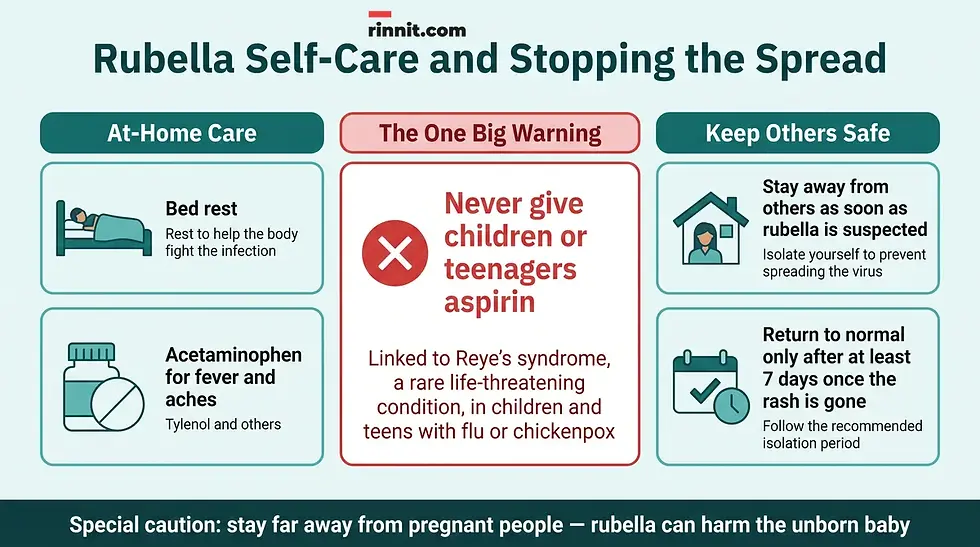
The most important step is staying away from others while infected, and it is most important to stay away from pregnant people. Stay away from others as soon as you suspect rubella, and stay away until at least seven days after the rash goes away. [2]
What Can You Do at Home?
A person with rubella needs simple self-care measures: bed rest, and acetaminophen (Tylenol, others) for relief from fever and aches. [2]
There is one important warning. Do not give children or teenagers aspirin. Aspirin has been linked to Reye's syndrome, a rare life-threatening condition, in children or teenagers who have the flu or chickenpox. [2] [4]
Support for an infant born with congenital rubella syndrome depends on how serious the infant's condition is. Children who have more than one complication may need early treatment from a team of specialists. [2]
How Can Rubella Be Prevented?
The rubella vaccine most often is given as a combined measles-mumps-rubella vaccine, called the MMR vaccine. A vaccine also may include the chickenpox (varicella) vaccine, called the MMRV vaccine. [1]
Healthcare professionals suggest that children get the first MMR vaccine between 12 and 15 months of age, and the second vaccine between 4 and 6 years of age, before they start grade school. [1] The MMR vaccine prevents rubella and protects against it for life, and getting the vaccine can prevent rubella during future pregnancies. [1]
Babies born of people who have received the vaccine or who already are immune are most often protected from rubella for 6 to 8 months after birth. [1] Some children might need the vaccine before 12 months of age for travel to certain countries or other reasons; they can get it as young as 6 months of age. But children who are vaccinated early still need to be vaccinated at the suggested ages later. [1]
Vaccine schedule | Timing |
First MMR dose | Between 12 and 15 months of age [1] |
Second MMR dose | Between 4 and 6 years of age, before grade school [1] |
Protection length | Lifelong |
Early travel option | As young as 6 months, with later doses still required [1] |
Newborn protection | Babies of vaccinated/immune parents usually protected 6 to 8 months after birth [1] |
Do You Need the MMR Vaccine?
You don't need a vaccine if you had two doses of the MMR vaccine after 12 months of age, if blood tests show you are immune to measles, mumps and rubella, or if you were born before 1957 — people born before 1957 are likely to have had measles, mumps and rubella during childhood and so are immune. But if you don't have a blood test that shows you're immune, talk to your healthcare professional about getting the MMR vaccine. [1]
You do need to get a vaccine if you have not had two doses of the MMR vaccine after age 12 months, or if you haven't had a blood test that shows you're immune to measles, mumps and rubella. [1]
Being sure you are immune is crucial if you are of childbearing age and could become pregnant, if you go to college, trade school or graduate school, if you work in a hospital, medical facility, child care center or school, or if you plan to travel overseas or take a cruise. [1]
Who Should Not Get the Vaccine?
The vaccine is not suggested for pregnant people or people who plan to get pregnant within the next four weeks, and for people who have had a life-threatening allergic reaction to gelatin, the antibiotic neomycin, or a prior dose of MMR vaccine. [1] If you have cancer, a blood disorder or another disease, or you take medicine that affects your immune system, talk to your healthcare professional before getting an MMR vaccine. [1]
Studies from the American Academy of Pediatrics, the National Academy of Medicine, and the Centers for Disease Control and Prevention conclude that there is no proven link between the MMR vaccine and autism. [1]
What Are the Side Effects?
Most people have no side effects from the vaccine. For some people, minor side effects may appear about two weeks after the first vaccine — a sore arm where the shot was given, fever, and a mild rash where the shot was given. [1] Symptoms are less likely to happen after the second shot. [1]
A few people get short-lived joint pain or stiffness (more likely in teens or adults assigned female at birth who were not already immune to rubella), swelling of the glands in the cheeks or neck, seizures that happen with a fever, a low level of platelets (the cells in the blood that help with clotting, which can cause unusual bleeding or bruising), a rash all over the body, and — very rarely — serious allergic reactions. [1]
How Do You Stop It From Spreading?
If you have been in contact with the rubella virus and get rubella, you can help keep friends, family and co-workers safe by telling them about your diagnosis and keeping your distance. If your child has rubella, let the school or child care provider know. [1]
When Should You See a Doctor?
Contact your healthcare professional if you think you or your child may have been exposed to the virus that causes rubella, or if you see symptoms of rubella. [1]
If you are thinking about getting pregnant, check your vaccination record to make sure you have had your MMR vaccine. If you are pregnant and you get rubella, especially during the first trimester, the virus can cause death or serious birth defects in the growing fetus. [1]
If you are pregnant, you will likely be screened to see if you are immune to rubella. But if you have never had the vaccine and you think you might have been exposed, contact your healthcare professional right away — a blood test can tell you if you are immune. [1]
How Should You Prepare for Your Appointment?
Before your appointment, write down questions you have. Your healthcare professional is likely to ask you questions as well, such as whether you have been vaccinated for rubella, how long you have had symptoms such as a rash or aching joints, whether you have been around anyone who had rubella, and whether you have traveled to other countries in recent weeks — and which ones. [2]
They may also ask whether anything seems to make your symptoms better or worse. [2]
When you go to your appointment, tell the people at the check-in desk that you suspect an infectious disease. You and your child may be asked to wear a face mask, or you may be shown to an exam room right away. [2]
What is the bottom line on rubella?
Rubella is the "mild one" of the childhood rash illnesses — for most people it brings a mild fever, a few days of cold-like symptoms, and a fine rash that travels from face to belly to limbs before disappearing on its own. But "mild" only describes rubella in everyone except a pregnancy. For a growing fetus, especially in the first three months, the same virus can cause miscarriage, stillbirth, and congenital rubella syndrome — the most common cause of deafness present at birth. The good news is that this entire problem is preventable. The MMR vaccine is safe and provides lifelong protection, with doses at 12 to 15 months and again at 4 to 6 years. If you were not vaccinated as a child, blood tests can confirm immunity, and the vaccine can be given. There is no medicine that speeds recovery, so self-care means rest, acetaminophen for fever and aches (never aspirin for children and teenagers), and staying away from others — above all, pregnant people — until at least a week after the rash is gone.
Take the Next Step
If you suspect you or your child has rubella, call your healthcare professional today and stay away from others — especially pregnant people — until at least seven days after the rash disappears. Use bed rest and acetaminophen for fever and aches, and never give aspirin to children or teenagers. If you are thinking about getting pregnant, check your vaccination record now and ask for a blood test if you are unsure of your immunity. If your family's MMR doses are incomplete, or your child is under-vaccinated, schedule the catch-up — one vaccine visit protects your family for life and protects every pregnancy in your community.
Frequently Asked Questions
What is rubella?
Rubella is a contagious viral infection, also called German measles or three-day measles, best known by its fine rash. It causes mild or no symptoms in most people but can cause serious problems for the unborn babies of pregnant people who get it.
How is rubella different from measles?
Rubella and measles are caused by different viruses. Rubella is not as easy to catch and does not cause as severe a disease as measles, though the two share some symptoms like a rash.
What are the symptoms?
Some people have no symptoms. When they appear — usually 2 to 3 weeks after exposure and lasting about 1 to 5 days — they include a mild fever of 102°F (38.9°C) or lower, headache, stuffy or runny nose, red itchy eyes, enlarged tender lymph nodes at the base of the skull, back of the neck, and behind the ears, a fine rash starting on the face and spreading to the belly, arms, and legs, and aching joints, most often in adults assigned female at birth.
How long is someone contagious?
A person with rubella is contagious from about one week before the rash starts until about one week after the rash goes away, so people can spread it before they know they have it.
How does it spread?
Rubella spreads when an infected person coughs or sneezes, through direct contact with infected mucus from the nose and throat, and from a pregnant person to their unborn child.
Why is rubella dangerous during pregnancy?
If a pregnant person gets rubella, it can cause miscarriage or stillbirth, and congenital rubella syndrome — which occurs in up to 85% of infants born to people infected during the first 12 weeks. The syndrome can cause growth delays, cataracts, deafness, congenital heart defects, problems with other organs, and learning problems. Rubella during pregnancy is the most common cause of deafness present at birth.
Is there a treatment?
No treatment makes rubella clear up faster, and symptoms often do not need to be treated. Self-care includes bed rest and acetaminophen for fever and aches — never aspirin for children or teenagers. Stay away from others until at least seven days after the rash goes away, especially pregnant people.
How is it diagnosed?
Because the rash can look like many other viral rashes, healthcare professionals usually confirm rubella with lab tests — a virus culture or blood test that finds rubella antibodies in your blood.
Who needs the MMR vaccine?
You need it unless you had two doses after age 12 months, have blood tests showing immunity, or were born before 1957. Immunity is especially crucial if you are of childbearing age, attend college or trade school, work in healthcare or child care, or plan to travel overseas.
Can babies be vaccinated early?
Yes — some children can get the vaccine as young as 6 months of age for travel or other reasons, but they still need to be vaccinated again at the suggested ages of 12 to 15 months and 4 to 6 years.
Is the MMR vaccine safe?
Yes. Most people have no side effects; minor side effects like a sore arm, fever, or mild rash may appear about two weeks after the first dose. Studies from the American Academy of Pediatrics, the National Academy of Medicine, and the CDC conclude there is no proven link between the MMR vaccine and autism.
What should I do if my child has rubella?
Let the school or child care provider know, keep your child away from others, and contact your healthcare professional. Tell friends, family, and co-workers about your diagnosis and keep your distance.
Related Reading
References
Mayo Clinic Staff. Rubella: Symptoms and causes. Mayo Clinic. Last updated December 24, 2025. Accessed October 14, 2026. https://www.mayoclinic.org/diseases-conditions/rubella/symptoms-causes/syc-20377310
Mayo Clinic Staff. Rubella: Diagnosis and treatment. Mayo Clinic. Last updated December 24, 2025. Accessed October 14, 2026. https://www.mayoclinic.org/diseases-conditions/rubella/diagnosis-treatment/drc-20377315
Centers for Disease Control and Prevention. Clinical overview of rubella. CDC. Last reviewed July 15, 2024. Accessed October 14, 2026. https://www.cdc.gov/rubella/hcp/clinical-overview/index.html
Merck Manual Professional Version. Reye syndrome. Merck Manuals. Accessed October 14, 2026. https://www.merckmanuals.com/professional/pediatrics/miscellaneous-disorders-in-infants-and-children/reye-syndrome
Winter AK, Moss WJ. Rubella. Lancet. 2022;399(10332):1336-1346. PMID: 35367004. https://doi.org/10.1016/S0140-6736(21)02691-X
Vynnycky E, Adams EJ, Cutts FT, et al. Using seroprevalence and immunisation coverage data to estimate the global burden of congenital rubella syndrome, 1996-2010: a systematic review. PLoS One. 2016;11(3):e0149160. PMID: 26962867. https://doi.org/10.1371/journal.pone.0149160
Di Pietrantonj C, Rivetti A, Marchione P, et al. Vaccines for measles, mumps, rubella, and varicella in children. Cochrane Database Syst Rev. 2021;11(11):CD004407. PMID: 34806766. https://doi.org/10.1002/14651858.CD004407.pub5
Disclaimer: This guide is for general information only and is not a substitute for professional medical advice, diagnosis, or treatment. Always seek the advice of a physician or other qualified health provider with any questions about a medical condition. Never disregard professional medical advice or delay seeking it because of something you have read here.



Comments