What Is Measles? A Plain-Language Guide to the Highly Contagious Childhood Rash Illness

Updated: 2 days ago
Medically reviewed by Dr. Baraa Alnahhal, MD · Last reviewed: October 2026
Quick Answer: Key Facts About Measles
Measles, also called rubeola, is a highly contagious viral infection that spreads through the air. It causes high fever, cough, runny nose, red eyes and a blotchy rash spreading from the face downward. About 90% of non-immune people exposed become infected. It can cause pneumonia or encephalitis and can be deadly. Two MMR vaccine doses give about 97% lifelong protection.
Question | Answer |
What is it? | A highly contagious viral infection, also called rubeola, that spreads through the air and can settle on surfaces. [1] |
What does it look like? | Fever up to 105°F, dry cough, runny nose and red, watering eyes, then tiny white spots inside the mouth (Koplik spots) and a blotchy rash that starts on the face or neck and spreads to the feet. [1] |
How contagious is it? | About 90% of people who are not immune and are around someone with measles become infected. A person can spread it from about 4 days before the rash appears to 4 days after. [1] |
Is it dangerous? | Most people recover in about 10 days, but pneumonia, encephalitis (brain swelling), ear infections and dehydration can occur, and measles can be deadly. [1] |
How is it treated? | There is no antiviral treatment. Care means rest, fluids and fever medicine (never aspirin for children or teens), plus antibiotics or vitamin A only when a healthcare professional recommends them. [2] |
How is it prevented? | Two doses of the MMR vaccine give about 97% of people lifelong protection. [1] |
What the research says
The vaccine works very well. A Cochrane review of 138 studies (23,480,668 participants) found that vaccine effectiveness in preventing measles was 95% after one dose and 96% after two doses (moderate-certainty evidence). For people exposed to measles, at least one dose given afterward was 74% effective at preventing illness (low-certainty evidence). (Di Pietrantonj et al., Cochrane Database Syst Rev, 2020)
There is no link between the MMR vaccine and autism. In a Danish nationwide cohort of 657,461 children followed for more than 5 million person-years, the fully adjusted autism hazard ratio for MMR-vaccinated versus unvaccinated children was 0.93 (95% CI 0.85 to 1.02), with no increased risk in any subgroup studied. The Cochrane review reached the same conclusion across two observational studies of 1,194,764 children (rate ratio 0.93, 95% CI 0.85 to 1.01). (Hviid et al., Ann Intern Med, 2019; Di Pietrantonj et al., 2020)
An early dose is protective but does not replace the full schedule. A meta-analysis of 41 studies found that a first dose given before 9 months of age carried a higher risk of measles than a first dose at 12 to 14 months (pooled risk ratio 3.56, 95% CI 1.28 to 9.88), while a first dose at 15 months or older carried a lower risk (0.48, 95% CI 0.36 to 0.63). This is why children vaccinated early still need two doses at the recommended ages. (Carazo et al., BMC Infect Dis, 2020)
What Is Measles?
Measles, also called rubeola, was once a common childhood illness. It is caused by a virus that spreads easily through the air and settles on surfaces. A vaccine can prevent measles infection. Most people recover in about 10 days, and it usually does not cause long-term medical issues. But measles can be serious and even deadly, especially for children younger than age 5 and people with severely weakened immune systems. [1]
Because of vaccination, measles has not been common in the United States for more than two decades. Often, measles cases in the U.S. come from outside the country, and outbreaks are more common among people who are not vaccinated. [1] Measles cases and outbreaks still occur every year in the United States, because measles is still commonly spread in other parts of the world. [3]

What Are the Symptoms of Measles?
Measles symptoms show up around 7 to 14 days after contact with the virus. The illness arrives in waves, and the rash is one of the last things to appear. [1]
Stage | Timing | What happens |
First symptoms | 7 to 14 days after contact with the virus | Fever that may be as high as 105°F (40.6°C), dry cough, runny nose, and red, watering eyes (conjunctivitis). |
Koplik spots | About 2 to 3 days after the first symptoms | Tiny white spots inside the mouth. |
Rash | About 3 to 5 days after symptoms start (about 14 days after contact) | Large, flat spots and small raised bumps that begin on the face or neck and spread down the body from the chest to the arms and legs. |
The rash may be shades of red, purple or brown depending on your skin color. It most often shows up first on the face and behind the ears, then spreads to the chest and back, and finally to the feet. Koplik spots are a classic clue that helps healthcare professionals spot measles early, before the rash appears. [1]
How Does Measles Spread, and How Contagious Is It?
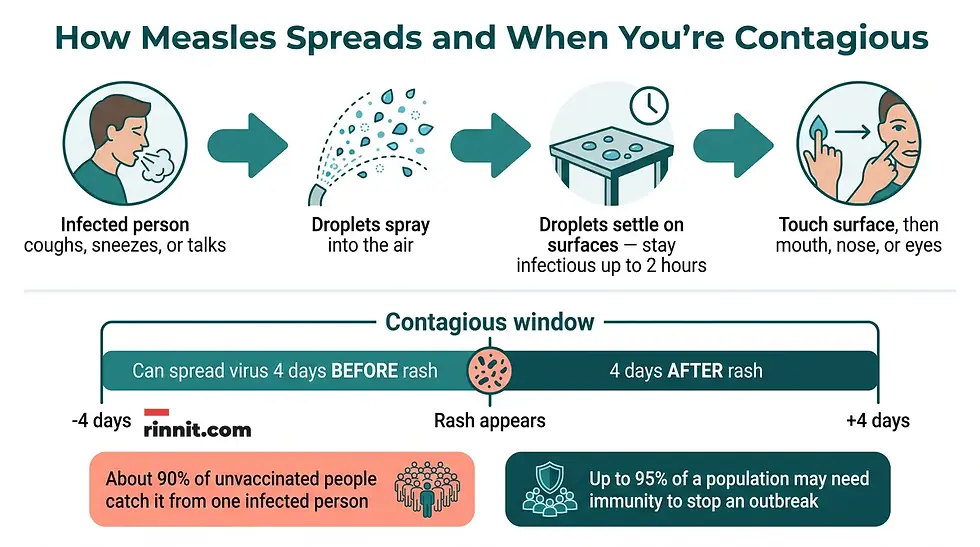
Measles is caused by a virus that spreads only among humans. When someone with measles coughs, sneezes or talks, droplets spray into the air, and people who breathe in the droplets can catch the virus. Droplets also may land on surfaces, and you can catch measles if you touch an infected surface and then touch your mouth, nose or eyes. These droplets can infect other people for up to two hours. [1]
A person with measles can spread the virus four days before the rash appears and four days after. About 90% of people who have not had measles or have not been vaccinated will become infected when around someone with measles. To stop an outbreak, as many as 95% of a population may need to be immune, and in the United States more than 90% of people may need immunity to keep measles from becoming more widespread. Soon after vaccination rates drop, measles starts to come back. [1]
Who Is Most at Risk of Catching Measles?
Your risk of measles goes up if you are not vaccinated, and also if you have had only one dose of the vaccine. Other groups at higher risk include: [1]
People who travel to places where measles regularly spreads or where there is an outbreak, especially without two doses of the vaccine.
Students living in dormitories.
People with weakened immune systems.
Infants who are not old enough to get the vaccine, if they are exposed.
What Complications Can Measles Cause?
Complications of measles may include: [1]
Dehydration: diarrhea and vomiting can cause the body to lose too much water.
Ear infection: one of the most common complications, caused by bacteria.
Bronchitis, laryngitis or croup: inflammation of the main air passages of the lungs, the voice box, or the airways.
Pneumonia: an infection in the lungs.
Encephalitis: about 1 in 1,000 people with measles get irritation and swelling of the brain, which may happen right after measles or months later and can cause lasting brain damage.
Pregnancy complications: measles during pregnancy can put the pregnant person's life in danger and can lead to pregnancy loss, fetal death or problems with how the baby forms.
Pneumonia and encephalitis are the most common causes of death from measles. According to the CDC, 1 to 3 out of every 1,000 children who become infected with measles will die from respiratory and neurologic complications. [3] Groups with a higher than average risk of death include children younger than age 5, adults older than age 20, people who are pregnant, people with weakened immune systems, and people who are severely malnourished, including those with vitamin A deficiency. [1]
Rarely, measles can cause brain or nervous system illness years after infection. People with a weakened immune system can get measles inclusion body encephalitis (MIBE). Measles can also lead to subacute sclerosing panencephalitis (SSPE), which most often shows up 7 to 11 years after infection and seems to be more likely in children who caught measles before age 2. In addition, measles infection in children may wipe out the immune system's memory of germs, so children may be more likely to get sick from germs they had recovered from before and may need standard childhood vaccines again. [1]
How Is Measles Diagnosed?
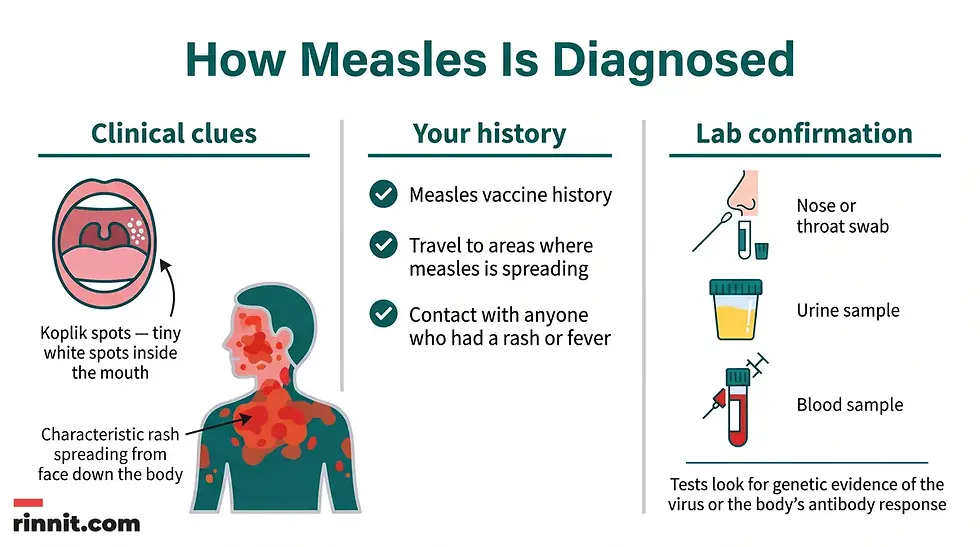
Measles may be diagnosed by a healthcare professional based on the disease's rash and the tiny white Koplik spots inside the mouth. The healthcare team may ask whether you or your child has had the measles vaccine, traveled to places where measles is spreading, or been around anyone with a rash or fever. [2]
Lab tests can confirm measles. They may look for genetic evidence of the virus or proteins used in the body's response to the virus, using a swab from the nose or throat, or a urine or blood sample. [2] Healthcare professionals must report suspected measles to the local health department. [3]
How Is Measles Treated?
Measles cannot be treated with an antiviral medicine, since no antiviral treatment exists for it. But other well-researched treatments can help ease symptoms, lower the risk of complications and prevent death from measles. [2]
After exposure. People older than 6 months who are exposed to measles and are not immune by previous illness or vaccination can get a measles vaccine for up to three days after contact, and after the vaccine they do not need to stay home. For up to six days after exposure, children up to 11 months old who are exposed and not immune can get a shot of antibodies called immune globulin, and after that they do need to quarantine for 21 days. [2]
Care at home. Get plenty of rest and eat nutritious foods as you are able. Focus on drinking fluids to prevent dehydration. Water, broth or rehydration solutions may help, and you should talk with your healthcare professional before giving rehydration fluids to infants. Over-the-counter medicines may help with fever and achiness, so read labels carefully or ask a pharmacist about the right dose. Do not give aspirin to children or teenagers, because aspirin has been linked to Reye's syndrome, a rare, life-threatening condition, in children and teenagers who have the flu or chickenpox. [2]
Treating complications. A bacterial infection such as pneumonia or an ear infection may need an antibiotic, but antibiotics do not treat measles itself. If airway inflammation lowers the body's ability to take in oxygen, you may need extra oxygen or breathing help. [2]
Vitamin A. A healthcare professional may give children vitamin A as part of treatment for measles, and the dose depends on the child's age. Children with low vitamin A levels who get measles are more likely to be very sick. Vitamin A does not prevent measles, and children should not be given it unless a healthcare professional recommends it, because taking too much can cause major harm. [2] The CDC advises that children with severe measles, such as those who are hospitalized, should be managed with vitamin A under the supervision of a healthcare provider. [3]
Treatments with limited evidence. There is no clear benefit from steroid treatments of any kind, and steroids may make measles worse in some people. Other treatments may help only people at high risk of serious illness or those who are already very ill, so a qualified healthcare professional can help weigh the risks and benefits. [2]
How Can Measles Be Prevented?
The CDC recommends that children and adults get a measles vaccine. On average, two doses give lifelong protection from measles to about 97% of people. For the small group who get measles after being fully vaccinated, symptoms tend to be mild and they tend not to spread the disease to others. [1]
In the United States, the vaccine is made from a weakened measles virus and is given as a combined shot. The MMR vaccine protects against measles, mumps and rubella, and the MMRV vaccine also protects against chickenpox (varicella). Measles vaccines offered outside the United States may protect against measles only, or against combinations of measles, mumps, rubella and varicella. [1]
Who should not get the vaccine. Do not get the vaccine if you have had a serious allergic reaction after the first dose of MMR or MMRV or to the antibiotic neomycin, if you are pregnant, or if you have a severely weakened immune system due to treatment or illness. Check with a healthcare professional first if you have had seizures or have a family history of seizures, plan to get pregnant in the next four weeks, recently needed a blood transfusion or other blood products, recently took corticosteroids, or are being treated for tuberculosis. [1]
What Is the Measles Vaccine Schedule?
The CDC recommends that children get a measles vaccine between 12 and 15 months of age, and again between 4 and 6 years of age, before they start school. The timing could shift in some situations. [1]
Vaccine timing | Detail |
First dose | Between 12 and 15 months of age. |
Second dose | Between 4 and 6 years of age, before starting school. |
Minimum gap between doses | 28 days. |
Early option | Children 6 to 11 months old may get the vaccine early if they were exposed to measles or for travel. They still need two doses at the recommended ages. |
Catch-up for older children and teens | Missing doses should be given at least 28 days apart. |
Side effects of the vaccine include a sore area where the shot was given, which may change color depending on your skin color. Other side effects are fever, rash, swelling of glands in the face or neck, and joint stiffness or pain. If a child gets a rash after the MMRV shot, it could be linked to the varicella part of the vaccine, and the child should be kept away from people with weakened immune systems and infants. Rarely, some children have had seizures after vaccination, and some have a temporary drop in platelets, the cells that help blood clot. [1] The Cochrane review estimated the vaccine-induced risk of febrile seizures at 1 per 1,700 to 1 per 1,150 doses, and about 1 case of immune thrombocytopenia per 40,000 doses, a lower risk than after natural infection with these viruses. (Di Pietrantonj et al., 2020)
Is the Measles Vaccine Linked to Autism?
No. Vaccines do not cause autism. The 1998 study that suggested a connection was based on scientific errors and was removed from the scientific record in 2010. [1] Large studies since then, including the Danish cohort and Cochrane review described above, found no increased risk.
What About Adults and Outbreaks?
Most people born or living in the U.S. before 1957 are immune to measles because they have had the infection, and if you have had measles, you cannot get it again. Proof includes a vaccine log showing two doses of a vaccine made from the weakened measles virus, a lab test showing you had measles or have antibodies to the virus, or a medical record showing you had measles. If you got the measles vaccine offered between 1963 and 1968, you need to be vaccinated again, because that vaccine does not give long-term protection. If you only had one shot, you may need another dose, which is especially true for people at high risk during an outbreak, college students, healthcare professionals and people who travel widely. The vaccine available for adults in the United States is the MMR vaccine. [1]
When measles starts to spread in a community, health departments may suggest other precautions, such as moving second shots for children earlier and discussing earlier vaccination of infants. If you have had two shots of MMR, a third dose is not recommended during an outbreak. People with measles should stay home and away from others from about four days before to four days after the rash appears. [1]
When Should You See a Doctor, and How Should You Prepare?
Call your healthcare professional if you think you or your child may have been around measles, or if you or your child has a rash that looks like measles. Check your family's vaccination records, especially before children start child care, school or college, and before traveling outside of the U.S. [1]
If you suspect measles, make an appointment and tell the staff at the check-in desk that you suspect measles. You and your child will likely be asked to wear a face mask and be taken to an exam room right away, and you may be asked to come in before or after office hours to lower the risk of spreading measles. Before the appointment, list the symptoms and when they began, recent travel or contact with someone who was sick, all medicines, vitamins or supplements and their doses, and your questions. Your professional will likely ask whether you or your child has been vaccinated and when, whether you have traveled out of the U.S. recently, and whether others in your home have been vaccinated. In the meantime, rest, drink lots of fluids and stay away from others. [2]
Learn more. For more evidence-based health guides, visit Rinnit.com.
Frequently Asked Questions
What is measles?
Measles, also called rubeola, is a viral infection that spreads easily through the air and settles on surfaces. It was once a common childhood illness, but vaccination has kept it uncommon in the United States for more than two decades. [1]
What are the symptoms of measles?
Symptoms appear 7 to 14 days after contact with the virus: fever up to 105°F, dry cough, runny nose and red, watering eyes. Tiny white Koplik spots follow inside the mouth, then a blotchy rash that spreads from the face or neck down the body. [1]
How contagious is measles?
About 90% of people who are not immune and are around someone with measles become infected. A person can spread it from about 4 days before the rash appears to 4 days after. [1]
How does measles spread?
Droplets from coughing, sneezing or talking spray into the air and can land on surfaces. You can catch it by breathing them in or touching an infected surface and then your mouth, nose or eyes. Droplets can infect others for up to two hours. [1]
How long does measles last?
Most people recover in about 10 days and it usually causes no long-term problems, but it can be serious and even deadly, especially for children under 5 and people with severely weakened immune systems. [1]
What complications can measles cause?
Dehydration, ear infections, bronchitis, laryngitis, croup, pneumonia, encephalitis (about 1 in 1,000 cases) and pregnancy complications. Pneumonia and encephalitis are the most common causes of death. [1]
Is there a treatment for measles?
There is no antiviral treatment. Care means rest, fluids and fever medicine (never aspirin for children or teens). Antibiotics treat bacterial complications but not measles itself. [2]
Should my child take vitamin A for measles?
Only if a healthcare professional recommends it. Vitamin A does not prevent measles, and too much can cause major harm. The CDC advises that children with severe measles, such as those who are hospitalized, should be managed with vitamin A under medical supervision. [2] [3]
What should I do after exposure to measles?
People over 6 months who are not immune can get a measles vaccine within three days of contact. Non-immune infants up to 11 months can get immune globulin within six days, followed by 21 days of quarantine. Call your healthcare professional right away. [2]
How is measles diagnosed?
Mainly from the rash and Koplik spots plus questions about vaccination, travel and exposure. Lab tests on a nose or throat swab, urine or blood confirm it. [2]
Who should get the measles vaccine, and when?
The CDC recommends doses at 12 to 15 months and again at 4 to 6 years, at least 28 days apart. Two doses give about 97% of people lifelong protection. [1]
Who should not get the measles vaccine?
People who had a serious allergic reaction after a first MMR or MMRV dose or to neomycin, people who are pregnant, and people with a severely weakened immune system. Check with a professional first if you have a seizure history or other listed conditions. [1]
Can the measles vaccine cause autism?
No. Vaccines do not cause autism. The 1998 study suggesting a link was based on scientific errors and was removed from the scientific record in 2010, and large later studies found no increased risk. [1]
Can a vaccinated person still get measles?
Rarely. For the small group who get measles after being fully vaccinated, symptoms tend to be mild and they tend not to spread it to others. [1]
How do I know if I am already immune?
Proof includes a vaccine log showing two doses, a lab test showing you had measles or have antibodies, or a medical record of measles. Most people born or living in the U.S. before 1957 are immune. If you had measles once, you cannot get it again. [1]
Conclusion
Measles is one of the most contagious diseases known: about 9 in 10 people who are not immune will catch it from an infected person, and droplets can linger for up to two hours. It begins with fever, cough, runny nose and red eyes, then Koplik spots and a rash that travels from the face to the feet. Most people recover in about 10 days, but pneumonia and encephalitis are the most common causes of death, and young children, adults over 20, pregnant people and people with weakened immune systems are at greatest risk. There is no antiviral treatment, so the plan is comfort and preventing complications. The vaccine changes everything: two doses of MMR give about 97% of people lifelong protection. If you are exposed, there are short post-exposure windows, three days for a vaccine and six days for immune globulin in infants, so call your healthcare professional right away. [1] [2] [3]
References
Mayo Clinic Staff. Measles: Symptoms & causes. Mayo Clinic. April 23, 2025. https://www.mayoclinic.org/diseases-conditions/measles/symptoms-causes/syc-20374857
Mayo Clinic Staff. Measles: Diagnosis & treatment. Mayo Clinic. April 23, 2025. https://www.mayoclinic.org/diseases-conditions/measles/diagnosis-treatment/drc-20374862
Centers for Disease Control and Prevention. Clinical Overview of Measles. Centers for Disease Control and Prevention (CDC). Updated August 5, 2026. https://www.cdc.gov/measles/hcp/clinical-overview/index.html
Di Pietrantonj C, et al. Vaccines for measles, mumps, rubella, and varicella in children. Cochrane Database Syst Rev. 2020;4(4):CD004407. PMID 32309885. https://doi.org/10.1002/14651858.CD004407.pub4
Hviid A, et al. Measles, Mumps, Rubella Vaccination and Autism: A Nationwide Cohort Study. Ann Intern Med. 2019;170(8):513-520. PMID 30831578. https://doi.org/10.7326/M18-2101
Carazo S, et al. Effect of age at vaccination on the measles vaccine effectiveness and immunogenicity: systematic review and meta-analysis. BMC Infect Dis. 2020;20(1):251. PMID 32223757. https://doi.org/10.1186/s12879-020-4870-x
Medical disclaimer
This article is for general educational purposes only and is not a substitute for professional medical advice. Always seek the advice of your physician or other qualified health provider with any questions you may have regarding a medical condition.



Comments