What Is Roseola? A Plain-Language Guide to the High Fever and Rash That Sweeps Through Infants

Updated: 2 days ago
Medically reviewed by Dr. Baraa Alnahhal, MD · Last reviewed: October 2026
Quick Answer
Roseola is a common, usually mild viral infection caused by human herpes virus 6 [1] [3] that typically affects children by age 2 [1]. It causes a sudden high fever lasting 3 to 5 days [1] [3], sometimes followed by a flat, non-itchy rash on the trunk [1] [7]. It spreads through saliva and the air [1] [4]. There is no specific treatment [2] [3]; most children recover within a week [1] [2].
What the research says
HHV-6, the virus behind roseola, is a leading cause of fevers and febrile seizures in babies. In a prospective study of 1,653 infants and young children under age 3 who came to an emergency department with a fever, 160 (9.7%) had primary HHV-6 infection. HHV-6 accounted for 20% of fever visits among children 6 to 12 months old and for one third of all febrile seizures in children up to age 2. (Hall et al., N Engl J Med, 1994) [5]
A first febrile seizure caused by HHV-6 did not raise the risk of more seizures. In a prospective study of 36 children whose first febrile seizure was linked to HHV-6 and 86 matched children whose seizure had other causes, 20% of the HHV-6 group and 40% of the comparison group had another seizure within one year (P < 0.038). (Jee et al., Pediatr Infect Dis J, 1998) [6]
Roseola is usually mild; febrile seizures are the main complication to watch for. A 2024 clinical review reports that febrile seizures occur in 10 to 15% of children with roseola during the fever, that the illness is generally benign and self-limited, and that serious complications are rare and occur more often in people who are immunocompromised. (Leung et al., Curr Pediatr Rev, 2024) [7]
What Is Roseola, in Plain Language?
Roseola is a common infection that usually affects children by age 2 [1]. It's caused by a virus that spreads from person to person [1]. It can cause a high fever followed by a rash that doesn't itch or hurt [1]. About a quarter of the people with roseola get a rash [1].
Roseola, also known as sixth disease, usually isn't serious, and it goes away on its own in a week or so [1]. Care for roseola includes cool cloths and medications to reduce fever [1].

What does roseola look like, including its fever and rash?
If your child is exposed to someone with roseola and becomes infected with the virus, it will likely take 1 to 2 weeks for signs and symptoms of infection to appear [1]. Or they may not appear at all. It's possible to become infected with roseola but not show any sign of it [1].
Roseola symptoms might include fever and rash, along with a handful of other signs:
Symptom | What it looks like |
Fever | |
Rash | After the fever goes away, a rash often appears. A roseola rash is many small spots or patches. These spots tend to be flat. The rash often starts on the chest, back and belly and then spreads to the neck and arms [1]. It might reach the legs and face [1]. The rash isn't likely to be itchy or painful [1]. It can last hours or days [1]. The rash might occur without a fever first [1]. |
Irritability | Your child may be crankier than usual during the illness [1]. |
Mild diarrhea | A mild change in stools can occur [1]. |
Decreased appetite | Your child may eat less than normal [1]. |
Swollen eyelids | The eyelids may puff up slightly [1]. |
What Causes Roseola?
Roseola is caused by a virus, usually human herpes virus 6 or sometimes human herpes virus 7 [1] [4]. It is spread by contact with an infected person's saliva, such as when sharing a cup, or through the air, such as when a person with roseola coughs or sneezes [1]. It can take about 9 to 10 days for symptoms to develop after exposure to an infected person [1] [4].
Roseola is no longer contagious after the fever has been gone for 24 hours [1].
Unlike chickenpox and other childhood viral illnesses that spread rapidly, roseola rarely results in a communitywide outbreak [1]. The infection most often occurs in the spring and fall [1] [4].
Who Is Most at Risk of Getting Roseola?
The risk of roseola is highest in older infants. It is most common between 6 and 15 months [1]. Older infants are at greatest risk of acquiring roseola because they haven't had time yet to develop their own antibodies against many viruses [1]. Newborns are protected by antibodies received from their mothers during pregnancy [1]. But this immunity decreases with time [1].
Can Roseola Cause Complications?
Roseola is usually a mild disease, but it can cause complications [1].
Can a Fever Cause a Seizure?
Occasionally a child with roseola experiences a seizure brought on by a sudden fever (febrile seizure) [1]. If this happens, your child might briefly lose consciousness, fall down, and have jerking arms and legs for several seconds to minutes [1].
If your child has a seizure, seek emergency care [1]. Although frightening, febrile seizures in otherwise healthy children tend to be short-lived and are rarely harmful [1].
What About People With Weak Immune Systems?
Roseola is of greater concern in people with a weak immune system. You might have a weak immune system, for example, if you've recently had a bone marrow transplant [1]. People with a weak immune system have less resistance to viruses. They tend to develop more-severe roseola or complications such as pneumonia or encephalitis [1]. Encephalitis is a potentially life-threatening inflammation of the brain [1].
When Should You See a Doctor?
Situation | What to do |
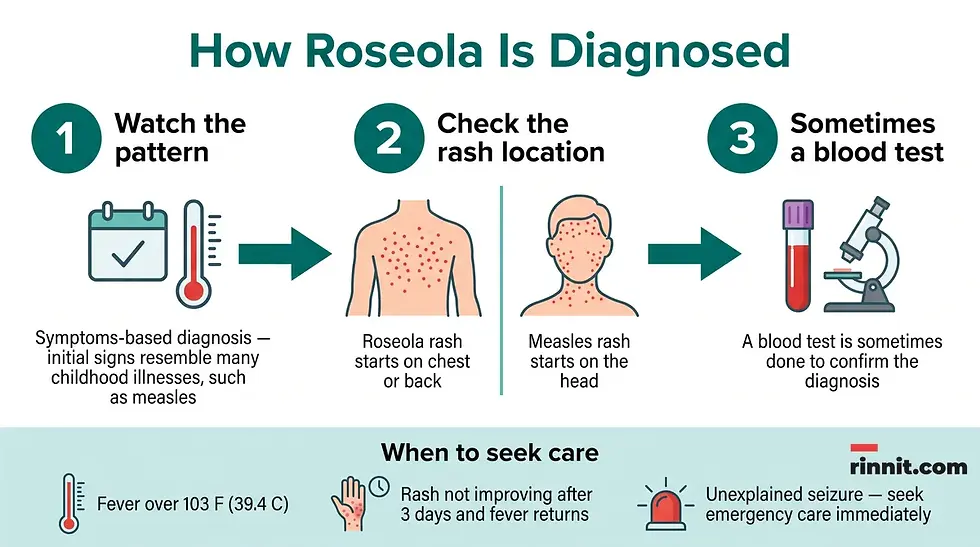
Unexplained seizure | Your child could have a convulsion (febrile seizure) if the fever becomes high or spikes quickly. Seek medical care immediately [1]. |
Fever over 103 F (39.4 C) [1] | Call your child's health care provider. |
Rash doesn't improve after three days and fever returns [1] | Call your child's health care provider. |
Weak immune system in the household | Contact your health care provider if anyone in the household has a problem with their immune system and comes in contact with someone who has roseola. They may need monitoring for a possible infection that could be more severe than it is for someone with a strong immune system [1]. |
How Is Roseola Diagnosed?
Roseola might be diagnosed based on the symptoms. The initial symptoms are similar to many other childhood illnesses, such as measles [2]. A roseola rash often starts on the chest or back [2]. A measles rash begins on the head [2].
Sometimes a blood test is done to confirm the diagnosis [2].
How Is Roseola Treated?
There's no treatment for roseola [2]. Most children recover within a week of the onset of the fever [2]. With your health care provider's advice, consider giving your child nonprescription fever and pain medications made for infants or children as a safer alternative to aspirin. Examples include acetaminophen (Tylenol, others) and ibuprofen (Children's Advil, others) [2].
Use caution when giving aspirin to children or teenagers. Children and teenagers recovering from a viral illness such as chickenpox or flu-like symptoms should never take aspirin, and it is generally not recommended for anyone under 19 unless a doctor advises it [2]. This is because aspirin has been linked to Reye's syndrome, a rare but potentially life-threatening condition, in such children [2].
There's no specific treatment for roseola [2] [3]. Some health care providers may prescribe the antiviral drug ganciclovir for people who have weakened immune systems [2].
How Can You Care for Your Child at Home?
Like most viruses, roseola just needs to run its course [2]. Once the fever subsides, your child will likely feel better soon [2]. Roseola rash is harmless and clears up in 1 to 3 days [2]. No creams or ointments are needed [2].
To treat your child's fever at home, your health care provider may recommend three things:
Self-care step | What to do |
Plenty of rest | Let your child rest in bed until the fever goes away. Use lightweight clothing and covers [2]. |
Plenty of fluids | Offer your child clear fluids to drink to prevent dehydration. Examples are water, ginger ale, lemon-lime soda, clear broth, an electrolyte rehydration solution (Pedialyte, others) and sports drinks, such as Gatorade or Powerade [2]. Remove the gas bubbles from carbonated fluids. You can do this by letting the bubbly drink stand or by shaking, pouring or stirring it. Removing the bubbles will help your child avoid the added discomfort of excess burping or intestinal gas [2]. |
Cool cloth or a sponge bath | Give your child a lukewarm sponge bath or apply a cool, damp cloth to the forehead. Doing this can soothe the discomfort of a fever [2]. |

Can Roseola Be Prevented?
No vaccine exists for roseola [1], but keeping a child with fever at home and frequent handwashing can help prevent its spread [1]. You can protect others by keeping home a child with fever until the fever has been gone for 24 hours [1]. Then, even if a roseola rash is present the disease isn't contagious [1].
Most people have antibodies to roseola by the time they're of school age, making them immune to a second infection [1]. Even so, if one household member gets the virus, make sure that all family members wash their hands often to prevent spread of the virus to anyone who isn't immune [1].
How Should You Prepare for Your Child's Appointment?
Before your child's roseola appointment, gather key information and a list of questions, and be ready to answer the doctor's questions about symptoms and recent illnesses [2].
What Information Should You Gather?
Before the appointment, gather these four things:
What to gather | Details |
Symptom history | List any symptoms your child has had, and for how long [2]. |
Key medical information | Include any other health problems and the names of any medications your child is taking [2]. |
Recent exposure to possible sources of infection | List any possible sources of infection, such as other children who've had a high fever or a rash in the last few weeks [2]. |
Questions to ask | List your questions so that you can make the most of your time with your health care provider [2]. |
Questions to ask your health care provider about your child's condition include [2]:
Your question | What it tells you |
What is the most likely cause of my child's signs and symptoms? | Whether this fits roseola's pattern |
Are there other possible causes? | Other illnesses to consider |
What treatment do you recommend? | Your care plan |
What nonprescription fever medications are safe for my child, if any? | Safe fever relief |
What else can I do to help my child recover? | Home-care steps |
How soon before symptoms improve? | The expected timeline |
Is my child contagious? For how long? | When normal activities can resume |
How do we reduce the risk of infecting others? | Protecting siblings and classmates |
What Will Your Doctor Ask?
Your health care provider may ask: What are your child's signs and symptoms? When did you notice these signs and symptoms? Have your child's signs and symptoms gotten better or worse over time? Have any children with whom your child interacts had a recent high fever or a rash? Has your child had a fever? How high? Has your child had diarrhea? Has your child continued to eat and drink? Have you tried any at-home treatments? Has anything helped? Has your child recently had any other medical conditions? Has your child recently taken any new medications? Is your child in school or child care? What else concerns you [2]?
What Can You Do in the Meantime?
Before your appointment, encourage your child to rest and drink fluids. You may be able to ease fever-related discomfort with a lukewarm sponge bath or a cool cloth to the forehead [2]. Ask your health care provider whether nonprescription fever medications are safe for your child [2].
What is the bottom line on roseola?
Roseola's classic pattern — a sudden, high fever in a baby, followed by a flat, harmless rash once the fever breaks [1] — is one of the most recognizable storylines in early childhood. And despite the fever that often tops 103 F (39.4 C) [1], the condition is usually mild, isn't serious, and resolves on its own within about a week of the fever's start [2]. The rash, when it appears (in roughly a quarter of cases [1]), needs no creams or ointments and clears in 1 to 3 days [2]. Parents can lean on the home-care trio — rest, plenty of clear fluids, and cool cloths — plus child-safe fever medicine such as acetaminophen or ibuprofen, while remembering the one firm rule: never give aspirin to a child recovering from chickenpox or flu-like symptoms [2]. The two moments that deserve immediate attention are an unexplained seizure (call for emergency care) [1] and a child who lives with someone whose immune system is weakened [1]. With no vaccine available, the best prevention is common sense: keep a child with a fever home until it's been gone for 24 hours [1], and make hand-washing a household habit [1].
Take the Next Step
If your child develops a sudden high fever, watch how they act as the days pass — a calm, playful child between fevers who breaks into a rash as the temperature drops fits roseola's classic picture [3]. Offer rest, fluids, and cool cloths, and ask your health care provider whether a child-appropriate fever medicine is right for your child [2]. Call your provider if the fever tops 103 F (39.4 C) or if the rash doesn't improve after three days and the fever returns [1], and seek emergency care immediately for any unexplained seizure [1]. For a baby younger than 3 months, call the provider right away for any fever of 100.4 F (38 C) or higher. If someone in your household has a weakened immune system and comes in contact with a child who has roseola, contact your health care provider about monitoring [1].
Frequently Asked Questions
What is roseola?
Roseola (also known as sixth disease) is a common viral infection that usually affects children by age 2 [1]. It's caused by a virus that spreads from person to person and typically causes a high fever followed by a rash that doesn't itch or hurt [1]. It usually isn't serious and goes away on its own in about a week [1].
What causes roseola?
Roseola is caused by a virus, usually human herpes virus 6 or sometimes human herpes virus 7 [1] [4]. It spreads through contact with an infected person's saliva — such as sharing a cup — or through the air when a person with roseola coughs or sneezes [1].
What are the symptoms?
Roseola often starts with a sudden high fever, often higher than 103 F (39.4 C) [1], that lasts 3 to 5 days [1] [3]. Some children also have a sore throat, runny nose, cough, or swollen lymph nodes in the neck [1]. After the fever goes away, a rash often appears — many small, flat spots or patches that usually start on the chest, back, and belly and spread to the neck and arms [1]. The rash isn't itchy or painful and can last hours or days [1]. Other possible symptoms include irritability, mild diarrhea, decreased appetite, and swollen eyelids [1].
Does every child with roseola get a rash?
No. About a quarter of the people with roseola get a rash [1].
Who is most at risk?
Roseola is most common in older infants between 6 and 15 months [1]. They haven't had time yet to develop their own antibodies against many viruses [1]. Newborns are protected by antibodies received from their mothers during pregnancy, but this immunity decreases with time [1].
Is roseola contagious?
Yes, while the fever is present. It can take about 9 to 10 days for symptoms to develop after exposure [1] [4]. Roseola is no longer contagious after the fever has been gone for 24 hours — even if a rash is still present [1]. Unlike chickenpox, it rarely causes communitywide outbreaks [1] and most often occurs in spring and fall [1] [4].
Can a fever cause a seizure?
Occasionally, a child with roseola has a seizure brought on by a sudden fever (febrile seizure) [1]. The child might briefly lose consciousness, fall down, and have jerking arms and legs for several seconds to minutes [1]. If your child has a seizure, seek emergency care — although frightening, febrile seizures in otherwise healthy children tend to be short-lived and are rarely harmful [1].
Is there a treatment for roseola?
There's no treatment for roseola itself; most children recover within a week of the fever's onset [2]. Care focuses on comfort: rest, plenty of clear fluids, lukewarm sponge baths or cool cloths, and nonprescription fever and pain medicine made for infants or children (acetaminophen or ibuprofen) with your provider's advice [2]. Children and teenagers recovering from chickenpox or flu-like symptoms should never take aspirin, which is linked to Reye's syndrome [2]. People with weakened immune systems may sometimes be prescribed the antiviral drug ganciclovir [2].
How long does roseola last?
Most children recover within a week of the onset of the fever [2]. The rash is harmless and clears up in 1 to 3 days [2].
How can I prevent roseola?
There is no vaccine to prevent roseola [1]. Keep home a child with fever until the fever has been gone for 24 hours, and make sure all family members wash their hands often to prevent spread to anyone who isn't immune [1]. Most people develop antibodies to roseola by school age and become immune to a second infection [1].
When should I see a doctor?
Seek emergency care for an unexplained seizure [1]. Call your child's health care provider if the fever is over 103 F (39.4 C), or if the rash doesn't improve after three days and the fever returns [1]. Contact your provider if anyone in the household has a weakened immune system and comes in contact with someone who has roseola, since they may need monitoring [1].
Related Reading
References
Mayo Clinic Staff. Roseola: Symptoms and causes. Mayo Clinic. Last updated April 30, 2025. Accessed October 14, 2026. https://www.mayoclinic.org/diseases-conditions/roseola/symptoms-causes/syc-20377283
Mayo Clinic Staff. Roseola: Diagnosis and treatment. Mayo Clinic. Last updated April 30, 2025. Accessed October 14, 2026. https://www.mayoclinic.org/diseases-conditions/roseola/diagnosis-treatment/drc-20377289
Hunt R, Mahoney M. Roseola in babies and toddlers: symptoms, causes & when to call the doctor. HealthyChildren.org, American Academy of Pediatrics. Last updated September 23, 2025. Accessed October 14, 2026. https://www.healthychildren.org/English/health-issues/conditions/skin/Pages/Roseola-Infantum.aspx
de St. Maurice A. Roseola infantum. Merck Manual Professional Version. Last updated May 2023. Accessed October 14, 2026. https://www.merckmanuals.com/professional/pediatrics/common-viral-infections-in-infants-and-children/roseola-infantum
Hall CB, Long CE, Schnabel KC, et al. Human herpesvirus-6 infection in children. A prospective study of complications and reactivation. N Engl J Med. 1994;331(7):432-438. PMID: 8035839. https://doi.org/10.1056/NEJM199408183310703
Jee SH, Long CE, Schnabel KC, et al. Risk of recurrent seizures after a primary human herpesvirus 6-induced febrile seizure. Pediatr Infect Dis J. 1998;17(1):43-48. PMID: 9469394. https://doi.org/10.1097/00006454-199801000-00010
Leung AKC, Lam JM, Barankin B, et al. Roseola infantum: an updated review. Curr Pediatr Rev. 2024;20(2):119-128. PMID: 36411550. https://doi.org/10.2174/1573396319666221118123844
Disclaimer: This guide is for general information only and is not a substitute for professional medical advice, diagnosis, or treatment. Always seek the advice of a physician or other qualified health provider with any questions about a medical condition. Never disregard professional medical advice or delay seeking it because of something you have read here.



Comments