What Is Myxofibrosarcoma? A Plain-Language Guide to This Rare Soft Tissue Sarcoma

Updated: 2 days ago
Medically reviewed by Dr. Baraa Alnahhal, MD · Last reviewed: October 2026
Quick Answer: Key Facts About Myxofibrosarcoma
Myxofibrosarcoma is a rare soft tissue sarcoma, a cancer of the tissues that connect, support and surround body structures. [1] It most often starts in the leg and appears as a painless, slow-growing lump under the skin. [1] It mostly affects adults ages 50 to 70. [1] Surgery is the main treatment, sometimes with radiation or chemotherapy. [2]
Question | Answer |
What it is | A rare soft tissue sarcoma — a cancer of the tissues that connect, support and surround body structures. [1] |
Where it starts | Most often in the leg, and sometimes the arm; rarely in the abdomen. [1] |
What it feels like | A painless lump under the skin that grows slowly. [1] |
Who gets it | Most often adults ages 50 to 70; rare in people under 30. [1] |
How it’s treated | Surgery is the main treatment; radiation and chemotherapy may be added to shrink the tumor or reduce the chance of it returning. [2] |
What the research says
Surgery is the standard treatment for localized myxofibrosarcoma. A clinical review describes myxofibrosarcoma as one of the most common soft tissue sarcomas in adults, typically arising in the extremities. Tumors are graded low, intermediate, or high, and higher grades correlate with distant metastases and tumor-related death. The review states that the standard treatment for localized disease is surgical resection and that systemic options for advanced disease are limited. (Nishio & Nakayama, Diagnostics (Basel), 2023 [3])
Evidence for radiation and chemotherapy is mixed. A systematic review of 10 studies (selected from 301 identified) found that neither chemotherapy nor radiation was significantly associated with the rate of local recurrence (p = 0.73 and p = 0.17) or overall survival (p = 0.97 and p = 0.27). Chemotherapy was associated with lower rates of distant metastasis (p = 0.03), while radiation was not (p = 0.67). The authors concluded there is no consensus on the effect of these added treatments, so decisions are made case by case. (Tibbo et al., J Surg Oncol, 2024 [4])
What Is Myxofibrosarcoma?
Myxofibrosarcoma is a type of cancer that begins in the connective tissue. It tends to happen in the arms and legs. [1]
Connective tissue is the body’s “framework” material — the soft tissues that connect, support and surround other body structures. Cancers of these tissues are called soft tissue sarcomas. Myxofibrosarcoma is one type of soft tissue sarcoma. [1]
Myxofibrosarcoma starts as a growth of cells that can grow into healthy body tissue. It might cause a lump under the skin that grows slowly. It often isn’t painful. This cancer happens most often in older adults. [1]
What Does Myxofibrosarcoma Feel Like?
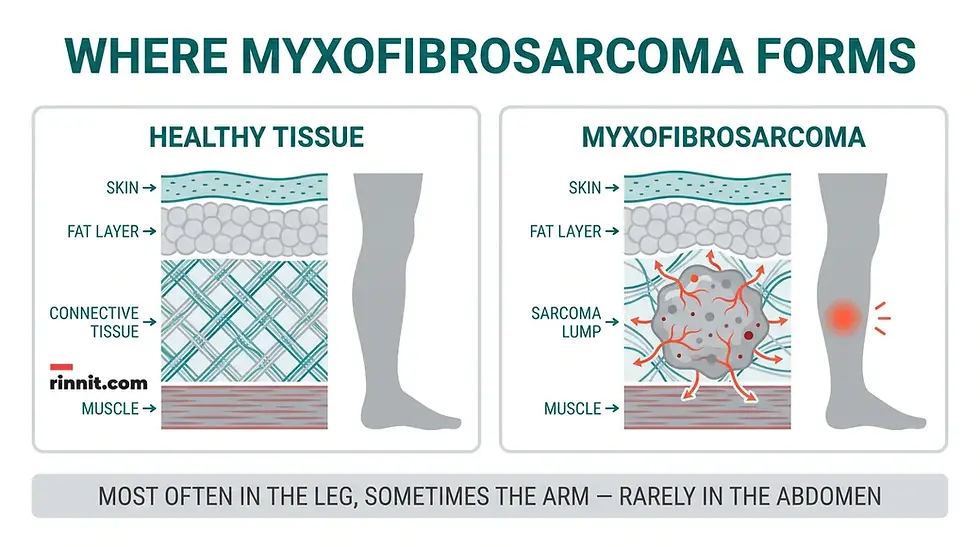
Myxofibrosarcoma usually feels like a painless, slowly growing lump on an arm or leg, most often the leg. [1]
A painless lump on an arm or leg.
A lump that grows slowly. [1]
Myxofibrosarcoma most often starts in the leg. It rarely starts in the abdomen, where other kinds of sarcomas tend to grow. [1]
Because the lump usually does not hurt, many people do not notice it right away. It can sit quietly under the skin while it grows.
When Should You See a Doctor About a Lump?
Make an appointment with a doctor or other healthcare professional if you have any symptoms that worry you. [1] A new lump on your arm or leg that does not go away is worth having checked, even if it does not hurt.

What Causes Myxofibrosarcoma?
The cause of myxofibrosarcoma often isn’t known. This cancer starts as a growth of cells in the connective tissue. [1]
Myxofibrosarcoma happens when cells develop changes in their DNA. A cell’s DNA holds the instructions that tell the cell what to do. In healthy cells, the DNA gives instructions to grow and multiply at a set rate. The instructions tell the cells to die at a set time. [1]
In cancer cells, the DNA changes give different instructions. The changes tell the cancer cells to grow and multiply quickly. Cancer cells can keep living when healthy cells would die. This causes too many cells. The cancer cells can form a lump that may grow into healthy body tissue. [1]

Who Is at Higher Risk?
The risk of myxofibrosarcoma is higher in adults. This cancer happens most often in adults ages 50 to 70. It is rare in people under age 30. [1]
Age Group | Myxofibrosarcoma Risk |
Under 30 | Rare |
50 to 70 | Most common age range [1] |
Over 70 | Risk stays higher in older adults |
There is no way to prevent myxofibrosarcoma. [1]
How Is Myxofibrosarcoma Diagnosed?
Myxofibrosarcoma is diagnosed with a physical exam, imaging tests such as MRI or CT, and a biopsy of the suspicious tissue. [2]
Physical exam. Your healthcare professional may ask about your symptoms and health. The health professional may check your body for signs of cancer. [2]
Imaging tests. Imaging tests make pictures of the body. The pictures might help your healthcare professional learn more about the cancer and its size. One test used for this purpose is MRI, which can look closely at the soft tissue, bone and muscle. You might have other imaging tests to look for signs that the cancer has spread to other parts of the body. This might be with a CT scan. [2]
Getting a sample of tissue for testing. A biopsy procedure often involves using a needle to take some of the suspicious tissue for testing. The tissue goes to a lab where tests can show if you have cancer and what type. Sometimes surgery is needed to get the tissue sample. [2]
Myxofibrosarcoma can be hard to diagnose because it can look like other types of cancer and other conditions that aren’t cancer. Careful imaging and lab tests can help your healthcare team make the correct diagnosis. [2]
What Tests Are Used?
Test | What It Does |
Physical exam | Checks the body for signs of cancer and asks about symptoms |
MRI | Looks closely at the soft tissue, bone and muscle to size the tumor [2] |
CT scan | Looks for signs that the cancer has spread to other parts of the body [2] |
Needle biopsy | Takes a small tissue sample with a needle for lab testing [2] |
Surgical biopsy | Sometimes surgery is needed to get the tissue sample |
How Is Myxofibrosarcoma Treated?
Myxofibrosarcoma treatment often involves surgery to remove the cancer. Other treatments include radiation therapy and chemotherapy. [2]
Myxofibrosarcoma can come back after surgery. This might be more likely if the cancer grows large or if lab tests show the cells are growing quickly. Your healthcare team may create a treatment plan with the goal of getting rid of all the cancer cells. To reach this goal, treatment might involve radiation therapy, chemotherapy or sometimes both treatments before or after surgery. These additional treatments may make it more likely that the cancer won’t come back. [2]
Which treatment is best for you will depend on your cancer, such as the size and location of the myxofibrosarcoma. [2]

What Happens During Surgery?
The goal of surgery is to cut out as much of the cancer as possible. If all the myxofibrosarcoma is removed, surgery might be the only treatment needed. [2]
Sometimes it’s hard to get all the myxofibrosarcoma because this cancer tends to spread out as it grows. It also may grow close to important structures such as blood vessels and nerves that make surgery hard to perform. It can grow deep into the tissue. Sometimes surgeons can’t see all the cancer to make sure it’s removed. [2]
In the past, surgeons often had to remove a limb to get rid of all the cancer. Today that’s often not needed because of newer treatments. Sometimes radiation therapy and chemotherapy are used before surgery to shrink the cancer. This makes it easier to remove and might reduce the risk that the cancer will come back. [2]
What Is Radiation Therapy?
Radiation therapy uses powerful energy beams to kill cancer cells. The energy beams can come from X-rays, protons and other sources. [2]
Radiation might be done before surgery to help shrink the myxofibrosarcoma. It also can be done after surgery to kill any cancer cells that might be left behind. [2]
What Is Chemotherapy?
Chemotherapy treats cancer with strong medicines. It might help control a myxofibrosarcoma that’s growing quickly. It might be an option if myxofibrosarcoma spreads to other parts of the body. [2]
What Are Clinical Trials?
Clinical trials are studies of new treatments. These studies provide a chance to try the latest treatments. The risk of side effects might not be known. [2] Ask your healthcare team if you might be able to be in a clinical trial.
Treatment Options at a Glance
Treatment | What It Does | When It Is Used |
Surgery | Cuts out as much of the cancer as possible | The main treatment; might be all that is needed [2] |
Radiation therapy | Powerful energy beams kill cancer cells | Before surgery to shrink the tumor, or after to kill leftover cells [2] |
Chemotherapy | Strong medicines fight cancer | To control fast-growing cancer or cancer that has spread [2] |
Combined approach | Radiation or chemotherapy before and/or after surgery | When the tumor is large or growing quickly, to reduce recurrence [2] |
Clinical trials | Studies of new treatments | To try the latest treatments; side effect risks may be unknown [2] |
Can Myxofibrosarcoma Come Back?
Yes. Myxofibrosarcoma can come back after surgery. This might be more likely if the cancer grows large or if lab tests show the cells are growing quickly. [2]
Adding radiation therapy, chemotherapy or both before or after surgery may make it more likely that the cancer won’t come back. [2]
What Specialists Treat Myxofibrosarcoma?
Myxofibrosarcoma is treated by specialists such as medical oncologists, cancer surgeons and radiation oncologists, and you may be referred to one if it is suspected. Specialists who care for people with myxofibrosarcoma include:
How Should You Prepare for Your Appointment?
Preparing ahead for a myxofibrosarcoma appointment is helpful, because appointments can be short. When you make the appointment, ask if there’s anything you need to do in advance, such as fasting before having a specific test. [2] Make a list of:
Your symptoms, including any that seem unrelated to the reason for your appointment.
Key personal information, including major stresses, recent life changes and family medical history.
All medications, vitamins or other supplements you take, including the doses.
Questions to ask your healthcare professional.
Take a family member or friend along, if possible, to help you remember the information you’re given. [2]
What Questions Should You Ask?
For myxofibrosarcoma, some basic questions to ask your healthcare professional include:
Do I have cancer?
Do I need to have the cancer removed?
Do I need more tests?
What are my treatment options?
What are the potential risks for these treatment options?
Do any of the treatments cure my cancer?
Can I have a copy of my pathology report?
How much time can I take to consider my treatment options?
Are there brochures or other printed materials that I can have? What websites do you suggest?
What would happen if I choose to not have treatment? [2]
Don’t hesitate to ask other questions.
What Will Your Doctor Ask?
Your healthcare professional may ask about your symptoms, such as:
When did your symptoms begin?
Have your symptoms been continuous or occasional?
How severe are your symptoms?
What, if anything, seems to improve your symptoms?
What, if anything, appears to worsen your symptoms? [2]
Conclusion and Next Steps
Myxofibrosarcoma is a rare soft tissue sarcoma that usually begins as a painless, slow-growing lump in the connective tissue of the leg or arm, most often in adults ages 50 to 70. It is caused by DNA changes in the cells, and while there is no way to prevent it, it is treatable. Surgery is the main treatment, and radiation therapy or chemotherapy may be added before or after surgery to help remove more of the cancer and reduce the chance it comes back.
Talk with a healthcare professional. If you find a lump on your arm or leg that does not hurt but keeps growing, get it checked by a healthcare professional. Early diagnosis matters, because careful imaging and lab tests are needed to tell myxofibrosarcoma apart from other cancers and non-cancer conditions.
If you have been diagnosed, work with your team — medical oncologists, surgical oncologists and radiation oncologists — to choose the plan that fits your situation.
Frequently Asked Questions
What is myxofibrosarcoma?
Myxofibrosarcoma is a rare type of soft tissue sarcoma — a cancer that begins in the connective tissue that supports and surrounds other body structures.
Where does myxofibrosarcoma usually start?
Myxofibrosarcoma most often starts in the leg, and also happens on the arm. It rarely starts in the abdomen, where other sarcomas tend to grow.
Does myxofibrosarcoma hurt?
Usually not. It typically appears as a painless lump under the skin that grows slowly.
Why is myxofibrosarcoma hard to diagnose?
Myxofibrosarcoma can look like other types of cancer and like conditions that aren’t cancer. Careful imaging, such as MRI and CT scans, plus lab tests on a tissue sample are needed to make the correct diagnosis.
Who gets myxofibrosarcoma?
Most often adults ages 50 to 70. It is rare in people under 30.
Can myxofibrosarcoma come back after surgery?
Yes. It is more likely to come back if the cancer grows large or if lab tests show the cells are growing quickly. Radiation or chemotherapy before or after surgery may lower that risk, although studies have not reached a firm consensus on this.
Is limb removal still needed?
Often not anymore. In the past surgeons sometimes had to remove a limb; newer treatments can shrink the cancer first, so limb removal is usually no longer needed.
Is there any way to prevent myxofibrosarcoma?
No. The cause is often unknown, and there is no way to prevent it.
Related Reading
Read next on Rinnit.com:
References
Mayo Clinic Staff. Myxofibrosarcoma - Symptoms & causes. Mayo Clinic. December 24, 2025. https://www.mayoclinic.org/diseases-conditions/myxofibrosarcoma/symptoms-causes/syc-20577507
Mayo Clinic Staff. Myxofibrosarcoma - Diagnosis & treatment. Mayo Clinic. January 17, 2025. https://www.mayoclinic.org/diseases-conditions/myxofibrosarcoma/diagnosis-treatment/drc-20577511
Nishio J, et al. Biology and Management of High-Grade Myxofibrosarcoma: State of the Art and Future Perspectives. Diagnostics (Basel). 2023;13(19):3022. PMID 37835765. https://doi.org/10.3390/diagnostics13193022
Tibbo ME, et al. The effect of radiation or chemotherapy on the local recurrence, overall survival, and distant metastasis in patients with myxofibrosarcoma: A systematic review. J Surg Oncol. 2024;130(3):586-593. PMID 39155707. https://doi.org/10.1002/jso.27782
Medical disclaimer
This article is for informational purposes only and is not medical advice. Always consult a qualified healthcare professional for diagnosis and treatment decisions.



Comments