What Is MOGAD? A Plain-Language Guide to Myelin Oligodendrocyte Glycoprotein Antibody-Associated Disease

Updated: 3 days ago
Medically reviewed by Dr. Baraa Alnahhal, MD · Last reviewed: October 2026
Quick Answer: MOGAD in 5 Points
MOGAD is a rare autoimmune disease in which antibodies attack myelin, the protective coating of nerve fibers in the optic nerves, brain and spinal cord. Symptoms include vision loss, eye pain and limb weakness. Diagnosis combines MRI and other tests with detection of the MOG antibody. There is no cure, but treatments speed recovery and may prevent relapses. [1] [2]
Question | Answer |
What it is | A rare autoimmune disease where antibodies attack myelin, the protective coating of nerve fibers in the central nervous system (optic nerves, brain, spinal cord). |
How common | Roughly 1.3–2.5 people per 100,000 have MOGAD, with about 3.4–4.8 new cases per million people each year. [4] |
Key symptoms | Vision loss and eye pain (optic neuritis), arm or leg weakness or paralysis (transverse myelitis), and confusion with unsteady walking in children (ADEM). |
How it’s diagnosed | A typical attack pattern confirmed by MRI, spinal tap, and eye scans, plus the MOG antibody detected in blood or spinal fluid. |
How it’s treated | No cure exists, but high-dose corticosteroids, plasma exchange, and IVIG can speed recovery from attacks, and immune-suppressing medicines may prevent relapses in people with repeated attacks. |
What the research says
MOGAD is rare, and it affects men and women about equally. A review of population-based studies (three in Europe, three in Asia, and one joint study in the Americas) put the prevalence at approximately 1.3–2.5 per 100,000 and the annual incidence at approximately 3.4–4.8 per million. There was no apparent female preponderance, about 30% of cases were in children, average age at onset was around 30 years, and a preceding infection was reported in roughly 20–40% of cases. (Hor & Fujihara, Front Neurol, 2023) [4]
About half of people have a relapsing course, and attacks usually respond well to steroids. A clinical review reported that a relapsing course is seen in approximately 50% of patients, that acute attacks appear very responsive to high-dose steroids, and that plasma exchange may be considered when steroids fail. Randomized trials are lacking, and attack-prevention treatments lack class-I data, so maintenance treatment is generally reserved for relapsing cases or severe lasting disability. These conclusions rest mostly on observational studies. (Sechi et al., Front Neurol, 2022) [5]
Diagnosis needs both the right attack pattern and the MOG antibody. An international expert panel proposed diagnostic criteria in which the MOG antibody is a core requirement. The panel stressed that cell-based assays are important for accuracy, that diseases such as multiple sclerosis must be excluded, and that not every person with multiple sclerosis should be screened for the antibody. The proposed criteria still require validation. (Banwell et al., Lancet Neurol, 2023) [6]

What Is MOGAD in Plain Language?
Myelin oligodendrocyte glycoprotein antibody-associated disease — MOGAD for short — is a rare inflammatory disease that affects the central nervous system, the network made up of the optic nerves, brain, and spinal cord. In MOGAD, the immune system attacks myelin, the fatty substance that coats and protects nerve fibers [1] like insulation around an electrical wire.
The brain sends messages down these nerve fibers to tell body parts what to do. When the myelin is damaged and the nerve fibers are exposed, those messages may be slowed or blocked. That means body parts will not work properly — and the effects depend on which nerves are hit. [1]
MOGAD symptoms are sometimes confused with other diseases such as multiple sclerosis (MS). [1] Doctors now recognize MOGAD as a separate condition with its own diagnosis and treatment path. [6]
What Causes MOGAD?
The cause of MOGAD is not known. It is an autoimmune disorder, which means the body’s immune system attacks its own tissues. In people with MOGAD, the immune system destroys myelin in the optic nerve, brain, and spinal cord. [1]
MOGAD is often misdiagnosed as another disease that also attacks myelin. It may be mistaken for multiple sclerosis (MS) or neuromyelitis optica spectrum disorder (NMOSD). [1]
MOGAD is different from MS and NMOSD in important ways. The first attack of MOGAD is usually the most severe, but people with the disease can have a complete recovery. MOGAD is also diagnosed differently, using results from MRI scans and blood tests. People with MS and NMOSD typically have multiple attacks, while about half of people with MOGAD have only one attack. [1]
What Are the Symptoms of MOGAD?
MOGAD causes painful inflammation that brings attacks of symptoms, and it may also cause seizures, headaches and fever. The symptoms come in three main attack types: [1]
Attack Type | What Gets Inflamed | What It May Cause |
Optic neuritis | Optic nerve (eye nerve) | Vision loss in one or both eyes; eye pain that gets worse with eye movement; in children it may be mistaken for a headache [1] |
Transverse myelitis | Spinal cord | Arm or leg weakness, muscle stiffness, or paralysis; sensory loss; changes in bowel, bladder, or sexual function [1] |
ADEM (acute disseminated encephalomyelitis) | Brain and spinal cord |
Other symptoms of MOGAD may include seizures, headaches, and fever. [1]
Does MOGAD Come Back After the First Attack?
The disease course varies from person to person. Some people who have MOGAD only experience one attack of symptoms. This is called monophasic MOGAD and is slightly more common. However, some people experience multiple attacks, called relapsing MOGAD. [1]
Attacks usually develop over days and can be severe and debilitating. Disability usually gets worse with each attack, and attack recovery can take weeks to months. [1]
Who Is at Higher Risk of MOGAD?
Two factors may increase a person's risk of developing myelin oligodendrocyte glycoprotein antibody-associated disease (MOGAD).
What Complications Can MOGAD Cause?
MOGAD complications come from attacks on the fatty coating that protects nerve fibers in the optic nerves, brain and spinal cord, and some treatments can also cause complications. The first attack is usually the worst, but each attack can cause more damage. Possible complications include: [1]
Some MOGAD treatments also may cause complications. Long-term use of certain medicines may result in infection, lymphoma or skin cancers, slowed growth in children, headaches, and kidney failure. Your healthcare team will work with you to decide which treatment options are best and how long to continue them. [1]
When Should I See a Doctor?
See a doctor or other healthcare professional if you experience any of the MOGAD symptoms for unknown reasons — vision loss, eye pain, arm or leg weakness, muscle stiffness, confusion, seizures, or unexplained headaches. [1]

How Is MOGAD Diagnosed?
A healthcare professional reviews any symptoms you’re having and may do a physical exam to look for signs of MOGAD. MOGAD is usually diagnosed after two things have been confirmed: symptoms were caused by a typical attack type (optic neuritis, transverse myelitis, or ADEM), and the MOG antibody is found in the blood or spinal fluid. [2]
Test | What It Looks For | What It Can Show |
MOG antibody test (cell-based assay) | MOG antibodies in the blood | The gold-standard test for MOGAD, though false positives are possible [2] |
Spinal tap (lumbar puncture) | Cerebrospinal fluid sample | Elevated white blood cells (common in MOGAD); oligoclonal bands more common in MS, helping distinguish the two [2] |
MRI (brain, spine, optic nerve) | Imaging of the central nervous system | Lesions (irregular spots) on the brain and spinal cord; optic nerve inflammation [2] |
Eye exam (optical coherence tomography) | Layers of the retina | Thicker retina during optic neuritis episodes; thinner retina after nerve cell damage [2] |
The MOG antibody test isn’t always accurate. Sometimes healthy people or people with other diseases can have MOG antibodies at lower levels. Your healthcare team uses your test results to make sure there isn’t something else causing your symptoms. [2]
How Is MOGAD Treated?
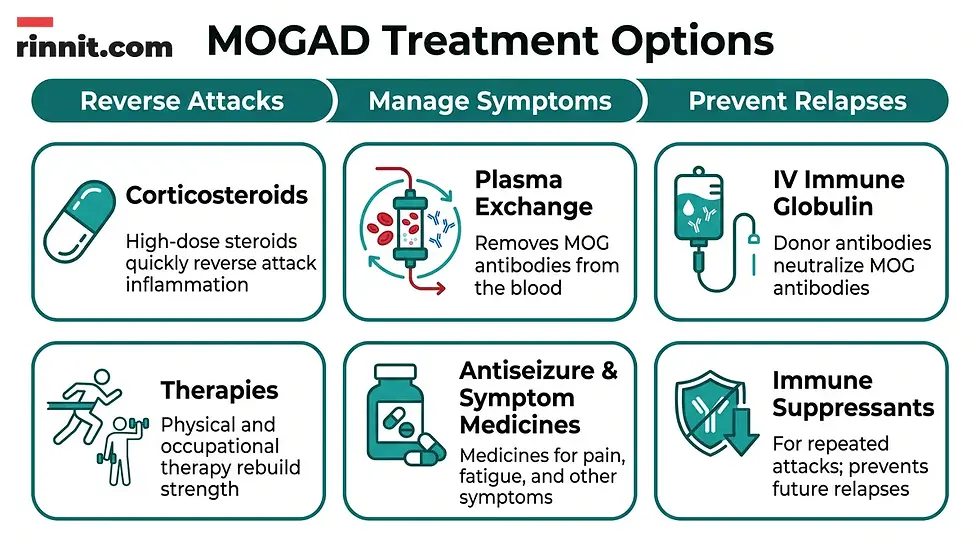
Myelin oligodendrocyte glycoprotein antibody-associated disease (MOGAD) currently has no known cure available. Treatment focuses on speeding recovery from attacks, managing symptoms, and reducing relapses. You meet with your healthcare team to create a treatment plan that fits your needs. [1] [2]
What Treatments Reverse an Active MOGAD Attack?
Attacks are usually severe and should be treated right away for the most complete recovery. Treatment options include: [2]
Treatment | How It Works | When It’s Used |
Corticosteroids | High-dose steroids reduce nerve inflammation and quickly reverse symptoms; taken by mouth or IV [2] | First-line treatment for attacks [3] |
Plasma exchange | Removes plasma containing MOG antibodies, then returns blood cells mixed with a protein solution [2] | When symptoms are new, severe, or unresponsive to corticosteroids [2] |
IV immune globulin (IVIG) | Antibodies from donor plasma neutralize MOG antibodies and reduce inflammation; also suppresses the immune system to prevent future attacks [2] | More commonly used in children [2] |
Corticosteroid side effects may include trouble sleeping, increased blood pressure and blood glucose levels, mood swings, and fluid retention. [2]
What Treatments Manage MOGAD Symptoms?
Treating symptoms can help reduce pain and side effects after attacks:
Treatment | What It Helps With |
Antiseizure medicines | Reduce the number of seizures and stop them from coming back [2] |
Physical and occupational therapy | Rehabilitate body parts damaged by weakness, stiffness, and paralysis [2] |
Other medicines | Treat pain, fatigue, bowel and bladder symptoms, and erectile dysfunction [2] |
What Treatments Prevent MOGAD Relapses?
Since MOGAD is a recently discovered disease, there are no proven treatments to prevent attacks, though clinical trials are underway. Prevention treatment is typically used only for relapsing MOGAD, and it suppresses the immune system — which can lead to other illnesses — so it is only used when necessary. It is usually started after the second attack, but may be used if the first attack was so severe that it caused permanent damage. [2] [5]
Prevention Treatment | How It’s Given | Side Effects |
Oral immunosuppressants (azathioprine, mycophenolate mofetil, prednisone) | By mouth | Can take up to a few months to work; infection, rash, cancer risk with long-term use [2] |
IV immune globulin (IVIG) | Through an IV | Suppresses the immune system [2] |
Rituximab, tocilizumab | Through an IV | Headaches, increased risk of infection [2] |
The type of prevention treatment you have affects how long you need it. Your healthcare team can help decide what’s best for you. [2]
How Can I Cope and Get Support?
Coping with MOGAD can be easier when you keep up daily activities and hobbies, stay connected with loved ones, join a support group and talk with your care team. To manage the stress of living with MOGAD, consider these suggestions: [2]
Maintain normal daily activities as best you can.
Stay connected to friends and family.
Continue to pursue hobbies that you enjoy and are able to do.
Contact a support group, for yourself or for family members.
Discuss your feelings and concerns about living with MOGAD with your healthcare team or a counselor.
How Should I Prepare for My Doctor Appointment?
You may be referred to a doctor who specializes in disorders of the brain and nervous system, called a neurologist. Before your visit, write down your symptoms (including any that may not seem related), make a list of all your medicines, vitamins, and supplements, bring any clinical notes, scans, or lab results from other healthcare professionals, and write down key questions ranked from most to least important. Take a family member or friend along — someone else may remember details you miss. [2]
Conclusion: What to Remember About MOGAD
MOGAD is a rare, recently recognized autoimmune disease that attacks the protective coating of nerve fibers in the optic nerves, brain, and spinal cord. About half of people have a single attack from which they can fully recover, while others experience repeated attacks that cause cumulative damage. [1] Because it mimics multiple sclerosis, accurate diagnosis — combining attack pattern, MRI findings, spinal fluid testing, and the MOG antibody blood test — is essential. While there is no cure, prompt treatment of each attack and immune-suppressing therapy for those with relapsing disease can speed recovery from attacks and reduce relapses. [2] If you notice vision loss, eye pain, weakness, or confusion without explanation, seeing a doctor quickly gives you the best chance at a full recovery.
Take the next step. If you or a loved one are experiencing symptoms like vision loss, eye pain, or unexplained weakness, talk to a healthcare professional as soon as possible. Early treatment of MOGAD attacks leads to better recovery. Talk to a qualified neurologist who understands rare demyelinating diseases.
Frequently Asked Questions
Is MOGAD the same as multiple sclerosis?
No. MOGAD is a separate autoimmune disease that is often misdiagnosed as MS. Unlike MS, the first attack of MOGAD is usually the most severe, and people with the disease can have a complete recovery. MOGAD is diagnosed differently, using MRI and blood tests, and about half of people with MOGAD have only one attack. [1]
Is MOGAD curable?
There is no cure for MOGAD. However, treatments help speed recovery from attacks, manage symptoms, and reduce the likelihood of symptoms returning. [1] [2]
How long does recovery from a MOGAD attack take?
Attack recovery can take weeks to months. Attacks usually develop over days and can be severe and debilitating. [1]
Why does the MOG antibody test sometimes give false results?
The MOG antibody test isn’t always accurate. Sometimes healthy people or people with other diseases can have MOG antibodies at lower levels. The cell-based assay is the gold-standard test, but there is potential for false positives, so caution is needed if symptoms are atypical or similar to another disease. [2]
Can MOGAD come back after one attack?
Some people only experience one attack (monophasic MOGAD), which is slightly more common. Others experience multiple attacks (relapsing MOGAD). Disability usually gets worse with each attack, so people with repeated attacks often need prevention treatment. [1] [2]
Who is most likely to get MOGAD?
Children and young adults are slightly more likely to develop MOGAD. It may also develop after an infectious illness or vaccination, such as SARS-CoV-2. [1]
What are the treatment options for MOGAD?
Attacks are treated with high-dose corticosteroids, plasma exchange, or IV immune globulin. Symptoms are managed with antiseizure medicines, physical and occupational therapy, and other medicines. People with repeated attacks may receive immune-suppressing treatments such as oral immunosuppressants or IV medicines to prevent relapses. [2]
What questions should I ask my neurologist?
Ask about the most likely cause of your symptoms, what tests you need and their preparation, whether your condition is likely temporary or ongoing, whether it will progress, what treatments are available, and how to manage other health conditions together. [2]
Related Reading
Read next on Rinnit.com:
References
Mayo Clinic Staff. Myelin oligodendrocyte glycoprotein antibody-associated disease (MOGAD) - Symptoms & causes. Mayo Clinic. January 3, 2024. https://www.mayoclinic.org/diseases-conditions/mogad/symptoms-causes/syc-20560476
Mayo Clinic Staff. Myelin oligodendrocyte glycoprotein antibody-associated disease (MOGAD) - Diagnosis & treatment. Mayo Clinic. January 3, 2024. https://www.mayoclinic.org/diseases-conditions/mogad/diagnosis-treatment/drc-20560477
Cleveland Clinic. Myelin Oligodendrocyte Antibody Disease Fact Sheet. Cleveland Clinic. Accessed October 15, 2026. https://my.clevelandclinic.org/departments/neurological/depts/multiple-sclerosis/ms-approaches/myelin-oligodendrocyte-glycoprotein-antibody-disease
Hor JY, et al. Epidemiology of myelin oligodendrocyte glycoprotein antibody-associated disease: a review of prevalence and incidence worldwide. Front Neurol. 2023;14:1260358. PMID 37789888. https://doi.org/10.3389/fneur.2023.1260358
Sechi E, et al. Myelin Oligodendrocyte Glycoprotein Antibody-Associated Disease (MOGAD): A Review of Clinical and MRI Features, Diagnosis, and Management. Front Neurol. 2022;13:885218. PMID 35785363. https://doi.org/10.3389/fneur.2022.885218
Banwell B, et al. Diagnosis of myelin oligodendrocyte glycoprotein antibody-associated disease: International MOGAD Panel proposed criteria. Lancet Neurol. 2023;22(3):268-282. PMID 36706773. https://doi.org/10.1016/S1474-4422(22)00431-8
Medical disclaimer
This article is for general informational purposes only and does not constitute medical advice. Always consult a qualified healthcare professional for diagnosis and treatment decisions related to your specific situation.



Comments