Neuromyelitis Optica (NMO): Symptoms, Causes, Diagnosis & Treatment — Complete Guide

Updated: 3 days ago
Medically reviewed by Dr. Baraa Alnahhal, MD · Last reviewed: October 17, 2026
Quick Answer
Neuromyelitis optica (NMO) is a rare central nervous system disorder in which the immune system attacks the optic nerves and spinal cord, causing blindness, weakness, numbness and bladder problems. It is often mistaken for multiple sclerosis but has its own antibody blood test. Because relapses can occur after weeks, months or years, long-term preventive treatment is essential.
What the research says
Several modern biologics prevent NMO relapses, but trials don't compare them head-to-head. A Bayesian network meta-analysis of 8 randomised trials (851 patients, 84% AQP4-IgG positive) indirectly compared ravulizumab, eculizumab, tocilizumab, rituximab, inebilizumab and satralizumab against placebo or azathioprine; ravulizumab had a 98% probability of being the best option for lengthening time to relapse. The authors note that direct head-to-head trials are lacking. (John et al., J Neurol, 2025) [3]
Misdiagnosis is still a real risk. A review of NMOSD diagnosis reports that, even though a specific biomarker (AQP4-IgG) exists, misdiagnosis rates as high as 35% have been reported, and misdiagnosed patients often receive unnecessary prolonged immunotherapy. (Carnero Contentti et al., Mult Scler, 2025) [4]
Neuromyelitis Optica at a Glance
Question | Answer |
What is it? | An autoimmune central nervous system disorder causing inflammation in the optic nerves and spinal cord |
Other names? | Neuromyelitis optica spectrum disorder (NMOSD), Devic disease |
Is it the same as MS? | No — NMO is a different condition, though it's often misdiagnosed as multiple sclerosis |
What causes it? | Altered antibodies attack proteins in the central nervous system; exact trigger is unknown |
Who gets it? | Mostly adults (average diagnosis age 40); women more than men |
Can it be cured? | No cure yet, but treatment can bring long-term remission and prevent disability |
Main treatments? | IV steroids and plasma exchange during attacks; monoclonal antibodies and immune-suppressing medicines to prevent relapses |
What Is Neuromyelitis Optica?
Neuromyelitis optica, also known as NMO, is a central nervous system disorder that causes inflammation in the nerves of the eye and the spinal cord.
The condition also goes by two other names: neuromyelitis optica spectrum disorder (NMOSD) and Devic disease.
NMO occurs when the immune system reacts against the body's own cells. This happens mainly in the spinal cord and in the optic nerves that connect the retina of the eye with the brain. But it sometimes happens in the brain.
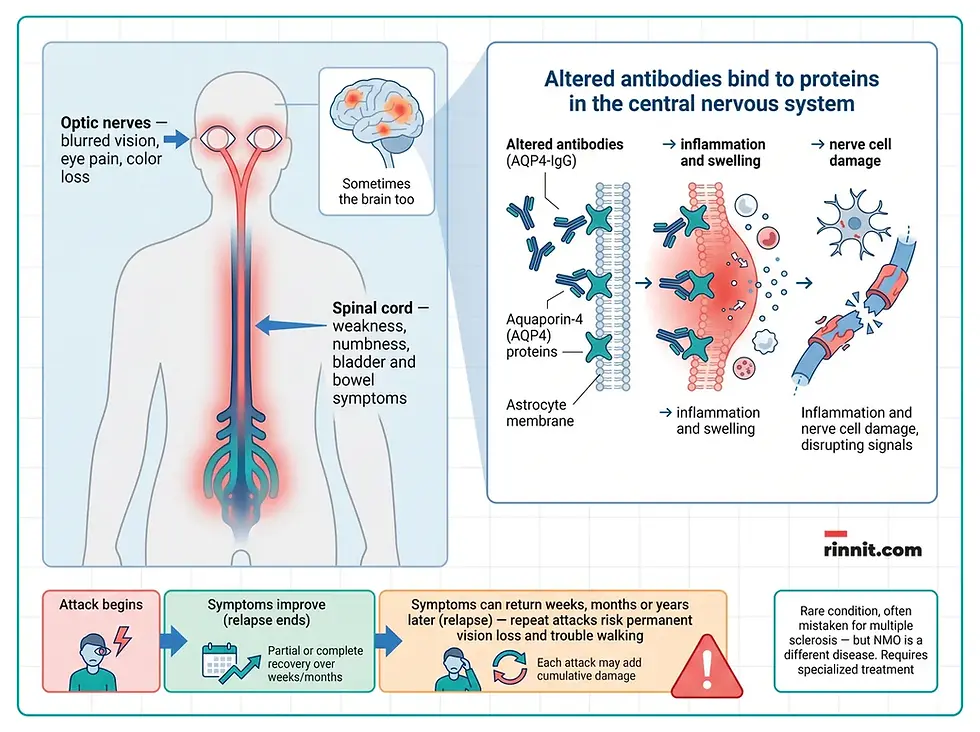
What are the symptoms of neuromyelitis optica (NMO)?
Symptoms of neuromyelitis optica are related to the inflammation that occurs in the nerves of the eye and spinal cord — plus a few surprising extras.
Optic Neuritis — The Eye Attack
Vision changes caused by NMO are called optic neuritis. These may include:
Blurred vision or loss of vision in one or both eyes
Not being able to see color
Eye pain
Transverse Myelitis — The Spinal Cord Attack
Symptoms related to the spinal cord are called transverse myelitis. These may include:
Stiffness, weakness or numbness in the legs and sometimes in the arms
Loss of feeling in the arms or legs
Inability to empty the bladder or trouble managing bowel or bladder function
A tingling feeling or shooting pain in the neck, back or stomach
The Unexpected Symptoms
Other symptoms of NMO may include:
Hiccups
Nausea and vomiting
In children, NMO can cause confusion, seizures or coma — although these symptoms in children are more common in a related condition known as myelin oligodendrocyte glycoprotein antibody-associated disease (MOGAD).
The Relapse Pattern — Why Speed Matters
Symptoms may get better and then worse again. When they get worse, it's known as a relapse. Relapses can happen after weeks, months or years. Over time, relapses can lead to total blindness, loss of feeling or loss of movement (paralysis) — which is why treatment to prevent relapses is so important.
What causes neuromyelitis optica (NMO)?
The exact cause of neuromyelitis optica (NMO) is unknown, though experts understand how the disease damages the nervous system. What we do know is what happens once it starts:
In people who have the disease, the immune system attacks healthy tissues in the central nervous system — the spinal cord, brain, and optic nerves.
This happens because altered antibodies bind to proteins in the central nervous system and cause damage.
The immune reaction causes swelling, known as inflammation, which leads to the damage of nerve cells.
The condition may appear after an infection, or it can be linked with another autoimmune condition.
Who is most likely to get neuromyelitis optica (NMO)?
Neuromyelitis optica is rare. Some factors that may raise the risk include:
Risk Factor | Details |
Sex assigned at birth | Women have NMO more often than men |
Age | Most often affects adults; the average age of diagnosis is 40, though children and older adults also can have it |
Race or ethnicity | People of Hispanic, Asian, or African or Afro-Caribbean descent have NMO at higher rates than people who are white |
Some research also suggests that not having enough vitamin D, smoking, and having few infections early in life may raise the risk of neuromyelitis optica.
How is neuromyelitis optica (NMO) diagnosed and told apart from MS?
Diagnosing neuromyelitis optica involves a physical exam and tests. A key part of the process is ruling out other nervous system conditions with similar symptoms — especially multiple sclerosis, which NMO is often mistaken for. Diagnostic criteria were proposed in 2015 by the International Panel for NMO Diagnosis.
Test | What It Involves |
Neurological exam | A neurologist examines movement, muscle strength, coordination, sensation, memory, thinking, vision and speech. An eye doctor also might be involved. |
MRI | Uses a magnetic field and radio waves to create a detailed view of the brain, optic nerves and spinal cord. Results may show lesions or damaged areas. |
Blood tests | Tests for the autoantibody AQP4-IgG (aquaporin-4-immunoglobulin G) — the marker that binds to proteins and causes NMO. This test helps distinguish NMO from MS and enables early diagnosis. Other biomarkers (GFAP and neurofilament light chain) help detect relapses, and an MOG-IgG antibody test looks for another inflammatory disorder that mimics NMO. |
Lumbar puncture (spinal tap) | A needle inserted into the lower back removes a small amount of spinal fluid to check levels of immune cells, proteins and antibodies. During NMO episodes, spinal fluid might show a very high level of white blood cells — higher than usually seen in MS — although this doesn't always happen. |
Stimuli response test (evoked potentials) | Electrodes attached to the scalp — sometimes also the earlobes, neck, arms, legs and back — record the brain's responses to sounds, sights or touch. Helps find lesions in the nerves, spinal cord, optic nerve, brain or brainstem. |
Optical coherence tomography | Looks at the retinal nerve fiber layer and its thickness. Patients with inflamed optic nerves from NMO have more-extensive vision loss and retinal nerve thinning than people with MS. |

How is neuromyelitis optica (NMO) treated?
Neuromyelitis optica can't be cured. But treatment can sometimes lead to a long-term period with no symptoms, known as remission. NMO treatment involves two complementary goals: reversing recent symptoms and preventing future attacks.
Reversing Recent Symptoms
In the early stage of an NMO attack, treatment focuses on quickly calming the immune attack:
IV corticosteroids: A corticosteroid medicine such as methylprednisolone (Solu-Medrol) is given through a vein in the arm for about five days, then usually tapered off slowly over several days.
Plasma exchange: Often recommended as the first or second treatment, usually in addition to steroid therapy. Some blood is removed from the body, blood cells are mechanically separated from the fluid called plasma, the cells are mixed with a replacement solution, and the blood is returned to the body. This process removes harmful substances and cleanses the blood.
Symptom management: Healthcare professionals also help manage other symptoms, such as pain or muscle problems.
Preventing Future Attacks
Strategy | Details |
Long-term low-dose steroids | A lower dose of corticosteroids taken over time to prevent future attacks and relapses |
Monoclonal antibodies | Proven in clinical trials to reduce the risk of NMO relapses: eculizumab (Soliris), satralizumab (Enspryng), inebilizumab (Uplizna), ravulizumab (Ultomiris) and rituximab (Rituxan) — many approved by the FDA for relapse prevention in adults. Eculizumab and ravulizumab carry a boxed warning for life-threatening meningococcal infections, so meningococcal vaccines are needed before starting them |
Immune-suppressing medicines | Azathioprine (Imuran, Azasan), mycophenolate (Cellcept, Myhibbin), methotrexate (Trexall, Xatmep), cyclophosphamide or tocilizumab (Actemra) |
Intravenous immunoglobulins | May decrease the relapse rate of NMO |
Clinical trials also continue to test new treatments, interventions and tests for this condition.
What are common questions about neuromyelitis optica (NMO)?
Common questions about neuromyelitis optica cover what NMO is, how it differs from multiple sclerosis, its first symptoms, its causes and who is most at risk.
What is neuromyelitis optica?
Neuromyelitis optica (NMO) is a rare central nervous system disorder in which the immune system attacks the optic nerves and spinal cord, causing inflammation. It is also known as neuromyelitis optica spectrum disorder (NMOSD) or Devic disease.
Is neuromyelitis optica the same as multiple sclerosis?
No. NMO is a different condition, but it is often misdiagnosed as MS because the symptoms look similar. The AQP4-IgG antibody blood test helps doctors distinguish NMO from MS and make an early diagnosis.
What are the first symptoms of NMO?
Vision changes — blurred vision or vision loss in one or both eyes, inability to see color, and eye pain (optic neuritis) — often appear first, along with spinal cord symptoms such as weak, stiff or numb legs, bladder or bowel trouble, and a tingling or shooting pain in the neck, back or stomach (transverse myelitis). Hiccups and nausea with vomiting are also characteristic.
What causes neuromyelitis optica?
The exact cause is unknown. Altered antibodies bind to proteins in the central nervous system, triggering inflammation and swelling that damages nerve cells. The condition may appear after an infection or be linked with another autoimmune condition.
Who is most at risk of NMO?
Women have NMO more often than men. It most often affects adults, with an average diagnosis age of 40, though children and older adults can also be affected. Rates are higher in people of Hispanic, Asian, or African or Afro-Caribbean descent. Low vitamin D, smoking, and few infections early in life may also raise risk.
How is NMO treated?
There is no cure, but attacks are treated with IV corticosteroids for about five days and often plasma exchange to reverse symptoms. Long-term, monoclonal antibodies (such as satralizumab, eculizumab, inebilizumab, ravulizumab, and rituximab) or immune-suppressing medicines prevent relapses — and treatment can lead to long periods without symptoms.
Can NMO cause permanent disability?
Yes, if relapses are not prevented. Over time, repeated attacks can lead to total blindness, loss of feeling or loss of movement (paralysis). That is why ongoing relapse-prevention treatment is considered essential.
Conclusion
Neuromyelitis optica deserves attention precisely because it hides behind a famous name — multiple sclerosis — while behaving differently and needing different treatment. This guide puts everything you need in one place:
Know the two attack zones. Optic neuritis (vision loss, color loss, eye pain) and transverse myelitis (weakness, numbness, bladder trouble) are the hallmarks — and unexplained hiccups or vomiting should never be dismissed.
Get the right diagnosis, fast. The AQP4-IgG antibody blood test can tell NMO apart from MS — a distinction that changes everything about how the disease is treated.
Prevention is the point. Attacks can be reversed with IV steroids and plasma exchange, but long-term monoclonal antibodies or immune-suppressing medicines are what keep relapses — and permanent blindness or paralysis — at bay.
If you're exploring vision and nerve conditions, continue with our lazy eye complete guide.
Disclaimer: This article is for informational purposes only and is not a substitute for professional medical advice, diagnosis, or treatment. Always consult a qualified healthcare provider about any medical condition.
References
Mayo Clinic Staff. Neuromyelitis optica - Symptoms and causes. Mayo Clinic. December 13, 2024. https://www.mayoclinic.org/diseases-conditions/neuromyelitis-optica/symptoms-causes/syc-20375652
Mayo Clinic Staff. Neuromyelitis optica - Diagnosis and treatment. Mayo Clinic. December 13, 2024. https://www.mayoclinic.org/diseases-conditions/neuromyelitis-optica/diagnosis-treatment/drc-20375655
John N, et al. Immunotherapies in neuromyelitis optica: Bayesian network meta-analysis. J Neurol. 2025;272(9):563. PMID 40775082. https://doi.org/10.1007/s00415-025-13279-7
Carnero Contentti E, et al. How to avoid missing a diagnosis of neuromyelitis optica spectrum disorder. Mult Scler. 2025;31(1):8-22. PMID 39501631. https://doi.org/10.1177/13524585241292797



Comments