What Is Chondroblastoma? Causes, Symptoms, Diagnosis and Treatment

Updated: 2 days ago
Medically reviewed by Dr. Baraa Alnahhal, MD · Last reviewed: October 2026
Quick Answer: What is chondroblastoma?
Chondroblastoma is a rare, noncancerous bone tumor that forms at the end of long bones, most commonly in teens and young adults, about ages 10 to 25. [1] [2] Symptoms include worsening pain near the shoulder or knee, a limp and stiff, swollen joints. [1] [2] Surgical removal often cures it, followed by checkups over two to five years for recurrence. [1] [2]
Key takeaways
Chondroblastoma is a rare benign (noncancerous) bone tumor that forms at the joint end of long bones such as the humerus, femur and tibia. [1] [2]
It most often affects teens and young adults, about ages 10 to 25, and it can occasionally occur in younger children or older adults. [1]
The most common early symptom is worsening pain near the shoulder joint or just above or below the knee. [1] [2]
Most cases are spontaneous and may involve changes in the H3F3B gene, usually acquired in the tumor cells themselves (somatic mutation) rather than inherited. [1] [2]
Diagnosis involves a symptom history, physical exam, bone scan, CT scan, MRI and a core needle biopsy examined by a pathologist. [1]
Surgery to remove the tumor often cures the disease, and bone grafting may rebuild the damaged bone. [1] [3] [2]
Recovery takes several weeks and may be longer with a bone graft. [1]
The tumor can return, so regular checkups continue for the first two to five years after surgery, sometimes including chest imaging. [1] [2]
What the research says
Almost all chondroblastomas carry the same genetic change. In a genome study, p.Lys36Met alterations, mostly in the H3F3B gene, were found in 73 of 77 chondroblastomas (95%). By contrast, 92% (49/53) of giant cell tumors of bone had histone H3.3 alterations only in a different gene, H3F3A. The mutations were restricted to the tumor's stromal cells and were not detected in osteoclasts or their precursors, and the study does not explain what triggers them (Behjati et al., Nat Genet, 2013). [6]
Recurrence happens in a minority of cases, and spread to the lungs is very rare. A pathology review reports recurrences in 5-15% of cases and postsurgical lung metastases in fewer than 1%, with thorough curettage as the treatment of choice, including for local relapses. It is a narrative review published in German, so it summarizes earlier studies rather than reporting new patient data (Jundt and Baumhoer, Pathologe, 2018). [7]
Adults can get chondroblastoma too, and outcomes look similar. In a single-center series of 23 patients diagnosed after age 30 (mean age 40; 15 male, 8 female), 65% of tumors involved small bones such as the talus and calcaneus rather than long bones. Most patients had curettage with phenol (13) or curettage alone (6). At a mean follow-up of 8.4 years, 20 patients (87%) remained disease-free and 3 had local recurrences, and none received chemotherapy. It was a small retrospective case series from one institution (Angelini et al., Eur J Orthop Surg Traumatol, 2017). [8]
What Is Chondroblastoma?

Chondroblastoma (pronounced "chon-drob-las-tom-ah") is a rare benign (noncancerous) bone tumor. It grows at the end of long bones, such as the humerus in your upper arm, the femur in your thigh or the tibia in your shin. [1] [2]
The disease typically affects young adults ages 19 to 25. [1] Children as young as 10 may also have chondroblastoma. [1]
Fact | Detail |
What it is | A rare benign (noncancerous) bone tumor |
Pronunciation | "chon-drob-las-tom-ah" |
Where it forms | Joint end of long bones — humerus, femur, tibia |
Who it affects | Typically teens and young adults, about ages 10 to 25 |
How it behaves | Benign, but can damage joints and bones if untreated |
Main treatment | Surgery to remove the tumor |
Can it cure the disease | Surgery often cures it, though the tumor may come back |
While the word "tumor" understandably raises alarm, chondroblastoma is not cancer. However, it is still a serious medical issue. Without treatment, the tumor may cause pain and damage your joints and bones [1] [3]. Very rarely, it may spread to your lungs — a reminder that benign does not mean harmless. [1] [7] [2]
Symptoms and Signs
What does chondroblastoma feel like?
The most common early symptom is worsening pain that you might feel in your upper arm near your shoulder joint or just above or below your knee [1]. The pain tends to build rather than appear suddenly, which is why early aches are easy to dismiss. [2]

Symptom | What It Looks or Feels Like |
Worsening pain | Most common early symptom; near the shoulder joint or above/below the knee |
Limp | Caused by a weakened leg muscle |
Withered or shrunken muscle | Muscle in the upper arm or near the knee looks smaller than normal |
Stiff or swollen joints | Reduced movement and visible swelling around the joint |
Tenderness | Soreness when touching parts of the arms or legs |
The limp deserves special attention. It is not just a sign of discomfort — it comes from a weakened leg muscle that has started to shrink. [1] [2] That is why you may notice the muscle in your upper arm or near your knee looking withered or shrunken [1]. Symptoms like these are often present for many months before people seek medical attention. [2]
Because the symptoms mimic common sports injuries and growing pains, chondroblastoma can hide in plain sight. The telling difference is persistence: an ache that does not go away or that keeps getting worse is the pattern to take seriously.
Causes and Risk Factors
What causes chondroblastoma?
Most cases are spontaneous, meaning there is no obvious cause [1]. Research shows chondroblastoma may be the result of changes in your H3F3B gene [1] [2] [6]. This change usually arises in the tumor cells themselves for no known reason — healthcare providers may call this a somatic mutation, a genetic change that arises in certain cells rather than being passed down. [1]
Cause Type | What It Means |
Spontaneous | Most cases — no obvious cause |
Somatic mutation | Change in the H3F3B gene that arises in the tumor cells for no known reason |
Germline mutation | Genetic change inherited from one biological parent (autosomal dominant inheritance) |
In some cases, you may inherit the genetic change from one of your biological parents — a pattern called autosomal dominant inheritance [1]. Providers may refer to this as a germline mutation, one present in all of a person's cells from conception onward. [1]
Risk at a glance:
The exact genetic and environmental factors behind chondroblastoma are not well understood. [2]
Diagnosis and Tests
How do doctors diagnose chondroblastoma?
A healthcare provider starts by asking about your symptoms and how long you have had them, then examining your arm or leg. From there, imaging tests reveal what is happening inside the bone.
Test | What It Shows |
Bone scan | Surveys the entire skeleton for areas of unusual bone activity |
CT scan | Produces detailed cross-sectional images of the tumor inside the bone |
MRI | Captures detailed images of the tumor and surrounding soft tissue and joint |
Your provider may refer you to an orthopaedic surgeon who has experience with oncology techniques for more tests. [1] Your surgeon may do a core needle biopsy to get tissue samples. Then, a medical pathologist will examine the tissue samples under a microscope [1] [3]. They may order tests to confirm the tumor is benign (noncancerous), and may also do tests to look for the genetic change that causes chondroblastoma — the H3F3B mutation. [1]
Step | Who Does It |
Symptom history and physical exam | Primary healthcare provider |
Imaging (bone scan, CT, MRI) | Radiology team |
Core needle biopsy | Orthopaedic surgeon experienced in oncology techniques |
Microscopic tissue analysis | Medical pathologist |
Genetic testing for H3F3B | Pathology/genetics team |
The biopsy step helps separate a chondroblastoma from other bone tumors. [2] [3] By looking at the cells under a microscope, the pathologist can confirm the tumor is benign — a crucial distinction, because benign and malignant bone tumors are treated very differently. [1] [9]
Treatment and Management
How is chondroblastoma treated?
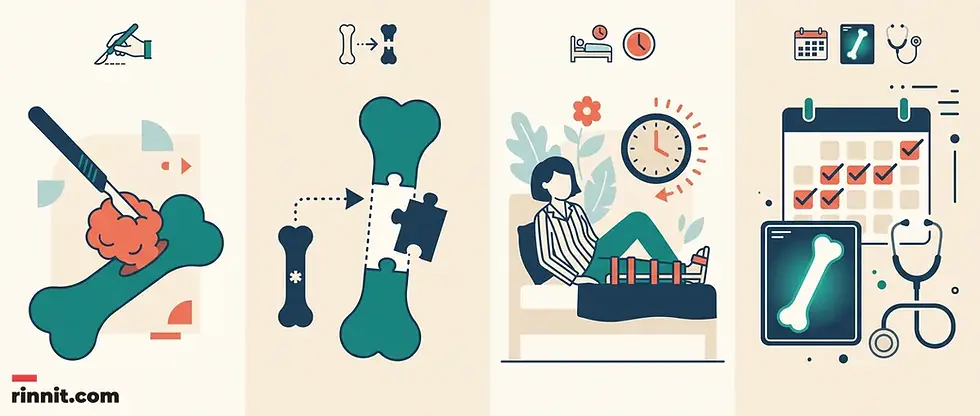
Surgery is the most common treatment for chondroblastoma. [1] [2] Surgery removes the tumor, stops the pain and prevents future bone damage [1] [2]. Your surgeon may perform bone grafting after removing the tumor. [1] [3] [2] Bone grafting replaces your damaged bone with healthy bone from another part of your body or with a bone graft substitute — essentially filling the space left behind so the bone stays strong. [1] [3]
Treatment | What It Does |
Surgical tumor removal | Removes the tumor, stops pain, prevents future bone damage |
Bone grafting | Replaces damaged bone with healthy bone from another part of your body or a graft substitute |
How long does recovery take?
It may take several weeks to recover from surgery. [1] Your recovery time may take longer if you receive a bone graft [1]. Your orthopaedic surgeon will explain what you can expect as you recover.
When should you contact your care team?
Rarely, surgery may cause complications like infection [1]. You should contact your care team if you have infection symptoms like:
Infection Sign | Threshold |
Fever | 101 degrees Fahrenheit (38.3 degrees Celsius) or higher |
Pain | Around the surgical wound |
Pus or drainage | Coming from the surgery site |
How is chondroblastoma monitored after treatment?
You will have regular checkups for the first two to five years after surgery [1]. Your orthopaedic surgeon will do tests to look for signs that chondroblastoma has come back [1] [2]. You may have imaging tests of the part of your body the tumor affected. Your surgeon may also order chest X-rays or CT scans to check for a tumor in your lungs — a safeguard against the very rare chance of the tumor spreading. [1] [4] [2]
Monitoring Component | Purpose |
Regular checkups (years 1 to 5) | Detect early signs of the tumor returning |
Imaging of the affected area | Monitor the treated bone |
Chest X-rays or CT scans | Check for a tumor in the lungs |
Conclusion and Outlook
Surgery to remove the tumor often cures the condition. But it may come back. That is why your orthopaedic care team will schedule regular follow-up appointments — catching a recurrence early keeps it manageable.
An occasional ache in your upper arm or leg may not mean anything at all. But an ache that doesn't go away or gets worse may be a symptom of chondroblastoma. This rare benign tumor is a serious medical issue: without treatment, it can damage your bones and joints. If you have persistent pain in your upper arm or lower leg, talk to a healthcare provider. They will ask about your symptoms and do tests to find out why you are hurting. Chondroblastoma may not be the issue — but if it is, prompt treatment may cure the condition.
Want to explain health topics like this one visually? If you found this article helpful, you may also like our library of visual health guides. Explore Rinnit's infographic templates to create clear, trustworthy health visuals for your own audience.
Frequently Asked Questions
What is chondroblastoma?
Chondroblastoma is a rare benign (noncancerous) bone tumor that grows at the end of long bones, such as the upper arm, thigh or shin. It usually affects teens and young adults, about ages 10 to 25, and surgery to remove it often cures the disease.
How do you pronounce chondroblastoma?
Chondroblastoma is pronounced "chon-drob-las-tom-ah."
Is chondroblastoma cancer?
No. Chondroblastoma is a benign (noncancerous) tumor. It does not behave like bone cancer, though without treatment it can still damage bones and joints, and very rarely may spread to the lungs.
What does "benign" mean in this context?
Benign means the tumor is not cancer and, in general, rarely spreads to other parts of the body. It can still be locally destructive: it can cause pain, damage the joint and bone, and sometimes return after surgery, which is why removal is usually recommended.
Where does chondroblastoma form?
It grows at the joint end of long bones — most often in the upper arm (humerus), thigh (femur) or shin (tibia).
Which bones are affected most often?
Long bones around the shoulder and knee are the most commonly reported sites, notably the shin bone (proximal tibia) and the upper arm bone (humerus). The thigh bone (femur) can also be involved.
Who gets chondroblastoma?
The disease typically affects teens and young adults, about ages 10 to 25, and it can occasionally occur in younger children or older adults.
Can a child get chondroblastoma?
Yes. Children as young as 10 may have chondroblastoma, and pediatric orthopaedic surgeons routinely treat it.
Is chondroblastoma common?
No, it is rare. Among all bone tumors, chondroblastoma accounts for only a small fraction of cases.
How rare is chondroblastoma?
It is an uncommon tumor overall, representing less than 1 percent of all bone tumors, and it concentrates in the adolescent and young adult age group.
Is chondroblastoma dangerous?
It is not cancer, but it is a serious medical issue. Without treatment, it can damage your bones and joints. Very rarely, it may spread to the lungs.
Can chondroblastoma spread to the lungs?
Very rarely, yes. That is one reason doctors monitor patients with chest X-rays or CT scans during follow-up.
What are the first signs of chondroblastoma?
The most common early symptom is worsening pain near the shoulder joint or just above or below the knee.
Does chondroblastoma hurt?
Yes. Worsening, persistent pain near the shoulder or knee is the most common early symptom.
Why does my knee hurt above and below the joint?
Pain just above or below the knee can signal a tumor in the end of the femur or tibia, which is exactly where chondroblastoma tends to form.
Can chondroblastoma cause a limp?
Yes. A weakened leg muscle can produce a limp, which is one of the recognized symptoms.
Why does the muscle look smaller near the tumor?
The muscle in the upper arm or near the knee may look withered or shrunken, a change doctors call muscular atrophy.
What does "tenderness" mean as a symptom?
It means parts of your arms or legs feel sore when touched or pressed.
Can chondroblastoma make joints stiff?
Yes. Stiff or swollen joints are among the listed symptoms, because the tumor forms at the joint end of the bone.
Do chondroblastoma symptoms come on suddenly?
Usually not. The pain typically worsens gradually, which is why early aches are easy to dismiss as a strain.
What causes chondroblastoma?
Most cases are spontaneous with no obvious cause. Research suggests many cases involve changes in the H3F3B gene.
What is the H3F3B gene?
H3F3B is a gene in which changes have been linked to chondroblastoma. The change usually arises in the tumor cells themselves for no known reason.
What is a somatic mutation?
A somatic mutation is a genetic change that arises in certain cells rather than being inherited. In chondroblastoma, the H3F3B change usually happens this way, in the tumor cells, for no known reason.
What is a germline mutation?
A germline mutation is a genetic change present from conception that can be inherited. In some cases, the H3F3B change behind chondroblastoma is inherited this way.
Can chondroblastoma be inherited?
In some cases, yes. The genetic change may be inherited from one biological parent through autosomal dominant inheritance.
What is autosomal dominant inheritance?
It is a pattern in which a genetic change from one biological parent is enough to be passed on to a child. Providers may describe inherited chondroblastoma this way.
Is chondroblastoma caused by injury?
No. Injury is not listed as a cause. Most cases are spontaneous and linked to gene changes.
Can you prevent chondroblastoma?
Most cases are spontaneous, and the exact genetic and environmental factors behind chondroblastoma are not well understood.
How is chondroblastoma diagnosed?
A provider reviews your symptoms, examines the arm or leg, and orders imaging — bone scan, CT scan and MRI. A core needle biopsy then confirms the diagnosis.
What imaging tests detect chondroblastoma?
A bone scan, CT scan and MRI are the imaging tests used to locate and characterize the tumor.
What is the difference between a CT scan and an MRI for this tumor?
A CT scan shows detailed cross-sectional images of the bone, while an MRI captures detailed pictures of the tumor and the surrounding soft tissue and joint.
What is a bone scan?
A bone scan surveys the whole skeleton for areas of unusual bone activity, helping doctors find where the tumor sits among your bones.
What is a core needle biopsy?
It is a procedure in which an orthopaedic surgeon uses a specialized needle to collect tissue samples from the tumor for examination.
Who examines the biopsy samples?
A medical pathologist examines the tissue under a microscope to confirm the tumor is benign and may test for the H3F3B genetic change.
Why is a biopsy necessary?
Microscopic examination of the tissue helps confirm the tumor is benign (noncancerous) rather than a malignant bone tumor, and the two are treated very differently.
Do doctors test for the H3F3B gene change?
Yes. The pathologist may do tests to look for the genetic change that causes chondroblastoma.
What specialist treats chondroblastoma?
An orthopaedic surgeon with experience in oncology techniques typically manages the biopsy and surgery.
How is chondroblastoma treated?
Surgery is the most common treatment. It removes the tumor, stops the pain and prevents future bone damage.
Can surgery cure chondroblastoma?
Yes. Surgery to remove the tumor often cures the disease, though the tumor can come back.
What is bone grafting after tumor removal?
Bone grafting replaces the damaged bone with healthy bone from another part of your body or with a bone graft substitute, rebuilding strength after the tumor is removed.
What is a bone graft substitute?
It is an artificial or processed material used in place of your own bone to fill the space left after the tumor is removed.
How long is recovery from chondroblastoma surgery?
It may take several weeks, and recovery may take longer if you receive a bone graft.
Is recovery longer with a bone graft?
Yes. Your recovery time may take longer if you receive a bone graft.
Can chondroblastoma surgery cause infection?
Rarely, yes. Contact your care team if you develop fever of 101 F (38.3 C) or higher, pain around the surgical wound, or pus or drainage from the site.
What fever should I report after surgery?
A fever of 101 degrees Fahrenheit (38.3 degrees Celsius) or higher should prompt a call to your care team.
Can chondroblastoma come back after surgery?
Yes, it may come back. That is why regular checkups are scheduled for the first two to five years after surgery.
How long are follow-up checkups needed?
Regular checkups continue for the first two to five years after surgery to watch for recurrence.
Why do doctors order chest X-rays after surgery?
Chest X-rays or CT scans check for a tumor in the lungs, because chondroblastoma very rarely spreads there.
What is the outlook for chondroblastoma?
Surgery to remove the tumor often cures the condition. The main caveat is that the tumor can return, which is why long-term monitoring is standard.
Does chondroblastoma affect life expectancy?
With treatment, the outlook is generally good — surgery often cures the disease, and recurrence is managed through monitoring.
When should I see a doctor about bone pain?
If you have persistent pain in your upper arm or lower leg — especially pain that does not go away or gets worse — talk to a healthcare provider.
Should I worry about every bone ache?
No. An occasional ache may mean nothing, but an ache that persists or worsens is the pattern that deserves a proper exam and testing.
Can physical therapy replace surgery for chondroblastoma?
No. Surgery is the main treatment because it removes the tumor and prevents ongoing bone and joint damage.
Is chondroblastoma the same as a bone cyst?
No. A bone cyst is a fluid-filled cavity in bone, while chondroblastoma is a solid benign tumor made of cartilage-producing cells.
Is chondroblastoma the same as bone cancer?
No. Chondroblastoma is benign (noncancerous). Bone cancers such as osteosarcoma are malignant and treated differently.
Can chondroblastoma be watched without treatment?
Generally no. Without treatment it can damage your bones and joints, so removal is typically recommended once diagnosed.
What questions should I ask my doctor about chondroblastoma?
Ask where the tumor sits, what type of surgery is planned, whether bone grafting is needed, how long recovery will take, what recurrence signs to watch for, and how often follow-up imaging is scheduled.
Where can I find more information about chondroblastoma?
Trusted resources include orthopaedic and pediatric orthopaedic patient guides and your orthopaedic surgeon's office.
Related Reading
References
Cleveland Clinic. Chondroblastoma. Cleveland Clinic. Medically reviewed; last updated July 15, 2026. https://my.clevelandclinic.org/health/diseases/22095-chondroblastoma
Limaiem F, Tafti D, Rawla P. Chondroblastoma. In: StatPearls [Internet]. Treasure Island (FL): StatPearls Publishing; 2026 Jan-. Updated August 1, 2023. PMID: 30725632. https://pubmed.ncbi.nlm.nih.gov/30725632/
Nystrom LM. Noncancerous Bone Tumors. Merck Manual Consumer Version. Full review April 2025; last updated November 2025. https://www.merckmanuals.com/home/cancer/bone-and-joint-tumors/noncancerous-bone-tumors
Klein; Rajani R. Chondroblastoma. Pediatric Orthopaedic Society of North America (POSNA) Study Guide. Accessed October 15, 2026. https://posna.org/physician-education/study-guide/chondroblastoma
Samargandi R, Bafail A, Le Nail LR, et al. Comprehensive insights into chondroblastoma metastasis: metastatic patterns and therapeutic approaches. Cancers (Basel). 2024;16(12):2283. PMID: 38927987. https://doi.org/10.3390/cancers16122283
Behjati S, Tarpey PS, Presneau N, et al. Distinct H3F3A and H3F3B driver mutations define chondroblastoma and giant cell tumor of bone. Nat Genet. 2013;45(12):1479-1482. PMID: 24162739. https://doi.org/10.1038/ng.2814
Jundt G, Baumhoer D. Chondroblastoma [in German]. Pathologe. 2018;39(2):132-138. PMID: 29209799. https://doi.org/10.1007/s00292-017-0397-3
Angelini A, Hassani M, Mavrogenis AF, et al. Chondroblastoma in adult age. Eur J Orthop Surg Traumatol. 2017;27(6):843-849. PMID: 28634924. https://doi.org/10.1007/s00590-017-1996-7
American Academy of Orthopaedic Surgeons. Bone Tumor - Types and Treatments. OrthoInfo. Accessed November 4, 2026. https://www.orthoinfo.org/diseases--conditions/bone-tumor
Medical disclaimer
This article is for informational purposes only and is not a substitute for professional medical advice, diagnosis, or treatment. Always seek the advice of a qualified healthcare provider with any questions about a medical condition or before making decisions about treatment. Never disregard professional medical advice or delay seeking it because of something you have read here.



Comments