What Is Cholinergic Urticaria? Causes, Symptoms, Diagnosis and Treatment

Updated: 3 days ago
Medically reviewed by Dr. Baraa Alnahhal, MD · Last reviewed: October 17, 2026
Quick Answer: What is cholinergic urticaria?
Cholinergic urticaria is hives that break out when the body heats up and sweats, caused by an immune reaction to acetylcholine from nerve endings. [1] Itchy pinpoint red dots appear within minutes of sweating and usually fade in 20 to 30 minutes, and exercise triggers most cases. [1] [3] Antihistamines and lifestyle changes help. [1] [3] Call emergency services for any signs of anaphylaxis.
Key takeaways
Cholinergic urticaria (heat bumps, heat hives) is hives triggered by a rise in body temperature and sweating — an immune reaction involving the chemical acetylcholine. [1]
It is common: as many as 1 in 5 people have hives at some point, and cholinergic urticaria accounts for about 1 in 3 cases of physical hives. [1] [2]
Symptoms often first appear between ages 10 and 30, and the hives show up on the arms, face and upper trunk a few minutes after sweating starts. [1]
Hives typically itch, burn, tingle and feel warm, lasting 20 to 30 minutes (sometimes over an hour). [1]
Exercise triggers nearly 9 in 10 cases; other triggers include stress, anxiety, hot showers, saunas, spicy foods and fever. [1]
Diagnosis involves skin exams plus exercise tests, methacholine injections or passive warming tests. [1]
Treatment includes antihistamines, and sometimes asthma, blood pressure or sweat-reducing (anticholinergic) drugs. [1]
The condition usually improves with age; for almost 15% of people it resolves completely. [1]
In rare cases it can accompany exercise-induced anaphylaxis — call 911 immediately if breathing becomes difficult. [1]
What the research says
Most people improve over time, but it can take years. In a retrospective review at a Bangkok urticaria clinic, 16 of 2,175 chronic urticaria patients (0.7%) were diagnosed with cholinergic urticaria, and 15 of the 16 (93.8%) reacted to an exercise provocation test. Kaplan-Meier analysis estimated remission in 12.5% of patients within 1 year, 35.5% within 5 years and 67.9% within 13 years, with non-sedating antihistamines as the main treatment. It was a small, single-center study in a tropical country, so rates may differ elsewhere (Rujitharanawong et al., Biomed Res Int, 2020). [4]
Omalizumab has helped some people who do not respond to high-dose antihistamines. In a Danish prospective study, 23 patients (63.9%) were refractory to up-dosed non-sedating antihistamines and started omalizumab, an anti-IgE injection. At 6 months their weekly urticaria activity score (UAS7) had improved by 10.8 points (P = .002) and quality-of-life scores improved significantly, while 5 patients (21.7%) reported suspected side effects such as headache, muscle pain, fatigue or injection-site reactions. The paper's systematic review found 58 more antihistamine-refractory patients treated with omalizumab (Ghazanfar et al., Dermatol Ther, 2020). [5]
It often starts young, and not every case shows visible hives. In a review of 203 patients in Korea (188 male, 15 female), 65% first developed symptoms in their teens and the condition was most prevalent in patients in their twenties (56%). Twenty-nine patients (14%) had only an itching or burning sensation with no visible skin eruption, and patients with visible hives responded better to antihistamines than those without skin lesions. The data came from a retrospective chart review in one country (Kim and Lee, Australas J Dermatol, 2017). [6]
What Is Cholinergic Urticaria?

Cholinergic urticaria is hives — raised red bumps on your skin — that appear when your body temperature rises and you start to sweat. It is an immune reaction that happens when you are exposed to heat, such as during exercise or while taking a hot shower. [1] Because of its appearance and trigger, it is also commonly called heat bumps or heat hives.
The condition can affect anyone, and symptoms often surface for the first time between the ages of 10 and 30. [1] [3] The name itself carries a helpful clue. The term "cholinergic" refers to a neurotransmitter — a chemical messenger in your body — called acetylcholine (Ach), which is released by your parasympathetic nervous system. "Urticaria" is simply the medical term for hives. Together, the name describes hives connected to your body's acetylcholine-driven sweat response.
Is cholinergic urticaria rare?
Not at all — it is actually quite common. As many as 1 in 5 people have hives at some point in their lives. [1] [2] Cholinergic urticaria accounts for about 1 in 3 cases of physical hives, which are hives that have a physical cause, like exposure to heat, cold or pressure. [1] About 7% of people with chronic hives — hives that last longer than six weeks — have cholinergic urticaria. [1]
Symptoms and Signs
What does cholinergic urticaria look and feel like?
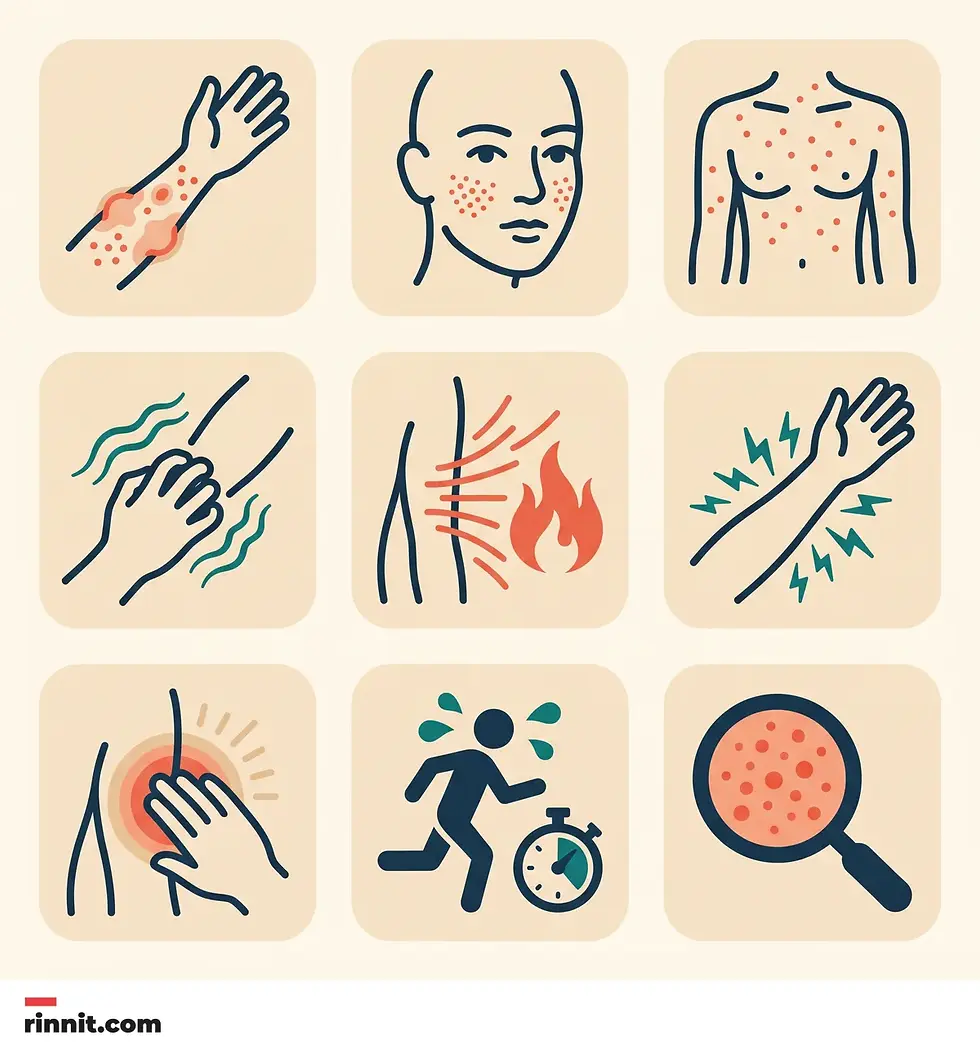
Heat bumps typically appear a few minutes after you start sweating and may last for 20 to 30 minutes. For some people, the hives linger for more than an hour. [1] They tend to appear on your arms, face and upper trunk.
The hives may look like small red dots (pinpoints) overlying a background of redness (erythema), or they may join together to form larger welts that swell. [1]
Sign | What It Looks or Feels Like |
Pinpoint hives | Small red dots (pinpoints) overlying a background of redness |
Larger welts | Hives that join together to form swollen, raised welts |
Itching | The most common sensation; often intense |
Burning | A hot, inflamed feeling on the affected skin |
Tingling | A pins-and-needles sensation on or near the hives |
Warmth | The affected skin feels warm to the touch |
Timing | Appears a few minutes after sweating begins |
Duration | Typically lasts 20 to 30 minutes; can exceed an hour |
Location | Arms, face and upper trunk are the most common spots |
What other symptoms can occur?
Although rare, some people with cholinergic urticaria also develop wider allergic-type symptoms:
Additional Symptom | Description |
Drooling | Unusual excess saliva during an episode |
Fainting (syncope) | Losing consciousness |
Headaches | Head pain accompanying the outbreak |
Heart palpitations | A fast or fluttering heartbeat |
Shortness of breath (dyspnea) | Difficulty getting enough air |
Upset stomach or diarrhea | Indigestion or loose stools |
Wheezing | A whistling sound when breathing |
Causes and Triggers
What causes cholinergic urticaria?
Experts still do not know exactly what causes cholinergic urticaria. One leading hypothesis centers on the cholinergic nervous system as the culprit. Here is how the theory works:
When your body temperature rises, you start to sweat.
In response, your nervous system releases cholinergic chemicals (acetylcholine) from nerve endings near the surface of your skin.
The acetylcholine irritates your skin, causing an allergic reaction that brings on hives and swelling.
What are the risk factors?
A risk factor is something that increases your chances of developing a certain condition. You may be more likely to develop cholinergic urticaria if you have chronic hives. Other risk factors include allergic rhinitis (hay fever), asthma, eczema, a family history of cholinergic urticaria or chronic hives, and hyperhidrosis (excessive sweating). [1]
Risk Factor | Why It May Increase Risk |
Chronic hives | Ongoing hives suggest a reactive skin and immune system |
Allergic rhinitis (hay fever) | Shared allergic tendency |
Asthma | Shared allergic tendency |
Eczema | Skin that reacts more readily to irritants |
Family history | Genetic predisposition to hives or cholinergic urticaria |
Hyperhidrosis (excessive sweating) | More sweating means more frequent acetylcholine release near the skin |
What triggers cholinergic urticaria?
For nearly 9 in 10 people, exercise or physical exertion brings on cholinergic hives. [1] Other triggers include anxiety, feeling angry or upset, entering a hot room (or the hot outdoors) from a cooler place, fever, hot weather, hot showers, saunas and hot tubs, spicy foods, stress, and wearing an air- and water-tight bandage to protect a wound. [1]
Trigger | Typical Situation |
Exercise or physical exertion | Runs, workouts or sports — the trigger for nearly 9 in 10 people |
Anxiety and stress | Emotional stress that raises body temperature |
Strong emotions | Feeling angry or upset |
Temperature shifts | Entering a hot room or outdoors from a cooler place |
Fever | Illness that raises core body temperature |
Hot weather | Warm or humid days |
Hot showers, saunas, hot tubs | Direct external heat |
Spicy foods | Foods that raise body temperature |
Tight, airtight bandages | Wearing an air- and water-tight bandage over a wound |
Diagnosis and Tests
How is cholinergic urticaria diagnosed?
If a healthcare provider thinks you have cholinergic hives, they will likely refer you to an allergist or dermatologist. They will examine your skin and ask questions about your symptoms. They might also run tests, which could include exercise tests using a treadmill, stationary bike or other equipment to induce sweating, methacholine injections to test your body's sensitivity to cholinergic chemicals, and passive warming tests using heated bath water or a heated room to raise your body temperature. [1] [3]
Test | How It Works |
Exercise test | Treadmill, stationary bike or other equipment induces sweating under observation |
Methacholine injection | Tests your body's sensitivity to cholinergic chemicals |
Passive warming test | Heated bath water or a heated room raises your body temperature |
Treatment and Management
How do you get rid of cholinergic urticaria?
The frequency and severity of cholinergic urticaria often improve as you age. The hives may resolve in a few years. [1] [3] In the meantime, your healthcare provider may recommend these treatments to ease your symptoms: antihistamines, asthma medications, blood pressure medications, and sweat-reducing drugs (anticholinergics).
Treatment | Purpose |
Antihistamines | Block histamine, the chemical that drives itching and swelling |
Asthma medications | Help control wheezing and airway reactivity |
Blood pressure medications | Modulate the allergic response in some cases |
Sweat-reducing drugs (anticholinergics) | Reduce sweating, cutting the trigger itself |
What are the complications?
In rare instances, cholinergic urticaria occurs along with exercise-induced anaphylaxis. Anaphylaxis is a potentially life-threatening allergic reaction that can swell your airways, making it difficult to breathe. [1] If this happens to you or someone you know, call 911 and seek immediate medical care. It is also a good idea to carry an epinephrine injector (EpiPen®) if you know you are prone to anaphylactic attacks. [1]
Outlook and Prognosis
How long does cholinergic urticaria last?
Cholinergic urticaria typically improves and goes away over time. For almost 15% of people with the condition, the symptoms resolve completely. [1]
Prevention
Can you prevent cholinergic urticaria?
You cannot totally prevent cholinergic urticaria because you cannot keep yourself from sweating or getting warm. Sweating is a natural function that cools your body and helps regulate your temperature. And you should not skip physical activity, as physical activity helps keep you healthy.
But there are steps you can take to reduce your risk of heat hives:
Prevention Step | How It Helps |
Avoid spicy foods | Prevents food-driven body temperature spikes |
Exercise early morning or late evening | Works out when outdoor temperatures are lower |
Manage stress and anxiety | Healthy stress coping keeps emotional triggers in check |
Take warm (not hot) showers or baths | Limits direct heat exposure |
Wear lightweight, loose, sweat-wicking clothing | Helps your body stay cool and dry |

Living With
When should I call my healthcare provider?
Call your healthcare provider if you develop bumps that look infected (pus-filled or painful to touch), hives and swelling, an unexplained skin rash, severe itching, shortness of breath or difficulty breathing, or any signs of anaphylaxis (call 911).
What should I ask my provider?
You may want to ask your healthcare provider: What caused the cholinergic urticaria? How can I reduce my risk of heat hives? What is the best cholinergic urticaria treatment for me?
Heat bumps vs. heat rash: What is the difference?
Heat rash (also called prickly heat or miliaria) is a type of heat illness. You develop this skin rash in response to heat and humidity when sweating does not effectively lower your body temperature to cool you down. A heat rash can be a warning sign of a more serious heat illness like heat exhaustion or heatstroke. [1] Cholinergic urticaria, by contrast, is an immune reaction involving acetylcholine, not a sign that your cooling system is failing.
The bottom line
Cholinergic urticaria can be uncomfortable. But you do not have to let hives stop you from exercising, enjoying warm climates or doing other things you enjoy. A healthcare provider can run tests to determine the cause of your symptoms. If you have cholinergic urticaria, medications can help. The rash typically goes away on its own in less than an hour. As you get older, the hives may become a thing of the past.
Conclusion
Cholinergic urticaria is one of the more manageable skin conditions people can face: it is common, it is rarely dangerous, and it usually fades with age. Understanding that your heat hives are an immune response tied to acetylcholine — not a hygiene problem or something to be ashamed of — takes the fear out of flare-ups. With the right antihistamine routine, trigger awareness and cooling habits, most people keep exercising, working and living fully.
Want to explain health topics like this one visually? If you are looking for clear, shareable ways to explain heat hives to family, clients or students, Rinnit's infographic templates make it easy to turn this kind of medical information into polished visual guides.
Frequently Asked Questions
What is cholinergic urticaria?
Cholinergic urticaria is hives — raised red bumps — that appear on your skin when your body temperature rises and you start to sweat. It is an immune reaction to heat exposure.
What are the other names for cholinergic urticaria?
It is also called heat bumps or heat hives.
What does "cholinergic" mean?
"Cholinergic" refers to a neurotransmitter (chemical messenger) called acetylcholine (Ach), which is released by your parasympathetic nervous system.
What does "urticaria" mean?
"Urticaria" is the medical term for hives.
Is cholinergic urticaria rare?
No, it is actually quite common. As many as 1 in 5 people have hives at some point in their lives.
How common is cholinergic urticaria among physical hives?
It accounts for about 1 in 3 cases of physical hives — hives that have a physical cause, like heat, cold or pressure.
How common is it among chronic hives?
About 7% of people with chronic hives (hives lasting longer than six weeks) have cholinergic urticaria.
Who gets cholinergic urticaria?
It can affect anyone. Symptoms often surface for the first time between the ages of 10 and 30.
What causes cholinergic urticaria?
Experts do not know exactly, but one leading hypothesis centers on the cholinergic nervous system and acetylcholine released from nerve endings near the skin.
How does the acetylcholine theory work?
When your body temperature rises, you sweat. Your nervous system releases acetylcholine from nerve endings near your skin's surface, and that chemical irritates your skin, triggering an allergic reaction with hives and swelling.
What triggers cholinergic urticaria most often?
For nearly 9 in 10 people, exercise or physical exertion brings on the hives.
What other things trigger cholinergic urticaria?
Anxiety, anger or being upset, entering a hot place from a cooler one, fever, hot weather, hot showers, saunas, hot tubs, spicy foods, stress, and wearing an air- and water-tight bandage over a wound.
Can stress cause cholinergic urticaria?
Yes. Stress and anxiety are listed triggers, likely because they can raise body temperature and activate the cholinergic nervous system.
Can spicy food trigger cholinergic urticaria?
Yes, spicy foods are a recognized trigger because they raise body temperature.
What do the hives look like?
They may look like small red dots (pinpoints) overlying a background of redness (erythema), or they may join together to form larger swollen welts.
Where do the hives appear?
They tend to appear on your arms, face and upper trunk.
How quickly do the hives appear?
They typically appear a few minutes after you start sweating.
How long do the hives last?
They may last 20 to 30 minutes. For some people they linger for more than an hour.
What do the hives feel like?
People report that the hives itch, burn, tingle and feel warm to the touch.
Can cholinergic urticaria cause fainting?
Yes, although rarely. Fainting (syncope) is one of the uncommon symptoms some people develop.
Can it cause shortness of breath?
Yes, rarely. Shortness of breath (dyspnea) and wheezing can occur in some people.
What other rare symptoms can happen?
Drooling, fainting, headaches, heart palpitations, shortness of breath, upset stomach or diarrhea, and wheezing.
How is cholinergic urticaria diagnosed?
A provider examines your skin and asks about your symptoms, then may run exercise tests, methacholine injections or passive warming tests.
What is an exercise test?
A test using a treadmill, stationary bike or other equipment to induce sweating under medical observation.
What is a methacholine injection test?
An injection that tests your body's sensitivity to cholinergic chemicals.
What is a passive warming test?
A test using heated bath water or a heated room to raise your body temperature and observe the reaction.
Which specialists treat cholinergic urticaria?
Providers typically refer patients to an allergist or a dermatologist.
How is cholinergic urticaria treated?
Treatments include antihistamines, asthma medications, blood pressure medications and sweat-reducing drugs (anticholinergics).
Do antihistamines help cholinergic urticaria?
Yes, antihistamines are a standard treatment to ease itching and swelling.
What are anticholinergics used for?
They are sweat-reducing drugs that cut down on sweating, reducing the trigger itself.
Why would asthma medications be used?
They can help control airway symptoms such as wheezing that sometimes accompany the condition.
Does cholinergic urticaria go away?
It typically improves and goes away over time. The hives may resolve in a few years.
What percentage of people recover completely?
For almost 15% of people with the condition, symptoms resolve completely.
What are the complications of cholinergic urticaria?
In rare instances it occurs along with exercise-induced anaphylaxis, a potentially life-threatening reaction that can swell your airways.
What is exercise-induced anaphylaxis?
A potentially life-threatening allergic reaction that can swell your airways and make it difficult to breathe, sometimes occurring alongside cholinergic urticaria.
What should I do if I have signs of anaphylaxis?
Call 911 and seek immediate medical care.
Should I carry an epinephrine injector?
It is a good idea to carry an epinephrine injector (EpiPen®) if you know you are prone to anaphylactic attacks.
Can you prevent cholinergic urticaria?
You cannot totally prevent it, because you cannot keep yourself from sweating or getting warm, and you should not skip physical activity.
How can I reduce my risk of heat hives?
Avoid spicy foods, exercise in the early morning or late evening, find healthy ways to cope with stress and manage anxiety, take warm (not hot) showers or baths, and wear lightweight, loose-fitting, sweat-wicking clothing.
What is the difference between heat bumps and a heat rash?
Heat rash (prickly heat or miliaria) is a type of heat illness that happens when sweating fails to cool your body, and it can warn of heat exhaustion or heatstroke. Heat bumps (cholinergic urticaria) are an immune reaction to heat and acetylcholine, not a cooling-system failure.
Is heat rash a heat illness?
Yes, heat rash is a type of heat illness related to heat and humidity.
When should I call my healthcare provider?
Call if you develop bumps that look infected (pus-filled or painful), hives and swelling, an unexplained rash, severe itching, or shortness of breath or difficulty breathing.
When should I call 911?
Call 911 immediately if you show signs of anaphylaxis.
Can you exercise with cholinergic urticaria?
Yes. You should not skip physical activity, and medications can help you exercise comfortably. Work with your provider to find a routine that works.
Is cholinergic urticaria contagious?
No. It is an immune reaction, not an infection.
Is cholinergic urticaria dangerous?
Usually not. It is uncomfortable but rarely serious — except in the rare cases involving exercise-induced anaphylaxis.
What questions should I ask my provider?
Ask what caused your cholinergic urticaria, how to reduce your risk of heat hives, and what the best treatment is for you.
Related Reading
Hives and Angioedema: Symptoms, Causes, Treatment & Complete Guide
Heat Rash (Prickly Heat): Complete Guide to Symptoms, Types, Causes, and Treatment
Hyperhidrosis (Excessive Sweating): Complete Guide to Symptoms, Causes, and Treatment Options
Anaphylaxis: Symptoms, Triggers, and Why Epinephrine Is the Only Emergency Treatment
Atopic Dermatitis (Eczema): Symptoms, Causes & Treatment — Complete Guide
Asthma: Symptoms, Causes, Triggers, Diagnosis & Treatment — Complete Guide
References
Cleveland Clinic. Cholinergic Urticaria. Cleveland Clinic. Medically reviewed; last updated December 29, 2023. https://my.clevelandclinic.org/health/diseases/cholinergic-urticaria
American College of Allergy, Asthma & Immunology (ACAAI). Hives (Urticaria). ACAAI Patient. Page reviewed for accuracy June 11, 2018. https://acaai.org/allergies/allergic-conditions/skin-allergy/hives/
Murphy L. Cholinergic urticaria. DermNet. Author's date July 2022; page last modified May 23, 2024. https://dermnetnz.org/topics/cholinergic-urticaria
Rujitharanawong C, Tuchinda P, Chularojanamontri L, et al. Cholinergic urticaria: clinical presentation and natural history in a tropical country. Biomed Res Int. 2020;2020:7301652. PMID: 32596363. https://doi.org/10.1155/2020/7301652
Ghazanfar MN, Holm JG, Thomsen SF. Omalizumab for cholinergic urticaria: 6 months prospective study and systematic review of the literature. Dermatol Ther. 2020;33(6):e14010. PMID: 32654349. https://doi.org/10.1111/dth.14010
Kim HJ, Lee MG. Cholinergic urticaria: more than a simple inducible urticaria. Australas J Dermatol. 2017;58(4):e193-e198. PMID: 27173142. https://doi.org/10.1111/ajd.12496
Medical disclaimer
This article is for informational purposes only and is not a substitute for professional medical advice, diagnosis, or treatment. Always seek the advice of a qualified healthcare provider with any questions about a medical condition or before making decisions about treatment. Never disregard professional medical advice or delay seeking it because of something you have read here.



Comments