What Is a Chauffeur Fracture? Symptoms, Causes, Treatment and Recovery

Updated: 3 days ago
Medically reviewed by Dr. Baraa Alnahhal, MD · Last reviewed: October 2026
Quick Answer: What is a chauffeur fracture?
A chauffeur fracture is a break at the tip of the radius bone near the wrist, caused by trauma such as a fall onto an outstretched hand, a car accident or a sports injury. [9] It is diagnosed with an exam and X-rays. [3] [7] Treatment includes casting, external fixation or surgery, and full recovery can take up to one year. [7]
Key takeaways
A chauffeur fracture breaks the radial styloid process, the pointed tip at the end of the radius bone near the wrist. [4]
It is a type of distal radius fracture that extends into the wrist joint, making it an intraarticular fracture. [4] [7]
Trauma from falls, blows, car accidents, or sports injuries causes the break. [9]
Distal radius fractures are the most common fracture treated in the U.S., making up nearly 17% of all ER-treated fractures. [6] [7]
Some chauffeur fractures require surgery; options include casting, external fixation, and internal fixation with plates and screws. [8]
Full recovery can take up to one year, and some people have permanent aching or stiffness. [7]
What the research says
For many adults over 60, long-term results were similar across treatments. In the WRIST randomized trial of 304 adults aged 60 or older with unstable distal radius fractures, 24-month hand function scores were 88 for plate fixation, 83 for external fixation, 85 for percutaneous pinning, and 85 for casting, with no clinically meaningful difference between groups. Malunion was far more common with casting (59.1%) than with plating (8.0%), external fixation (17.0%), or pinning (9.8%), but it was not linked to the 24-month outcome difference. The trial covered older adults with unstable distal radius fractures in general, not chauffeur fractures specifically, and younger or more active people may weigh the options differently (Chung et al., JAMA Netw Open, 2021). [1]
3D-printed models may make surgery for joint-involving fractures more efficient. In a randomized trial of 32 patients with intra-articular distal radius fractures, surgery planned with a 3D-printed model had shorter operating time, less blood loss, and fewer intraoperative X-ray images than routine surgery, while pain scores, DASH scores, and wrist motion did not differ. This was a small single-center trial, so the findings are early (Kong et al., Medicine, 2020). [2]
Distal radius fractures are very common, and some management questions are still open. A review notes that these fractures account for up to 20% of all fractures treated in emergency departments, that options range from conservative care to pins, external fixation, and plating, and that many questions remain unanswered and need good randomized trials. This is consistent with the "nearly 17%" figure often quoted for U.S. emergency rooms (Meena et al., J Family Med Prim Care, 2014). [3]
What Is a Chauffeur Fracture?
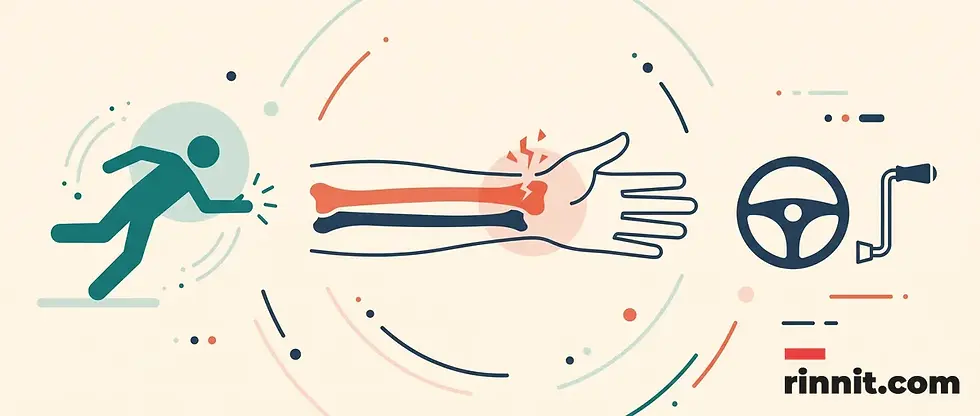
A chauffeur fracture is a broken bone near your wrist. There are two long bones in your forearm: the radius and the ulna. [7] A chauffeur fracture occurs when the pointed tip at the end of your radius, called the radial styloid process, breaks. [4]
A chauffeur fracture is a type of distal radius fracture, which means the break is at the end of the radius bone. It also extends into your wrist joint. [4] When a fracture crosses into a joint, providers call it an intraarticular fracture. [7]
Who Might Get a Chauffeur Fracture?
Anyone can get a chauffeur fracture, but most people with distal radius fractures are either active younger people or people over age 65. Older people with osteoporosis are at higher risk. [7]
Distal radius fractures are the most common fracture treated by U.S. healthcare providers. [6] This type of fracture makes up nearly 17% of all fractures treated in emergency rooms. [7]
Why Is It Called a "Chauffeur Fracture"?
French orthopaedic surgeon Just Lucas-Championnière named this fracture after the many chauffeurs who started cars in the early 20th century. At the time, people started cars by vigorously turning a crank handle clockwise. [4] Sometimes the start of the motor caused the crank handle to jerk back. This led to a person's hand twisting backward at the wrist and breaking the tip of the radial bone. [4]
The fracture itself was described earlier, in 1866, by British surgeon Jonathan Hutchinson, which is why it is also called a Hutchinson fracture. [4] Lucas-Championnière introduced the term "chauffeur fracture" in 1904. [4]
Symptoms of a Chauffeur Fracture
If you have a chauffeur fracture, you may experience the following symptoms in your wrist:

Symptom | What You May Notice |
Bruising | Discoloration around the wrist |
Limited motion | Difficulty moving the wrist normally |
Pain | Aching or sharp pain at the wrist |
Swelling | Puffiness around the joint |
Tenderness | Pain when the area is touched |
Unusual bend, bump or twist | A visible change in the shape of your wrist |
What Causes a Chauffeur Fracture?
Trauma to your wrist causes a chauffeur fracture. This trauma may result from a fall onto an outstretched hand, a blow to the back of your wrist, a car accident, or a sports injury. [9]
Cause of Trauma | Typical Scenario |
Fall onto an outstretched hand | Slipping on ice, tripping, or losing balance |
Blow to the back of the wrist | Direct impact during an accident or contact sport |
Car accident | Force transmitted through the wrist during a crash |
Sports injury | High-impact sports such as football or rugby, or activities like in-line skating or snowboarding |
How Is a Chauffeur Fracture Diagnosed?
Your healthcare provider will ask about symptoms and examine your wrist and other parts of your body for signs of trauma. They will also do a neurologic assessment to check the function of the median nerve in your wrist and hand. [8]
Providers use the following imaging tests to confirm and evaluate the fracture:
Test | What It Shows |
X-ray | The location of the fracture and the number of pieces of broken bone; the provider also looks at radial length, often comparing both wrists |
CT (computed tomography) scan | Confirms fractures and shows related damage to tendons, ligaments, or soft tissue |
MRI (magnetic resonance imaging) | Confirms fractures and shows related damage to tendons, ligaments, or soft tissue |
Treatment and Management
How Is a Chauffeur Fracture Treated?
Providers aim to put the broken bones back into their original place and keep them there while they heal. Treatment depends on the severity of the fracture, whether the injury happened in your dominant hand, whether your bones have shifted (displaced), your activity level, your age, and other injuries to your arms or legs that may affect your ability to function or bear weight.
Treatments can be nonsurgical, though some of these fractures require surgery to heal:
Treatment | How It Works |
Closed reduction and casting | The provider moves your bones back into place without making an incision, places a splint over your fracture for several days, then replaces it with a plaster cast. The cast may be changed after two to three weeks with X-ray checks, and is usually fully removed after about six weeks |
External fixation | A stabilizer device is placed across your wrist joint and attached by metal pins; used if bones fail to stay in place with a cast or if you have multiple areas of trauma |
Limited open reduction | The provider uses a small incision to move your bones back into place, then uses an external fixation device to maintain the position; used when bones have shifted more than 2 millimeters |
Open reduction and internal fixation (ORIF) | The surgeon makes an incision in the volar part of your wrist (the front part, where you feel your pulse), reattaches the bone pieces, and holds them in place with a plate and screws; some surgeons now use 3D printing to create models of the area to increase accuracy |
Are There Complications of Treatment?
Complications of treatment vary from person to person. The most common complication of nonsurgical treatment is when a fracture heals in a less than optimal position (malunion). [10] This can result in a bone that is shorter, twisted, or bent. Other complications may include arthritis, bones that fail to heal (nonunion), compartment syndrome (when muscle pressure reaches dangerous levels), complex regional pain syndrome (CRPS), infection, joint or tendon injuries, neurologic injuries such as carpal tunnel syndrome, pain, stiffness or loss of motion, and ulnar wrist pain.
Complication | What It Means |
Malunion | The fracture heals in a less than optimal position, leaving the bone shorter, twisted, or bent |
Nonunion | Bones that fail to heal |
Arthritis | Joint inflammation developing after the injury |
Compartment syndrome | Muscle pressure reaches dangerous levels |
Complex regional pain syndrome (CRPS) | Causes pain and swelling |
Infection | Bacterial infection at or around the injury site |
Joint or tendon injuries | Additional soft tissue damage |
Neurologic injuries | Nerve damage, such as carpal tunnel syndrome |
Pain, stiffness or loss of motion | Ongoing wrist discomfort and reduced range of movement |
Ulnar wrist pain | Pain on the ulna side of the wrist |

Recovery and Outlook
How Soon After Treatment Will I Feel Better?
Healing time after treatment varies from person to person. You may heal more slowly if you are older or have other conditions such as osteoporosis or diabetes.
If you have surgery for a chauffeur fracture, your surgeon will place a splint on your wrist for about one to two weeks. At your follow-up visit, it will be replaced with a removable splint that you usually wear until about six to eight weeks after surgery. [8]
A chauffeur fracture may cause pain for a few days to a few weeks. Your provider may recommend pain relief, such as ibuprofen and acetaminophen, and may prescribe a stronger medication for severe pain. [7] Your provider will also show you gentle exercises to keep your wrist and fingers moving, and may recommend physical therapy to build up strength and movement in your wrist. [7]
Are There Long-Term Effects?
You may have stiffness and pain in your wrist for up to two years. [7] Physical therapy can help you regain motion in your wrist. [7]
You can usually start light activities, such as swimming, about one to two months after cast removal or surgery. [7] You can begin more energetic activities such as rugby or snowboarding about three to six months after the injury. [7] Full recovery can take up to one year. [7]
Some people may experience permanent aching or stiffness, especially if the injury was severe, if they are older than 50, or if they have osteoarthritis. [7]
Prevention
How Can I Reduce My Risk of a Chauffeur Fracture?
You can reduce your risk of developing a chauffeur fracture with several everyday habits:
Prevention Strategy | Details |
Weight-bearing exercise | Walking, jogging, and dancing |
Resistance exercise | Lifting weights |
Healthy diet | Enough calcium and vitamin D |
Osteoporosis care | Prevent or manage osteoporosis through diet, exercise, and medication |
Quit smoking | Stop smoking and using tobacco products |
Medication review | Talk to your doctor about medications that may negatively affect your body's use of calcium and vitamins |
Fall prevention at home | Install handrails near your stairs or grab bars in your bathroom |
Protective gear | Wear wrist guards and protective gear for high-impact sports such as football or rugby, or activities such as in-line skating or snowboarding |
When Should I See My Healthcare Provider?
See your provider if you are not able to move your fingers within 24 hours after you get a cast or have surgery due to swelling or pain. [7] You should try to regain the full motion of your fingers as soon as possible. [7] Get medical help right away if pain keeps getting worse or your fingers become numb, tingly, pale or cold, as the cast may be too tight.
Conclusion
A chauffeur fracture may sound like an antique curiosity, but it remains one of the most common wrist breaks today, part of the distal radius fracture group that makes up about 1 in 6 broken bones treated in U.S. emergency rooms. The break at the tip of the radius that extends into the wrist joint is serious enough that some cases require surgery, and full recovery can take up to a year. Fortunately, providers can successfully treat these fractures with a cast, an external fixation device, or surgery, and most people are able to return to their regular activities within a few months. Gentle exercises, physical therapy, fall-proofing your home, and protecting your wrists during high-impact sports all help your wrist heal and help prevent the next break.
Want to explain health topics like this one visually? Complex medical topics like this one are far easier to grasp when they are broken into simple visuals, which is why Rinnit's infographic templates can help you turn health information into clear explainers for yourself, your family, or your community.
Frequently Asked Questions
What is a chauffeur fracture?
A chauffeur fracture is a broken bone near your wrist where the pointed tip at the end of your radius bone (the radial styloid process) breaks.
What bone breaks in a chauffeur fracture?
The radius, one of the two long bones in your forearm. Specifically, the radial styloid process at the wrist end of the radius.
What is the radial styloid process?
The pointed tip at the end of the radius bone near your wrist.
Is a chauffeur fracture the same as a distal radius fracture?
It is a type of distal radius fracture, meaning the break is at the end of the radius bone. It also extends into the wrist joint.
What is an intraarticular fracture?
A fracture that crosses into a joint. Since a chauffeur fracture extends into the wrist joint, it is an intraarticular fracture.
Why is it called a chauffeur fracture?
French orthopaedic surgeon Just Lucas-Championnière named it after early 20th-century chauffeurs who started cars by turning a hand crank. When the motor started, the crank could jerk back, twisting the hand backward at the wrist and breaking the tip of the radial bone.
What is a backfire fracture?
"Backfire" describes the classic way a chauffeur fracture happened: the engine backfired and jerked the starting crank back against the driver's hand.
What is a Hutchinson fracture?
Another name for a chauffeur fracture, also referring to the radial styloid break. It is named for British surgeon Jonathan Hutchinson, who described the fracture in 1866.
What is a radial styloid fracture?
A synonym for chauffeur fracture: a break at the radial styloid process.
Who gets chauffeur fractures?
Anyone can, but most people with distal radius fractures are either active younger people or people over age 65. Older people with osteoporosis are at higher risk.
How common are distal radius fractures?
They are the most common fracture treated by U.S. healthcare providers, making up nearly 17% of all fractures treated in emergency rooms.
How common are distal radius fractures?
In the U.S., about 1 out of every 6 broken bones treated in the emergency room is a distal radius fracture.
What causes a chauffeur fracture?
Trauma to your wrist, most often from a fall onto an outstretched hand, a blow to the back of your wrist, a car accident, or a sports injury.
Can a fall cause a chauffeur fracture?
Yes. A fall onto an outstretched hand is one of the classic causes.
Can a car accident cause a chauffeur fracture?
Yes. Car accidents are one of the trauma causes.
Can sports cause a chauffeur fracture?
Yes. Sports injuries from high-impact sports like football or rugby, or activities like in-line skating or snowboarding, can cause it.
What are the symptoms of a chauffeur fracture?
Bruising, limited motion, pain, swelling, tenderness, and an unusual bend, bump, or twist to your wrist.
Does a chauffeur fracture hurt?
Yes. Pain is one of the main symptoms, along with tenderness when the area is touched.
Does a chauffeur fracture make your wrist look different?
It can. An unusual bend, bump, or twist to your wrist is one of the symptoms.
How is a chauffeur fracture diagnosed?
Your provider will ask about symptoms, examine your wrist and body for signs of trauma, and perform a neurologic assessment to check the function of the median nerve in your wrist and hand.
What imaging tests diagnose a chauffeur fracture?
X-rays show the fracture location and number of bone pieces, and the provider checks radial length, often comparing both wrists. A CT scan or MRI may confirm the fracture and show related tendon, ligament, or soft tissue damage.
Why do doctors compare both wrists on an X-ray?
To check the radial length of the injured wrist against the healthy one.
When is a CT scan or MRI needed?
To confirm fractures and show related damage to tendons, ligaments, or soft tissue.
Does a chauffeur fracture affect the nerves?
It can, which is why providers perform a neurologic assessment to check the function of the median nerve in your wrist and hand, and nerve injury is a possible complication.
How is a chauffeur fracture treated?
Options include closed reduction and casting, external fixation, limited open reduction, and open reduction and internal fixation (ORIF) with a plate and screws.
Do I need surgery for a chauffeur fracture?
Some of these fractures require surgery to heal, though nonsurgical treatments like closed reduction and casting are possible depending on your case.
What determines which treatment I get?
The severity of the fracture, whether it is in your dominant hand, whether your bones have shifted, your activity level, your age, and other injuries affecting your ability to function or bear weight.
What is closed reduction and casting?
The provider moves your bones back into place without an incision, applies a splint for several days, then a plaster cast. The cast may be changed after two to three weeks with X-ray checks and is usually removed after about six weeks.
What is external fixation?
A stabilizer device placed across your wrist joint and attached by metal pins, used when bones fail to stay in place with a cast or when you have multiple areas of trauma.
When is limited open reduction used?
When your bones have shifted more than 2 millimeters; the provider uses a small incision to reposition the bones and an external fixation device to hold them.
What is ORIF for a chauffeur fracture?
Open reduction and internal fixation: the surgeon makes an incision in the volar part of your wrist (the front, where you feel your pulse), reattaches the bone pieces, and holds them with a plate and screws.
Do surgeons use 3D printing for chauffeur fracture surgery?
Some surgeons now use 3D printing to create models of the area to increase surgical accuracy.
What is the most common complication of treatment?
Malunion is the most common complication of nonsurgical treatment. It is when the fracture heals in a less than optimal position, leaving the bone shorter, twisted, or bent.
What complications can happen after treatment?
Arthritis, nonunion, compartment syndrome, complex regional pain syndrome (CRPS), infection, joint or tendon injuries, neurologic injuries like carpal tunnel syndrome, pain, stiffness or loss of motion, and ulnar wrist pain.
What is compartment syndrome?
A complication where muscle pressure reaches dangerous levels.
Can arthritis develop after a chauffeur fracture?
Yes, arthritis is one of the possible complications.
How long does pain last after treatment?
A chauffeur fracture may cause pain for a few days to a few weeks. Your provider may recommend ibuprofen and acetaminophen, or prescribe stronger medication for severe pain.
How long is the splint worn after surgery?
About one to two weeks in a splint, then a removable splint until about six to eight weeks after surgery.
How long do I wear a cast?
Your provider may change the cast after two to three weeks and usually fully removes it after about six weeks.
Do I need physical therapy?
Your provider may recommend physical therapy to build up strength and movement in your wrist, and will show you gentle exercises to keep your wrist and fingers moving.
Does age affect healing time?
Yes. You may heal more slowly if you are older or have conditions such as osteoporosis or diabetes.
When can I swim again?
Usually about one to two months after cast removal or surgery.
When can I play contact sports again?
You can begin energetic activities such as rugby or snowboarding about three to six months after the injury.
How long does full recovery take?
Full recovery can take up to one year.
Can a chauffeur fracture cause permanent problems?
Some people may experience permanent aching or stiffness, especially if the injury was severe, they are older than 50, or they have osteoarthritis. Stiffness and pain may last up to two years.
How can I prevent a chauffeur fracture?
Weight-bearing and resistance exercises, a diet with enough calcium and vitamin D, preventing or managing osteoporosis, quitting smoking, reviewing calcium-affecting medications with your doctor, fall-proofing your home, and wearing wrist guards during high-impact sports.
When should I call my doctor after treatment?
If you cannot move your fingers within 24 hours after getting a cast or having surgery due to swelling or pain. You should try to regain full finger motion as soon as possible.
Related Reading
References
Chung KC, Kim HM, Malay S, et al. Comparison of 24-month outcomes after treatment for distal radius fracture: the WRIST randomized clinical trial. JAMA Netw Open. 2021;4(6):e2112710. PMID: 34137830. https://doi.org/10.1001/jamanetworkopen.2021.12710
Kong L, Yang G, Yu J, et al. Surgical treatment of intra-articular distal radius fractures with the assistance of three-dimensional printing technique. Medicine (Baltimore). 2020;99(8):e19259. PMID: 32080133. https://doi.org/10.1097/MD.0000000000019259
Meena S, Sharma P, Sambharia AK, et al. Fractures of distal radius: an overview. J Family Med Prim Care. 2014;3(4):325-332. PMID: 25657938. https://doi.org/10.4103/2249-4863.148101
Andreotti M, Tonon F, Caruso G, et al. The "chauffeur fracture": historical origins of an often-forgotten eponym. Hand (N Y). 2020;15(2):252-254. PMID: 30079762. https://doi.org/10.1177/1558944718792650
Mulders MAM, Rikli D, Goslings JC, et al. Classification and treatment of distal radius fractures: a survey among orthopaedic trauma surgeons and residents. Eur J Trauma Emerg Surg. 2017;43(2):239-248. PMID: 26872680. https://doi.org/10.1007/s00068-016-0635-z
Diaz-Garcia RJ, Chung KC. Common myths and evidence in the management of distal radius fractures. Hand Clin. 2012;28(2):127-133. PMID: 22554655. https://doi.org/10.1016/j.hcl.2012.02.005
American Academy of Orthopaedic Surgeons. Distal Radius Fractures (Broken Wrist). OrthoInfo. Accessed October 30, 2026. https://www.orthoinfo.org/diseases--conditions/distal-radius-fractures-broken-wrist/
Hsu H, Fahrenkopf MP, Nallamothu SV. Wrist fracture. In: StatPearls. Treasure Island (FL): StatPearls Publishing; 2023. PMID: 29763147. https://www.ncbi.nlm.nih.gov/books/NBK499972/
Mayo Clinic Staff. Broken wrist: symptoms and causes. Mayo Clinic. Last updated April 14, 2026. https://www.mayoclinic.org/diseases-conditions/broken-wrist/symptoms-causes/syc-20353169
Katt B, Seigerman D, Lutsky K, et al. Distal radius malunion. J Hand Surg Am. 2020;45(5):433-442. PMID: 32220492. https://doi.org/10.1016/j.jhsa.2020.02.008
Medical disclaimer
This article is for informational purposes only and is not a substitute for professional medical advice, diagnosis, or treatment. Always seek the advice of a qualified healthcare provider with any questions about a medical condition or before making decisions about treatment. Never disregard professional medical advice or delay seeking it because of something you have read here.



Comments