What Is a Broken Jaw? Causes, Symptoms, Diagnosis, Treatment, and Recovery

Updated: 2 days ago
Medically reviewed by Dr. Baraa Alnahhal, MD · Last reviewed: October 17, 2026
Quick Answer: What is a broken jaw?
A broken jaw is a break in the lower jawbone caused by a hard impact. It causes intense pain, swelling and often a misaligned bite, and it is always a medical emergency. [1] Mild fractures may be treated with a liquid diet for four to six weeks, while severe ones may need surgery with plates, wires or elastics. [1]
Key takeaways
A broken jaw means the lower jawbone (mandible) has been broken by a hard impact, and it is always a medical emergency. [1]
Broken jawbones are the second most common facial fracture, behind nasal fractures. [1]
Common symptoms include severe jaw pain, swelling, bruising, a lump, chipped or loose teeth, a bite that does not line up, and ear pain.
The most common causes are interpersonal violence (being hit in the jaw) and vehicle accidents, followed by workplace and sports injuries. [1] [4]
Mild fractures often heal with a liquid diet for four to six weeks; severe fractures may need surgery with metal plates, bars, wires, or elastics. [1]
Full recovery takes weeks to months, and you may need a liquid or soft diet, ice packs, pain medication, and activity restrictions while healing. [1]
What the research says
Surgical repair works, but complications and plate removal are common enough to plan for. In a retrospective study of 377 adults who had open reduction and internal fixation of mandibular fractures, 17.0% had surgical-site or hardware-related complications and the plates were later removed in 112 patients (29.6%) (Bigus et al., BMC Oral Health, 2026) [5].
Timely surgery and stable fixation are linked to better bone healing. A scoping review of 13 studies found that open reduction and internal fixation was consistently associated with lower rates of malunion and nonunion than closed reduction techniques, particularly in comminuted fractures, while delayed surgery (around 6–7 days after injury) was associated with higher rates (Tadepalli et al., Cureus, 2026) [6].
A numb lower lip is common after a jaw fracture, but it rarely lasts. In 208 patients (237 fractures), nerve deficits in the lower jaw were present before surgery in 74 fractures (31.2%) and persisted at six months or longer in only 3 (1.3%) (Ritschl et al., Clinical Oral Investigations, 2026) [7].
What Is a Broken Jaw?
A broken jaw (fractured jaw) means something hit your lower jawbone (mandible) or upper jawbone (maxilla) hard enough to break the bone. This article focuses on lower jawbone fractures. [1]
You can break your lower jawbone in more than one place, from the top of the lower jawbone (condyle) to the angle in your jaw that curves up and back toward your ears. A broken jaw is a medical emergency regardless of what part of your jawbone is broken. [1]
Are Broken Jaws Common?
Broken jawbones are the second most common facial fracture. Fractured noses (nasal fractures) account for 40% to 50% of all facial fractures. [1]
Broken Jaw Symptoms
Broken lower jaws hurt a lot, particularly if you try to move your lower jaw back and forth or up and down. You may not be able to close your mouth or open it wide. [1]
Other signs that point to a possible fracture include bleeding from your nose or mouth, a bruised or swollen jaw or cheek, chipped or loose teeth, and upper and lower teeth that do not match up when you close your mouth. Some people also have trouble breathing, pain when chewing or talking, an inability to open or close the mouth, ear pain, and numbness in the face, particularly the lower lip. [1]
Symptom | What it feels or looks like |
Severe jaw pain | Worst when moving the jaw up, down, or side to side |
Trouble opening or closing the mouth | Limited jaw movement or jaw that will not close |
Bleeding | From the nose or mouth |
Swelling and bruising | A lump, swelling, or bruise on the jaw or cheek |
Dental problems | Chipped or loose teeth; bite that does not line up |
Breathing difficulty | Trouble breathing after the injury |
Chewing and talking pain | Hurts to chew food or to speak |
Ear pain | Pain in or around the ears |
Numbness | Face, especially the lower lip, feels numb |

What Causes a Broken Jaw?
Research shows interpersonal violence — being hit in the jaw by another person — is the most common cause of broken jaws, followed by vehicle accidents. [4] Other causes include workplace accidents and sports injuries. [1]
What Are the Complications of a Broken Jaw?
A broken jaw may affect your ability to eat, speak, and breathe. Left untreated, your jawbone may not heal or may heal in a way that affects the way it looks or works. [1]
How Is a Broken Jaw Diagnosed?
A healthcare provider will ask how you hurt your jaw and gently examine it. They will also order imaging tests, including:
Test | Why it is used |
X-rays | To see the break in the jawbone |
CT scan (computed tomography) | To check for other broken bones in the face or internal bleeding |
Broken Jaw Treatment
Treatment depends on whether the jaw fracture was mild or more severe, meaning your lower jawbone fractured in more than one place. [1]
Fracture type | Typical treatment | What it involves |
Mild | Liquid diet | You may be prescribed a liquid diet for four to six weeks |
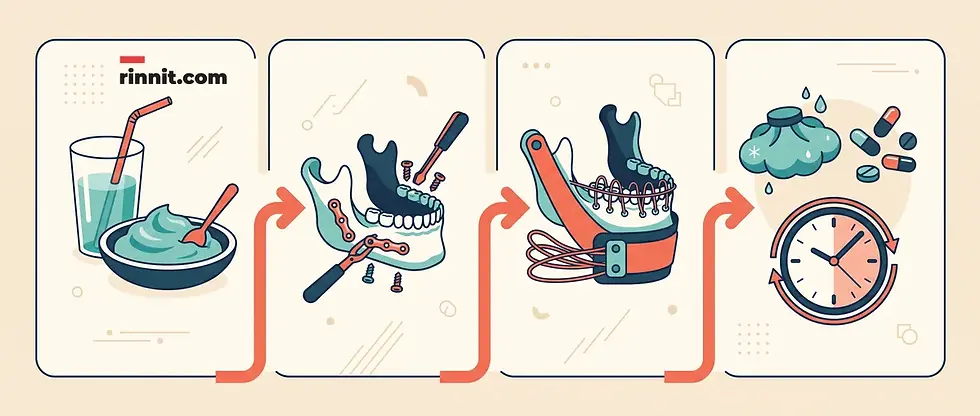
Severe | Surgery | Metal plates or bars are placed on the broken area to hold the bone in place as it heals; the jaw may also be held closed with wires or elastics |
What Are Treatment Side Effects?
One study suggests that hardware failure and infection are the most common treatment side effects. [1] Hardware failure happens when the plates, screws, and wires break or do not work like they should.
How Long Does Broken Jaw Recovery Take?
It may take weeks for your broken jaw to heal, even if you did not need surgery to repair it. [1] While your jaw heals, you may need to:
Go on a liquid diet if you had surgery, drinking fluids through a straw. You will not be able to brush your teeth and may need to use a dental rinse. [1] If you did not need surgery, you may need to follow a soft-food-only diet.
Place ice packs on your jaw to help with swelling. [1]
Take nonsteroidal anti-inflammatory drugs (NSAIDs) to ease pain and swelling. [1]
If your jaw is wired shut, remember to carry a wire cutter to cut the wire if you feel like you are going to vomit or feel like you are choking on something you need to spit out. [1]
Place your fist or hand under your chin when you yawn or sneeze so that your jaw does not move. [1]
What Is the Best Way to Sleep With a Broken Jaw?
You need to protect your broken jaw even while you are asleep. The best way to do that is to sleep on your back so you do not put pressure on your jaw. [1]
What Can I Expect After Treatment?
If you had surgery, it may be a month or more before your jawbone heals completely. [1] Your healthcare provider may recommend you stay on a liquid diet until your jaw heals and they can remove the plates and wires holding your jawbone together. You may want to talk to a nutritionist for ways to incorporate nutritious foods into a liquid diet.
Broken jaws heal very slowly. It may be weeks or months before you can resume your usual daily activity, including participating in sports.
Can Broken Jaws Be Prevented?
Most people break their jaws after being injured in an accident or being hit in the jaw. You may not be able to prevent accidents or situations where someone could hit you in the jaw. But there are steps you can take to reduce your risk:
Prevention step | When it helps |
Wear a full-face helmet | When riding motorcycles, bikes, or scooters |
Always wear your seatbelt | When riding in or driving a vehicle |
Wear a protective face mask and mouth guard | When playing contact sports, including skiing |
Wear protective headgear at work | If your job involves activity where you could be hit in the face |
When Should I Call a Healthcare Provider?
Contact your provider if you have:
Pain that does not improve with at-home treatments.
Shortness of breath or difficulty breathing (call 911 right away if breathing is hard).
Signs of infection, such as fever and chills.
Nausea and vomiting. [1]
What Questions Should I Ask My Healthcare Provider?
If you have a broken jaw, you may want to ask your provider these questions:
What part of my jaw is broken?
What treatment do you recommend?
If I need surgery, what type of surgery do you recommend?
How long before my jaw heals?
What activities should I avoid?
Broken Jaw vs. Dislocated Jaw: What Is the Difference?
The difference is that a dislocated jaw does not involve a broken jawbone. It happens when your lower jawbone pulls away from your temporomandibular joints. But both dislocated and broken jawbones are medical emergencies. [1]
Conclusion
A broken jaw is a painful, always-serious injury that demands prompt medical care. Most cases stem from blows or vehicle accidents, and while the symptoms — severe pain, swelling, a misaligned bite — are unmistakable, the good news is that most people heal. Mild fractures often recover with diet changes alone, and even surgical cases typically heal within weeks to months when treatment and recovery guidance are followed closely.
Understanding what to expect — from liquid diets and jaw wiring to long recovery timelines — makes the healing process far easier to navigate.
Frequently Asked Questions
Is a broken jaw a medical emergency?
Yes. A broken jaw is a medical emergency regardless of what part of the jawbone is broken, and you need immediate medical care if you break your jaw.
How common are broken jaws?
Broken jawbones are the second most common facial fracture. Fractured noses account for 40% to 50% of all facial fractures.
What part of the jaw gets broken?
A broken jaw involves the lower jawbone (mandible), though the upper jawbone (maxilla) can also be broken. The lower jaw can break in more than one place, from the condyle at the top to the angle that curves up and back toward the ears.
What does a broken jaw feel like?
A broken jaw hurts a lot, particularly if you try to move your lower jaw back and forth or up and down. You may not be able to close your mouth or open it wide.
Can you tell if your jaw is broken by how it looks?
You may notice a lump on your jaw or cheek, swelling, and bruising, along with other symptoms such as bleeding or a misaligned bite.
Why does my bite feel wrong after an injury?
A broken jaw can cause teeth in the upper and lower jaws to no longer match up when you close your mouth, which is a key sign of a fracture.
Can a broken jaw cause bleeding from the nose?
Yes, bleeding from the nose or mouth is a possible symptom of a broken jaw.
Why does my lower lip feel numb after a jaw injury?
Numbness in the face, particularly the lower lip, is one of the recognized symptoms of a broken jaw.
What is the most common cause of a broken jaw?
Research shows interpersonal violence — being hit in the jaw by another person — is the most common cause, followed by vehicle accidents. Workplace accidents and sports injuries are other causes.
How is a broken jaw diagnosed?
A healthcare provider asks how you hurt your jaw, gently examines it, and orders imaging tests, including X-rays and a CT scan to check for other broken facial bones or internal bleeding.
Do all broken jaws need surgery?
No. Treatment depends on severity. Mild fractures may be treated with a liquid diet for four to six weeks, while severe fractures (broken in more than one place) may require surgery with metal plates, bars, wires, or elastics.
What are the side effects of broken jaw surgery?
One study suggests hardware failure and infection are the most common treatment side effects. Hardware failure happens when the plates, screws, and wires break or do not work as they should.
How long does it take for a broken jaw to heal?
A broken jaw may take weeks to heal even without surgery, and a month or more after surgery. Broken jaws heal very slowly, and it may be weeks or months before you can resume normal activities, including sports.
What should I eat while my jaw heals?
You may need a liquid diet (often drinking fluids through a straw) if you had surgery, or a soft-food-only diet if you did not. You may also want to talk to a nutritionist about getting nutritious foods into a liquid diet.
Can I brush my teeth with a wired jaw?
If you had surgery, you will not be able to brush your teeth and may need to use a dental rinse instead.
Should I carry wire cutters if my jaw is wired shut?
Yes. If your jaw is wired shut, remember to carry a wire cutter to cut the wire if you feel like you are going to vomit or are choking on something you need to spit out.
What should I do when I yawn or sneeze with a broken jaw?
Place your fist or hand under your chin when you yawn or sneeze so that your jaw does not move.
How should I sleep with a broken jaw?
Sleep on your back so you do not put pressure on your jaw.
Can I prevent a broken jaw?
You cannot prevent all accidents, but wearing a full-face helmet when riding, always wearing a seatbelt, using protective face masks and mouth guards in contact sports, and wearing protective headgear at work can reduce your risk.
What is the difference between a broken jaw and a dislocated jaw?
A dislocated jaw does not involve a broken jawbone; it happens when the lower jawbone pulls away from the temporomandibular joints. Both are medical emergencies.
When should I call my healthcare provider during recovery?
Call your provider if you have pain that does not improve with at-home treatments, shortness of breath or difficulty breathing, signs of infection such as fever and chills, or nausea and vomiting.
Will my jaw work normally after it heals?
Most people heal from broken jaws, although a full recovery may take a few months. Left untreated, however, a jawbone may not heal or may heal in a way that affects how it looks or works.
Related Reading
References
Cleveland Clinic. Broken Jaw (Fractured Jaw). Cleveland Clinic Health Library. Medically reviewed; last updated June 12, 2023. Accessed October 15, 2026. https://my.clevelandclinic.org/health/diseases/25072-broken-jaw
Kidwai SM, Lu GN. Mandibular body fractures. Facial Plast Surg Clin North Am. 2022;30(1):99-108. PMID 34809890. https://doi.org/10.1016/j.fsc.2021.08.008
Pickrell BB, Hollier LH Jr. Evidence-based medicine: mandible fractures. Plast Reconstr Surg. 2017;140(1):192e-200e. PMID 28654619. https://doi.org/10.1097/PRS.0000000000003469
Singleton C, Manchella S, Nastri A, Bordbar P. Mandibular fractures — what a difference 30 years has made. Br J Oral Maxillofac Surg. 2022;60(9):1202-1208. PMID 35817638. https://doi.org/10.1016/j.bjoms.2022.05.010
Bigus S, Elter TL, Welter M, et al. Predictors for complications and the removal of osteosynthesis material after mandibular fractures: a retrospective analysis. BMC Oral Health. 2026;26(1):620. PMID 41866503. https://doi.org/10.1186/s12903-026-08112-0
Tadepalli PS, Scaccia J, Patel SR, et al. Risk factors and interventional predictors for postoperative malunion and nonunion in adult mandibular fractures: a scoping review. Cureus. 2026;18(2):e103931. PMID 41873266. https://doi.org/10.7759/cureus.103931
Ritschl LM, Schwaiberger B, Pippich K, et al. Preoperative CT displacement predicts inferior alveolar nerve injury in mandibular fractures: a tool for clinical risk stratification. Clin Oral Investig. 2026;30(8):340. PMID 42467118. https://doi.org/10.1007/s00784-026-07002-7
Medical disclaimer
This article is for general informational purposes only and is not a substitute for professional medical advice, diagnosis, or treatment. Always seek the advice of a qualified healthcare provider with any questions about a medical condition. A broken jaw is a medical emergency — seek immediate medical care if you suspect you have one.



Comments