Broken Nose: Symptoms, Causes, and Treatment

Updated: 3 days ago
Medically reviewed by Dr. Baraa Alnahhal, MD · Last reviewed: October 2026
Quick answer
A broken nose is a fracture of one or more nasal bones, usually at the bridge, often from a sports hit, fall or accident. It causes pain, swelling, a nosebleed and trouble breathing. Get prompt care if the nose looks crooked or breathing stays blocked. Shifted breaks are realigned within 14 days; serious breaks may need surgery. [1] [2]
What the research says
According to PubMed:
Fights, traffic accidents, and sports cause most nasal fractures. A systematic review of 26 papers found the most frequent causes in adults were fights (36.3%), traffic accidents (20.8%), sports (15.3%), and falls (13.4%), while in children sports were the leading cause (59.3%); the authors noted seatbelts are needed to prevent injuries from traffic accidents. (Hwang et al., DOI).
Packing after realignment can occasionally overcorrect the nose. In a review of 535 closed reductions of nasal bone fractures, packing was applied in 524 cases and overcorrection was noted in 16 (3.1%); the authors recommended post-procedure X-rays and removing the packing right away if overcorrection is seen. (Hwang and Ma, DOI).
Deeper fractures involving the nose and eye socket are harder to treat. A meta-analysis of 16 studies (459 adults) of naso-orbital-ethmoid fractures — more complex injuries around the nose — found open reduction with internal fixation was the most common treatment (90.1%), and complications included tear-duct obstruction (38.6%). (Conti et al., DOI).
Study details are from PubMed abstracts.
What is a broken nose?
A broken nose, also called a nasal fracture, is a crack or break in one of the bones inside the nose. The bone at the bridge of the nose is the one that typically breaks [1].
The nose is mostly bone at the top and cartilage at the bottom, so a strong impact to the center of the face is often enough to cause a fracture. Contact sports, falls, and physical fights cause most of these injuries [1].
A broken nose is painful and often causes a nosebleed. The nose and the area under the eyes may swell and bruise, the nose may look crooked, and breathing through it may feel blocked [1].
The good news is that most broken noses do not require surgery. In many cases, treatment involves a quick office procedure to move the bones back into place so the nose heals properly [1].
What are the symptoms of a broken nose?
A broken nose usually causes a clear cluster of symptoms right after the injury. Not every symptom shows up in every person, but several appearing together point strongly to a fracture [1].
Symptom | What it looks or feels like |
Pain or tenderness | Hurts especially when you touch the nose [1] |
Swelling | In and around the nose, often making the shape hard to judge at first [1] |
Nosebleed | Bleeding from one or both nostrils [1] |
Bruising | Around the nose or under one or both eyes [1] |
Crooked shape | The nose looks misshapen, crooked, or twisted [1] |
Breathing trouble | Feeling that one or both nasal passages are blocked [1] |
Mucus discharge | Fluid draining from the nose [1] |
Swelling can hide the true shape of the nose in the first few days. Waiting until the swelling goes down often reveals whether the nose is actually crooked or just puffed up [2].
When should you seek emergency care for a broken nose?
Most broken noses are not emergencies, but a few warning signs demand immediate medical attention. If a nose injury comes with any of the following, get emergency care right away [1].
Warning sign | Why it matters |
Severe headache, neck pain, vomiting, or loss of consciousness | May signal a head or neck injury from the same blow [1] |
Trouble breathing | The airway may be blocked and needs urgent clearing [1] |
Bleeding that will not stop | Ongoing blood loss needs professional control [1] |
Noticeable shape change not caused by swelling | A crooked or twisted nose that remains after swelling eases suggests a shifted fracture [1] |
Clear, watery fluid draining from the nose | May indicate cerebrospinal fluid leaking, a sign of a more serious skull injury [1] |
If the impact was strong enough to break your nose, it was strong enough to potentially injure your neck. Get care promptly whenever the force behind the injury was significant [2].
What causes a broken nose?
A broken nose happens when something strikes the face hard enough to crack the nasal bone. The bridge is the most common fracture site because it sits farthest forward on the face [1].
The most frequent causes include the following [1].
Cause | Typical scenario |
Contact sports | A ball, elbow, or collision to the face in football, hockey, basketball, baseball, or soccer [1] |
Physical fights | A punch or head-butt directly to the nose [1] |
Motor vehicle accidents | Impact from a car, motorcycle, or all-terrain vehicle crash [1] |
Electric scooter accidents | A face-first fall or collision while riding [1] |
Falls | Tripping and landing with the face down, especially in children and older adults [1] |
What are the risk factors for a broken nose?
Anyone can break a nose, but some activities and habits raise the odds considerably. The common thread is any situation that increases the chance of an impact to the face [1].
Playing sports such as soccer, basketball, and baseball raises risk, and contact sports like football and hockey raise it further, especially when athletes skip the helmet and face mask [1].
Other risk factors include getting into physical fights, lifting weights without a spotter, riding a bicycle without a helmet, riding in a car without a seat belt, and riding motorcycles, all-terrain vehicles, or electric scooters without proper protection [1].
What complications of a broken nose should you watch for?
A broken nose can cause problems beyond the fracture itself. Recognizing these complications early leads to better outcomes [1].
A deviated septum happens when the fracture shifts the wall between the nostrils, narrowing one or both nasal passages and making breathing harder. Medicines such as decongestants and antihistamines can manage the symptoms, but surgery is needed to fix the shift [1].
A septal hematoma occurs when pools of clotted blood form inside a broken nose and can block one or both nostrils. Surgery to remove the clotted blood must happen quickly to prevent permanent damage to the nasal cartilage [1].
A cartilage fracture may occur when a strong impact, such as a car accident, breaks the cartilage as well as the bone. If surgery is needed, healthcare professionals typically treat the bone and cartilage injuries together [1].

How is a broken nose diagnosed?
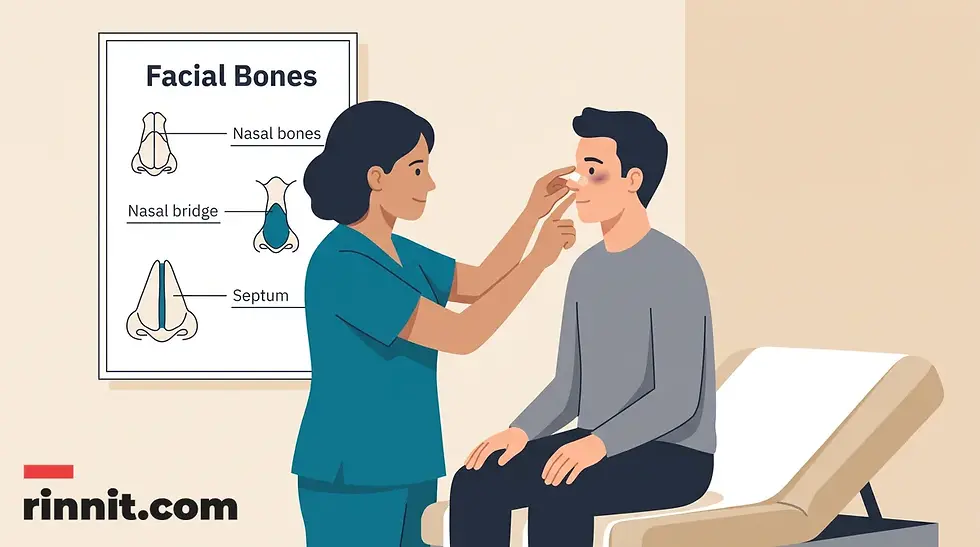
Diagnosing a broken nose is mostly a hands-on process. The healthcare professional gently presses on the nose and the areas around it to check for pain, swelling, and broken bones, and looks inside the nose to check for blockage or other signs of injury. A numbing medicine may be given for comfort during the exam [2].
Interestingly, X-rays and other imaging are typically not needed to diagnose a broken nose. The physical exam is usually enough [2].
If the injury is more serious, or a complete exam is not possible, a CT scan may be ordered to check for broken bones or other facial injuries [2].
What should you expect from broken nose treatment?
Treatment depends on how much the break has shifted the bones. A minor fracture with a nose that is not crooked or misshapen may not need any medical treatment at all. Ice and over-the-counter pain medicine are often enough [2].
Manual realignment (reduction)
If the break has shifted the bones or cartilage out of place, they may need to be moved back. This procedure is called reduction [2].
Timing matters. Realignment should be done within 14 days of the injury, and sooner generally gives the best results [2].
During the procedure, a numbing medicine is given for comfort. The healthcare professional typically moves the nose back into place gently by hand, though special tools are sometimes needed [2].
After the realignment, the nose is supported while it heals. Support may include packing placed inside the nose, a dressing or splint on the outside of the nose, or a temporary internal splint. Packing usually stays in for about one week, and an external dressing may stay on for up to two weeks [2].
Because the nose naturally carries bacteria, antibiotics may be prescribed after the procedure to prevent infection [2].
Surgery
Some breaks need surgery. Serious fractures, noses with multiple breaks, or breaks that have gone untreated for more than 14 days may require a surgical approach [2].
Surgery can realign the bones and, if needed, reshape the nose. If the nasal septum — the middle wall dividing the nostrils — is injured, the nose may feel blocked or constantly stuffy, and surgery may reconstruct the nose to improve breathing and correct the damage [2].

How can you care for a broken nose at home?
In the first days after the injury, a few simple steps make a big difference in comfort and healing [2].
Act quickly after a nosebleed. Breathe through your mouth and lean forward so blood does not drain down your throat [2].
Apply ice as soon as possible. Use an ice pack or cold compress at least four times a day during the first 24 to 48 hours, for 10 to 15 minutes at a time. Always place a thin cloth between the ice and your skin to prevent frostbite, and avoid pressing too hard on the injured nose [2].
Take over-the-counter pain medicine. Acetaminophen, ibuprofen, and naproxen sodium can all help with pain and swelling [2].
Keep your head elevated. Propping your head up, especially while sleeping, lessens swelling and throbbing [2].
Limit activity. Avoid sports for the first two weeks and avoid contact sports for at least six weeks after the injury [2].
Self-care step | How to do it |
Stop the bleeding | Breathe through the mouth and lean forward [2] |
Ice | At least 4 times daily for 24–48 hours, 10–15 minutes per session, cloth barrier on skin [2] |
Pain relief | Acetaminophen, ibuprofen, or naproxen sodium [2] |
Elevate | Keep the head raised, especially when sleeping [2] |
Rest | No sports for 2 weeks; no contact sports for 6 weeks [2] |
How should you prepare for a broken nose appointment?
If your injury is serious, seek care right away and there may be no time to prepare. If you only have swelling and moderate pain, you may choose to wait a short time before seeking care, since less swelling makes the evaluation easier [2].
If your symptoms are not improving, plan to see a healthcare professional within 3 to 5 days of the injury. Care usually starts with a primary healthcare professional, who may refer you to an ear, nose, and throat (ENT) specialist [2].
Get help right away if your pain or swelling is not getting better, your nose still looks misshapen or crooked after the swelling goes down, you cannot breathe well after the swelling lessens, you have frequent nosebleeds, or you develop a fever [2].
Before your visit, write down your symptoms and what you were doing at the time of the injury, list all medicines, vitamins, and supplements you take, and bring a photo of yourself taken before the injury if possible, so the professional can compare. Write down your questions ahead of time [2].
Questions you might ask include whether you need tests such as X-rays, how long the swelling and bruising will last, whether your nose will look the same after healing, whether you need surgery, whether activity should be restricted, what pain medicine you can take, and whether there are brochures or recommended websites [2].
Expect to be asked how and when the injury occurred, whether symptoms have improved since, whether there is clear nasal drainage, whether your nose looks the same or different, whether you can breathe easily through your nose, and whether you play contact sports or plan to return to them [2].
How can you prevent a broken nose?
Many broken noses are preventable by reducing face impact risk during sports, driving, and everyday activities [1].
Always wear a seat belt in vehicles, and make sure children ride in the right car seat or booster seat for their age and size. Wear proper safety equipment, including a helmet and face mask, when playing hockey, football, or other contact sports, and wear a helmet when riding a bicycle or motorcycle [1].
Conclusion
A broken nose is a common and usually straightforward injury. Most cases heal well with ice, pain relief, and sometimes a quick realignment procedure, and surgery is needed only for serious or long-untreated breaks. The key is knowing the warning signs that need emergency care, getting an evaluation within a few days if symptoms persist, and protecting the face during sports and travel.
Next steps: Talk with a healthcare professional about your nose injury — within 3 to 5 days if symptoms are not improving, and right away for trouble breathing, bleeding that will not stop, severe headache, or clear watery drainage.
Frequently asked questions
Do I need an X-ray for a broken nose?
Usually not. A healthcare professional can typically diagnose a broken nose with a physical exam, gently pressing the nose and looking inside it. Imaging such as a CT scan is usually reserved for serious injuries or when a complete exam is not possible [2].
How long after a broken nose can it be fixed?
If the bones or cartilage have shifted, realignment should be done within 14 days of the injury, and sooner generally gives the best results. Breaks left untreated longer than 14 days may need surgery instead [2].
Will my nose look the same after it heals?
For many people with minor fractures, yes. However, a significant shape change that remains after the swelling goes down suggests a shifted fracture that may need realignment. Surgery can realign the bones and, if needed, reshape the nose [2].
Why does my nose feel blocked after breaking it?
A fracture can shift the septum, the wall between the nostrils, narrowing one or both nasal passages and creating a deviated septum. Clotted blood pooling inside the nose (a septal hematoma) can also block the nostrils and needs prompt treatment [1].
When should I go to the emergency room for a nose injury?
Go right away if you have trouble breathing, bleeding that will not stop, severe headache, neck pain, vomiting, loss of consciousness, or clear watery fluid draining from your nose. Also seek urgent care if the nose looks crooked in a way that is not just swelling [1].
This article is for general education and is not a substitute for professional medical advice, diagnosis, or treatment. Always consult a qualified healthcare professional about your individual situation.
References
Mayo Clinic Staff. Broken nose - Symptoms and causes. Mayo Clinic. June 6, 2025. https://www.mayoclinic.org/diseases-conditions/broken-nose/symptoms-causes/syc-20370439
Mayo Clinic Staff. Broken nose - Diagnosis and treatment. Mayo Clinic. June 6, 2025. https://www.mayoclinic.org/diseases-conditions/broken-nose/diagnosis-treatment/drc-20370444
American Academy of Otolaryngology–Head and Neck Surgery Foundation. Nasal fractures. ENT Health. January 2019. https://www.enthealth.org/conditions/nasal-fractures/
Most SP. Nasal fractures. Merck Manual Professional Version. April 2026. https://www.merckmanuals.com/professional/injuries-poisoning/facial-trauma/fractures-of-the-nose
Hwang K, Ki SJ, Ko SH. Etiology of nasal bone fractures. J Craniofac Surg. 2017;28(3):785-788. PMID 28468166. https://doi.org/10.1097/SCS.0000000000003477
Hwang K, Ma SH. Overcorrection of nasal bone fracture reduction can be minimized by packing removal. J Craniofac Surg. 2022;33(4):e364-e365. PMID 34510061. https://doi.org/10.1097/SCS.0000000000008144
Conti KR, Bhat AM, Nguyen SA, et al. Outcomes of surgical repair of adult naso-orbital-ethmoid fractures: a systematic review and meta-analysis. Laryngoscope. 2025;135(3):991-999. PMID 39422367. https://doi.org/10.1002/lary.31805



Comments