What Is a Barton Fracture? Symptoms, Causes, and Treatment

Updated: 2 days ago
Medically reviewed by Dr. Baraa Alnahhal, MD · Last reviewed: October 2026
Quick Answer: What is a Barton fracture?
A Barton fracture is a break in the distal radius near the wrist that knocks part of the wrist joint out of place, usually after falling on a bent wrist. After splinting, a surgeon typically performs open reduction and internal fixation. Healing may take a few months to a year, and most people recover normal activity.
Key takeaways
A Barton fracture is a broken wrist in which a piece of the distal radius breaks and pulls part of the wrist joint out of alignment. [3]
There are two types: a dorsal Barton fracture (bump on the back of the hand) and a volar or reverse Barton fracture (bump on the palm side). Reverse fractures happen more often.
Falls are almost always the cause; car and motorcycle accidents can also cause this break.
About 70% of these fractures happen to young men who are manual workers or motorcyclists.
Treatment usually involves a splint, then surgery (ORIF) to realign the bones, plus pain medication and physical therapy.
Full healing can take up to a year [1], though most people return to their usual activities.
What the research says
Short-arm and long-arm casts work equally well for distal radius fractures treated without surgery. A meta-analysis of 9 randomized trials with 983 cases found no significant differences in radiographic outcomes, loss of reduction, need for surgery, or patient-reported function between below-elbow and above-elbow immobilization. These trials covered distal radius fractures in general, not Barton fractures specifically (Chaudhry et al., Cureus, 2024). [4]
Complex regional pain syndrome after wrist fracture surgery is linked to lingering anxiety. In a study of 1,875 women aged 40 to 65 who had surgical fixation of a distal radius fracture, 150 (8.0%) developed complex regional pain syndrome within 6 months. Women whose anxiety stayed high had about 4.85 times the odds after adjustment (19.2% developed it, versus 4.9% of women whose anxiety stayed low) (Gao et al., Eur J Pain, 2026). [5]
Endoscopic carpal tunnel release returns people to work sooner than open release. In a meta-analysis of 33 randomized trials (1,568 open and 1,447 endoscopic releases), endoscopic release shortened time to return to work by about 8 days and had fewer scar-related complications, with no significant difference in revision surgery or nerve injury (Hassan Zadeh Tabatabaei et al., Asian J Neurosurg, 2026). [6]
What Is a Barton Fracture?

A Barton fracture is where you break part of your wrist and knock another part out of place. [3] It usually happens when you fall on top of your bent wrist.
The part of your wrist that breaks, your distal radius, is also part of your forearm. Your radius is the most commonly broken arm bone. [1] These breaks make up about 1 in 6 broken bones treated in U.S. emergency rooms (see our guide to bone fractures). [1]
What makes a Barton fracture different from a standard broken wrist is the displacement: the broken bone edge pushes part of the wrist joint out of its normal position. If the joint seems out of place after an injury, you might have a Barton fracture.
What are the different types of Barton fractures?
There are two types of Barton fractures. The type depends on which side of the wrist the displaced bump appears on.
Type | Where the bump appears and how often |
Dorsal Barton fracture | Back of the hand; less common |
Volar (reverse) Barton fracture | Palm side of the wrist; more common, these happen more often |
The volar version is sometimes called a reverse Barton fracture. Both types involve the same underlying injury, a distal radius break that displaces the joint, but in opposite directions.
How common are Barton fractures?
Barton fractures are rare. There are many other, more common wrist fractures. But they can happen to anyone because anyone can fall.
70% of the time, this kind of fracture happens to young men who are either manual workers or motorcyclists. They get hurt on the job or in an accident.
You're also at a higher risk if you have osteoporosis, a disease that weakens your bones. Weak bones are more likely to break. [1] If you're over 50, you're at an increased risk for this disease.
What Causes a Barton Fracture?
A fall is almost always the cause of this kind of fracture. The classic mechanism is landing on the top of a bent wrist, which drives the bone fragments and displaces the joint.
Car and motorcycle accidents can also cause this break, often through similar high-energy impact forces on the hand and wrist.
Who gets Barton fractures?
Risk factor | Why it increases risk |
Falling on a bent wrist | The classic injury mechanism for this fracture |
Manual labor work | Higher exposure to falls and accidents on the job |
Motorcycle riding | Crash-related hand and wrist impact |
Osteoporosis | Weakens bones, making them more likely to break [1] |
Age over 50 | Increased risk of osteoporosis |
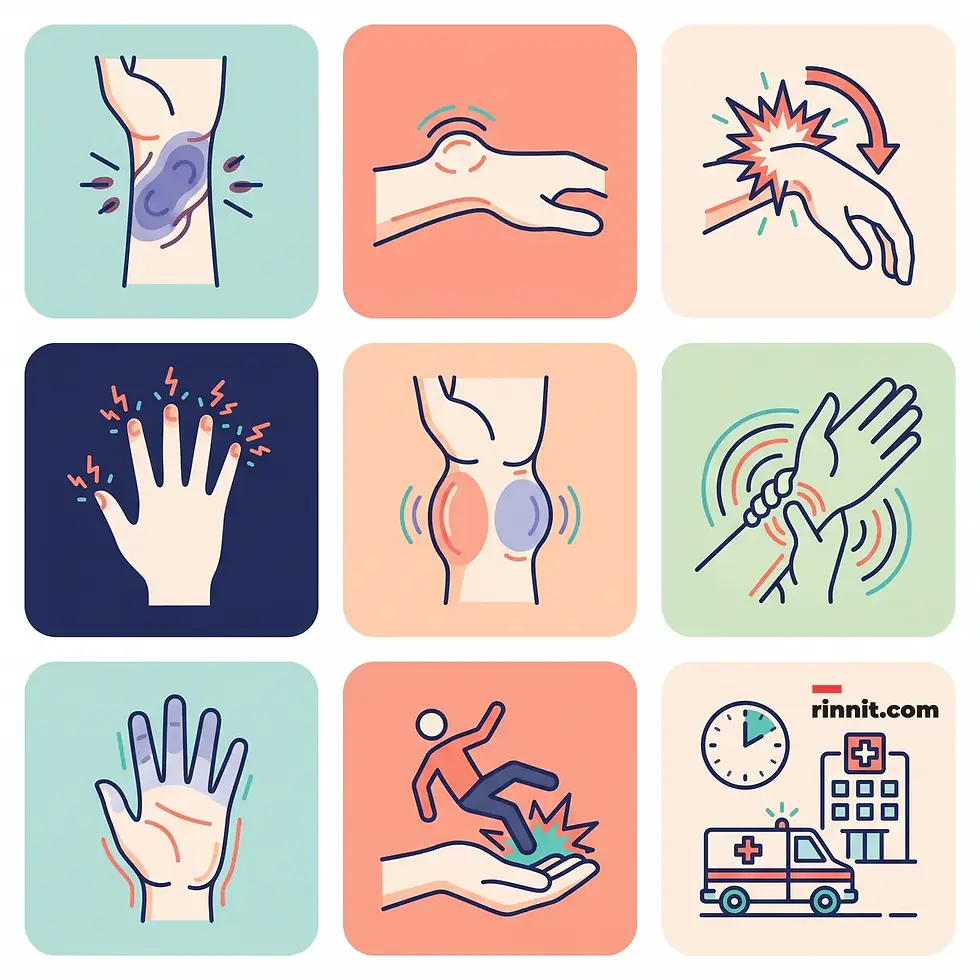
What Are the Symptoms of a Barton Fracture?
Barton fracture symptoms are about the same as other types of distal radius breaks (see also our guide to wrist pain).
Symptom | What it looks like |
Wrist pain | Pain at the wrist, especially when trying to move it |
Swelling | The wrist becomes visibly enlarged around the injury [1] |
Bump on the wrist | A visible bump where the bone has shifted out of place |
Bruising around the wrist | Discoloration of the skin around the injury [1] |
Painful movement | Failure to move your wrist without pain |
Numb or tingling fingertips | Nerve pressure causes numbness or a pins-and-needles feeling in the fingertips |
If your fingertips feel numb or tingle, or your fingers change color, that can signal pressure on nerves or blood vessels, and it means you should seek care right away.
How Are Barton Fractures Diagnosed?
When you see your healthcare provider, they'll want you to list your symptoms, describe how bad they are, and explain how you hurt your wrist.
Your provider will order an X-ray to make sure that you have a broken bone and to figure out the type of break. The X-ray will also show them:
If other bones are broken
The amount of space between the broken pieces
The roughness or smoothness of the broken bone
You might need a CT scan or MRI. These tests check for problems with your tendons, muscles, and ligaments around the wrist.
What questions might a healthcare provider ask?
Question | What it tells the provider |
How much pain are you in? | Severity of the injury |
How severe are your symptoms? | Overall impact of the fracture |
Are you able to move your wrist? | Whether the joint is displaced or locked |
How did you hurt your wrist? | The injury mechanism (fall, accident) |
When did you hurt your wrist? | Timing of the injury for treatment planning |
How Is a Barton Fracture Treated?
Your healthcare provider will place your wrist in a splint and then refer you to an orthopaedic surgeon. Orthopaedic surgeons treat problems with your bones, muscles, tendons, ligaments, and soft tissues.
You'll likely need a surgical procedure called an open reduction and internal fixation (ORIF). An ORIF puts the bone fragments of your wrist back together. There are two steps:
Step | What happens |
Open reduction | The surgeon makes a cut, finds the broken bones, and moves them back to where they were before the injury |
Internal fixation | The surgeon puts the bones together using pins, rods, plates, screws, or a combination |
Your healthcare provider might tell you to take medications like acetaminophen and ibuprofen to help with the pain. [1]
What if surgery isn't done?
If you don't get surgery, you'll have to wear a cast around your wrist for about 4 to 6 weeks and then go to physical therapy. [1] At therapy, you'll work on your wrist movement and strength.

How Long Does It Take to Heal?
You may feel better in a few months, but healing can take a year. [1]
Be sure to ask your healthcare provider about when you can resume exercise, and when you can get back to contact sports like soccer or hockey.
What's the outlook?
Most people go back to their usual daily activities after a Barton fracture. With proper treatment and rehabilitation, the displaced joint is realigned, and wrist function is generally restored.
What are the complications?
Sometimes problems happen after surgery (complications).
Complication | What happens |
Acute compartment syndrome (ACS) | ACS can stop blood from getting to important parts of your body. This could damage your nerves and muscles. See our guide to [compartment syndrome](https://www.rinnit.com/post/compartment-syndrome-what-it-is-why-it-happens-and-how-it-s-treated). |
Bone infection (osteomyelitis) | If you have an open wrist fracture (the bone breaks through your skin), you have a higher risk of infection. [1] See our guide to [osteomyelitis](https://www.rinnit.com/post/osteomyelitis-symptoms-causes-and-treatment). |
Carpal tunnel syndrome | A broken wrist that doesn't heal right might lead to carpal tunnel syndrome. The syndrome causes pain, weakness, and numbness. There are treatments that help. |
Complex regional pain syndrome (CRPS) | CRPS is a painful condition that happens when your nerves don't work right and are irritated following your injury. |
Malunion | Malunion is when your broken bones don't line up right when they heal. |
Other damage | Broken bones can damage the area around them, including your muscles, blood vessels, nerves, ligaments, and tendons. |
Talk with your healthcare provider if you're worried about complications. Some treatments can help.
Can a Barton Fracture Be Prevented?
You can't prevent every fall, but you can reduce your risk.
Be extra careful when you're playing sports, working manual labor, riding a motorcycle, or climbing something high like a ladder.
If you're at higher risk for osteoporosis, eliminate tripping hazards in your home. Be sure to always use your cane or walker if you use one.
When should I go to the emergency department?
It's best to go to the emergency department if you think you have a broken wrist, especially if your pain is really bad, your wrist looks different, is numb, or your fingers are a different color than they usually are.
When should I contact my healthcare provider?
If you're 50 or older and you've had a bone fracture, your primary healthcare provider might want to test you for osteoporosis. A fracture could mean your bones are weak.
What questions should I ask my healthcare provider?
Question | Why it matters |
Do I need surgery? | Determines the treatment path |
What kind of broken bone do I have? | Helps you understand your specific fracture |
When can I get my cast off? | Sets expectations for the healing timeline |
When can I get back to my usual activities? | Guides your return to work, exercise, and sports |
Conclusion
A Barton fracture is more than a typical broken wrist. It's a break that displaces part of the wrist joint, which is why it almost always requires prompt evaluation and usually surgery. The injury typically happens when you land on top of a bent wrist, and falls are the most common cause. Symptoms include wrist pain, swelling, a visible bump, bruising, painful movement, and numb or tingling fingertips.
If you suspect a broken wrist, go to the emergency department right away. Quick treatment lessens the pain and starts healing. Most people return to their usual activities after treatment, and with proper rehabilitation, the wrist regains its movement and strength.
Take the next step in understanding your health. Understanding your fracture type, your treatment plan, and your recovery timeline helps you partner with your care team for the best outcome. If you create health education materials, Rinnit's library of infographic templates can help you turn complex medical information into clear, shareable visuals for your audience.
Frequently Asked Questions
What exactly is a Barton fracture?
A Barton fracture is a break in the distal radius (part of the forearm that forms the wrist) that knocks part of the wrist joint out of place. It usually happens when you fall on top of your bent wrist.
What's the difference between a dorsal and a volar Barton fracture?
If the displaced bump is on the back of your hand, it's a dorsal Barton fracture. If the bump is on the palm side, it's a volar or reverse Barton fracture. Reverse fractures happen more often.
How does a Barton fracture happen?
A fall is almost always the cause, especially landing on top of a bent wrist. Car and motorcycle accidents can also cause this break.
Who is most likely to get a Barton fracture?
About 70% of the time, this fracture happens to young men who are manual workers or motorcyclists. People with osteoporosis or who are over 50 are also at higher risk because their bones are more fragile.
Are Barton fractures common?
No. Barton fractures are rare. There are many other, more common wrist fractures, but this specific type involves the joint itself being displaced.
What are the symptoms of a Barton fracture?
Symptoms are similar to other distal radius breaks: bruising around the wrist, a bump on the wrist, failure to move the wrist without pain, numb or tingling fingertips, swelling, and wrist pain.
Is a Barton fracture an emergency?
Yes. It's best to go to the emergency department if you think you have a broken wrist, especially if your pain is really bad, your wrist looks different, is numb, or your fingers are a different color than usual.
How is a Barton fracture diagnosed?
Your provider will review your symptoms and injury history, then order an X-ray to confirm the break and identify the fracture type. The X-ray shows whether other bones are broken, the space between fragments, and the bone's roughness. A CT scan or MRI may check for tendon, muscle, or ligament problems.
Does a Barton fracture always need surgery?
You'll likely need surgery. After splinting your wrist, your provider will refer you to an orthopaedic surgeon, who will usually perform an open reduction and internal fixation (ORIF) to realign and fix the bones.
What happens during ORIF surgery?
Open reduction means the surgeon makes a cut, finds the broken bones, and moves them back to their original position. Internal fixation means the surgeon holds the bones together using pins, rods, plates, screws, or a combination.
How long does a Barton fracture take to heal?
You may feel better in a few months, but healing can take a year. [1] If you don't have surgery, you'll wear a cast for about 4 to 6 weeks before starting physical therapy. [1]
What complications can occur?
Possible complications include acute compartment syndrome, bone infection (osteomyelitis), especially with open fractures where bone breaks through the skin, carpal tunnel syndrome, complex regional pain syndrome (CRPS), malunion (bones healing out of line), and damage to nearby muscles, blood vessels, nerves, ligaments, or tendons.
Can I prevent a Barton fracture?
You can reduce your risk by being careful during sports, manual labor, motorcycle riding, and climbing. If you're at higher risk for osteoporosis, eliminate tripping hazards at home and always use your cane or walker if you have one.
Should I be tested for osteoporosis after a fracture?
If you're 50 or older and you've had a bone fracture, your primary healthcare provider might want to test you for osteoporosis. A fracture could mean your bones are weak.
Will I get my normal wrist function back?
Most people go back to their usual daily activities after a Barton fracture. Ask your provider when you can resume exercise and return to contact sports like soccer or hockey.
Related Reading
References
American Academy of Orthopaedic Surgeons. Distal Radius Fractures (Broken Wrist). OrthoInfo. Accessed October 30, 2026. https://www.orthoinfo.org/diseases--conditions/distal-radius-fractures-broken-wrist
American Society for Surgery of the Hand. Wrist Fracture. HandCare. Accessed October 30, 2026. https://www.assh.org/handcare/condition/wrist-fracture
Helms JT, Maldonado KA, Burns B. Anatomy, Shoulder and Upper Limb, Hand Radiocarpal Joint. In: StatPearls. StatPearls Publishing; updated August 8, 2023. PMID 30969566. https://www.ncbi.nlm.nih.gov/books/NBK539744/
Chaudhry YP, Morway GR, Papadelis EA, et al. Comparison of short-arm immobilization and long-arm immobilization in conservatively managed distal radius fractures: a meta-analysis and systematic review. Cureus. 2024;16(3):e55813. PMID: 38590464. https://doi.org/10.7759/cureus.55813
Gao M, Xiong J, Gao R, et al. Hospital Anxiety and Depression Scale trajectories and risk of complex regional pain syndrome in middle-aged women after surgical treatment of acute distal radial fracture: a prospective longitudinal cohort study. Eur J Pain. 2026;30(9):e70422. PMID: 42870731. https://doi.org/10.1002/ejp.70422
Hassan Zadeh Tabatabaei MS, Pour-Rashidi A, Noori A, et al. Endoscopic versus open carpal tunnel release: a systematic review and meta-analysis. Asian J Neurosurg. 2026;21(4):700-713. PMID: 42857862. https://doi.org/10.1055/s-0046-1823131
Medical disclaimer
The information provided in this article is for educational purposes only and is not intended as medical advice. Always seek the advice of your physician or other qualified health provider with any questions you may have regarding a medical condition. If you think you have broken your wrist, go to the emergency department right away.



Comments