Wandering Atrial Pacemaker (WAP): Symptoms, Causes, and Diagnosis

Updated: 2 days ago
Medically reviewed by Dr. Baraa Alnahhal, MD · Last reviewed: October 2026
Quick Answer
Wandering atrial pacemaker is a benign heart arrhythmia with a normal rate of 60 to 100 beats per minute but an irregular pattern, identified on an EKG by at least three distinct P wave shapes. [1] It usually causes no symptoms and may be linked to lung disease, medications or high fitness. Treatment is rarely necessary. [1]
What the research says
The wandering pacemaker pattern is an EKG finding, and other tests can add detail. A review of P-wave patterns explains that the EKG can reveal ectopic atrial activation and wandering pacemaker activity, and that vectorcardiography and transesophageal recording are complementary methods (Bagliani et al., Card Electrophysiol Clin, 2017) [2]. Large studies with patient numbers on wandering atrial pacemaker itself are scarce.
A faster look-alike rhythm, multifocal atrial tachycardia, can be more serious. Multifocal atrial tachycardia (MAT) is defined by irregular P-P, R-R, and P-R intervals with a heart rate above 100 beats per minute. In a review of pediatric MAT, the outlook was favorable for most patients, but adverse outcomes such as cardiogenic death (3%), respiratory failure (6%), or persistent arrhythmia (7%) were reported, linked to delayed diagnosis and poorly controlled MAT (Chen et al., Front Pediatr, 2022) [3].
What Is a Wandering Atrial Pacemaker?
A wandering atrial pacemaker (WAP) is an abnormal but typically harmless heart rhythm. In a healthy heart, the electrical signal that triggers a heartbeat starts in the sinus node, located in the right atrium. With WAP, this impulse "wanders," starting in different places within the upper heart chambers (atria) from one beat to the next. [1]
Despite this irregularity, the heart rate stays within the normal range of 60 to 100 beats per minute. [1] This distinguishes WAP from more serious arrhythmias that make the heart beat too fast or too slow.
Symptoms and Clinical Presentation
For the vast majority of people, a wandering atrial pacemaker causes no noticeable symptoms. [1] It is often discovered by chance during a routine physical exam or a test for an unrelated condition. [1]
However, if the heart rate becomes slow or if the person is particularly sensitive to their heart rhythm, they may feel:
Causes and Triggers
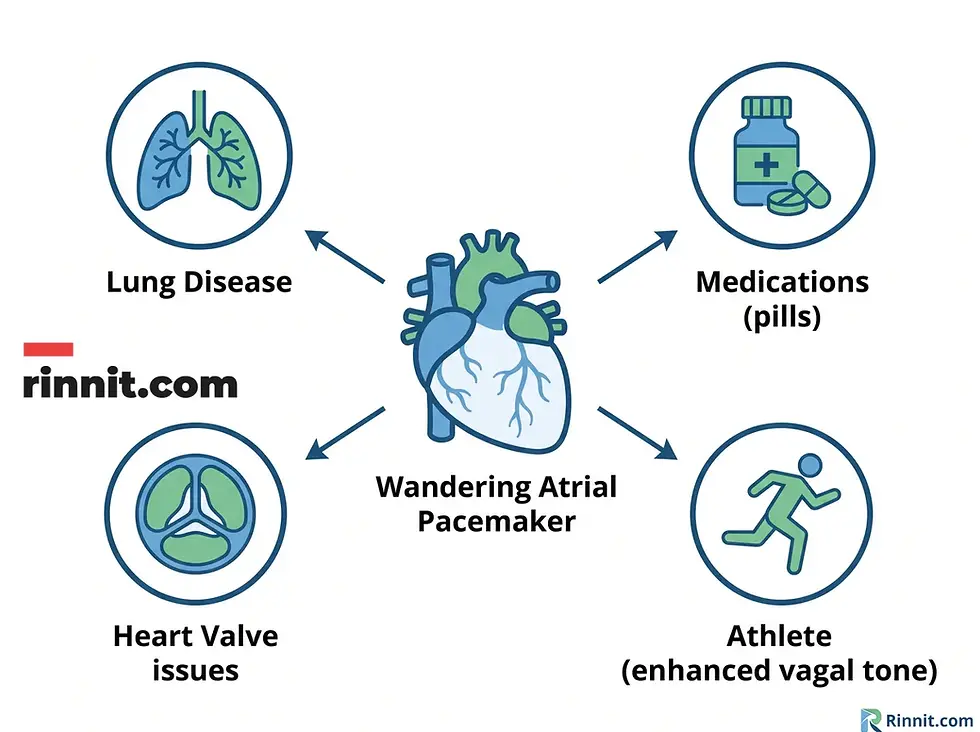
WAP can occur in healthy people, including children and well-trained athletes, but it is also associated with several medical conditions and external factors.
Diagnosis and Testing
Because WAP often causes no symptoms, healthcare providers usually identify it through electrical monitoring of the heart. The primary diagnostic tool is the electrocardiogram (EKG). [1]
EKG Findings
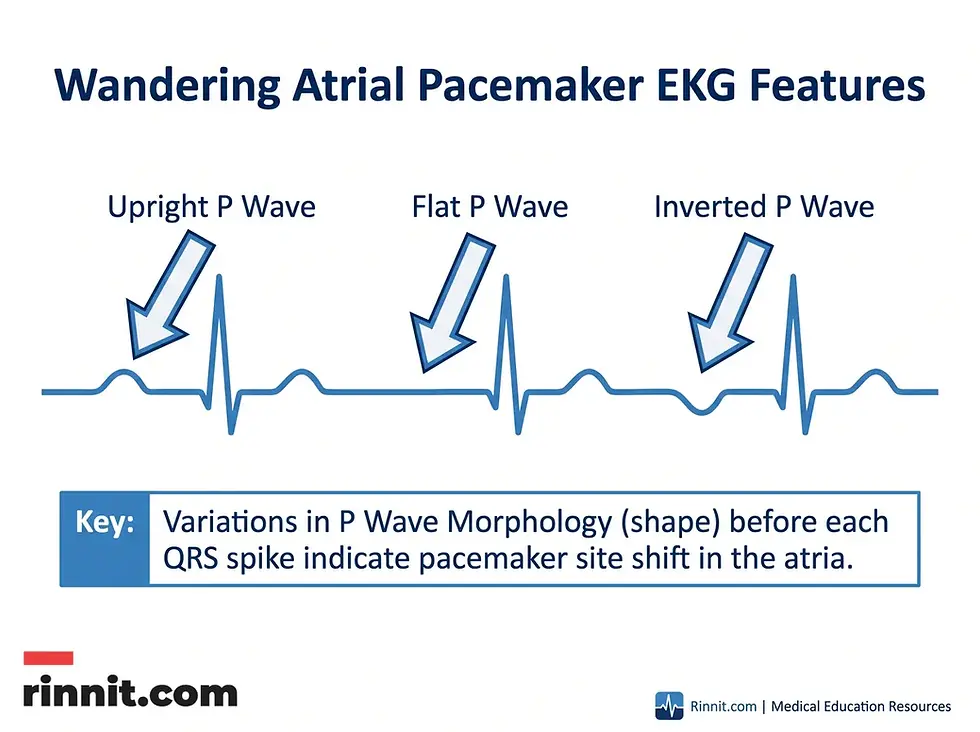
On an EKG, WAP is confirmed when a provider sees at least three different shapes of P waves (the small wave that occurs just before the main heartbeat spike). [1] These different shapes show that the electrical signals are starting from different spots in the atria.
Additional Tests
In some cases, a provider might use:
Management and Treatment
In most cases, a wandering atrial pacemaker needs no direct treatment. [1] Because the rhythm itself is not dangerous, doctors focus on the "why" rather than the "what."
If WAP is caused by a specific condition, such as a medication side effect or lung disease, treating that underlying issue will usually resolve the irregular rhythm. For example, if a digoxin overdose is the cause, adjusting the dose is the primary step. [1]
Treatment Approach | Details |
Observation | Regular monitoring if no symptoms are present. |
Underlying Care | Treating lung or heart disease to stabilize the rhythm. |
Medication Review | Adjusting doses of stimulants or heart medications. |

Outlook and Prognosis
The outlook for someone with a wandering atrial pacemaker is excellent. The condition is not considered life-threatening [1] and does not typically interfere with daily activities. In some older adults, however, WAP may be an early sign of sick sinus syndrome, a condition in which the heart's natural pacemaker does not work correctly. In these uncommon cases, a permanent pacemaker might eventually be needed.
If you have been diagnosed with WAP, keep following up with your healthcare provider as recommended, especially if you have existing heart or lung conditions.
Frequently Asked Questions
1. Is a wandering atrial pacemaker a serious condition?
No, WAP is generally considered a benign and harmless heart rhythm that does not require treatment in most people.
2. What is the difference between WAP and a normal heart rhythm?
In a normal rhythm, every beat starts in the sinus node. In WAP, the beat starts in different parts of the atria from beat to beat.
3. Can athletes have a wandering atrial pacemaker?
Yes, it can occur in athletes because of "enhanced vagal tone," a healthy adaptation of the nervous system to intense training.
4. Will I need a pacemaker for WAP?
Typically, no. A pacemaker is only needed if WAP leads to a more serious condition such as sick sinus syndrome.
5. Does WAP cause a fast heart rate?
No, by definition, WAP occurs with a normal heart rate of 60 to 100 beats per minute.
6. Can children have this condition?
Yes, wandering atrial pacemaker can occur in both children and adults.
7. What are P waves on an EKG?
P waves represent the electrical activity in the heart's upper chambers (atria) just before they contract.
8. Can stress cause WAP?
While stress affects the heart, WAP is more commonly linked to lung disease, specific medications, or physical conditioning.
9. Is WAP the same as atrial fibrillation (AFib)?
No. AFib is a much more chaotic and potentially dangerous rhythm. WAP is organized and generally harmless.
10. How is WAP usually discovered?
WAP is most often found incidentally during a routine EKG or while testing for other medical issues.
11. Can caffeine trigger WAP?
Caffeine is not a well-established trigger, but stimulants such as certain ADHD medications and nasal decongestants are known triggers.
12. What is sick sinus syndrome?
Sick sinus syndrome is a group of heart rhythm problems in which the sinus node (the heart's natural pacemaker) fails to work properly.
13. Do I need to stop exercising if I have WAP?
Usually, no. Athletes often have WAP as a normal physiological finding. Consult your doctor for personalized advice.
14. What is a vectorcardiogram?
A vectorcardiogram is a diagnostic tool that provides a three-dimensional view of the heart's electrical impulses.
15. Should I be worried if my EKG shows WAP?
In most cases, there is no cause for concern. Your doctor will likely check for any underlying causes that might need treatment.
Trusted External Resources
American Heart Association (AHA): guides on heart rhythms and cardiac health.
Heart Rhythm Society: information on arrhythmias and electrical disorders of the heart.
National Heart, Lung, and Blood Institute (NHLBI): resources on diagnostic tests such as the EKG.
Related Reading
Multifocal Atrial Tachycardia: Symptoms, Causes and Treatment covers the faster form of the same irregular atrial rhythm.
Premature Atrial Contractions (PACs): Causes, Symptoms, and Management explains early extra heartbeats that start in the upper chambers.
Sick Sinus Syndrome: Symptoms, Causes, and Treatment describes a problem with the heart's natural pacemaker that causes rhythm changes.
Electrocardiogram (EKG or ECG): Why It's Done, How to Prepare, What Happens and Results explains the heart rhythm test used to diagnose wandering atrial pacemaker.
References
Cleveland Clinic. Wandering Atrial Pacemaker. Cleveland Clinic. Last updated January 28, 2026. https://my.clevelandclinic.org/health/diseases/wandering-atrial-pacemaker
Bagliani G, Leonelli F, Padeletti L. P wave and the substrates of arrhythmias originating in the atria. Card Electrophysiol Clin. 2017;9(3):365-382. PMID 28838546. https://doi.org/10.1016/j.ccep.2017.05.001
Chen H, Ma Y, Wang Y, et al. Progress of pathogenesis in pediatric multifocal atrial tachycardia. Front Pediatr. 2022;10:922464. PMID 35813391. https://doi.org/10.3389/fped.2022.922464
Medical Disclaimer
This article is for informational purposes only and does not constitute medical advice. Always seek the advice of your physician or other qualified health provider with any questions you may have regarding a medical condition. Never disregard professional medical advice or delay in seeking it because of something you have read in this article.



Comments