Visceral Artery Aneurysm: Symptoms, Types, and Treatment Options

Updated: 2 days ago
Medically reviewed by Dr. Baraa Alnahhal, MD · Last reviewed: October 17, 2026
Editorial note: This article is provided for educational purposes only. It is not medical advice. Always consult a qualified healthcare professional about your individual health situation.
Quick Answer: What Is a Visceral Artery Aneurysm?
A visceral artery aneurysm is a rare condition in which the wall of an abdominal artery weakens and expands, often due to atherosclerosis, trauma or connective tissue disorders. [1] Most people have no symptoms [1] until a rupture causes severe abdominal or back pain. CT or MRI confirms it, and treatment depends on the aneurysm's size, location and rupture risk.
What the research says
Endovascular and open repair have similar death rates, with different trade-offs. A systematic review of 80 observational, mostly noncomparative studies covering 2,845 aneurysms found no statistically significant difference in mortality between open and endovascular repair. Endovascular repair was linked to shorter hospital stays and fewer cardiovascular complications but more reinterventions, and pseudoaneurysms tended to have higher mortality and reintervention rates. The certainty of the evidence was low (Barrionuevo et al., J Vasc Surg, 2019 [2]).
Rupture of a giant splenic artery aneurysm is often fatal. A literature review of 78 patients with giant splenic artery aneurysms (5 cm or larger) found rupture in 15, with 33.3% mortality among those who ruptured. The authors advise treating patients at evident risk without delay (Akbulut & Otan, Medicine (Baltimore), 2015 [3]).
Splenic artery aneurysms are especially dangerous in pregnancy. A systematic review of 75 ruptured and 9 unruptured cases in pregnancy reported no deaths in unruptured aneurysms, but 25.7% maternal and 50.0% fetal mortality when they ruptured (Aung et al., Int J Gynaecol Obstet, 2022 [4]).
Understanding Visceral Artery Aneurysms
Visceral artery aneurysms occur when the wall of an artery in the abdomen becomes weak and expands outward, similar to a balloon filling with air. [1] These arteries branch off the aorta—the body's main artery—to deliver oxygen-rich blood to vital organs such as the stomach, liver, pancreas, spleen, kidneys, and intestines. [1] If the weakened wall expands too far, it can rupture, leading to a life-threatening internal hemorrhage. [1]
Types of Aneurysms
Medical professionals categorize these abdominal weaknesses into two primary types based on their structure and formation. True aneurysms involve a weakened section of the actual artery wall that expands outward. [1] In contrast, pseudoaneurysms, or "fake" aneurysms, occur when a hole forms in the artery wall, allowing blood to pool in the surrounding tissue. [1] This pooled blood eventually forms a weak, unstable wall that is significantly more likely to rupture than a true aneurysm.

Symptoms and Warning Signs
The majority of people with a visceral artery aneurysm do not experience any noticeable symptoms. [1] Consequently, these conditions are frequently discovered by chance when a healthcare provider orders imaging tests, such as CT scans or MRIs, for an unrelated medical issue. [1] When symptoms do occur, they are often associated with the location of the aneurysm or indicate that a rupture has taken place. [1]
Emergency notice: A ruptured visceral artery aneurysm is a critical medical emergency. If you experience sudden, severe abdominal or back pain, seek immediate emergency medical attention.
Causes and Risk Factors
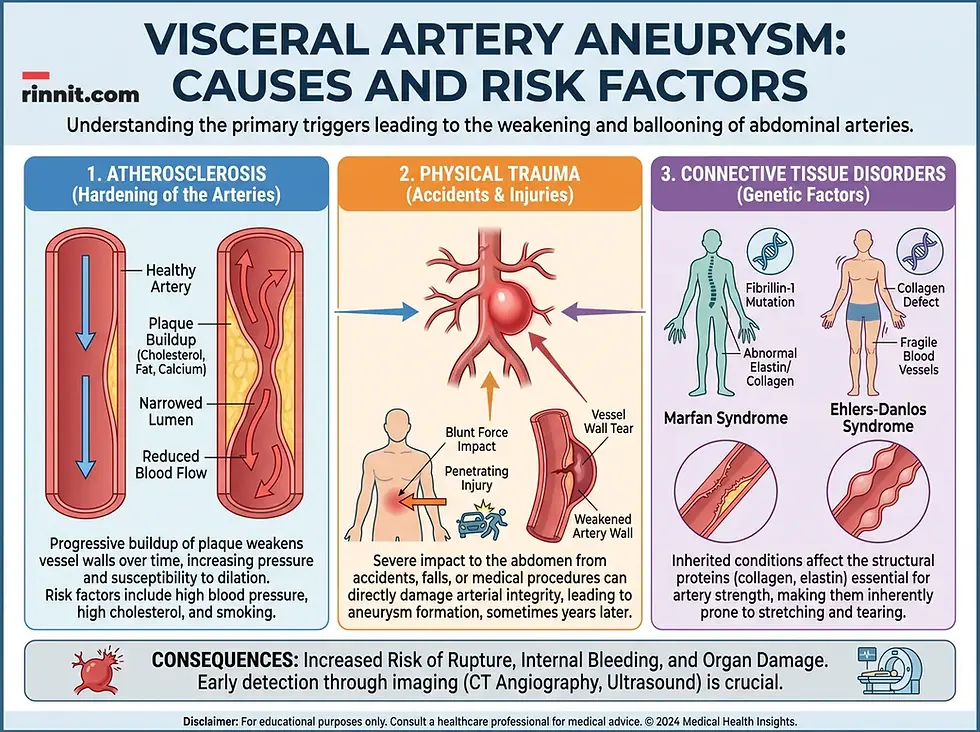
True aneurysms are often the result of long-term vascular issues or genetic conditions. Atherosclerosis, a condition where arteries harden and narrow, is a leading cause. [1] Connective tissue diseases, such as Marfan syndrome, Ehlers-Danlos syndrome, and fibromuscular dysplasia, also significantly increase the risk of arterial wall weakening. [1] Additionally, physical trauma from accidents can lead to the formation of an aneurysm. [1]
Pseudoaneurysms typically have different triggers, often stemming from localized inflammation or injury. Common causes include complications from liver or pancreatic surgery, bouts of pancreatitis, or vasculitis (inflammation of the blood vessels). [1] The instability of the wall formed around these leaks makes pseudoaneurysms particularly dangerous regardless of their size. [1]
Diagnosis and Evaluation
Healthcare providers utilize advanced medical imaging to diagnose and measure visceral artery aneurysms. CT scans and MRIs are the standard tools for assessing the size and precise location of the ballooning artery. These measurements are vital for determining whether the condition requires immediate intervention or can be safely monitored over time. [1]
In some cases, a minimally invasive procedure called angiography is performed. This involves inserting a thin catheter into a vein and threading it to the affected abdominal artery. A contrast dye is then injected, allowing X-rays or CT images to highlight abnormal areas [1] with high precision. If an aneurysm is identified during this test, providers can sometimes deliver treatment through the same catheter immediately. [1]
Management and Treatment Roadmap
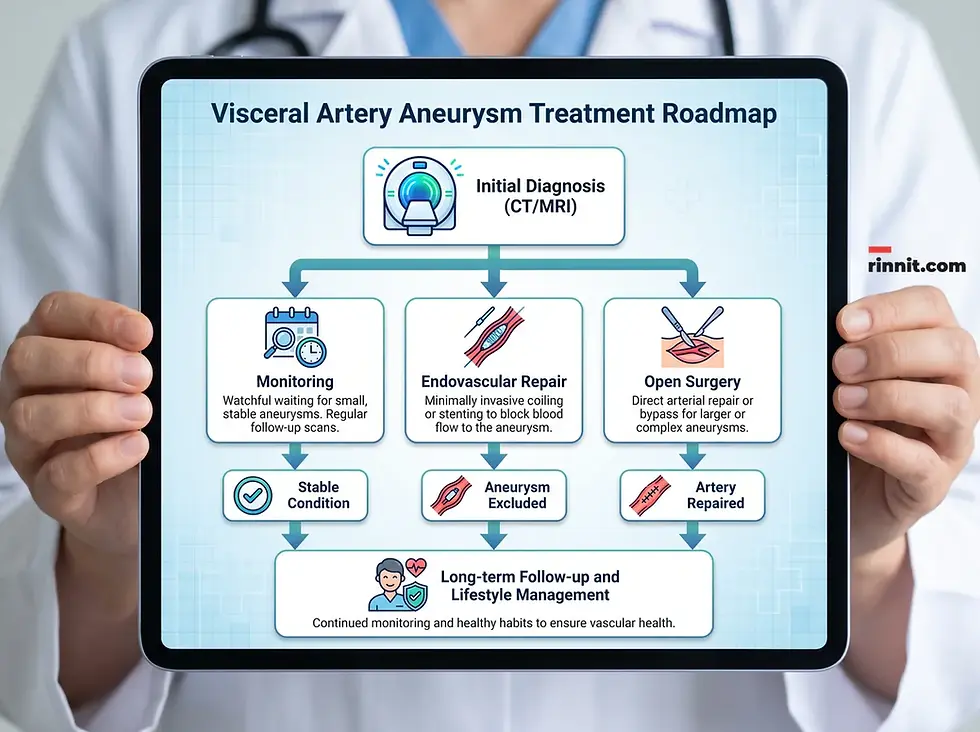
Treatment decisions for visceral artery aneurysms are highly individualized, focusing on the size, type, and location of the aneurysm, as well as the patient's overall health. [1] For small, true aneurysms (typically less than 2 centimeters), providers may recommend "watchful waiting." [1] This involves routine monitoring through imaging to ensure the aneurysm is not growing, often combined with blood pressure medications [1] to reduce stress on the artery walls.
When Intervention Is Necessary
Surgical or endovascular repair is generally recommended for any aneurysm that poses a high risk of bursting. This includes all pseudoaneurysms regardless of size, and true aneurysms larger than 2 centimeters (or 3 centimeters for those in the splenic artery). [1] Immediate treatment is also prioritized for aneurysms located in the superior mesenteric, gastroduodenal, or pancreaticoduodenal arteries due to their higher likelihood of rupture. [1]
Treatment Modality | Description and Application |
Monitoring | Routine imaging and blood pressure management for small, stable true aneurysms. [1] |
Endovascular Repair | Minimally invasive coiling, stenting, or liquid embolization via a catheter. [1] |
Open Surgery | Direct surgical repair or replacement of the damaged artery section through an incision. [1] |
Recovery and Outlook
Both minimally invasive endovascular procedures and traditional open surgeries are considered safe and effective. [1] [2] Endovascular techniques typically offer faster recovery times and shorter hospital stays, though they may occasionally require a follow-up procedure. [1] [2] The overall outlook is significantly better for individuals whose aneurysms are treated before they cause symptoms or rupture. [1] Approximately 25% of those who seek emergency care for a visceral artery aneurysm are already experiencing a rupture [1], which carries a much higher risk of mortality.
Conclusion
Visceral artery aneurysms are complex vascular conditions that require careful evaluation by medical specialists. While many remain silent for years, the risk of rupture makes early detection and professional monitoring essential. By managing underlying factors like blood pressure and atherosclerosis, individuals can often reduce the risk of aneurysm growth and complications.
If you have been diagnosed with an abdominal aneurysm or have a family history of connective tissue disorders, consult a vascular specialist to discuss a personalized monitoring and care plan.
Related reading: Abdominal Aortic Aneurysm (AAA): Complete Guide to Symptoms, Causes, Screening, and Treatment Options | Fibromuscular Dysplasia (FMD): Complete Guide to Symptoms, Diagnosis, and Treatment | Pancreatitis: Symptoms, Causes, and Treatment — A Clear Guide to Understanding and Managing the Condition
Sources: Cleveland Clinic — Visceral Artery Aneurysm | Barrionuevo et al., 2019 | Akbulut & Otan, 2015 | Aung et al., 2022
Frequently Asked Questions
1. What exactly is a visceral artery aneurysm?
A visceral artery aneurysm is a weakened, bulging area in one of the arteries that supplies blood to the organs in your abdomen.
2. Are these aneurysms common?
No, they are considered rare, though their exact frequency is unknown because they often cause no symptoms.
3. What is the difference between a true aneurysm and a pseudoaneurysm?
A true aneurysm is a bulge in the artery wall itself, while a pseudoaneurysm is a leak where blood pools and forms a weak, unstable wall outside the artery.
4. Which organs are most commonly affected?
Aneurysms most often occur in the arteries leading to the spleen, kidneys, and liver.
5. Can women be more at risk for certain types?
Yes, females are more likely to develop aneurysms in the splenic artery (the artery leading to the spleen).
6. What are the primary symptoms of a rupture?
The main signs are sudden, severe pain in the back or abdomen and signs of anemia.
7. How are these aneurysms usually found?
Visceral artery aneurysms are typically discovered by chance during CT scans or MRIs performed for other medical conditions.
8. What causes the artery walls to weaken?
Leading causes include atherosclerosis, physical trauma, and genetic connective tissue diseases like Marfan syndrome.
9. Is surgery always required?
No. Small, stable true aneurysms under 2 centimeters may be monitored with regular imaging instead of surgery.
10. What is angiography?
Angiography is a minimally invasive test where a catheter and dye are used to get a highly detailed look at the blood vessels.
11. When is immediate treatment necessary?
Treatment is required for pseudoaneurysms of any size, true aneurysms over 2-3cm, or those in specific high-risk arteries.
12. What are endovascular procedures?
Endovascular procedures are minimally invasive treatments where a provider uses a catheter to place coils, plugs, or stents to repair the aneurysm.
13. Can lifestyle changes help?
Yes. Managing cholesterol and blood pressure through diet, exercise, and avoiding tobacco can help prevent atherosclerosis-related aneurysms.
14. What is the risk if an aneurysm ruptures?
A rupture is life-threatening and requires emergency care; studies show at least 10% of people with a rupture do not survive.
15. Is the outlook better if it's found early?
Yes, outcomes are significantly better for patients whose aneurysms are treated before they cause symptoms or burst.
References
Cleveland Clinic. Visceral Artery Aneurysm. Cleveland Clinic. July 26, 2022. https://my.clevelandclinic.org/health/diseases/17620-visceral-artery-aneurysm
Barrionuevo P, Malas MB, Nejim B, et al. A systematic review and meta-analysis of the management of visceral artery aneurysms. J Vasc Surg. 2019;70(5):1694-1699. PMID 31126761. https://doi.org/10.1016/j.jvs.2019.02.024
Akbulut S, Otan E. Management of Giant Splenic Artery Aneurysm: Comprehensive Literature Review. Medicine (Baltimore). 2015;94(27):e1016. PMID 26166071. https://doi.org/10.1097/MD.0000000000001016
Aung YY, Berry C, Jayaram PR, et al. Splenic artery aneurysm in pregnancy: A systematic review. Int J Gynaecol Obstet. 2022;160(1):1-11. PMID 35598155. https://doi.org/10.1002/ijgo.14278
Medical disclaimer
The information provided in this article is for educational purposes only and should not be used as a substitute for professional medical advice, diagnosis, or treatment. Always seek the advice of your physician or other qualified health provider with any questions you may have regarding a medical condition. Never disregard professional medical advice or delay in seeking it because of something you have read here.



Comments