
Virilization: Causes, Symptoms, and Treatment Options

Updated: 3 days ago
Medically reviewed by Dr. Baraa Alnahhal, MD · Last reviewed: October 2026
Quick Answer: What is virilization and how is it treated?
Virilization is a process in which a female develops male characteristics because the body has too much androgen. Causes include congenital adrenal hyperplasia, PCOS, tumors and anabolic steroid use. Signs include increased facial hair, acne and a deepening voice. Treating the cause can reverse some changes, but a deeper voice or an enlarged clitoris may be permanent. [1]
What the research says
One inherited cause, congenital adrenal hyperplasia, affects about 1 in 9,500 births. A systematic review and meta-analysis of 58 studies from 31 countries found an overall incidence of classic congenital adrenal hyperplasia of 1 in 9,498 (95% CI 1:9,089–1:9,945), with 21-hydroxylase deficiency behind approximately 95% of cases (Navarro-Zambrana & Sheets, Hormone Research in Paediatrics, 2022) [2].
Virilization is a red flag that deserves a work-up. A clinical review reports that polycystic ovary syndrome and idiopathic hyperandrogenism account for more than 85% of hirsutism cases, while women with rapid onset of hirsutism over a few months or signs of virilization are at high risk of having an androgen-secreting tumor (Matheson & Bain, American Family Physician, 2019) [3].
Androgen-secreting tumors are uncommon but important to exclude. A review of hyperandrogenism reports that an ovarian androgen-secreting tumor is diagnosed in 1–3 of every 1,000 patients presenting with hirsutism and makes up less than 0.5% of all ovarian tumors; once a source is suspected, MRI of the adrenal glands or ovaries is recommended (Yoldemir, Climacteric, 2021) [4].
What Is Virilization?
Virilization is a process in which a female develops male physical characteristics, or a newborn shows signs of exposure to male hormones at birth. It is driven by an excess of androgens, the hormones typically associated with male development. It can happen if your adrenal glands make too much androgen or if you take anabolic steroids [1].

A female can develop virilization at any age. In males, virilization is less obvious: if signs aren't apparent at birth, they may become apparent during puberty [1].
Affected group | Common signs of virilization |
|---|---|
Adult females | Smaller breasts, irregular periods, an enlarged clitoris, and a shrinking uterus |
Newborns | Visible signs of male hormone exposure at birth |
Males | Less obvious; many males who produce excess androgen start puberty earlier than their peers, and in adult males excess adrenal hormones might suppress testicular function and lead to infertility |
Symptoms and Causes
Recognizing the Symptoms
Symptoms vary from person to person and may include [1]:
Increased facial or body hair
Acne or oily skin
Irregular periods
Male pattern baldness
Smaller breast size
An enlarged clitoris
Deepening of the voice
Increased sex drive
It is important to tell virilization apart from hirsutism, which is limited to increased body hair — most commonly on the face, chest, belly, back, and inner thighs — and causes less severe symptoms than virilization [1].
Underlying Causes
The main cause of virilization is the overproduction of male hormones (androgens). Health conditions that may result in excess androgens include [1]:
Adrenal conditions: congenital adrenal hyperplasia (a genetic condition) and adrenal gland tumors such as adrenal adenoma.
Ovarian conditions: polycystic ovary syndrome (PCOS) and ovarian tumors.
Hormonal disorders: Cushing syndrome.
External factors: taking anabolic steroids to enhance physical performance, which is more common in sports like weightlifting.
Diagnosis and Management
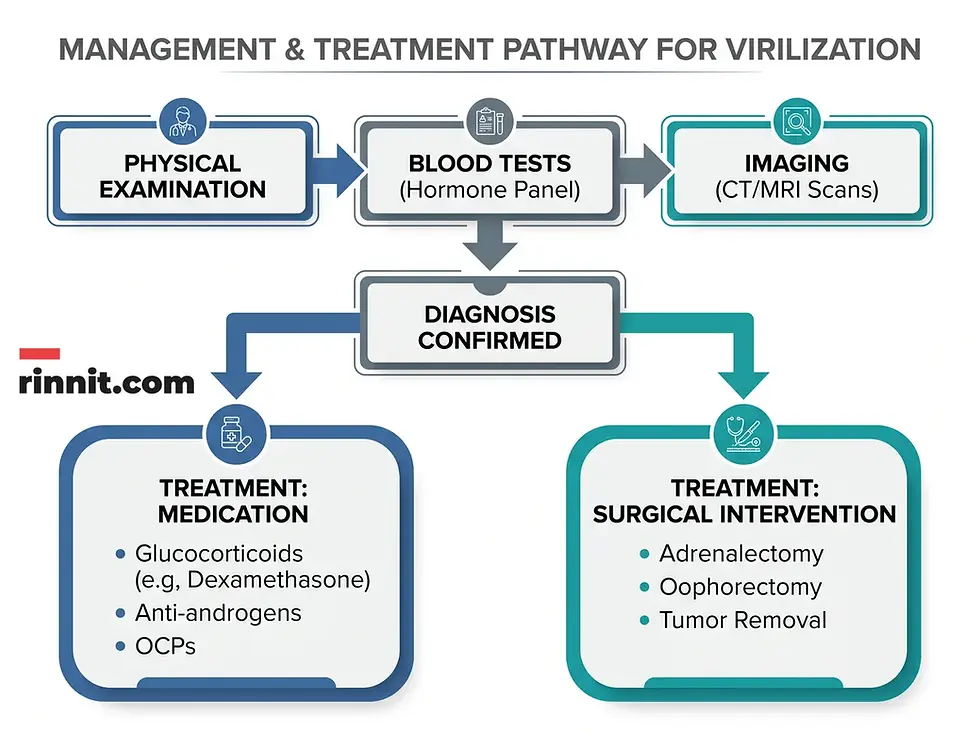
A healthcare provider will do a physical examination and review your symptoms and medical history [1]. To confirm the diagnosis, they may request:
Blood tests to measure your androgen levels
Imaging tests, such as an ultrasound, CT scan, or MRI, to get a better look at your adrenal glands or ovaries
Treatment Pathways
Treatment depends on the cause, and its goal is to reverse virilization [1]:
Cause | Primary treatment strategy |
|---|---|
Genetic conditions (such as congenital adrenal hyperplasia) | Glucocorticoids — a type of steroid that can suppress androgen production in the adrenal glands |
Adrenal tumor | Surgical removal of the affected adrenal gland (adrenalectomy); most adrenal tumors are benign, though rarely they can be cancerous |
Ovarian tumor | Surgery is the standard treatment (oophorectomy); depending on age and pregnancy plans, removal of one ovary and one fallopian tube may preserve the possibility of pregnancy |
Anabolic steroid use | Follow your healthcare provider's instructions; treatment at a specialized voice center may help with vocal changes |
Outlook and Prevention
Virilization is typically reversible with appropriate treatment, and your healthcare provider will build a personalized plan. One possible exception involves anabolic steroids: females who develop virilizing symptoms because of them may experience permanent vocal changes, although some can raise the pitch of their voice again through treatment at a specialized voice center [1].
Preventive Measures
You can't prevent virilization if you have a genetic condition that causes your symptoms, but you can successfully manage the condition with treatment. Females who take anabolic steroids have an increased risk of virilization, so if you take these medications, follow your healthcare provider's instructions to reduce your risk of unwanted symptoms [1].

When to See a Healthcare Provider
You know your body better than anyone. Call a provider any time you notice something out of the ordinary. If you suddenly develop thicker body hair or other symptoms that aren't typical for you, let a provider know — they can find out why and tell you whether they recommend treatment [1].
Conclusion
Virilization is a hormonal process that calls for a careful medical approach to find and treat its root cause. Whether it is driven by a genetic condition, a tumor, or the use of anabolic steroids, it is typically reversible with the right treatment. Developing visible characteristics that don't match how you feel on the inside can take a toll on mental health, and your symptoms may point to an underlying condition — so if you notice signs of virilization, talk to a healthcare provider and take the first step toward diagnosis and treatment [1].
Frequently Asked Questions
What is the main difference between hirsutism and virilization?
Hirsutism is when a female develops increased body hair, most commonly on the face, chest, belly, back, and inner thighs, and its symptoms are less severe than those of virilization. Virilization involves a broader range of male characteristics, such as voice deepening and changes in the body. Like virilization, hirsutism can happen when the adrenal gland makes too much androgen, but it is also a symptom of several other conditions, like PCOS and Cushing syndrome [1].
Is virilization always caused by a tumor?
No. Tumors of the adrenal glands or ovaries can cause virilization, but other causes include congenital adrenal hyperplasia, polycystic ovary syndrome (PCOS), Cushing syndrome, and the use of anabolic steroids [1].
Can virilization symptoms be reversed?
Yes, virilization is typically reversible with appropriate treatment, which depends on the cause. One possible exception is permanent vocal changes in females who develop virilizing symptoms because of anabolic steroids [1].
Why does my voice deepen during virilization?
Excess androgens can thicken the vocal cords, similar to what happens in males during puberty. Deepening of the voice is one of the listed symptoms of virilization [1].
Are there specific risks for males with excess androgens?
Virilization is less obvious in males. Many males who produce excess androgen start puberty earlier than their peers, and in adult males excess adrenal hormones might suppress testicular function and lead to infertility [1].
What is an "undervirilized male"?
The term refers to a person who is male but produces lower-than-typical levels of androgen, which results in female characteristics [1].
How is congenital adrenal hyperplasia related to virilization?
Congenital adrenal hyperplasia (CAH) is an inherited condition in which defects in adrenal enzymes impair the production of cortisol, aldosterone, or both [2]. It is one of the health conditions that can lead to excess androgens and virilizing symptoms, and glucocorticoids are used to suppress androgen production when a genetic condition like CAH is the cause [1].
Should I see a doctor for increased facial hair?
Yes. Call a healthcare provider any time you notice something out of the ordinary, such as suddenly thicker body hair or other symptoms that aren't typical for you. They can find out why and whether treatment is recommended [1].
Can voice changes from steroids be fixed?
Females who develop virilizing symptoms because of anabolic steroids may have permanent vocal changes, but some can raise the pitch of their voice again through treatment at a specialized voice center [1].
Is virilization common in children?
Virilization can happen at any age. In males, excess androgen often shows up as puberty starting earlier than in their peers, and if signs aren't apparent at birth they may become apparent during puberty [1].
Related Reading
Understanding the Endocrine System: Functions, Organs, and Health — how the adrenal glands and ovaries regulate hormone production
Adrenalectomy: Understanding Adrenal Gland Removal — what the surgery involves
References
Source currency note: The Cleveland Clinic page was last updated on February 26, 2024, and the three studies were checked against PubMed. This article reflects the most current information available from those sources.
Cleveland Clinic. Virilization. Cleveland Clinic. February 26, 2024. https://my.clevelandclinic.org/health/diseases/virilization
Navarro-Zambrana AN, Sheets LR. Ethnic and national differences in congenital adrenal hyperplasia incidence: a systematic review and meta-analysis. Hormone Research in Paediatrics. 2022;96(3):249-258. PMID 35973409. https://doi.org/10.1159/000526401
Matheson E, Bain J. Hirsutism in women. American Family Physician. 2019;100(3):168-175. PMID 31361105. https://pubmed.ncbi.nlm.nih.gov/31361105/
Yoldemir T. Postmenopausal hyperandrogenism. Climacteric. 2021;25(2):109-117. PMID 33988479. https://doi.org/10.1080/13697137.2021.1915273
Medical disclaimer
Health information, not medical advice. This article is for general education and is not a substitute for professional diagnosis or treatment. Always consult a qualified healthcare provider about your own health, and seek emergency care for urgent symptoms.



Comments