Verrucous Carcinoma: Symptoms, Causes, and Treatment Options

Updated: 3 days ago
Medically reviewed by Dr. Baraa Alnahhal, MD · Last reviewed: October 2026
Quick Answer: What is verrucous carcinoma?
Verrucous carcinoma is a rare, slow-growing, highly treatable form of squamous cell carcinoma that forms wart-like lesions, most often in the mouth. [1] It is most common in older males and strongly linked to tobacco use, heavy alcohol use and poor oral hygiene. Surgery cures it for most people [1], and early detection is key to an excellent outcome.
What the research says
Surgery is the preferred treatment. A systematic review and meta-analysis of oral verrucous carcinoma (13 studies, 630 cases) found surgery to be the preferred option. Even when lymph nodes were enlarged they were negative for metastasis, so neck dissection added only unnecessary morbidity, and 23.3% of cases had been given a wrong histopathology diagnosis (Pal et al., Ann Maxillofac Surg, 2023 [2]).
Recurrence after surgery varies widely. A PRISMA systematic review of 49 articles found recurrence rates of 4.6% to 75.0% after wide local excision (margins of 0.5 to 3.0 cm), and an overall recurrence rate of 12.9% with Mohs micrographic surgery (Fawaz et al., J Dermatolog Treat, 2022 [3]).
It is rare, and surgery is the treatment linked to better outcomes. In a SEER database analysis of 2,039 head and neck verrucous carcinoma cases (1973 to 2015), the incidence was 0.075 per 100,000 and declining over time, the median age was 62 (versus 67 for other head and neck cancers), and surgery was the primary treatment that significantly improved prognosis (Wang et al., Medicine, 2020 [4]).
Understanding Verrucous Carcinoma
Verrucous carcinoma is a specialized form of squamous cell carcinoma, a cancer that begins in the squamous cells found in many tissues of the body. These cells line the mouth and throat and form the surface of the skin. [1] This cancer is known for its slow progression and its tendency to stay localized rather than spreading (metastasizing) to distant organs. [1]
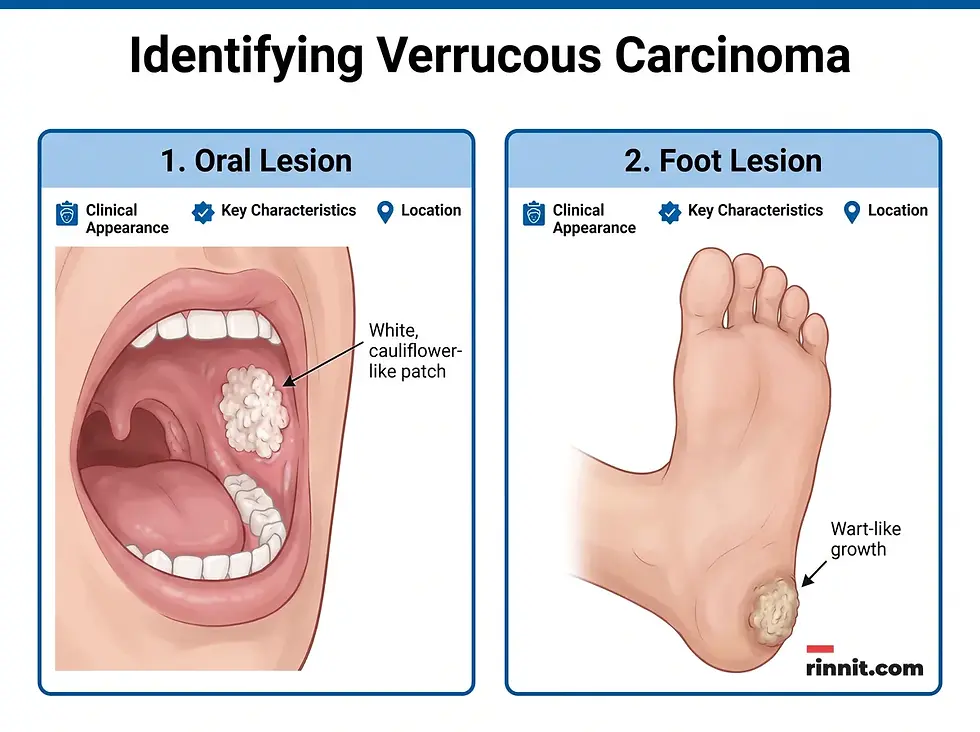
When it occurs in the mouth, it is managed as an oral cancer. It most often forms in the cells lining the cheeks, lips, and inside of the mouth, and it may also affect the gums, tongue, throat, and the bone that holds the tooth sockets. [1] Less often, it develops on the genitals or the feet. On the genitals it is managed as anal, penile, or vulvar cancer, and on the feet it is managed as a skin cancer. [1]
Symptoms and Warning Signs
Because verrucous carcinoma grows slowly, symptoms may not be noticeable for a while. [1] As it progresses, abnormal areas of tissue (lesions) often develop in the mouth, on the genitals, or on the soles of the feet.
Common Symptoms | Description |
Oral lesions | Reddish or white patches or sores in the mouth. [1] |
Physical growths | Warty, cauliflower-like masses in the mouth, on the genitals, or on the feet. [1] |
Oral distress | Trouble chewing or swallowing, or persistent bad breath. [1] |
Localized pain | Pain at the site of the lesion or growth. [1] |
Causes and Risk Factors
Doctors do not know exactly what causes the abnormal cell growth in verrucous carcinoma, but exposure to cancer-causing substances (carcinogens) plays a role. [1] The condition is most common in males, especially those in their 60s and 70s. [1]
Primary Risk Factors
Tobacco use: smoking cigarettes, cigars, or pipes, as well as using smokeless tobacco such as snuff or chewing tobacco. [1]
Alcohol consumption: heavy drinking or alcohol use disorder. [1]
Oral hygiene: chronic poor oral hygiene and long-term inflammation. [1]
Betel nut chewing: chewing betel nuts (areca palm seeds). [1]
Skin conditions: a history of lichen planus or lichen sclerosus. [1]
In some cases the cancer forms after an injury to the mouth or skin, [1] particularly where long-term inflammation is present.

Diagnosis and Clinical Testing
Diagnosis begins with a physical examination and a review of your medical history, including tobacco and alcohol habits. A biopsy, in which a tissue sample is tested for cancer cells, is needed to confirm the diagnosis. [1] To find out whether the cancer has grown into nearby tissue, your provider may order:
Let your provider know if you find lesions in your mouth or on your genitals or feet that could be verrucous carcinoma. This condition will not go away on its own, [1] and early treatment helps keep it from growing or spreading.
Management and Treatment Options
Surgery is the most common treatment for verrucous carcinoma. Once the tumor is removed, most people recover fully. [1] The treatment you need depends on your individual diagnosis.
Treatment Modalities
Treatment type | Application |
Surgery | Primary treatment to remove the tumor; often curative. [1] |
Radiation therapy | Used when a tumor is so large that surgery would damage too much surrounding tissue, or after surgery to destroy remaining cancer cells. [1] |
Chemotherapy | Used for advanced cases to relieve symptoms, with or without radiation. [1] |
Surface therapies | Cryotherapy, laser therapy, or photodynamic therapy for tumors on the skin's surface, with fewer side effects and shorter recovery. [1] |

Outlook and Prognosis
The outlook for verrucous carcinoma is excellent. The five-year survival rate is more than 75%, which means more than 3 out of 4 people who get treatment are alive five years after diagnosis, [1] and many go on to live cancer-free lives. The size of the tumor and your general health also matter. [1] The cancer can come back, [1] but early treatment lowers that risk. Some people need reconstructive surgery if a lot of tissue or bone had to be removed, and surgery on the skin can leave scarring. [1]
Prevention
Lowering your risk is mainly about lifestyle. Avoiding all tobacco products, including cigarettes, cigars, pipes, vaping, and smokeless tobacco, [1] is the most effective step. Drinking alcohol only in moderation [1] and keeping up good oral hygiene can also reduce your risk.
Frequently Asked Questions
1. Is verrucous carcinoma contagious?
No. It is a type of cancer and cannot be spread from person to person.
2. Can it spread to my lungs?
It is rare for verrucous carcinoma to spread (metastasize) to distant organs, though it can grow into nearby tissue and bone.
3. Does it always look like a wart?
Often it has a warty or cauliflower-like appearance, but it can also look like white or red patches or a sore.
4. Is surgery the only option?
Surgery is the most common treatment, but radiation and chemotherapy are also used depending on the tumor's size and stage. Cryotherapy, laser therapy, or photodynamic therapy may be options for tumors on the skin's surface.
5. How long is the recovery after surgery?
Recovery time varies with the size of the tumor removed. Superficial treatments have shorter recovery periods.
6. Can verrucous carcinoma come back?
Yes. Recurrence is possible, so regular follow-up appointments with your provider are important.
7. Is it the same as a common wart?
No. It may look like a wart, but it is a malignant cancer and needs professional medical treatment.
8. What is a betel nut?
A betel nut is a seed from the areca palm. Chewing betel nuts is linked to a higher risk of verrucous carcinoma.
9. Do women get verrucous carcinoma?
Yes. It is more common in males, but women can also develop it.
10. What is a biopsy?
A biopsy is a procedure in which a small sample of tissue is removed and tested in a lab to check for cancer cells.
11. Will I need chemotherapy?
Chemotherapy is generally reserved for advanced cases where surgery alone is not enough.
12. Does poor oral hygiene cause cancer?
Long-term inflammation from poor oral hygiene is a known risk factor for developing oral cancers such as verrucous carcinoma.
13. Is radiation therapy painful?
The treatment itself is not painful, though it can cause side effects such as skin irritation or fatigue.
14. Can I prevent this cancer?
Avoiding tobacco and limiting alcohol are the best ways to lower your risk.
15. What is the survival rate?
The five-year survival rate is more than 75% for people who receive treatment.
Related Reading
Trusted External Resources
References
Cleveland Clinic. Verrucous Carcinoma. Cleveland Clinic. Last updated January 6, 2026. https://my.clevelandclinic.org/health/diseases/22286-verrucous-carcinoma
Pal US, Maurya H, Yadav SK, et al. Protocol for treatment of oral verrucous carcinoma: a systematic review and meta-analysis. Ann Maxillofac Surg. 2023;13(1):88-94. PMID 37711531. https://doi.org/10.4103/ams.ams_65_23
Fawaz B, Vieira C, Decker A, et al. Surgical treatment of verrucous carcinoma: a review. J Dermatolog Treat. 2022;33(4):1811-1815. PMID 33849379. https://doi.org/10.1080/09546634.2021.1914312
Wang N, Huang M, Lv H. Head and neck verrucous carcinoma: a population-based analysis of incidence, treatment, and prognosis. Medicine (Baltimore). 2020;99(2):e18660. PMID 31914052. https://doi.org/10.1097/MD.0000000000018660
Medical Disclaimer
This article is for informational purposes only and does not constitute medical advice. Always seek the advice of your physician or other qualified health provider with any questions you may have regarding a medical condition. Never disregard professional medical advice or delay in seeking it because of something you have read in this article.



Comments