Vaginismus: Symptoms, Causes, and Treatment Options

Updated: 3 days ago
Medically reviewed by Dr. Baraa Alnahhal, MD · Last reviewed: October 2026
Editorial note: This article is provided for educational purposes only. It is not medical advice. Always consult a qualified healthcare professional about your individual health situation.
Quick Answer
Vaginismus is a condition in which the muscles around the vaginal opening contract uncontrollably in response to anticipated or attempted penetration. This involuntary spasm can make intercourse, pelvic exams or tampon use painful. It is diagnosed through a symptom review and gentle pelvic exam. Treatment is highly effective, including pelvic floor physical therapy, counseling and gradual dilation therapy.
What the research says
Most people who are treated are able to have penetrative intercourse. A systematic review and meta-analysis of 43 observational studies (1,660 women) and 3 randomized trials (264 women) found that about 79% of treated women completed penetrative intercourse (success rate 0.79, 95% CI 0.74–0.83), regardless of the therapy used. The evidence is limited by the small number of trials and by the lack of a comparison group in the observational studies (Maseroli et al., J Sex Med, 2018).
Combining psychological and physical therapies appears to work best. A 2026 systematic review and meta-analysis of 18 studies with 863 patients reported pooled success rates of 86% for combined psychosexual interventions, 85% for pelvic floor physiotherapy, 85% for botulinum toxin injection, 82% for cognitive-behavioral therapy and 78% for vaginal dilator therapy. Diagnostic criteria and outcome definitions varied between studies (Zulfikaroglu, J Sex Med, 2026).
A history of sexual or emotional abuse is linked to higher odds of vaginismus. A meta-analysis of 14 case-control studies (1,428 participants) found higher odds of vaginismus with a history of sexual abuse (odds ratio 1.55, 95% CI 1.14–2.10) and emotional abuse (odds ratio 1.89, 95% CI 1.24–2.88), but no significant link with physical abuse. The authors suggest these histories should be asked about sensitively and addressed in treatment (Tetik & Yalçınkaya Alkar, J Sex Med, 2021).
Important: Consult a healthcare provider if you experience persistent pain during vaginal penetration. While not typically a medical emergency, sudden and severe pelvic pain accompanied by fever or heavy bleeding requires immediate clinical evaluation to rule out acute infections or other underlying complications.
What Is Vaginismus?
Vaginismus is a medical condition characterized by the involuntary tensing or contracting of the muscles surrounding the vagina. This reaction occurs automatically when something—such as a finger, tampon, medical instrument, or penis—attempts to enter the vaginal canal. These muscle spasms are out of a person’s control and can range from mild discomfort to intense pain [1].
In clinical settings, healthcare providers may refer to this condition as genito-pelvic pain/penetration disorder (GPPPD), a term that combines vaginismus and dyspareunia (painful intercourse). Vaginismus can significantly impact intimacy, relationship health, and the ability to undergo necessary medical screenings [1].
Symptoms and Recognition
The primary indicator of vaginismus is the automatic tightening of the vaginal opening when penetration is anticipated or attempted. Symptoms may be present from the first attempt at penetration or develop later in life after years of pain-free activity [1].
Common signs include:
Painful Intercourse: Discomfort or sharp pain during sexual activity involving penetration.
Tampon Difficulties: Difficulty or inability to insert tampons comfortably.
Pelvic Exam Distress: Intense muscle spasms or pain during gynecological examinations.
Involuntary Spasms: A physical “closing” of the vaginal opening that cannot be consciously relaxed.

Causes and Contributing Factors
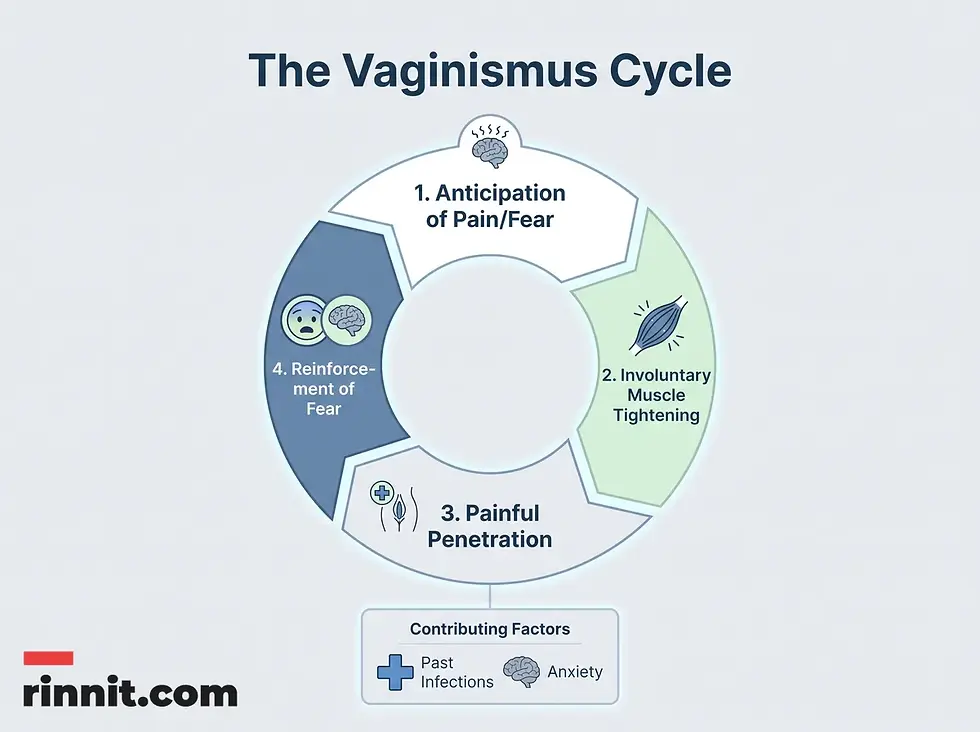
While the exact cause of vaginismus is not always known, it is widely believed to be a physical response to a fear of pain. This creates a cycle where the anticipation of pain leads to muscle tightening, which then makes penetration painful, reinforcing the original fear [1].
Factors contributing to vaginismus
Category | Contributing Factors |
Physical Factors | Past yeast infections, pelvic surgery, vaginal delivery trauma, or painful pelvic exams. |
Emotional Factors | Anxiety about sex, negative beliefs about intimacy, or fear of pregnancy. |
Traumatic Factors | History of sexual assault, abuse, or highly painful first sexual experiences. |
Idiopathic | Cases where no specific psychological or physical trigger is identified. |
Diagnosis and Evaluation
Diagnosis is primarily conducted by a gynecologist who will review your medical and sexual history. Honesty about your symptoms is essential for an accurate diagnosis. A pelvic exam is often recommended to rule out other physical causes of pain, such as infections or structural issues [1].
To make the exam more comfortable, providers may suggest:
Communication: Discussing the steps of the exam beforehand.
Visual Aids: Using a mirror so you can see what the provider is doing.
Patient Control: Allowing you to guide the provider’s hand during the examination.
Management and Treatment
Vaginismus is highly treatable, with approximately 80% of individuals responding well to a multi-therapy approach. Treatment plans are individualized to address both the physical and emotional components of the condition [1].
Primary Treatment Modalities
Pelvic Floor Physical Therapy: A specialist teaches exercises to help you consciously relax and control your pelvic muscles.
Talk Therapy: Counseling with a psychologist or sex therapist helps address fears, negative beliefs, and relationship distress.
Vaginal Dilator Therapy: The use of tube-shaped devices of increasing sizes at home to help the body gradually get used to penetration [1].
Vaginismus treatment roadmap
Step | Focus | Goal |
Step 1: Clinical Consultation | Diagnosis and history review. | Identify triggers and rule out other conditions. |
Step 2: Combined Therapy | Physical therapy and counseling. | Relax muscles and address the fear-pain cycle. |
Step 3: Gradual Dilation | At-home dilator use. | Restore comfort with vaginal penetration. |

Conclusion
Vaginismus is a distressing but treatable condition that does not have to be a permanent barrier to intimacy or health. By addressing the involuntary muscle response through specialized therapy and support, most people can achieve a significant reduction in pain and a restoration of function.
Ready to take the next step? Speak with a gynecologist or a pelvic health specialist today to discuss a customized recovery plan and regain control over your body.
Related reading: Chronic Pelvic Pain: Symptoms, Causes & Treatment — A Clear Guide
Sources: Cleveland Clinic — Vaginismus | Maseroli et al., 2018 | Zulfikaroglu, 2026 | Tetik & Yalçınkaya Alkar, 2021
Frequently Asked Questions
1. Is vaginismus permanent?
No, it is a treatable condition. Most people see significant improvement with consistent therapy.
2. Can I still get pregnant if I have vaginismus?
Yes, though it may be more challenging if penetrative sex is impossible. Treatment can help restore the ability for intercourse.
3. Does vaginismus go away on its own?
Vaginismus typically does not go away without treatment, as the fear-pain cycle tends to reinforce itself.
4. How long does treatment take?
Treatment duration varies by individual, but many notice improvements within several weeks to a few months of consistent therapy.
5. What does a vaginal dilator do?
A vaginal dilator helps the vaginal muscles and the brain get used to the sensation of penetration in a controlled, gradual way.
6. Is pelvic floor therapy painful?
The goal is to reduce pain. Therapists work within your comfort level to help you relax your muscles.
7. Can stress cause vaginismus?
General anxiety and stress can contribute to muscle tension, which may exacerbate the condition.
8. Is vaginismus the same as a yeast infection?
No, but a painful yeast infection can sometimes be a trigger that leads to the development of vaginismus.
9. Do I need surgery for vaginismus?
Surgery is rarely needed; most cases are managed through physical and talk therapy.
10. Can men have a similar condition?
Vaginismus is specific to vaginal muscles, but men can experience other types of pelvic floor dysfunction.
11. Will my partner understand?
Open communication is key. Many couples find that attending therapy together helps strengthen their relationship.
12. Is it okay to use lubricants?
Yes, water-based lubricants can help reduce friction and discomfort during therapy or attempts at intimacy.
13. Can I use tampons during treatment?
As your comfort increases through therapy, you may gradually be able to use tampons again.
14. Is vaginismus common?
While exact numbers vary, it is a recognized condition that many women experience at some point in their lives.
15. What if therapy doesn’t work?
If your current plan isn’t helping, talk to your provider about adjusting your approach or seeking a second opinion from a specialist.
References
Cleveland Clinic. Vaginismus. Cleveland Clinic. July 11, 2025. https://my.clevelandclinic.org/health/diseases/15723-vaginismus
Maseroli E, Scavello I, Rastrelli G, et al. Outcome of Medical and Psychosexual Interventions for Vaginismus: A Systematic Review and Meta-Analysis. J Sex Med. 2018;15(12):1752-1764. PMID 30446469. https://doi.org/10.1016/j.jsxm.2018.10.003
Zulfikaroglu E. Vaginismus treatment: a systematic review and meta-analysis of contemporary therapeutic approaches. J Sex Med. 2026;23(1):qdaf295. PMID 41148166. https://doi.org/10.1093/jsxmed/qdaf295
Tetik S, Yalçınkaya Alkar Ö. Vaginismus, Dyspareunia and Abuse History: A Systematic Review and Meta-analysis. J Sex Med. 2021;18(9):1555-1570. PMID 34366265. https://doi.org/10.1016/j.jsxm.2021.07.004
Medical disclaimer
This content is for informational purposes only and does not constitute medical advice. Always seek the advice of a physician or other qualified health provider with any questions regarding a medical condition.



Comments