Understanding the Vas Deferens

Updated: 3 days ago
Medically reviewed by Dr. Baraa Alnahhal, MD · Last reviewed: October 2026
The vas deferens, also known as the ductus deferens or sperm duct, is a critical muscular tube within the male reproductive system responsible for transporting mature sperm from the testicles to the urethra. [1] Typically existing in pairs, these ducts play a vital role in fertility by ensuring the successful delivery of sperm during ejaculation. [1] While conditions such as congenital absence or infections like vasitis can affect their function, medical advancements allow for various diagnostic tests and treatments. Understanding the anatomy and purpose of the vas deferens is essential for reproductive health awareness and family planning.
Quick Answer: What is the vas deferens?
The vas deferens is a long, fibromuscular tube, 30 to 45 centimeters in length, that carries sperm from the epididymis to the ejaculatory duct through rhythmic muscle contractions during sexual arousal. [1] It is essential for male fertility and is the site targeted during a vasectomy for permanent contraception. [1]
What the research says
Vasovasostomy is linked with better results than vasoepididymostomy. A meta-analysis of 13 studies (6,867 patients) found that microsurgical vasovasostomy was associated with higher patency than vasoepididymostomy (OR 6.98, 95% CI 4.23-11.50), higher natural pregnancy odds (OR 2.01, 95% CI 1.38-2.91) and higher overall live-birth odds (OR 2.79, 95% CI 1.67-4.67) (Alhanifa et al., International Braz J Urol, 2026) [2].
Vasectomy shows an association, not a proven cause, with prostate cancer. A pooled analysis of 19 cohort studies (over four million participants) found a small association between vasectomy and prostate cancer of any grade (RR 1.09, 95% CI 1.05-1.14), but Mendelian randomization found no genetic causal link, and the authors note vasectomy can remain a viable long-term contraceptive choice (Wang et al., BMC Cancer, 2025) [3].
Azoospermia evaluation relies heavily on history and examination. A systematic review describes azoospermia as a severe form of male infertility in which no sperm are present in the ejaculate, and reports that evaluation centers on patient history and physical examination with selected hormone tests, a karyotype and screening for Y chromosome microdeletions (Punjani et al., Arab Journal of Urology, 2021) [4].
Anatomy and Structure
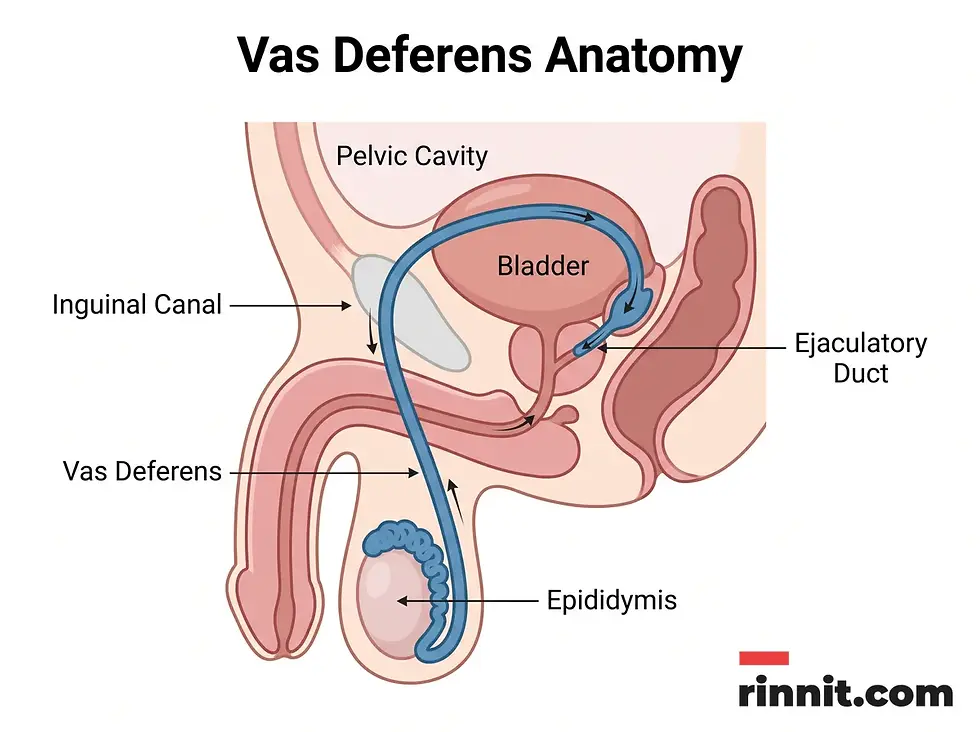
The vas deferens is a complex structure designed for the efficient movement of biological material through the pelvic cavity.
Feature | Description |
Location | Starts in the scrotum at the epididymis, travels through the pelvic cavity, and joins the seminal vesicle duct. [1] |
Length | Typically ranges from 30 to 45 centimeters (approximately 12 to 18 inches). [1] |
Composition | A fibromuscular tube consisting of both fibrous and muscle tissues. [1] |
Enclosure | Protected within the spermatic cord alongside blood vessels and nerves. |
Reproductive Function
The primary role of the vas deferens is the active transport of sperm cells as they prepare for ejaculation.
Sperm Transport
Sperm cells are produced in the testes and stored in the epididymis until they reach maturity. [1] Upon sexual arousal, the muscular walls of the vas deferens undergo contractions that propel the sperm forward. [1] As the sperm travels through the duct, secretions from other glands are added to form the final semen that is eventually expelled through the urethra. [1]
Comparison to Other Systems
While the vas deferens is unique to the male reproductive system, the fallopian tubes in the female reproductive system serve a comparable purpose by transporting eggs from the ovaries to the uterus. [1]

Medical Conditions and Symptoms
Several clinical issues can arise within the vas deferens, ranging from congenital abnormalities to inflammatory infections.
Common Disorders
Congenital Absence: Some individuals are born without one or both ducts, a condition often linked to cystic fibrosis that can result in infertility. [1]
Vasitis: Also known as deferentitis, this involves inflammation or infection of the duct, often causing swelling and pain. [1]
Blockages: Trauma or severe infections can lead to physical obstructions within the tube [1], preventing the passage of sperm.
Vasectomy: A common surgical procedure where the ducts are intentionally cut or sealed to provide a permanent form of birth control. [1]
Signs and Symptoms
Individuals experiencing issues with their vas deferens may notice localized pain, swelling in the scrotum, unusual discharge, or difficulties with fertility. Sudden, severe pain in the scrotum or testicle, especially with swelling, nausea or vomiting, is an emergency that needs immediate care, because it can be testicular torsion. [1] Azoospermia, the absence of sperm in the semen, is a significant indicator of potential ductal problems. [1]

Diagnostic Testing and Care
Maintaining reproductive health involves regular monitoring and timely medical intervention when symptoms occur.
Healthcare providers use a variety of tools to assess the health of the vas deferens. A physical exam involving gentle palpation of the scrotum is typically the first step. [1] Further diagnostic measures may include scrotal ultrasounds, MRI scans, and semen analysis to evaluate sperm count and motility. [1] In some cases, a biopsy or lab tests of blood and urine are required to identify infections or other underlying issues. [1]
To keep the reproductive system healthy, individuals are encouraged to maintain a balanced diet, stay hydrated, avoid tobacco, and practice safe sex to prevent infections. [1] Wearing protective gear during sports is also crucial to avoid traumatic injury to the pelvic area. [1]
Conclusion
The vas deferens is an indispensable component of male reproductive biology, facilitating the journey of sperm and playing a central role in human fertility. By understanding its anatomy, function, and the conditions that can affect it, individuals can take proactive steps to maintain their reproductive health and seek appropriate medical care when necessary.
Frequently Asked Questions
What is the vas deferens?
The vas deferens is a muscular tube in the male reproductive system that transports mature sperm from the epididymis to the urethra.
How long is the vas deferens?
The vas deferens is typically between 30 and 45 centimeters long, or about 12 to 18 inches.
What happens to the vas deferens during a vasectomy?
During a vasectomy, the vas deferens is cut or sealed to prevent sperm from entering the semen, providing permanent birth control.
Can you be born without a vas deferens?
Yes, some people are born without one or both ducts, a condition known as congenital absence of the vas deferens, which is often associated with cystic fibrosis.
What is vasitis?
Vasitis is the inflammation or infection of the vas deferens, which can cause pain and swelling in the pelvic or scrotal area.
Does the vas deferens produce sperm?
No, sperm is produced in the testes; the vas deferens only serves as a transport tube for mature sperm.
What are the symptoms of a blocked vas deferens?
Symptoms can include scrotal pain, swelling, and infertility due to the absence of sperm in the semen.
How do doctors test the health of the vas deferens?
Doctors use physical exams, ultrasounds, MRI scans, and semen analysis to check for blockages or other issues.
Can a blocked vas deferens be repaired?
In many cases, surgery can be performed to remove blockages or repair the duct to restore fertility.
Do women have a vas deferens?
No, women do not have a vas deferens; the fallopian tubes are the closest functional equivalent in the female reproductive system.
Related Reading
Vasectomy: Procedure, Recovery, Effectiveness and Risks explains the birth-control procedure that cuts or seals the vas deferens.
CBAVD: What It Means, What Causes It, and How People With CBAVD Have Biological Children covers being born without a vas deferens and fertility options.
Epididymitis: Symptoms, Causes, and Treatment explains inflammation of the tube that feeds sperm into the vas deferens.
Male Infertility: Causes, Symptoms, Tests, and Treatments Explained describes the causes, tests and treatments for male infertility.
References
Cleveland Clinic. Vas Deferens. Cleveland Clinic. Last updated April 11, 2022. https://my.clevelandclinic.org/health/body/22763-vas-deferens
Alhanifa AF, Mahapradana PT, Artawan PKA, et al. Patency, Pregnancy, and Live Birth Outcomes of Microsurgical Vasovasostomy Compared with Vasoepididymostomy for Vasectomy Reversal: A Systematic Review and Meta-Analysis. International Braz J Urol. 2026;52(6). PMID 42490507. https://doi.org/10.1590/S1677-5538.IBJU.2026.0353
Wang L, Chen SY, Wan S, et al. Vasectomy and prostate cancer risk: a pooled of cohort studies and Mendelian randomization analysis. BMC Cancer. 2025;25(1):332. PMID 39994603. https://doi.org/10.1186/s12885-025-13750-8
Punjani N, Kang C, Lamb DJ, et al. Current updates and future perspectives in the evaluation of azoospermia: A systematic review. Arab Journal of Urology. 2021;19(3):206-214. PMID 34552771. https://doi.org/10.1080/2090598X.2021.1954415
Medical disclaimer
The information provided in this article is for educational purposes only and should not be used as a substitute for professional medical advice, diagnosis, or treatment. Always seek the advice of your physician or other qualified health provider with any questions you may have regarding a medical condition.



Comments