Understanding the Uvula

Updated: 2 days ago
Medically reviewed by Dr. Baraa Alnahhal, MD · Last reviewed: October 2026
The uvula is a small, teardrop-shaped fleshy ball hanging from the back of the soft palate in the throat. [1] Primarily found in humans, it serves several critical roles, including secreting saliva to keep the mouth hydrated, preventing food and liquid from entering the nasal cavity during swallowing, and aiding in the formation of specific speech sounds. [1] While it is a vital part of the gag reflex to prevent choking, it is possible for individuals to live without a uvula if surgical removal is required for conditions like severe snoring or sleep apnea. [1]
Quick Answer: What is the uvula?
The uvula is a teardrop-shaped piece of tissue hanging from the soft palate at the back of the roof of the mouth. [1] It moistens the throat with saliva and moves backward during swallowing to block the nasal passage. [1] It also plays a role in speech and triggers the gag reflex, helping prevent foreign objects from entering the airway.
What the research says
The uvula is part of a finely tuned muscle system. A narrative review of 75 studies on soft palate anatomy reports that the musculus uvulae and palatopharyngeus contain more Type II (fast) fibers, which support rapid velopharyngeal closure, while noting substantial variability between individuals (Miller et al., Clinical Anatomy, 2026) [2].
Palate surgery can reduce snoring and daytime sleepiness. A meta-analysis of 55 studies (1,815 adults) found that palatopharyngeal surgery without tonsillectomy reduced the Epworth Sleepiness Scale score by a mean of 3.3 points (95% CI 2.7-3.9) and snoring intensity by 4.1 points (95% CI 3.7-4.6), with considerable heterogeneity between studies (Tschopp et al., The Laryngoscope, 2026) [3].
A split uvula can occasionally accompany a hidden palate cleft. In a study of 5,004 patients with orofacial clefts, submucous cleft palate with or without a bifid uvula accounted for 0.64% of cases, and the authors advise thorough examination of any cleft deformity (Chauhan and Sharma, The Cleft Palate-Craniofacial Journal, 2023) [4].
Anatomy and Location
The uvula is a central component of the soft palate, positioned at the very back of the oral cavity. Its appearance is often compared to a small punching bag or a teardrop, and it is composed of a complex mix of connective tissue, muscle fibers, and specialized glands.
While most people have a single, central uvula, there are anatomical variations. For instance, a bifid uvula is split in two and occurs in approximately 2% of the population as a congenital trait. [1] Others may have an elongated uvula, which is considered a variation of normal anatomy. [1]

Functions of the Uvula
Although its purpose was once debated, medical experts now recognize several key functions that the uvula performs to maintain oral and respiratory health.
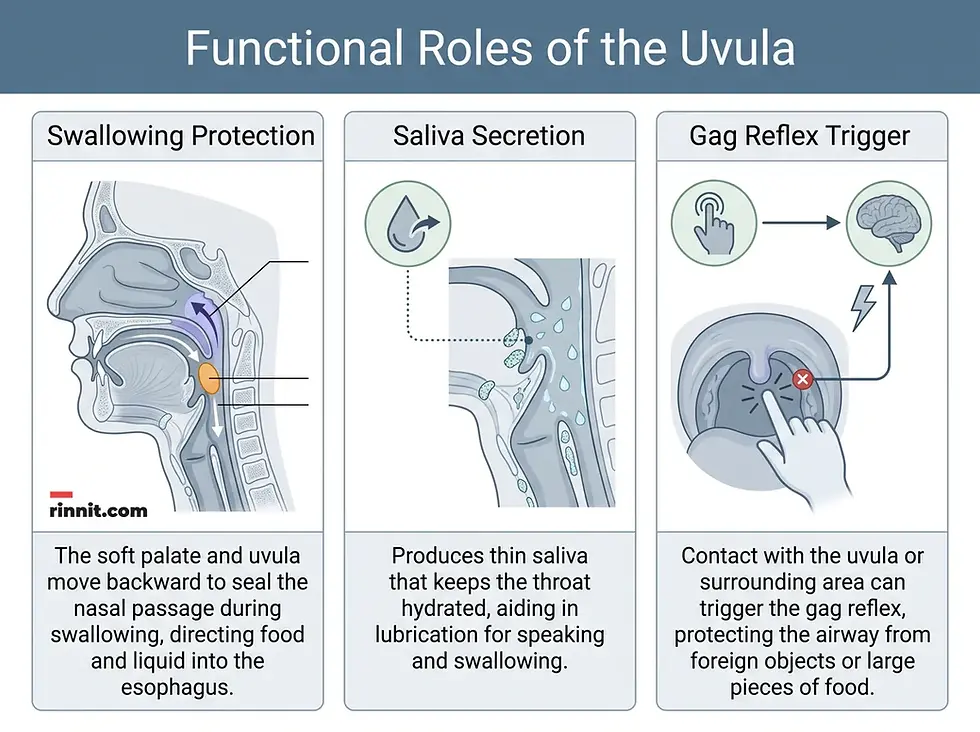
Hydration: The glands within the uvula secrete saliva, which helps keep the mouth and throat moist. [1]
Swallowing Protection: When you swallow, the soft palate and uvula move backward to seal off the nasopharynx, preventing food and drink from going up your nose. [1]
Speech Production: The uvula is essential for articulating certain "uvular" sounds common in languages like French and German.
Safety Mechanism: As part of the gag reflex, it helps the body detect and expel objects that might cause choking if they move down the airway incorrectly. [1]
Common Conditions and Disorders
The uvula can be affected by various infections, allergies, and anatomical issues that may cause discomfort or signaling problems.
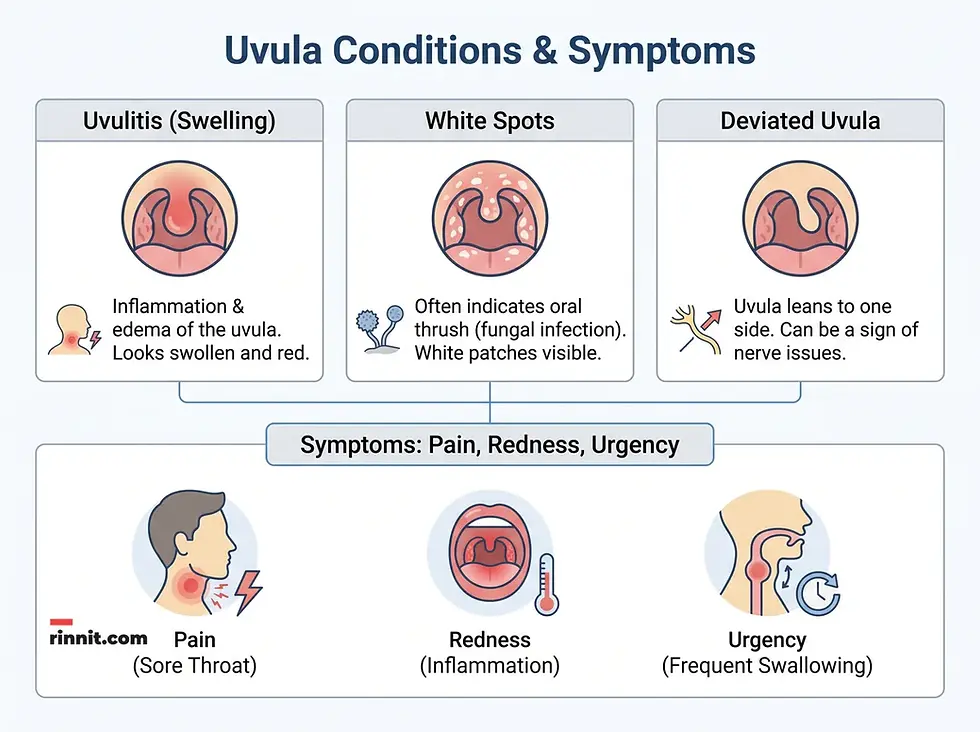
Uvulitis: Inflammation and swelling of the uvula, often caused by strep throat, the flu, or seasonal allergies. Chronic snoring can also lead to this condition. [1]
White Spots: These may indicate oral thrush, tonsillitis, or uvular necrosis, the latter sometimes occurring after medical intubation. [1]
Deviated Uvula: A condition where the uvula leans to one side, which can be a sign of cranial nerve weakness or a peritonsillar abscess. [1]
Uvular Bumps: While often benign, any new growth on the uvula should be evaluated to rule out oropharyngeal cancer. [1]
Treatments typically focus on the underlying cause, such as antibiotics for bacterial infections or antihistamines for allergies. [1] In severe cases of snoring or obstructive sleep apnea, a surgical procedure called a uvulectomy may be performed to remove part or all of the tissue. [1]
Conclusion
The uvula is a small but multifunctional organ that plays a significant role in swallowing, speech, and oral hydration. While it is a distinctive human trait that contributes to our daily comfort and safety, it is also susceptible to various inflammatory and infectious conditions. Understanding its function and monitoring for changes in its appearance can help ensure long-term throat health.
Frequently Asked Questions
What is the uvula?
The uvula is the small, fleshy piece of tissue that hangs from the back of the roof of your mouth.
What is the main purpose of the uvula?
The uvula's primary roles are to secrete saliva to moisten the throat and to prevent food from entering the nose during swallowing.
Can you live without a uvula?
Yes, it is possible to live without a uvula, and many people undergo a uvulectomy to treat severe snoring or sleep apnea.
What causes a swollen uvula?
Common causes include viral or bacterial infections (like strep throat), allergies, and chronic snoring.
What does "uvula" mean?
The word "uvula" is derived from the Latin word for "little grape."
Is a split uvula normal?
A split or "bifid" uvula is a congenital variation that affects about 2% of the population and is generally considered normal.
How does the uvula help with speech?
The uvula helps form specific sounds, particularly in languages that use uvular consonants, such as French or German.
What should I do if my uvula has white spots?
White spots can be a sign of infection like thrush or strep throat; you should consult a healthcare provider for a diagnosis.
What is a uvulectomy?
A uvulectomy is a surgical procedure to remove part or all of the uvula, often to address sleep-related breathing issues.
Does the uvula trigger the gag reflex?
Yes, touching the uvula or the surrounding soft palate can trigger the gag reflex to help prevent choking.
Related Reading
Bifid Uvula: The Split in the Little Ball at the Back of Your Throat That Usually Causes No Problems at All explains a split uvula and its possible link to cleft palate.
Obstructive Sleep Apnea: Symptoms, Causes, and What Actually Helps covers sleep apnea warning signs, testing and treatment.
Uvulopalatopharyngoplasty (UPPP): A Surgical Approach to Sleep Apnea explains throat surgery that trims the uvula to treat sleep apnea.
Tonsillitis: Symptoms, Causes, Diagnosis and Treatment — What You Need to Know explains tonsil infection symptoms and when treatment is needed.
References
Cleveland Clinic. Uvula. Cleveland Clinic. Last updated April 6, 2022. https://my.clevelandclinic.org/health/body/22674-uvula
Miller JCD, Mills N, Chan HF, et al. Anatomy of the Soft Palate and Its Role in Upper Airway Function: A Narrative Review. Clinical Anatomy. 2026. PMID 42418278. https://doi.org/10.1002/ca.70183
Tschopp S, Meinert F, Mantokoudis G, et al. Patient-Reported Outcomes of Palatopharyngeal Surgery Without Tonsillectomy: A Meta-Analysis. The Laryngoscope. 2026;136(9):3706-3717. PMID 41906272. https://doi.org/10.1002/lary.70526
Chauhan JS, Sharma S. Morphological Presentation of Orofacial Clefts: An Epidemiological Study of 5004 Patients in a Tertiary Care Hospital of Central India. The Cleft Palate-Craniofacial Journal. 2023;60(2):219-224. PMID 34787506. https://doi.org/10.1177/10556656211057739
Medical disclaimer
The information provided in this article is for educational purposes only and should not be used as a substitute for professional medical advice, diagnosis, or treatment. Always seek the advice of your physician or other qualified health provider with any questions you may have regarding a medical condition.



Comments