Understanding the Substantia Nigra: The Brain’s Movement and Chemistry Center

Updated: 3 days ago
Medically reviewed by Dr. Baraa Alnahhal, MD | Last reviewed: October 17, 2026

Quick Answer
The substantia nigra is a small, dark band of tissue in the midbrain that is part of the basal ganglia and helps control movement. [1] Its pars reticulata uses GABA to block unwanted signals to muscles, while its pars compacta makes dopamine, which influences movement, muscle tone, motivation and risk and reward. [1] Its dark color comes from melanin. [1]
What the research says
Exercise improves motor symptoms in Parkinson’s disease, the best-known condition of the substantia nigra. A Cochrane network meta-analysis of 154 randomized trials (7,837 people, mostly with mild to moderate disease) found beneficial effects of most exercise types compared with no exercise; for example, dance lowered motor scores on the UPDRS-M scale by 10.18 points (95% CI −14.87 to −5.36; moderate confidence), well beyond the 2.5-point minimum clinically important difference. The trials were small, and the authors note that the exact exercise type may matter less than staying active ([Ernst et al., Cochrane Database of Systematic Reviews, 2024](https://doi.org/10.1002/14651858.CD013856.pub3)) [2].
Glial cells do not outnumber neurons 10 to 1. Counting cells in four adult male human brains, researchers found about 86.1 billion neurons and 84.6 billion non-neuronal cells, roughly one to one, challenging the widely quoted ten-to-one ratio ([Azevedo et al., Journal of Comparative Neurology, 2009](https://doi.org/10.1002/cne.21974)) [3]. This count covers the whole brain, not the substantia nigra alone.
The Dual Architecture of the Substantia Nigra
The substantia nigra is not a single uniform structure. It is divided into two sections with different chemistry and connections, [1] and they work together so that movements are precise and cognitive processes such as learning and judgment are properly regulated.
Section | Primary Chemical | Functional Role |
Pars reticulata | GABA (gamma-aminobutyric acid) | Inhibits brain cell activity to redirect or stop signals that should not reach the muscles; has connections involved in eye movement, learning, and thinking |
Pars compacta | Dopamine | Controls movement and muscle tone; has connections involved in emotions, learning, motivation, and risk-reward judgment |
You have two substantiae nigrae, one on each side of the midbrain, which is the top part of the brainstem. [1] Each has its own pars reticulata and pars compacta. [1] They are tiny, with about 25 average-sized substantiae nigrae fitting into a single golf ball, but they are essential parts of the basal ganglia, the group of structures that form connections and circuits throughout the brain. [1]
Cellular Composition and Unique Pigmentation
“Substantia nigra” is Latin for “black substance.” [1] Most of the brain is pinkish-gray, but this region appears as a dark band surrounded by lighter tissue because its cells contain melanin, the same pigment that darkens skin when it tans. [1]
Two main types of cells make up the structure. Neurons send and relay electrical and chemical signals using axons, dendrites, and synapses, and many have a protective coating of myelin around the axon. [1] Glial cells are support cells that do not relay signals themselves but help the neurons that do: they help develop and maintain neurons, protect the nervous system from infection, control its chemical balance, and make the myelin coating. [1] Glial cells are often said to outnumber neurons ten to one, but careful counts of the whole human brain show the two are present in roughly equal numbers. [3]
Impact of Conditions Affecting the Substantia Nigra
When the substantia nigra is affected by disease, injury, or toxins, the result is often a disruption of movement and clear thinking. [1] Parkinson’s disease is the classic example: it is caused by the loss of dopamine-producing neurons in this region. Many other conditions can also involve the substantia nigra, [1] and the symptoms depend strongly on the cause.
Condition Category | Examples | Possible Symptoms |
Degenerative and inherited diseases | Parkinson’s disease, Alzheimer’s disease, Huntington’s disease, Lewy body dementia, multiple system atrophy, progressive supranuclear palsy, Wilson’s disease | Tremors, muscle spasms, balance and coordination problems, trouble thinking |
Injury and vascular events | Concussions and other traumatic brain injuries, stroke | Muscle weakness, coordination problems, balance problems |
Toxins, infections, and other causes | Poisons such as trichloroethylene (TCE), brain tumors, infections that cause encephalitis, autoimmune conditions such as lupus | Trouble focusing and problem-solving, eye movement problems, muscle weakness |
Diagnosis often involves imaging such as MRI, CT, or PET scans, along with other tests such as blood tests (which can detect toxins and metals such as copper, mercury, or lead, as well as immune problems), evoked potentials, genetic testing, or a SPECT scan. [1] Treatment depends on the condition. Some conditions respond to medication, others need surgery, and when a cure is not possible the focus is on managing symptoms. [1]

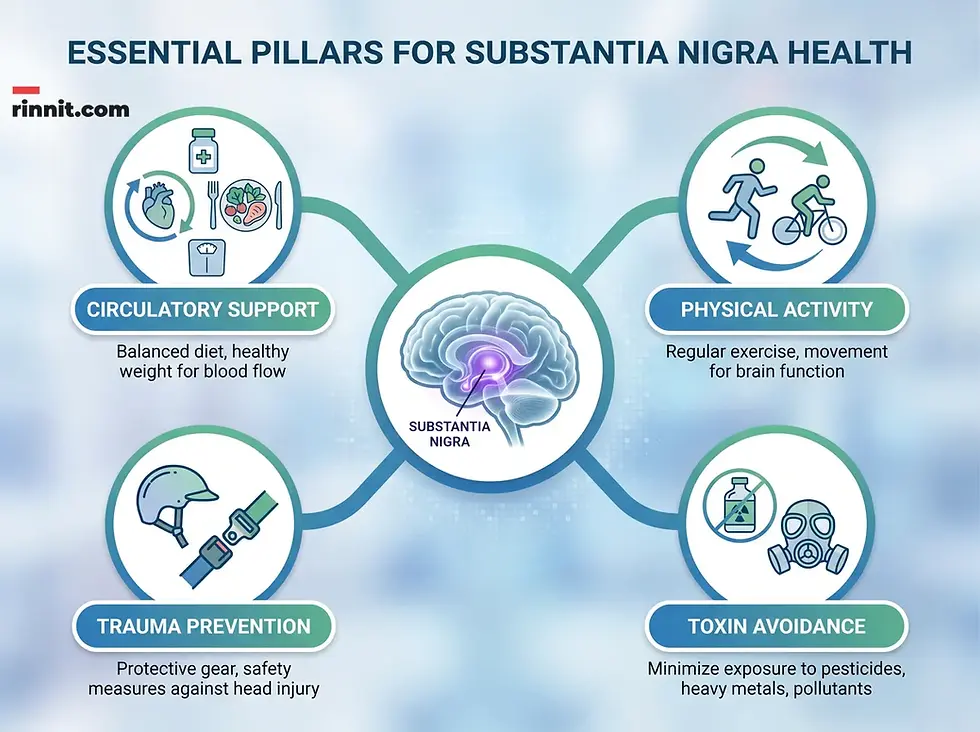
Essential Pillars for Brain and Midbrain Health
Some conditions, including Parkinson’s disease, cannot be predicted or reliably prevented. [1] Even so, many brain conditions can be prevented or delayed, [1] and these habits support the substantia nigra and the rest of the nervous system:
Circulatory support: Eat a balanced diet and keep a healthy weight, since diet and weight affect circulatory and brain health, [1] including blood pressure and stroke risk.
Physical activity: Stay active. Activity helps prevent or delay conditions that affect the brain, especially high blood pressure and stroke. [1]
Trauma prevention: Wear a helmet during high-risk activities and use seatbelts, because head injuries can cause damage that is sometimes permanent. [1]
Toxin avoidance: Minimize exposure to known poisons, such as trichloroethylene (TCE), and other environmental toxins.
Chronic condition management: Treat chronic conditions, which can slow their progression and reduce the impact of symptoms. [1]
Conclusion
The substantia nigra is a key regulator of how we move and, to a degree, how we think. By producing dopamine and GABA signals, this small midbrain structure helps keep our movements controlled and our decisions well judged. Understanding its anatomy and the conditions that affect it is a first step toward better neurological health.
Call to Action
If you or a loved one has persistent tremors, balance problems, or unexplained muscle spasms, talk to a healthcare professional about a neurological evaluation. Early diagnosis helps with managing conditions that affect the substantia nigra and keeping a good quality of life.
Frequently Asked Questions
What is the primary function of the substantia nigra?
It helps control movement and muscle tone, and it influences the brain chemistry involved in learning, mood, judgment, and motivation.
Where is the substantia nigra located?
It is in the midbrain, the top part of the brainstem, deep in the center of the brain.
Why is it called the “black substance”?
The name comes from Latin and reflects its dark appearance, which is due to melanin in its cells.
What is the difference between the two sections of the substantia nigra?
The pars reticulata uses GABA to redirect or stop unwanted signals and is linked to eye movement, while the pars compacta makes dopamine and is linked to movement, emotions, motivation, and risk-reward judgment.
How does the substantia nigra relate to Parkinson’s disease?
Parkinson’s disease is caused by the loss of dopamine-producing neurons in this area, which leads to tremors and movement difficulties.
Can the substantia nigra be seen on a brain scan?
Yes. Imaging such as MRI, CT, and PET can be used when a condition affecting the brain is suspected.
What are the symptoms of a substantia nigra disorder?
Symptoms depend on the condition but can include balance and coordination problems, muscle weakness and spasms, tremors, trouble focusing or problem-solving, and eye movement difficulties.
What is the role of dopamine here?
Dopamine made in the pars compacta helps control movement and muscle tone and influences emotions, motivation, and the judgment of risks and rewards.
How small is the substantia nigra?
Very small. About 25 average-sized substantiae nigrae would fit into a single golf ball.
What is GABA, and why is it in the substantia nigra?
GABA is a chemical that inhibits activity in brain cells. In the pars reticulata it helps redirect and stop signals that should not reach the muscles.
Do I have two substantiae nigrae?
Yes. There is one on each side of the midbrain, and each has a pars reticulata and a pars compacta.
What are glial cells?
They are support cells that help develop and maintain neurons, protect the nervous system from infection, control its chemical balance, and make myelin. Across the whole brain they are roughly as numerous as neurons, not ten times more numerous.
Can toxins damage the substantia nigra?
Yes. Poisons such as trichloroethylene (TCE) can affect it, and blood tests can check for toxins, including metals such as copper, mercury, and lead.
Is it possible to prevent substantia nigra problems?
Many brain conditions can be prevented or delayed with a balanced diet, regular activity, a healthy weight, protective gear, and good management of chronic conditions. Others, including Parkinson’s disease, cannot be predicted or prevented.
What treatments are available for substantia nigra conditions?
Treatment depends on the cause. It can include medication, surgery, and measures to manage symptoms when a cure is not possible.
Related Reading
Parkinson's Disease: Symptoms, Causes, and Treatment — A Clear Guide to Understanding and Managing the Condition explains the movement disorder linked to loss of dopamine cells.
Parkinsonism: Understanding the Umbrella of Movement Disorders covers conditions that cause Parkinson-like slowness and stiffness.
Parkinson's Disease Medications: A Comprehensive Guide to Treatment Options reviews the medicines used to replace or boost dopamine.
Dopamine Agonists: How They Work, What They Treat, and Their Risks explains drugs that mimic dopamine and their side effects.
Sources
Cleveland Clinic. Substantia Nigra (SN). Cleveland Clinic. Last updated May 15, 2022. https://my.clevelandclinic.org/health/body/23010-substantia-nigra-sn
Ernst M, Folkerts AK, Gollan R, et al. Physical exercise for people with Parkinson’s disease: a systematic review and network meta-analysis. Cochrane Database Syst Rev. 2024;4(4):CD013856. PMID: 38588457. DOI: 10.1002/14651858.CD013856.pub3
Azevedo FAC, Carvalho LRB, Grinberg LT, et al. Equal numbers of neuronal and nonneuronal cells make the human brain an isometrically scaled-up primate brain. J Comp Neurol. 2009;513(5):532-541. PMID: 19226510. DOI: 10.1002/cne.21974
Medical disclaimer
The information provided in this article is for educational purposes only and is not intended as medical advice. Always seek the guidance of a qualified healthcare provider regarding any medical condition or treatment.



Comments