Understanding the Splenic Flexure: Anatomy, Function, and Health

Updated: 3 days ago
Medically reviewed by Dr. Baraa Alnahhal, MD | Last reviewed: October 17, 2026

Quick Answer: What is the splenic flexure?
The splenic flexure, or left colic flexure, is the bend at the top left of the large intestine where the transverse colon turns down to become the descending colon, near the spleen and pancreas. [1] Waste passes through it toward the rectum. [1] It is clinically important as a site for trapped gas, volvulus, obstruction and colon cancer. [1]
What the research says
Cancers at the splenic flexure are uncommon, and the type of operation does not clearly change survival. Splenic flexure colon cancer accounts for about 2–5% of colorectal cancers. A meta-analysis of 13 studies (5,918 patients) comparing extended right colectomy, segmental colectomy, and left colectomy found no significant differences in complications, 5-year overall survival, or 5-year disease-free survival; extended right colectomy harvested more lymph nodes but took longer and involved more blood loss. The studies were retrospective, so the authors call for randomized trials (Cao et al., Frontiers in Oncology, 2024) [2].
Laparoscopic surgery for splenic flexure cancer appears safe. A meta-analysis of 7 publications (2,397 patients) found fewer overall complications with laparoscopic than with open colectomy (OR 0.53, 95% CI 0.38–0.75) and less blood loss, with no significant difference in 3- or 5-year overall or disease-free survival (Wu et al., International Journal of Colorectal Disease, 2022) [3].
Anatomy and Functional Role
The splenic flexure sits at the highest point of the large intestine on the left side of the body. [1] To see where it fits, follow the path of digestion. Food first moves through the small intestine and into the large intestine, where it travels up the ascending colon, bends left at the hepatic flexure near the liver, and crosses the abdomen through the transverse colon. At the splenic flexure, the waste turns downward into the descending colon. [1] If the large intestine were a winding staircase, the splenic flexure would be the tight corner you navigate to get down the stairs.
The flexure is also important for blood supply to the colon. [1] Blood reaches this region from both the superior mesenteric artery and the inferior mesenteric artery. [1]
Feature | Description |
Location | Upper left abdomen, near the spleen and the tail of the pancreas |
Alternative name | Left colic flexure |
Primary function | Passage for food waste and a junction in the colon’s blood supply |
Blood supply | Superior and inferior mesenteric arteries |
Nearby structures | Spleen, tail of the pancreas, transverse colon, descending colon |
Common Conditions and Clinical Significance
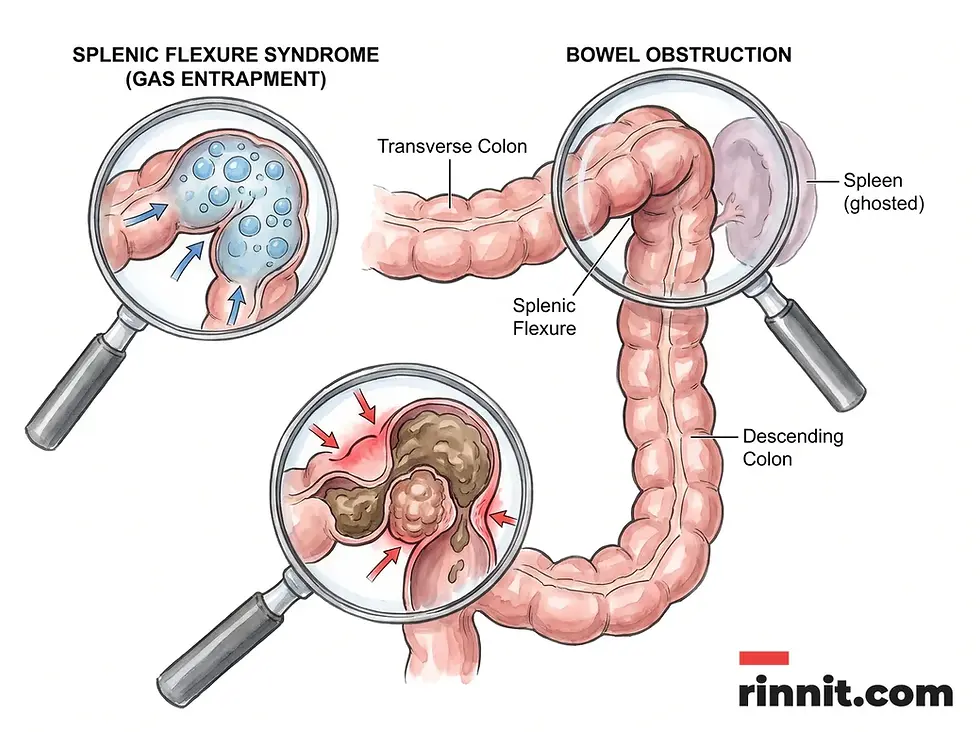
Several conditions can affect the splenic flexure, usually with everyday digestive symptoms such as constipation, diarrhea, gas, or bloating. [1] One of the best known is splenic flexure syndrome, in which gas becomes trapped in the bend and causes bloating and discomfort in the upper left abdomen. Pain in this area is not always from gas, and new or severe chest pain should never be assumed to be digestive, so it needs prompt medical evaluation.
More serious problems include splenic flexure volvulus, in which part of the flexure twists, and bowel obstruction from colon cancer or a cancerous polyp, which can have life-threatening complications. [1] Because the flexure is a tight corner of the colon, it receives particular attention during colonoscopy.
Condition | Description |
Splenic flexure syndrome | Bloating and discomfort caused by gas trapped in the bend |
Volvulus | A twisting of part of the splenic flexure |
Bowel obstruction | A blockage, for example from colon cancer or a cancerous polyp |
Ulcerative colitis | Inflammatory bowel disease that affects the lining of the colon |
Irritable bowel syndrome (IBS) | A functional gut disorder that can cause constipation, diarrhea, gas, and pain |
Diagnostic Approaches and Maintenance
Which tests you need depends on your symptoms. Providers may use a colonoscopy, CT scan, MRI, barium enema, or a complete blood count to look for obstruction, inflammation, or other causes. [1] Persistent bloating, changes in bowel habits, unexplained weight loss, or unusual exhaustion are reasons to see a provider. [1]
Treatment depends on the underlying condition. [1] For trapped gas, a provider may suggest eating fewer carbohydrates and cutting back on sugar substitutes. [1] If a polyp or tumor is found, surgery may be needed to remove it [1] and restore normal flow. Day to day, supporting digestive health means eating a balanced, fiber-rich diet, drinking enough fluid, attending screening as recommended, and keeping track of changes in your bowel habits.

Conclusion
The splenic flexure is a small but important part of the large intestine. It carries waste toward the rectum and sits at a junction in the colon’s blood supply. Recognizing the symptoms linked to this region can lead to earlier diagnosis and better management of digestive health.
Call to Action
If you have persistent abdominal pain, bloating, or changes in your bowel habits, talk to a healthcare professional for a full evaluation of your digestive health.
Frequently Asked Questions
What exactly is the splenic flexure?
The splenic flexure is a bend at the top left of the large intestine, where the transverse colon turns downward into the descending colon.
Where is the splenic flexure located in the body?
The splenic flexure is in the upper left abdomen, near the spleen and the tail of the pancreas.
Why is it called the splenic flexure?
The splenic flexure is named for its closeness to the spleen.
What is another name for the splenic flexure?
The splenic flexure is also called the left colic flexure.
What does the splenic flexure do?
Food waste travels through it on the way to the rectum, and it lies at a junction in the colon’s blood supply.
What is splenic flexure syndrome?
Splenic flexure syndrome is a condition in which the splenic flexure traps gas, causing bloating and discomfort.
What are the symptoms of problems in this area?
Common symptoms include bloating, constipation, diarrhea, gas, and sometimes abdominal pain.
Can the splenic flexure twist?
Yes. A condition called splenic flexure volvulus is a twisting of part of the flexure.
How is the splenic flexure supplied with blood?
The splenic flexure receives blood from both the superior mesenteric artery and the inferior mesenteric artery.
What is the difference between the splenic and hepatic flexures?
The splenic flexure is on the left side near the spleen, while the hepatic flexure is on the right side near the liver.
What tests are used to check this area?
Providers may use a colonoscopy, CT scan, MRI, barium enema, or a complete blood count.
Can colon cancer affect the splenic flexure?
Yes. Colon cancer or a cancerous polyp can develop here and may block the bowel, which can be life-threatening. Cancers at the splenic flexure make up about 2–5% of colorectal cancers.
What are the warning signs of a serious problem?
Unexplained weight loss, unusual exhaustion, and severe or persistent digestive symptoms are reasons to see a provider.
How are splenic flexure conditions treated?
Treatment depends on the cause. It may include dietary changes, treatment for IBS or ulcerative colitis, or surgery to remove a polyp or tumor.
Does diet affect the splenic flexure?
Diet can. For trapped gas, a provider may suggest eating fewer carbohydrates and cutting back on sugar substitutes.
Related Reading
What Is Ischemic Colitis? The Colon Blood Flow Problem That Usually Heals on Its Own — and the Signs That Mean Trouble explains reduced blood flow to the colon and its warning signs.
Gas and Gas Pains: Why They Happen, What Your Body Is Telling You, and What Actually Helps covers trapped gas, bloating and ways to ease it.
Colonoscopy: Purpose, Prep, Procedure, Results and Risks describes the exam used to view the full length of the colon.
Colon Cancer: Symptoms, Screening, Diagnosis, Treatment and Support explains colon cancer symptoms, screening and treatment.
Sources
Cleveland Clinic. Splenic Flexure. Cleveland Clinic. Last updated July 3, 2025. https://my.clevelandclinic.org/health/body/splenic-flexure
Cao Y, He M, Chen K, et al. Short- and long-term outcomes after surgical treatment of 5918 patients with splenic flexure colon cancer by extended right colectomy, segmental colectomy and left colectomy: a systematic review and meta-analysis. Front Oncol. 2024;14:1244693. PMID: 38686198. DOI: 10.3389/fonc.2024.1244693
Wu J, Li B, Tu S, et al. Comparison of laparoscopic and open colectomy for splenic flexure colon cancer: a systematic review and meta-analysis. Int J Colorectal Dis. 2022;37(4):757-767. PMID: 35303158. DOI: 10.1007/s00384-022-04127-5
Medical disclaimer
The information provided in this article is for educational purposes only and is not intended as medical advice. Always seek the guidance of a qualified healthcare provider regarding any medical condition or treatment.



Comments