Understanding the Humerus: Anatomy, Function, and Bone Health

Updated: 3 days ago
Medically reviewed by Dr. Baraa Alnahhal, MD · Last reviewed: October 2026
The humerus is the long bone of the upper arm that connects the shoulder to the elbow [1]. It supports 13 muscles and is essential for arm rotation and movement, though it remains vulnerable to fractures and bone-weakening conditions like osteoporosis [1].
Quick Answer: What is the humerus?
The humerus is the single bone of the upper arm, extending from the shoulder joint to the elbow [1]. The longest bone in the body after those in the legs [1], it supports many muscles and nerves and enables arm movements like flexion and rotation. Weight-bearing exercise, good nutrition and bone density screenings help prevent fractures and support skeletal health.
What the research says
The radial nerve is vulnerable around humeral shaft fractures. In a meta-analysis of 9 studies (1,303 patients who had surgery for a humerus shaft fracture), radial nerve palsy after surgery occurred in 35 of 678 patients treated through the anterolateral approach and 69 of 497 treated through the posterior approach (odds ratio 2.72; 95% CI 1.70-4.35) (Shon et al., Journal of Orthopaedic Science, 2023) [2].
Calcium and vitamin D supplements alone did not clearly lower fracture risk. A meta-analysis of 33 randomized trials (51,145 community-dwelling adults over 50) found no significant association between calcium, vitamin D, or both and hip fracture risk (combined calcium plus vitamin D: RR 1.09; 95% CI 0.85-1.39) (Zhao et al., JAMA, 2017) [3].
Exercise lowers the risk of fall-related fractures. A network meta-analysis of 192 randomized trials in community-dwelling adults aged 65 and older found that exercise was associated with fewer fall-related fractures (risk ratio 0.62; 95% CI 0.42-0.90) and fewer people experiencing falls (risk ratio 0.83; 95% CI 0.77-0.89) (Dautzenberg et al., Journal of the American Geriatrics Society, 2021) [4].
The Critical Role and Function of the Humerus
The humerus is more than just a structural support; it is the primary anchor for the upper arm's complex movement system. By serving as a connection point for 13 different muscles, the humerus allows for the wide range of motion required for daily activities, including lifting, reaching, and rotating the arm [1].
In addition to facilitating movement, the humerus provides essential stability for the lower arm [1]. It forms the upper portion of the elbow joint [1] and works in tandem with the shoulder socket to ensure the entire arm remains secure during high-impact tasks.
Anatomy of the Humerus
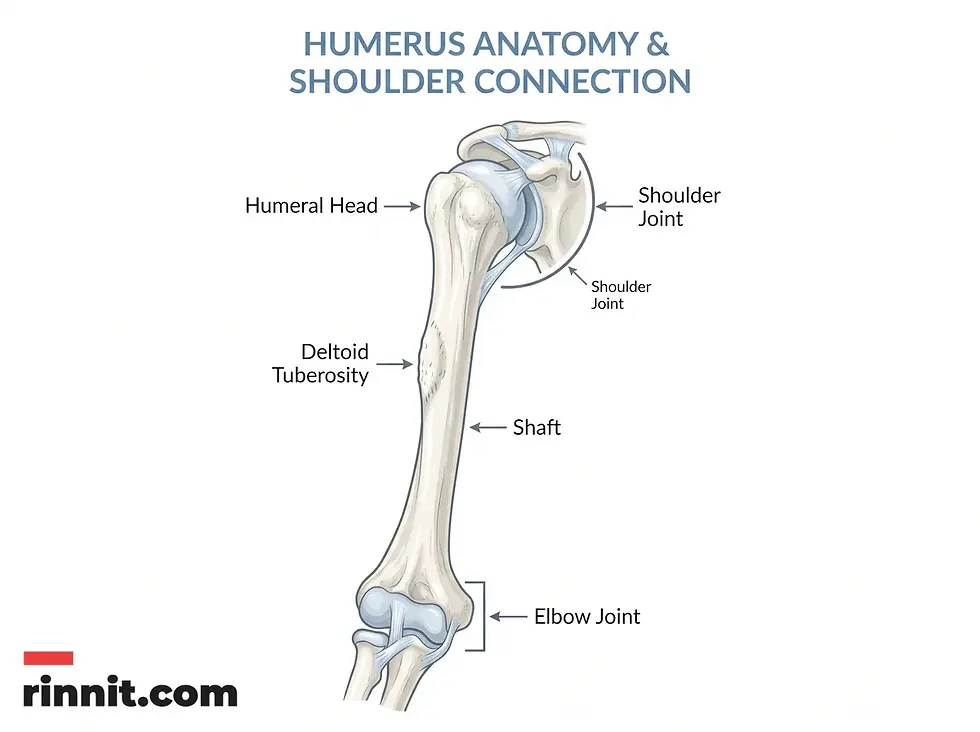
While it appears as a single long shaft, the humerus is composed of several specialized regions that interact with different joints and muscle groups.
Structural Divisions
The humerus is divided into three primary sections: the proximal aspect, the shaft, and the distal aspect [1].
The proximal head is a rounded ball that fits into the shoulder socket [1], while the distal end is flatter to form the hinge of the elbow. The shaft itself provides the necessary length and shape to support the weight of the upper arm.
Common Conditions Affecting the Humerus
The humerus is susceptible to injuries from trauma and long-term bone density loss, both of which can significantly impact arm functionality.
Fractures and Trauma
Humerus fractures are often the result of sudden impacts, such as falls, car accidents, or sports injuries [1]. These fractures can occur at the neck (near the shoulder), along the shaft, or at the distal end near the elbow.
Symptoms: Intense pain, swelling, visible deformity, bruising, and an inability to move the arm [1].
Nerve Involvement: Because the radial nerve runs along the humerus, shaft fractures can injure it (in roughly 1 in 10 cases), affecting movement in the wrist and hand.

Osteoporosis
Osteoporosis is a systemic condition that weakens bone tissue [1], making the humerus more likely to break during minor falls. This condition is particularly common in adults over the age of 50 and post-menopausal females. Since osteoporosis often lacks obvious symptoms, it is frequently diagnosed only after a fracture has occurred [1].
Diagnosis and Treatment Options
Healthcare providers use a variety of diagnostic tools to assess humerus health and determine the best course of action for injuries.
Diagnostic Testing
Treatment Strategies
Treatment for humerus issues depends on the severity of the condition. Minor fractures may only require immobilization with a splint or cast [1], while complex breaks often necessitate surgery to realign the bone with metal plates or screws. For osteoporosis, treatment focuses on vitamin D and calcium supplements, along with medications to slow bone loss.
Maintaining Humerus and Bone Health
Proactive care is essential for preventing humerus injuries and maintaining skeletal strength throughout life.
A balanced diet rich in calcium and vitamin D provides the minerals necessary for bone remodeling. Regular weight-bearing exercise also stimulates bone growth and strengthens the 13 muscles attached to the humerus. Additionally, individuals should practice fall prevention by decluttering workspaces and using proper safety equipment during sports or home maintenance tasks [1] [4].

Conclusion
The humerus is a vital component of the human skeletal system, enabling the versatile movements of the upper arm while supporting a vast network of muscles and nerves. By prioritizing bone density screenings and practicing consistent safety measures, individuals can protect this essential bone from the long-term effects of osteoporosis and the sudden impact of traumatic injuries.
Next step: If you are concerned about your bone health or recovering from an arm injury, schedule a consultation with an orthopedic specialist to discuss a personalized care and strengthening plan.
Frequently Asked Questions
Where is the humerus bone located?
The humerus is the single bone of the upper arm, located between the shoulder and the elbow.
Is the humerus the longest bone in the body?
The humerus is the longest bone in the upper body, but the leg bones (femur) are longer.
What does a humerus fracture feel like?
A fracture typically causes immediate, sharp pain, along with swelling, tenderness, and an inability to move the arm normally.
How many muscles attach to the humerus?
There are 13 muscles connected to the humerus that help with arm movement and stability.
What is a "funny bone" hit?
While often called the funny bone, the sensation actually comes from hitting the ulnar nerve near the distal end of the humerus.
Can osteoporosis cause humerus fractures?
Yes, osteoporosis weakens the bone, making it much more likely to break from a minor fall or impact.
How is a broken humerus treated?
Treatment varies from wearing a cast or sling to undergoing surgery for more complex fractures.
What is a DEXA scan?
A DEXA scan is a low-level X-ray test used to measure bone density and screen for osteoporosis.
Can you damage nerves when you break your humerus?
Yes, the radial nerve is particularly vulnerable during humerus shaft fractures.
How can I keep my humerus healthy?
Focus on a diet high in calcium and vitamin D, engage in regular exercise, and follow safety tips to prevent falls.
Related Reading
Understanding Humerus Fractures: Types, Symptoms, and Recovery covers types of upper arm fractures and how they heal.
Shoulder Joint: Anatomy, Function, and Common Conditions explains how the shoulder joint works and its common problems.
Osteoporosis: Causes, Symptoms, Diagnosis and Treatment Explained explains bone thinning, fracture risk and treatment options.
Radial Nerve: Function, Pathway, Symptoms and When to Seek Care describes the arm nerve that can be injured with humerus fractures.
References
Cleveland Clinic. Humerus. Cleveland Clinic. Last updated January 3, 2023. https://my.clevelandclinic.org/health/body/24612-humerus
Shon HC, Yang JY, Lee Y, et al. Iatrogenic radial nerve palsy in the surgical treatment of humerus shaft fracture - anterolateral versus posterior approach: a systematic review and meta-analysis. Journal of Orthopaedic Science. 2023;28(1):244-250. PMID 34716068. https://doi.org/10.1016/j.jos.2021.09.015
Zhao JG, Zeng XT, Wang J, et al. Association between calcium or vitamin D supplementation and fracture incidence in community-dwelling older adults: a systematic review and meta-analysis. JAMA. 2017;318(24):2466-2482. PMID 29279934. https://doi.org/10.1001/jama.2017.19344
Dautzenberg L, Beglinger S, Tsokani S, et al. Interventions for preventing falls and fall-related fractures in community-dwelling older adults: a systematic review and network meta-analysis. Journal of the American Geriatrics Society. 2021;69(10):2973-2984. PMID 34318929. https://doi.org/10.1111/jgs.17375
Medical disclaimer
The information provided in this article is for educational purposes only and should not be used as a substitute for professional medical advice, diagnosis, or treatment. Always seek the advice of your physician or other qualified health provider with any questions you may have regarding a medical condition.



Comments