Understanding the Brachial Artery: Anatomy, Function, and Health

Updated: 3 days ago
Medically reviewed by Dr. Baraa Alnahhal, MD · Last reviewed: October 2026
TL;DR: The brachial artery is the main blood vessel that delivers oxygen-rich blood to the upper arm, elbow, forearm, and hand. It begins near the armpit as a continuation of the axillary artery, runs down the front of the upper arm, and splits into the radial and ulnar arteries at the inner elbow. [1] It is the artery a blood pressure cuff squeezes and a standard pulse point. A warm, swollen, discolored, or painful arm needs prompt medical care.
Get medical help right away: Swelling in one arm, pale, red, or blue skin, warm areas, or painful sores on the fingers can signal a blood clot or a blocked artery. After an arm injury, a pale, cold, or numb hand is an emergency. Call your local emergency number.
Quick Answer: What is the brachial artery?
The brachial artery is the major blood vessel that carries oxygen-rich blood to the upper arm, elbow, forearm and hand. It continues from the axillary artery near the armpit, runs down the front of the upper arm and divides into the radial and ulnar arteries at the inner elbow. [1] It is also a standard pulse point and blood pressure site.
What the research says
Brachial artery function tracks heart and stroke risk. In a systematic review and meta-analysis of 35 studies with 17,280 participants, each 1% rise in brachial flow-mediated dilation (an ultrasound test of how well the artery widens) was linked to a 12% lower risk of cardiovascular events (adjusted relative risk 0.88, 95% CI 0.84-0.91) (Matsuzawa et al., J Am Heart Assoc, 2015) [2].
The ankle-brachial index adds to standard risk scores. Across 16 population cohorts (24,955 men and 23,339 women), a low ankle-brachial index (0.90 or less) went with a 10-year cardiovascular death rate of 18.7% in men versus 4.4% with a normal index, and 12.6% versus 4.1% in women (Fowkes et al., JAMA, 2008) [3].
Brachial artery access for procedures is relatively safe. In a meta-analysis of 31 studies, haematoma after percutaneous brachial artery access occurred in 4.76% of cases and pseudoaneurysm in 1.06% (Khan et al., Vasc Endovasc Surg, 2025) [4].
Key takeaways
The brachial artery supplies the upper arm, elbow, forearm, and hand. You have one in each arm.
It continues from the axillary artery and ends at the inner elbow by splitting into the radial and ulnar arteries.
Its branches, in order, are the deep brachial, superior ulnar collateral, and inferior ulnar collateral arteries, then the radial and ulnar arteries.
Blood pressure cuffs, pulse checks, and the ankle-brachial index (ABI) test all rely on it.
Trauma, peripheral artery disease, and complications of dialysis access can affect it. A warm, swollen, discolored, or painful arm needs prompt medical care.
What does the brachial artery do and where does it run?
The brachial artery and its branches deliver oxygen and nutrients to the bones, nerves, and soft tissues of your arm. Muscles it helps nourish include the biceps, triceps, and coracobrachialis. [1] Because it lies close to the skin along the front of the biceps, clinicians can reach it easily, which is why it is used in several routine checks.
Use | How the brachial artery is involved |
Blood pressure check | The cuff around your upper arm compresses the artery to measure pressure. [1] |
Ankle-brachial index (ABI) | Pressure in the brachial artery is compared with pressure near the ankle to help diagnose peripheral artery disease (PAD). [1] |
Pulse point | A provider can feel the brachial pulse just above the elbow crease. [1] |
Procedure access | Surgeons can occasionally use it as an entry point for catheter-based (endovascular) procedures. [1] |

What is the structure of the brachial artery and how does it branch?
The brachial artery runs along the front of the biceps near the skin, beside the median nerve [1], and several arteries branch off it between the armpit and inner elbow. Like other arteries, its wall has three layers:
Tunica intima (inner layer): endothelial cells form a smooth lining for blood to flow through.
Tunica media (middle layer): smooth muscle lets the artery widen and narrow.
Tunica adventitia (outer layer): strong connective tissue gives the artery its shape. [1]
Several arteries branch off along its course, from just below the armpit to the inner elbow:
Branch | Order of origin | Where it goes |
Deep brachial artery (profunda brachii) | First branch | Runs alongside the radial nerve to the deeper tissues of the arm. [1] |
Superior ulnar collateral artery | Second branch (in some people it arises from the deep brachial artery) | Supplies the upper elbow region. |
Inferior ulnar collateral artery | Third branch | Links with other vessels around the elbow joint. |
Radial artery | Terminal branch | Runs from the elbow crease to the base of the thumb. [1] |
Ulnar artery | Terminal branch | Runs from the elbow crease to the base of the little finger. [1] |

What conditions affect the brachial artery and what are the warning signs?
Brachial artery problems include peripheral artery disease, trauma from fractures or deep cuts, and rare aneurysms or pseudoaneurysms, and arm changes can signal a clot or blockage.
Peripheral artery disease (PAD): plaque buildup limits blood flow, and clots can form on the plaque. PAD usually affects the legs but can also involve arm arteries such as the brachial artery. [1]
Trauma: broken bones, especially near the shoulder or elbow, and deep cuts can damage the artery. [1]
Aneurysm: a weak, bulging area in the artery wall. It is rare in the brachial artery but can occur as a complication of an arteriovenous (AV) fistula made for dialysis access [1] (see our guide to the dialysis fistula).
Pseudoaneurysm: also rare, usually after an injury. It involves only some layers of the artery wall [1] (read more in Understanding Pseudoaneurysm).
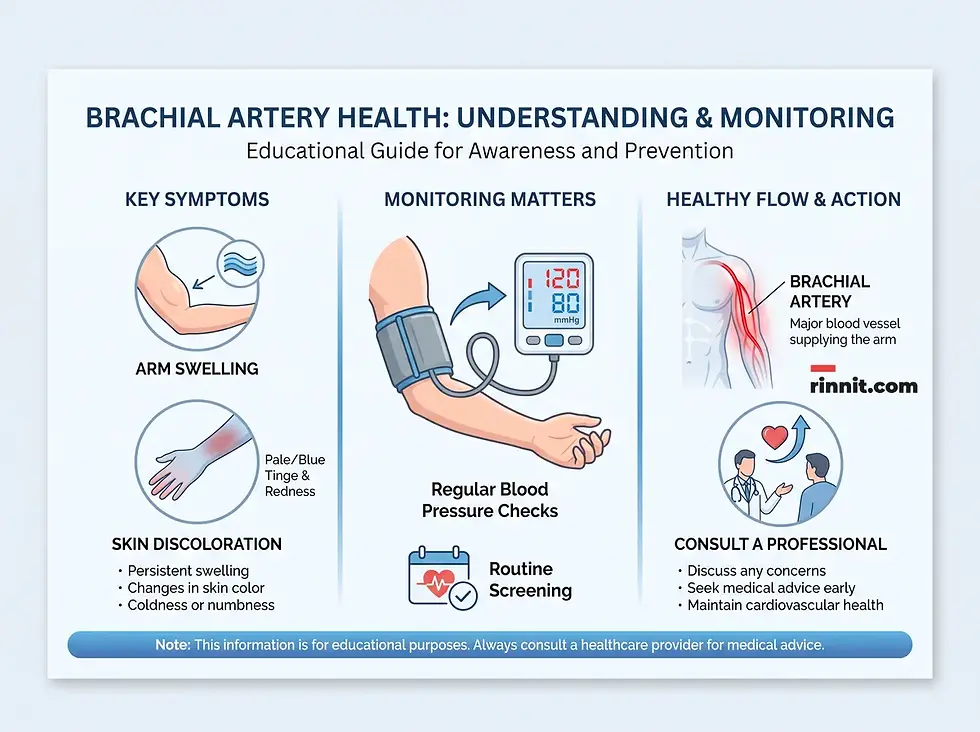
Changes in the arm can point to a blood clot or a blocked artery. Get medical care right away if you notice any of these signs:
Sign | What it may mean | What to do |
Warm areas in the arm | A possible blood clot in an arm vein (deep vein thrombosis); a blocked artery more often makes the arm or hand cool and pale [1] | Seek immediate medical attention |
Skin that looks pale, red, or blue | Reduced blood flow to the arm or hand | Seek immediate medical attention |
Painful sores on the hands or fingers | Severe arterial insufficiency | Seek immediate medical attention |
Swelling in one arm | A possible clot or blocked vessel | Seek immediate medical attention |
How can you protect the circulation in your upper arm?
You can protect your brachial artery and upper arm circulation by caring for your cardiovascular health: checking blood pressure, not smoking, managing chronic conditions and staying active.
Have your blood pressure checked regularly. It is a quick way to spot high blood pressure early (see Normal Blood Pressure by Age).
Do not smoke.
Manage diabetes, high blood pressure, and high cholesterol with your care team.
Stay physically active and eat a balanced diet.
Get arm injuries checked, especially if your hand looks pale or feels cold or numb afterward.
When should you see a healthcare provider about your brachial artery?
Talk to your primary care provider or a vascular specialist if you notice persistent swelling in one arm, skin that looks pale, red, or blue, or a warm area in your arm. Do not wait on these signs. Seek emergency care for sudden swelling, blue discoloration, severe pain, or a cold, numb hand, especially after an injury.
Conclusion
The brachial artery is more than a vessel for the upper arm. It is a practical window into your health, since blood pressure readings and the ankle-brachial index both depend on it. Knowing its path and the warning signs of vascular trouble helps you act early and protect the circulation in your arm and hand.
Related reading
Frequently Asked Questions
What is the main function of the brachial artery?
The brachial artery carries oxygen-rich blood to the upper arm, forearm, and hand.
Where can I feel the brachial pulse?
On the inner side of the arm, just above the elbow crease.
Why is the brachial artery used for blood pressure?
The brachial artery is large, lies close to the skin, and is easy to compress with a cuff.
What is the deep brachial artery?
The deep brachial artery is the first branch of the brachial artery and runs with the radial nerve to supply deeper arm tissues.
How does the brachial artery end?
At the elbow crease, it splits into the radial and ulnar arteries.
What is peripheral artery disease (PAD) in the arm?
Peripheral artery disease (PAD) is plaque buildup that narrows an artery and limits blood flow. It is more common in the legs.
Can a broken arm damage the brachial artery?
Yes. Severe fractures near the shoulder or elbow can injure the artery.
What are the three layers of the brachial artery wall?
The tunica intima (inner), tunica media (middle), and tunica adventitia (outer).
Is a brachial artery aneurysm common?
No. Aneurysms in this artery are rare.
How is an AV fistula connected to the brachial artery?
Surgeons may join the artery to a vein to create dialysis access. In rare cases this leads to an aneurysm.
Which nerve runs near the brachial artery?
The median nerve runs alongside it in the upper arm.
What does the radial artery supply?
The thumb side of the forearm and hand.
What does the ulnar artery supply?
The little-finger side of the forearm and hand.
What is the tunica media made of?
Smooth muscle cells that let the artery widen and narrow.
When should I seek emergency care for arm symptoms?
Get help right away for sudden swelling, pale or blue skin, severe pain, or a cold, numb hand.
Sources
Cleveland Clinic. Brachial Artery. Cleveland Clinic. Last updated December 22, 2025. https://my.clevelandclinic.org/health/body/22193-brachial-artery
Matsuzawa Y, Kwon TG, Lennon RJ, et al. Prognostic value of flow-mediated vasodilation in brachial artery and fingertip artery for cardiovascular events: a systematic review and meta-analysis. J Am Heart Assoc. 2015;4(11):e002270. PMID 26567372. https://doi.org/10.1161/JAHA.115.002270
Fowkes FG, Murray GD, Butcher I, et al. Ankle brachial index combined with Framingham Risk Score to predict cardiovascular events and mortality: a meta-analysis. JAMA. 2008;300(2):197-208. PMID 18612117. https://doi.org/10.1001/jama.300.2.197
Khan K, Amir E, Akano O, et al. Challenging the controversy surrounding percutaneous brachial artery access related complications: a systematic review and meta-analysis. Vasc Endovascular Surg. 2025;59(1):47-63. PMID 39210681. https://doi.org/10.1177/15385744241278048
Medical disclaimer
The information in this article is for educational purposes only and is not a substitute for professional medical advice, diagnosis, or treatment. Always seek the advice of your physician or another qualified health provider with any questions you may have about a medical condition. Never disregard professional medical advice or delay seeking it because of something you have read here. If you think you may have a medical emergency, call your doctor or your local emergency number immediately.



Comments