Understanding Spinal Stroke: Symptoms, Causes, and Recovery

Updated: 2 days ago
Medically reviewed by Dr. Baraa Alnahhal, MD · Last reviewed: October 2026
MEDICAL EMERGENCY: If you or someone near you has sudden, intense back or neck pain together with leg weakness, numbness, or loss of bladder or bowel control, call your local emergency number (911 in the United States) immediately.
Quick Answer: What Is a Spinal Stroke?
A spinal stroke, also called a spinal infarction, is blocked or interrupted blood flow to the spinal cord from a clot or bleeding. Symptoms often include sudden, intense back or neck pain, muscle weakness and loss of sensation or bowel control. Because it can be fatal or cause permanent paralysis, immediate emergency care is critical, followed by intensive rehabilitation. [1]
What the research says
Spinal strokes can be missed. In a Mayo Clinic series of 133 patients with spontaneous spinal cord infarction (median age 60; 76% with vascular risk factors), 77% reached their worst deficits within 12 hours, and the first spine MRI was normal in 24%. The authors note these patients are often misdiagnosed as having transverse myelitis (Zalewski et al., JAMA Neurology, 2019).
Recovery depends on how severe the early deficits are. A review of eight patients plus 11 published series found that prognosis is mainly determined by the severity of motor or sensory loss. In most series, 40–60% of patients had severe initial deficits (ASIA A/B), and a similar share remained wheelchair dependent at follow-up (Rigney et al., Journal of Clinical Neuroscience, 2015).
Understanding Spinal Infarction
A spinal stroke is a critical medical emergency in which the blood supply to the spinal cord is sharply reduced or stopped. Unlike strokes in the brain, spinal strokes affect the pathways that control movement and sensation throughout the body [1]. They account for less than 1% of all stroke cases, but the impact can be life-altering, including permanent paralysis or other severe disabilities.
There are two main mechanisms. In an ischemic spinal stroke, a blood vessel is blocked, usually by a clot. This is the most common form. In a hemorrhagic spinal stroke, a blood vessel ruptures or tears, causing bleeding in or around the spinal cord. Both types need rapid diagnosis to prevent irreversible tissue damage [1].

What Are the Symptoms and Warning Signs?
Symptoms often appear suddenly and vary with the part of the spinal cord affected. One of the most distinct early signs is intense, localized pain in the neck or back, which may spread into the limbs, followed by neurological problems that progress quickly [1].
Symptom category | Common indicators |
|---|---|
Pain | Sudden, intense neck or back pain; pain radiating to the arms or legs. |
Sensory | Numbness, tingling, loss of touch, inability to feel temperature. |
Motor | Muscle weakness (especially in the legs), difficulty walking, sudden paralysis. |
Autonomic | Loss of bladder control and loss of bowel control. |

What Causes a Spinal Stroke, and Who Is at Risk?
The causes are often linked to vascular health. For ischemic events, conditions that promote clots or narrow the arteries are the main drivers. Hemorrhagic events are often triggered by weak blood vessels or sudden pressure changes in the spinal column [1].
Risk category | Contributing factors |
|---|---|
Vascular health | High blood pressure, high cholesterol, atherosclerosis. |
Medical conditions | Diabetes, obesity, heart defects, clotting disorders. |
Lifestyle factors | Smoking, vaping, alcohol use disorder, nonprescription drug use. |
Other triggers | Spinal tumors, aneurysms, infections such as meningitis, spinal injuries. |
How Is a Spinal Stroke Diagnosed and Treated?
Diagnosis combines a clinical evaluation with imaging. Doctors perform a neurological exam to assess movement and sensation, and an MRI is the main test for seeing the spinal cord and areas of infarction or bleeding [1]. The diagnosis can be hard: in one large series the first MRI was normal in about a quarter of patients, and spinal strokes are often mistaken for transverse myelitis [2]. A lumbar puncture may be used to rule out inflammation or infection that can mimic a stroke.
Treatment is tailored to the type of stroke [1]:
Ischemic stroke: The goal is to treat the cause and restore blood flow. The approach depends on the cause and is decided by the care team; it can include medicines such as blood thinners and, in selected cases, procedures to remove or dissolve a clot.
Hemorrhagic stroke: Care focuses on stopping the bleeding and controlling blood pressure. Surgery may be needed to relieve pressure on the spinal cord from accumulated blood.
What Does Recovery and Rehabilitation Involve?
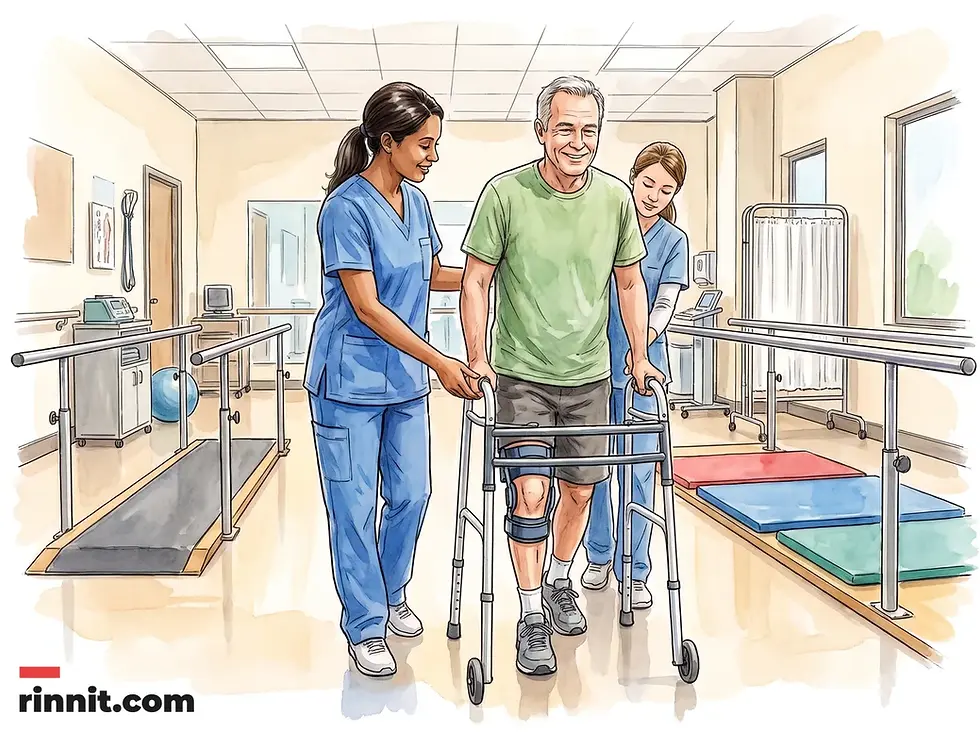
Rehabilitation is a cornerstone of recovery. The main goal is to regain as much mobility and independence as possible [1]. Physical therapy focuses on strengthening muscles and improving balance, while occupational therapy helps people adapt to daily tasks and fine movements.
Recovery timelines vary widely. Some people regain full function within a few months, while others face long-term challenges and need mobility aids such as walkers or canes. The outlook depends on the severity of the initial damage, the speed of treatment, and the person's overall health and age. In published series, those with the most severe early deficits had the poorest outcomes [3].
Conclusion
A spinal stroke is rare but can be devastating, and it demands immediate attention. Recognizing sudden, intense back pain with neurological symptoms can make the difference between recovery and permanent disability. With prompt medical care and dedicated rehabilitation, many people can manage the long-term effects and improve their quality of life.
If you or someone near you has sudden, intense back pain with leg weakness or loss of sensation, call emergency services immediately. Early care is the best way to limit spinal cord damage and support a better recovery.
Related Reading
Frequently Asked Questions
Is a spinal stroke the same as a brain stroke?
No. Both involve interrupted blood flow, but a spinal stroke affects the spinal cord rather than the brain. It tends to cause back pain and leg weakness rather than facial drooping or slurred speech [1].
Can a spinal stroke cause permanent paralysis?
Yes. If blood flow is interrupted long enough, the nerve damage can cause lasting paralysis below the level of the injury [1].
What is the most common cause of a spinal stroke?
Most spinal strokes are ischemic, meaning a blockage, such as a blood clot, cuts off blood flow to part of the spinal cord [1].
Are spinal strokes common?
No. They are rare, accounting for less than 1% of stroke cases.
Does a spinal stroke always cause pain?
Sudden, intense neck or back pain is a common early symptom, but the sensation varies with the location of the stroke.
How is a spinal stroke diagnosed?
A neurological exam and MRI of the spinal cord are the main tools. Some people have a normal MRI early on, so the diagnosis can be missed at first, and tests such as a lumbar puncture may be used to rule out look-alike conditions [2].
Can high blood pressure cause a spinal stroke?
Yes. Chronically high blood pressure is a major risk factor, including for hemorrhagic strokes caused by a ruptured blood vessel [1].
What is the difference between an ischemic and a hemorrhagic spinal stroke?
An ischemic stroke is caused by a blockage, such as a clot. A hemorrhagic stroke is caused by a blood vessel that breaks and bleeds [1].
Can you recover fully from a spinal stroke?
Some people recover well, but it often takes months or years of intensive therapy, and many people have some lasting disability. In one literature review, 40–60% of patients had severe early deficits (ASIA A/B) and a similar share remained wheelchair dependent [3].
Does smoking increase the risk of spinal stroke?
Yes. Smoking and vaping damage blood vessels and raise the likelihood of clots, so they are risk factors.
What is a mechanical thrombectomy?
It is a procedure in which a clot is physically removed from a blocked blood vessel. It is established for some brain strokes, but its use for spinal cord stroke is uncommon and decided case by case by specialists.
Can infections lead to a spinal stroke?
Rarely. Certain infections, such as meningitis, can cause inflammation that leads to a spinal stroke.
Is age a factor in spinal stroke risk?
Spinal strokes most often affect middle-aged and older adults (the median age was 60 in one large series), but they can occur at any age [2].
What role does physical therapy play in recovery?
Physical therapy is essential for strengthening muscles, improving coordination, and helping people regain mobility after a spinal stroke [1].
Can a spinal stroke be fatal?
Yes. Because it affects critical neural pathways, a spinal stroke can be life-threatening, which is why emergency care matters [1].
References
Cleveland Clinic. Spinal stroke. Cleveland Clinic Health Library. Source content dated December 13, 2024. https://my.clevelandclinic.org/health/diseases/spinal-stroke
Zalewski NL, Rabinstein AA, Krecke KN, et al. Characteristics of spontaneous spinal cord infarction and proposed diagnostic criteria. JAMA Neurology. 2019;76(1):56-63. PMID 30264146. https://doi.org/10.1001/jamaneurol.2018.2734
Rigney L, Cappelen-Smith C, Sebire D, et al. Nontraumatic spinal cord ischaemic syndrome. Journal of Clinical Neuroscience. 2015;22(10):1544-1549. PMID 26154150. https://doi.org/10.1016/j.jocn.2015.03.037
Medical disclaimer
This guide is based on medical information dated December 13, 2024. Always consult a healthcare professional for diagnosis and treatment decisions.
Health information, not medical advice. This article is for general education and is not a substitute for professional diagnosis or treatment. Always consult a qualified healthcare provider about your own health, and seek emergency care for urgent symptoms.



Comments