Understanding Rocky Mountain Spotted Fever: Symptoms, Treatment, and Prevention

Updated: 2 days ago
Medically reviewed by Dr. Baraa Alnahhal, MD · Last reviewed: October 2026
Rocky Mountain spotted fever (RMSF) is a serious, potentially fatal bacterial infection spread by tick bites. [1] Early symptoms include high fever and severe headache, often followed by a spotted rash. Because the illness can progress quickly, treatment with doxycycline works best when started within the first five days of symptoms. [1] Avoiding tick bites and checking your skin for ticks are the best ways to prevent it.
Quick Answer: What is Rocky Mountain spotted fever (RMSF)?
Rocky Mountain spotted fever (RMSF) is a bacterial infection caused by Rickettsia rickettsii and spread by infected ticks. [1] Symptoms include high fever, headache and muscle pain, often followed by a spotted rash starting on the wrists and ankles. [1] Treatment is doxycycline, usually for seven to 10 days. [1] In the U.S., the fatality rate is 5% to 10% even with treatment. [1]
What the research says
Doxycycline is the treatment of choice, and early treatment prevents severe disease. CDC practice guidance states that tickborne rickettsial diseases still cause severe illness and death in otherwise healthy adults and children despite low-cost, effective antibiotics, that early signs are nonspecific or mimic other illnesses, and that early empiric therapy with doxycycline can prevent severe disease and death (Biggs et al., MMWR Recommendations and Reports, 2016) [2].
Treatment delay is linked to death. In 104 children hospitalized with RMSF in Sonora, Mexico (2004 to 2013), the case fatality ratio was 20.2%; starting doxycycline on or after day 5 of symptoms was associated with higher odds of death (adjusted odds ratio 2.62, 95% CI 1.24 to 5.52), as were acute kidney injury (4.84) and hemorrhage (6.11) (Alvarez-Hernandez et al., Pediatric Infectious Disease Journal, 2015) [3]. Fatality rates are much higher in some regions than in the U.S. [1]
How does Rocky Mountain spotted fever (RMSF) affect the body?
RMSF is a whole-body infection, not just a skin reaction. The bacteria attack the cells that line blood vessels. If not treated right away, this leads to leaking blood vessels, excess fluid in tissues and damage to muscles, nerves and organs. [1]
Because the infection targets the circulatory system itself, complications can appear suddenly. Even with antibiotic treatment, some people develop serious complications. [1]
Clinical Feature | Description | Potential Complication |
Vascular damage | Inflammation of blood vessel linings | Leaking vessels, fluid in the lungs, internal bleeding |
Organ strain | Infection affecting heart, lungs and kidneys | Acute kidney injury, ARDS, organ failure, sepsis |
Neurological impact | Inflammation of the brain (encephalitis) | Seizures, partial paralysis, lasting nerve damage |
Tissue death | Severely reduced circulation to the extremities | Gangrene, sometimes requiring amputation |
How do Rocky Mountain spotted fever symptoms progress?
Early Rocky Mountain spotted fever looks like many other illnesses, which makes its symptoms hard to recognize and diagnose at first. [2] Symptoms usually develop over a few days, starting with flu-like symptoms and getting worse. [1] Common symptoms include:
High fever and headache
Muscle pain or soreness, and lack of appetite
Nausea, vomiting and stomach pain
Sensitivity to light
A flat rash of red, pink, purple or dark dots or splotches
The rash usually appears a few days to a week after the first symptoms, often starting on the wrists, forearms and ankles and then spreading. [1] Some people never get a rash [1], which can delay diagnosis. Later, more severe symptoms can include confusion, shortness of breath, agitation, seizures, and numbness or weakness. [1]

How is Rocky Mountain spotted fever diagnosed, and why is fast care urgent?
Providers diagnose RMSF from a physical exam, your symptoms and whether you may have been exposed to ticks. [1] Tell your provider if you have been anywhere you could have met a tick in the past two weeks, even if you do not remember a bite. [1]
Blood tests and skin biopsies of the rash can confirm the infection, but results may not be available right away, and blood tests usually do not turn positive until seven to 10 days after symptoms begin. [1] Providers often have to decide on treatment before results come back. [1] If RMSF is suspected, treatment should start straight away rather than wait for confirmation. [2] Treatment works best within five days of the first symptoms. [1]
People at higher risk of severe illness include children under 10, adults over 40, people with G6PD deficiency and people with a weakened immune system. [1]

How is Rocky Mountain spotted fever treated, and what is long-term recovery like?
RMSF is treated with doxycycline, usually for seven to 10 days. Doxycycline is the recommended treatment for adults and children of all ages, so it should not be delayed in a child. [1] If treatment starts soon after symptoms appear, most people feel better within a few days, but you must finish the whole course. [1] If symptoms do not improve, contact your provider right away.
People who are severely ill may need hospital care, including blood transfusions, mechanical ventilation or other therapies. [1] Even after recovery, some people have long-term problems, especially after a severe illness, including nerve damage or paralysis, hearing loss, vision loss, speech difficulties, and balance problems or vertigo. [1]
When should you get medical care for Rocky Mountain spotted fever?
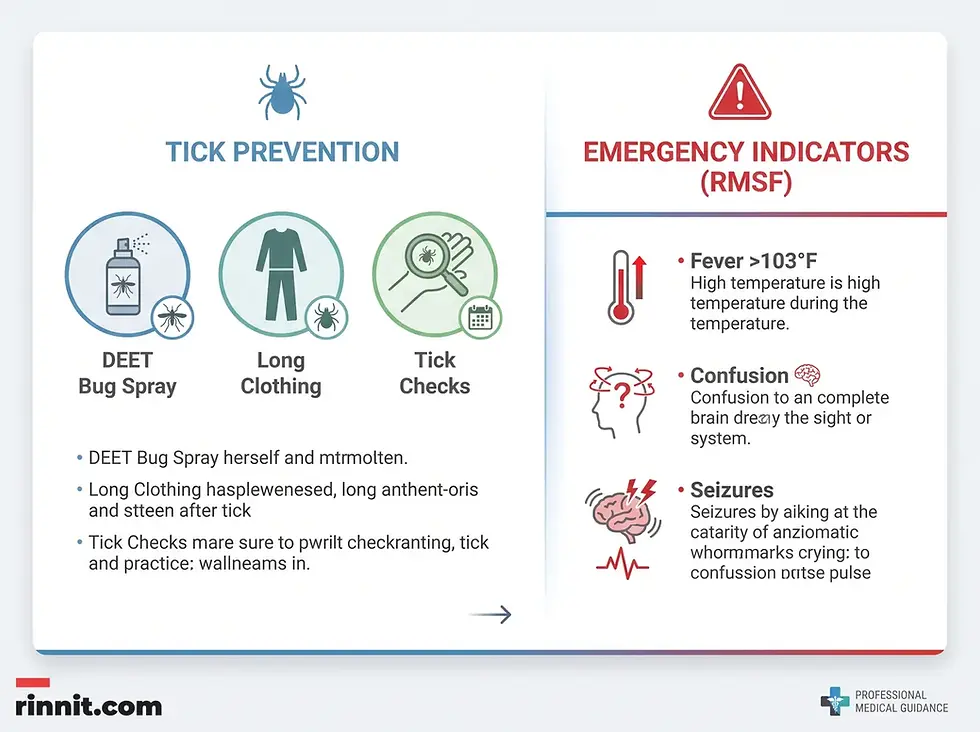
See a provider right away if you have a tick bite or have been in an area with ticks and develop symptoms of RMSF [1], and tell them you think you may have it. Go to the nearest emergency room for a fever over 103 degrees Fahrenheit (39.4 degrees Celsius), coughing up blood, swollen hands or feet, severe stomach pain, confusion, seizures, numbness or weakness, or severe vomiting. [1]
How can you prevent Rocky Mountain spotted fever by avoiding ticks?
The best protection is to avoid tick bites. Ticks are most active in warmer months [1] and are common in long grass and wooded areas.
Cut your grass regularly; grass over 5 inches attracts ticks. [1]
Stay on cleared paths in wooded areas.
Use tick-repellent bug spray such as DEET and cover as much skin as you can with clothing; some clothing is pre-treated with tick repellent. [1]
Check for ticks after being outdoors, including your children. Ask someone to check places you cannot see, such as your back and scalp. [1]
Protect pets with treatments your veterinarian recommends and check them often for ticks. [1]
Conclusion
Rocky Mountain spotted fever is a serious tick-borne infection, but it is treatable when caught early. Because early symptoms look like the flu and the rash can be late or absent, the key is to seek care promptly after tick exposure with fever and headache, and not to wait for a rash. Avoiding tick bites and checking yourself, your family and your pets remains the best defense.
Next step: If you develop fever, headache or muscle aches within two weeks of possible tick exposure, contact a healthcare provider right away and mention the tick exposure.
Frequently Asked Questions
What causes Rocky Mountain spotted fever?
Rocky Mountain spotted fever is caused by the bacterium Rickettsia rickettsii, which people get through the bite of an infected tick. In the U.S., the American dog tick and the Rocky Mountain wood tick are the main carriers.
Is RMSF only found in the Rocky Mountains?
No. Despite its name, RMSF occurs in most U.S. states, as well as in Canada, Mexico, and Central and South America. Cases are reported every month of the year but are most common in warmer months.
Does everyone with RMSF get a rash?
No. The rash is common, but some people never develop one, and it usually appears several days after the fever starts. Do not wait for a rash before seeking care.
What is the most effective treatment for RMSF?
The antibiotic doxycycline is the treatment of choice, usually taken for seven to 10 days. Take the whole course even if you feel better.
How quickly should treatment start?
Treatment is most effective when started within five days of the first symptoms. Later treatment raises the risk of life-threatening complications.
Can I get RMSF from my pet?
RMSF is spread by tick bites, not directly from pets. However, pets can bring infected ticks into your home, so check them often and use tick protection recommended by your veterinarian.
What are the emergency signs of RMSF?
Go to the nearest emergency room for a fever over 103 degrees Fahrenheit (39.4 degrees Celsius), coughing up blood, swollen hands or feet, severe abdominal pain, confusion, seizures, numbness or weakness, or severe vomiting.
Is RMSF the same as Lyme disease?
No. Both come from tick bites, but they are different illnesses caused by different bacteria. RMSF can be fatal if not treated quickly, while Lyme disease usually is not life-threatening.
Can you die from Rocky Mountain spotted fever?
Yes. In the U.S. the fatality rate is 5% to 10% even with treatment, and the risk is higher the later treatment starts. The rate is much higher in some countries, such as Mexico and Brazil.
Should I take antibiotics after a tick bite if I feel fine?
No. Antibiotics taken when you have no symptoms do not prevent RMSF. Watch for symptoms and see a provider right away if they start, because not every tick bite spreads the infection.
Related Reading
Tick Bites: Symptoms, Removal, Treatment and Prevention explains how to remove ticks safely and prevent bites.
Ehrlichiosis: Symptoms, Causes, and Treatment covers another tick-borne infection treated with doxycycline.
Understanding Lone Star Tick Diseases: A Comprehensive Guide to Symptoms and Prevention explains the illnesses spread by the lone star tick.
What Is Babesiosis? Symptoms, Causes, and Treatment covers a tick-borne infection that affects red blood cells.
References
Cleveland Clinic. Rocky Mountain Spotted Fever. Cleveland Clinic. Last updated March 26, 2026. https://my.clevelandclinic.org/health/diseases/17838-rocky-mountain-spotted-fever
Biggs HM, Behravesh CB, Bradley KK, et al. Diagnosis and management of tickborne rickettsial diseases: Rocky Mountain spotted fever and other spotted fever group rickettsioses, ehrlichioses, and anaplasmosis - United States. MMWR Recommendations and Reports. 2016;65(2):1-44. PMID 27172113. https://doi.org/10.15585/mmwr.rr6502a1
Alvarez-Hernandez G, Murillo-Benitez C, Candia-Plata MDC, Moro M. Clinical profile and predictors of fatal Rocky Mountain spotted fever in children from Sonora, Mexico. Pediatric Infectious Disease Journal. 2015;34(2):125-130. PMID 25126856. https://doi.org/10.1097/INF.0000000000000496
Medical disclaimer
The information provided in this article is for educational purposes only and should not be used as a substitute for professional medical advice, diagnosis, or treatment. Always seek the advice of your physician or other qualified health provider with any questions you may have regarding a medical condition.



Comments