Ehrlichiosis: Symptoms, Causes, and Treatment

Updated: 2 days ago
Medically reviewed by Dr. Baraa Alnahhal, MD · Last reviewed: October 2026
Quick answer
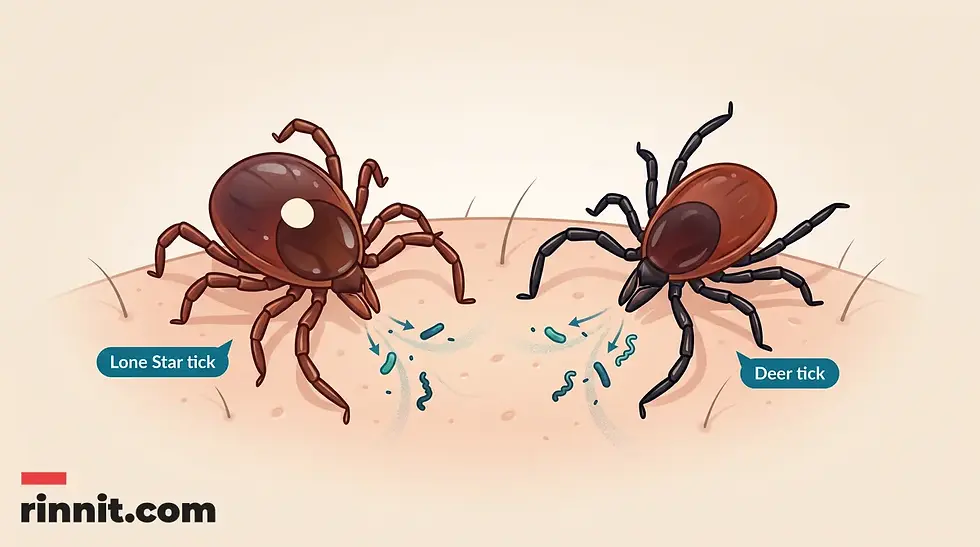
Ehrlichiosis and anaplasmosis are tick-borne illnesses caused by bacteria carried by the Lone Star tick and the deer tick. Main symptoms are fever, chills, headache, muscle aches and feeling unwell, and confusion or a rash may point to ehrlichiosis. The antibiotic doxycycline works quickly, and symptoms usually improve within a few days of starting treatment. [1] [2]
What the research says
According to PubMed:
Diagnosis is often delayed. In a retrospective Mayo Clinic Florida analysis of 22 ehrlichiosis patients (from 67 treated between 2018 and 2021), fever and malaise were common, severe cases included altered mental status and septic shock, and the median time from admission to diagnosis was 4 days. Prompt doxycycline was effective. (Murawska Baptista et al., DOI).
Tick-borne disease cases are rising in the Midwest. Among 6,423 human tick-borne disease cases reported in Illinois from 2004 to 2022, the annual number of cases increased by 23 cases per year (95% CI 15 to 31). Incidence was higher in rural counties and counties with higher deer harvests. (Chakraborty et al., DOI).
Coinfection with other tick-borne germs happens. In 3,521 US patients with babesiosis, ehrlichiosis coinfection was found in 3.7% (95% CI 3.1% to 4.4%) and anaplasmosis in 0.3% (95% CI 0.2% to 0.6%). Doxycycline was prescribed more often in the coinfection group (25% vs 18%). (Ssentongo et al., DOI).
Study details are from PubMed abstracts.
Key facts at a glance
Fact | Detail |
What it is | A tick-borne bacterial illness (or the closely related anaplasmosis) [1] |
What spreads it | Primarily the Lone Star tick (ehrlichiosis) and deer tick (anaplasmosis) [1] |
How symptoms start | Flu-like signs within about 14 days of a tick bite [1] |
Main symptoms | Fever, chills, headache, muscle aches, not feeling well [1] |
First-line treatment | The antibiotic doxycycline [2] |
How fast it improves | Within a few days of starting the right antibiotic [2] |
Without treatment | Serious or life-threatening complications [1] |
Best prevention |
What are ehrlichiosis and anaplasmosis?
Ehrlichiosis (ar-LIK-e-o-sis) and anaplasmosis (ana-plas-MO-sis) are infections you pick up from tick bites. The two illnesses produce symptoms that are most often the same: fever, muscle aches, headache, chills, joint pain, upset stomach, vomiting, loose stools, and simply not feeling well. [1]
Ehrlichiosis may produce the more severe illness of the two. It can also bring symptoms that anaplasmosis rarely causes, such as confusion or changes in mental state and a rash. [1]
Some people who are infected never develop symptoms at all. But when symptoms do appear, they most often show up within 14 days of the tick bite, so a memory of a recent bite or time spent in tick habitat matters. [1]
Symptoms: what to watch for
Because these infections feel like ordinary flu at first, the biggest clue is context: have you been bitten by a tick, or around ticks, in the past two weeks? [1]
Symptom | Details |
Fever | Often one of the first signs [1] |
Chills | Frequently accompanies the fever [1] |
Headache | Common and can be significant [1] |
Muscle aches | A classic flu-like feature [1] |
Not feeling well | General malaise and fatigue [1] |
Joint pain | Common across both illnesses [1] |
Upset stomach, vomiting, loose stools | Gastrointestinal symptoms are frequent [1] |
Loss of appetite | Not wanting to eat [1] |
Confusion or mental changes | Linked mainly with ehrlichiosis [1] |
Rash | Linked mainly with ehrlichiosis [1] |
Some people may be infected and never get symptoms. Others feel mildly unwell and recover on their own. Still others, especially those with weakened immune systems, can become seriously ill if the infection is not treated. [1]
When to see a doctor
If you develop any symptoms of illness after a tick bite or after being around ticks, see your healthcare professional. Remember that it can take up to 14 days for symptoms to appear, so the bite may have happened a while ago. [1]
What causes ehrlichiosis?
Different types of bacteria cause the two illnesses, and different ticks carry them. [1]
Illness | Bacterium | Main tick carrier | Where the tick lives |
Ehrlichiosis | Ehrlichia chaffeensis [1] | Lone Star tick | South-central, southeastern, and eastern coastal U.S. states [1] |
Anaplasmosis | Anaplasma phagocytophilum [1] | Deer tick (black-legged tick) | Upper Midwest, northeastern U.S. states, and central Canada; Western black-legged ticks carry it in coastal Western states, and other species carry it in Europe and Asia [1] |
The adult female Lone Star tick has a single white spot on its back, which is where its name comes from. It is mainly found in the Southern and Eastern United States. Black-legged ticks are less common carriers of ehrlichiosis bacteria, but they are the main spreaders of anaplasmosis. [1]
How the infection spreads
Ticks feed on blood. A tick attaches itself to a host and feeds until it swells to many times its size. While feeding, it can pick up bacteria from a host such as a deer and then spread the bacteria to another host, such as a person. The transfer of bacteria from tick to host most likely happens about 24 hours after the tick has begun feeding, which is why prompt removal matters. [1]

Beyond tick bites, the bacteria can also spread through donor blood or organs, from a pregnant person to an unborn baby, or through contact with an infected animal that has been killed. [1]
Risk factors: who is most likely to get sick
The main risk factor is spending time in grassy, wooded, or bushy areas where ticks live. Several everyday habits raise your odds of a bite. [1]
Risk factor | Why it matters |
Time in grassy, wooded, or bushy areas | This is where ticks live and wait for hosts [1] |
Warm spring and summer months | Ticks are most active in warmer weather [1] |
Gardening, camping, hiking, golfing, or hunting in grassy areas | These activities put you in tick habitat [1] |
Exposed skin | Not wearing clothing that covers your skin makes biting easier [1] |
Pets that have ticks | Outdoor pets can carry ticks into the home [1] |
Why prompt treatment matters
Without fast treatment, ehrlichiosis and anaplasmosis can cause serious damage. People with weakened immune systems face a higher risk of the more severe and life-threatening outcomes. [1]
Complication | Detail |
Kidney failure | A serious consequence of untreated infection [1] |
Lung failure | The lungs can fail in severe cases [1] |
Heart failure | The heart can be affected [1] |
Damage to the central nervous system | The brain and spinal cord can be damaged [1] |
Seizures | Severe cases can trigger seizures [1] |
Coma | Untreated infection can progress to coma [1] |
Other serious infections | Compromised systems invite further illness [1] |
How ehrlichiosis is diagnosed
Tick-borne infections are hard to diagnose based on symptoms alone, because the symptoms look like many other common conditions. That is why it helps to tell your healthcare professional about any tick bites you have had or any time spent around ticks. [2]
Your healthcare professional does a physical exam and orders blood tests. Because the bacteria can be hard to detect early, you may need more than one test. [2] More detail for clinicians is in the CDC clinical overview of ehrlichiosis.
Treatment: what works
The standard treatment for both ehrlichiosis and anaplasmosis is the antibiotic doxycycline. Your healthcare professional may even start treatment before the diagnosis is fully confirmed, because waiting can allow the illness to progress. Some people with mild symptoms recover without treatment at all. [2]
The length of treatment depends on how sick you are. [2]
If you are pregnant or allergic to doxycycline, your healthcare professional may prescribe the antibiotic rifampin instead. Quick treatment makes a real difference: with the right antibiotic, symptoms typically improve within a few days. [2]
If you find a tick on your body
How you remove a tick matters. Do the right thing, and you remove the threat cleanly. Do the wrong thing, and you can make things worse. [1]

The steps to follow are simple. Do not try to force the tick out with petroleum jelly, nail polish, rubbing alcohol, or a hot match, because these methods do not work. Use fine-tipped tweezers to grab the tick firmly near its head or mouth, as close to the skin as you can get. Pull the tick's body away from your skin steadily and slowly, without jerking or twisting. If any mouth parts remain, remove them with clean tweezers. Then kill the tick in alcohol (do not crush it) and flush the dead tick away or wrap tape around it before throwing it in the trash. Finally, clean your hands and the bite site with soap and water, rubbing alcohol, or hand sanitizer. [1]
The bite site itself usually produces a small bump that looks like a mosquito bite and goes away in a few days. Call your healthcare professional if it bothers you or if you develop symptoms that may point to an infection. [1]
Preparing for your appointment
You may first see your main healthcare professional, or go to an emergency room if your symptoms are bad. From there, you may be sent to a doctor who specializes in infectious diseases. [2]
If you think a tick bite may have caused your illness, tell your healthcare professional when and where you might have been bitten. If you removed a tick and kept it, bring it to the appointment. [2]
Before you go, make a list of your symptoms and when they began, all medicines, vitamins, and supplements you take (including dosages), and any allergies you have to medicines or anything else. [2]
Prevention: how to avoid tick bites
The best way to prevent ehrlichiosis or anaplasmosis is to not get tick bites in the first place. If you plan to work or play where ticks are likely, follow these protections. The CDC page on preventing tick bites has more practical guidance. [1]
Use tick repellents
Spray your outdoor clothing, shoes, tent, and other camping gear with a repellent that contains 0.5% permethrin, or buy gear and clothing already treated with permethrin. For exposed skin, use an insect repellent registered with the U.S. Environmental Protection Agency. Options include products with DEET, picaridin, IR3535, oil of lemon eucalyptus (OLE), para-menthane-diol (PMD), or 2-undecanone. Apply repellent to all exposed skin except your face. Do not use products with OLE or PMD on children younger than 3. [1]
Dress for protection
Wear light-colored clothing that makes ticks easier to spot before they bite. Skip open-toed shoes and sandals in tick country. Tuck long-sleeved shirts into your pants and tuck long pants into your socks. [1]
Check for ticks
Shower as soon as you can after being outside to wash off loose ticks, and check your whole body with a mirror. Pay attention to your underarms, hair and hairline, ears, waist, between your legs, behind your knees, and inside your belly button. Put your clothes and gear in a hot dryer for at least 10 minutes to kill ticks, and wash anything that needs washing in hot water. Check outdoor pets for ticks every day, and stay on cleared paths rather than wandering through tall grass and brush. [1]
Prevention step | What to do |
Treat gear | 0.5% permethrin on clothing, shoes, and camping gear [1] |
Protect skin | EPA-registered repellent (DEET, picaridin, and others) on all exposed skin except the face [1] |
Dress smart | Light-colored clothes, long sleeves tucked in, pants tucked into socks, closed shoes [1] |
Check your body | Full-body mirror check: underarms, hair, ears, waist, between legs, behind knees, belly button [1] |
Kill hidden ticks | Hot dryer for at least 10 minutes on clothes and gear [1] |
Protect pets | Daily tick checks on outdoor pets [1] |
Stay on path | Cleared paths; avoid tall grass where questing ticks wait [1] |
Conclusion
Ehrlichiosis and anaplasmosis are flu-like illnesses that deserve attention because they are easy to dismiss and fast to treat. The pattern is clear: a tick bite, up to two weeks of waiting, then fever, aches, and chills. Telling your healthcare professional about the tick exposure, not just the symptoms, is often the key that unlocks the right diagnosis, and the standard antibiotic works quickly when it is started early. [1] [2]
If you spend time outdoors, make tick checks part of your routine. The same habits that prevent these illnesses protect you against other tick-borne diseases too. [1]
Take action: If you have a fever, chills, or muscle aches after a tick bite or time outdoors in tick country, contact a healthcare professional and mention the exposure.
Frequently asked questions
What is the difference between ehrlichiosis and anaplasmosis?
Both are tick-borne bacterial illnesses with nearly identical symptoms, but different bacteria and different ticks cause them. Ehrlichiosis comes from Ehrlichia chaffeensis, carried mainly by the Lone Star tick, and tends to be the more severe illness; it can also cause confusion and a rash. Anaplasmosis comes from Anaplasma phagocytophilum, carried mainly by deer ticks. [1]
How long after a tick bite do symptoms appear?
Symptoms most often appear within 14 days of the tick bite. The tick usually must be attached and feeding for about 24 hours before the bacteria pass to the host, which is why removing ticks quickly lowers the risk of infection. [1]
Can ehrlichiosis go away on its own?
Some people with mild symptoms recover without treatment, and some infected people never develop symptoms at all. But without treatment, the infection can cause serious and life-threatening complications such as kidney, lung, or heart failure, so medical treatment is strongly recommended. [1] [2]
What antibiotic treats ehrlichiosis?
Doxycycline is the standard treatment for both ehrlichiosis and anaplasmosis. Treatment typically lasts at least 7 to 10 days, or 3 to 5 days after the fever is gone and symptoms improve; more serious illness may need 2 to 3 weeks. People who are pregnant or allergic to doxycycline may be given rifampin instead. [2]
How do I remove a tick correctly?
Use fine-tipped tweezers to grasp the tick firmly near its head, as close to the skin as possible, and pull up steadily without jerking or twisting. Kill the tick in alcohol without crushing it, and clean your hands and the bite site. Do not use petroleum jelly, nail polish, rubbing alcohol, or a hot match to try to force the tick out. [1]
This article is for general education and is not a substitute for professional medical advice, diagnosis, or treatment. Always consult a qualified healthcare professional about your individual situation.
References
Mayo Clinic Staff. Ehrlichiosis and anaplasmosis: Symptoms and causes. Mayo Clinic. Accessed October 14, 2026. https://www.mayoclinic.org/diseases-conditions/ehrlichiosis/symptoms-causes/syc-20372142
Mayo Clinic Staff. Ehrlichiosis and anaplasmosis: Diagnosis and treatment. Mayo Clinic. Accessed October 14, 2026. https://www.mayoclinic.org/diseases-conditions/ehrlichiosis/diagnosis-treatment/drc-20372147
Centers for Disease Control and Prevention. Clinical Overview of Ehrlichiosis. CDC. Updated May 15, 2024. https://www.cdc.gov/ehrlichiosis/hcp/clinical-overview/index.html
Centers for Disease Control and Prevention. Preventing Tick Bites. CDC. Accessed October 14, 2026. https://www.cdc.gov/ticks/prevention/index.html
Murawska Baptista A, Kaminska A, Gorasevic M, et al. Presenting Symptoms and Delayed Diagnosis of Ehrlichiosis. Mayo Clin Proc Innov Qual Outcomes. 2025;9(3):100608. PMID 40248478. https://doi.org/10.1016/j.mayocpiqo.2025.100608
Chakraborty S, Black H, Hussain A, Mateus-Pinilla N, Smith RL. Tick-borne diseases in Illinois (USA): A retrospective case analysis. Ticks Tick Borne Dis. 2026;17(4):102675. PMID 42335481. https://doi.org/10.1016/j.ttbdis.2026.102675
Ssentongo P, Venugopal N, Zhang Y, Chinchilli VM, Ba DM. Beyond Human Babesiosis: Prevalence and Association of Babesia Coinfection with Mortality in the United States, 2015-2022: A Retrospective Cohort Study. Open Forum Infect Dis. 2024;11(10):ofae504. PMID 39381028. https://doi.org/10.1093/ofid/ofae504



Comments