Understanding Microphobia: The Intense Fear of Small Things

Updated: 2 days ago
Medically reviewed by Dr. Baraa Alnahhal, MD · Last reviewed: October 2026
Microphobia is an intense fear of small things, such as germs and insects. Trying to avoid them can lead to negative thoughts and behaviors that disrupt daily life, but therapy can help you get better[1].
Quick Answer: What is microphobia?
Microphobia is a specific phobia involving an extreme fear of small things, such as germs, insects, pollen or tiny broken pieces, far greater than the actual danger. It can lead to avoidant behavior, a rapid heart rate and sometimes panic attacks. It is treatable with exposure therapy and cognitive behavioral therapy, while medications can help with related mood problems. [1]
What the research says
Exposure-based therapy has the strongest evidence for specific phobias. A meta-analysis of 33 randomized treatment studies found that exposure-based treatment produced large effects compared with no treatment, and outperformed placebo conditions and other psychotherapy approaches. More sessions predicted better outcomes, and effects were not moderated by the type of specific phobia (Wolitzky-Taylor et al., Clin Psychol Rev, 2008 [2]).
Genes play a moderate role in specific phobias. A review and meta-analysis of 5 twin studies on fears and 10 on specific phobias concluded that fears and specific phobias are moderately heritable. Estimates varied widely, even within subtypes; the highest mean heritability was 45% for animal fear among fear subtypes and 33% for blood-injury-injection phobia among specific phobia subtypes (Van Houtem et al., J Anxiety Disord, 2013 [3]).
Online and mobile exposure programs show early promise. A systematic review and preliminary meta-analysis of 9 studies found that internet- and mobile-based interventions, all built around exposure, were linked to a significant reduction in specific phobia symptoms (g = 1.15). The authors note that the number of studies is small and more research is needed (Mor et al., Internet Interv, 2021 [4]).
What Is Microphobia?
Microphobia is an extreme fear of small things. It is a specific phobia, meaning that it causes fear of a particular situation or object, and the fear is typically much greater than the actual risk of danger. Most small things are part of everyday life and cause no harm, but for people with microphobia the thought of them can bring on severe anxiety and sometimes panic attacks[1].
Unlike ordinary discomfort, a phobia is intense enough that you go out of your way to avoid the trigger. These efforts can overtake rational thinking and lead to abnormal thoughts and behaviors[1].
People can have more than one specific phobia. Phobias that may occur alongside microphobia include[1]:
Entomophobia: fear of insects.
Mysophobia: fear of germs.
Nosophobia: fear of disease.
Nosocomephobia: fear of hospitals.
Iatrophobia: fear of doctors.
Thanatophobia: fear of death.
What are the common triggers of microphobia?
The small things that trigger microphobia vary greatly from person to person. Examples include[1]:
Trigger category | Examples |
Germs | Germs and other tiny organisms. |
Insects | Small insects. |
Environmental | Pollen and tiny fragments from broken objects. |
Food | Rice and other grains made up of small pieces. |

Triggers vary greatly from person to person.
What are the symptoms and behavioral effects of microphobia?
Microphobia causes a combination of behaviors and physical responses. Symptoms worsen over time if you keep avoiding your triggers without help[1].
Avoidant behaviors
Refusing to leave the house because of fear.
Not eating certain foods, such as rice and other grains made up of small pieces.
Only working in certain professions to lower the chance of contact with small things.
Trying not to damage things so you are less likely to deal with small pieces of a broken object.
Keeping windows closed to stop pollen from getting into your home or car.
Physical responses
Anxiety and stress.
Rapid heart rate and high blood pressure.
Muscle tension.
Sweating and trembling.
What causes microphobia, and what are the risk factors?
Genetics and environmental factors can increase the risk of specific phobias like microphobia[1][3]:
Genetics: a family history of mood disorders may make you more likely to have a specific phobia.
Environment: emotional trauma related to small things increases the risk. This may be especially true if a loved one was harmed by a severe illness, such as a viral infection.

Genetic predisposition and negative past experiences can both contribute to microphobia.
How is microphobia diagnosed?
Microphobia is diagnosed by a healthcare provider who asks about your symptoms, behaviors and personal or family history of anxiety disorders or phobias. They may ask[1]:
Which small things you find bothersome, and how exposure to them makes you feel.
Whether the fear is making you change your daily routine, or avoid activities and places you used to enjoy.
How often you think about small things.
The type and severity of your symptoms.
Whether you have a personal or family history of anxiety disorders or phobias.
How is microphobia treated and managed?
Microphobia is treatable, and most people can improve with the right approach[1].
Exposure therapy: a common treatment. Your therapist exposes you to situations that trigger your fear, starting with something simple such as pictures of germs or other small objects. Over time you may progress to touching small objects or going somewhere you have been too anxious to go[2].
Cognitive behavioral therapy (CBT): your therapist helps you explore why small objects make you anxious and teaches healthier alternatives to negative thoughts and behaviors.
Stress reduction: yoga and meditation help quiet your mind and relax your body, which can reduce the likelihood of panic when you meet a trigger.
Medication: medications do not cure microphobia. Antidepressants can help with mood disorders, and anti-anxiety medications can help you through a challenging time, such as going back out in public where you may meet triggers.
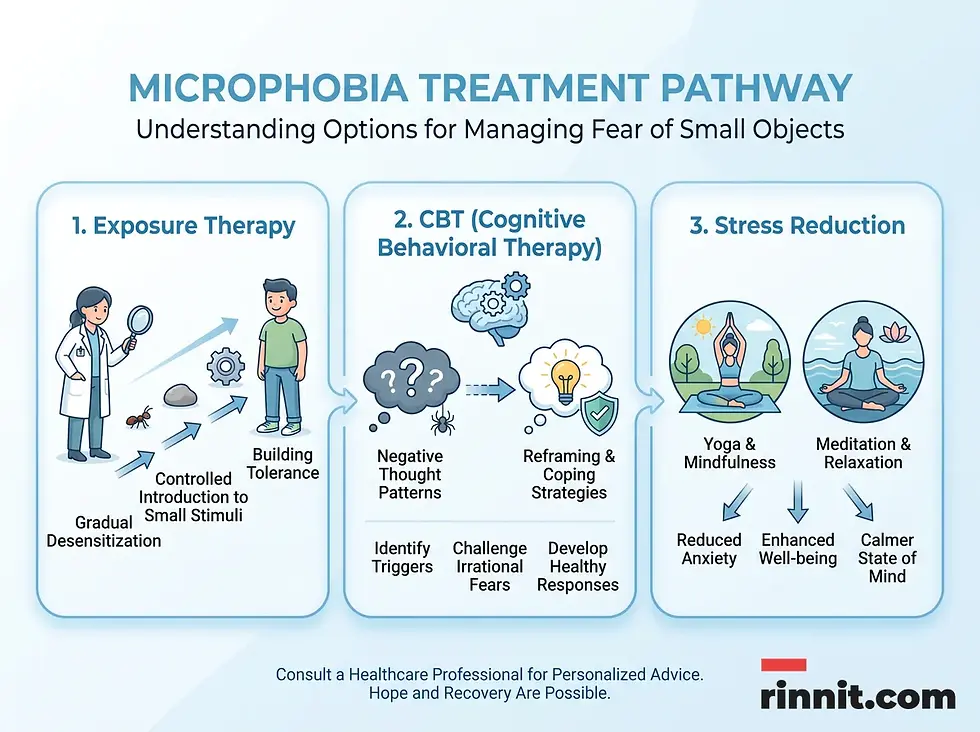
Exposure therapy, CBT, and stress reduction are the main approaches to managing microphobia.
What is the outlook for microphobia, and can it be prevented?
Treatment helps you manage the fear, although small things may still cause some anxiety. Knowing how to calm your mind when you meet a trigger can prevent the fear from escalating. If symptoms become hard to control, contact your healthcare provider, who can suggest additional therapies. It takes time to overcome a phobia, so do not let that discourage you[1].
If you are at higher risk of anxiety disorders, managing anxiety may lower the chance that worries escalate into phobias. Helpful steps include limiting alcohol and recreational drugs, lowering stress, quitting smoking and other tobacco use, spending time with loved ones, and taking up a new hobby[1].
What is the bottom line on microphobia?
Microphobia can make the world feel dangerous, but it does not have to control your life. Changing your lifestyle to avoid small things can make the fear worse, and there is no reason to feel embarrassed about having a phobia. The first step is to talk to a healthcare provider, who can help you find a therapist. If you or a loved one has an intense fear of small objects that interferes with daily life, reach out to a mental health professional[1].
Frequently Asked Questions
What exactly is microphobia?
Microphobia is a specific phobia: an intense fear of small things, such as germs, insects, pollen, or tiny fragments, that is out of proportion to the real danger.
Is microphobia the same as a fear of germs?
No. A fear of germs is called mysophobia. It is a separate phobia that can occur alongside microphobia, and people can have more than one specific phobia.
What are the most common symptoms of microphobia?
Avoidant behaviors, such as refusing to leave the house, and physical signs such as a rapid heart rate, sweating, trembling, and muscle tension.
Can microphobia be cured?
Treatment can ease the fear so that small things become less bothersome, although they may still sometimes cause anxiety. Exposure therapy and CBT are the main approaches.
What causes someone to develop a fear of small things?
Genetics, such as a family history of mood disorders, and environmental factors, such as emotional trauma related to small things, can both raise the risk.
How does exposure therapy work for microphobia?
A therapist exposes you to your triggers, starting with pictures of small objects and gradually moving toward touching them or going to places you have avoided.
Can children have microphobia?
Specific phobias can affect people of any age. If a child's fear of small things is intense and disrupts daily life, talk to their healthcare provider.
Are there medications for microphobia?
Medications do not cure the phobia. Antidepressants can help with mood disorders, and anti-anxiety medications can help during a challenging time.
Does microphobia lead to panic attacks?
Microphobia can. The thought of small things can bring on severe anxiety and sometimes panic attacks.
How can I help someone with microphobia?
Encourage them to talk to a healthcare provider, without judgment. Phobias are common, and a therapist can teach healthier ways to cope.
Related Reading
Specific Phobias: Symptoms, Causes, and How Exposure Therapy Helps You Overcome Them explains specific phobias and how exposure therapy helps.
Entomophobia (Fear of Insects): Symptoms, Causes, Triggers, Diagnosis, Treatment and When to See Your Provider — What You Need to Know covers the fear of insects, a common related phobia.
Exposure Therapy: What It Is, How It Works, Types, and What to Expect describes how gradual, guided exposure reduces fear over time.
Panic Attacks and Panic Disorder: Symptoms, Causes, and Treatment explains panic attacks and how they are treated.
References
Cleveland Clinic. Microphobia (Fear of Small Things). Cleveland Clinic. February 28, 2022. https://my.clevelandclinic.org/health/diseases/22427-microphobia
Wolitzky-Taylor KB, Horowitz JD, Powers MB, Telch MJ. Psychological approaches in the treatment of specific phobias: a meta-analysis. Clin Psychol Rev. 2008;28(6):1021-1037. PMID 18410984. https://doi.org/10.1016/j.cpr.2008.02.007
Van Houtem CMHH, Laine ML, Boomsma DI, Ligthart L, van Wijk AJ, De Jongh A. A review and meta-analysis of the heritability of specific phobia subtypes and corresponding fears. J Anxiety Disord. 2013;27(4):379-388. PMID 23774007. https://doi.org/10.1016/j.janxdis.2013.04.007
Mor S, Grimaldos J, Tur C, Miguel C, Cuijpers P, Botella C, Quero S. Internet- and mobile-based interventions for the treatment of specific phobia: a systematic review and preliminary meta-analysis. Internet Interv. 2021;26:100462. PMID 34646752. https://doi.org/10.1016/j.invent.2021.100462
Medical disclaimer
This article is for informational purposes only and is not a substitute for professional medical advice, diagnosis, or treatment. The clinical information in this guide reflects source material last reviewed in February 2022.



Comments