Understanding Micrognathia: Symptoms, Causes, and Treatments

Updated: 3 days ago
Medically reviewed by Dr. Baraa Alnahhal, MD · Last reviewed: October 2026
Micrognathia means a baby's lower jaw is smaller than usual. Because a smaller jaw leaves less room for the tongue, it can make breathing and feeding harder, and treatment focuses on keeping the airway open [1].
Quick Answer: What is micrognathia?
Micrognathia, also called mandibular hypoplasia, is a condition in which a baby is born with an underdeveloped or smaller-than-usual lower jaw, which can push the tongue back and make breathing and feeding hard. It is often linked to inherited conditions or syndromes. Some cases resolve as the baby grows, while others need positioning, breathing support or surgery. [1]
What the research says
Most infants with Robin sequence are managed without surgery. A systematic review and meta-analysis of 88 articles found that in studies reporting both operative and non-operative care, 2,924 of 4,708 infants with Pierre Robin sequence (a combination of a small lower jaw, a tongue that falls back, and airway obstruction) received a non-operative intervention (pooled 65.8%); positioning (1,664 infants), orthodontic appliances (1,299), and nasopharyngeal tubes (983) were the most commonly reported approaches, although the included studies were of moderate quality (Haas et al., J Craniomaxillofac Surg, 2024 [2]).
Jaw distraction surgery usually avoids a tracheostomy, but it works less well in syndromic cases. A systematic review of 66 studies in children with micrognathia or Pierre Robin sequence who had not improved with conservative treatment found that mandibular distraction osteogenesis prevented the need for a tracheostomy in 95% of cases, while children with an associated syndrome had four times greater odds of failure than those with isolated Pierre Robin sequence (Breik et al., Int J Oral Maxillofac Surg, 2016 [3]).
Distraction surgery is effective but carries real complications that need follow-up. A review of 49 studies covering 1,209 patients with Robin sequence reported a tracheostomy avoidance rate of 94% (817 of 870) and a mortality rate of 0.99%, with an overall complication rate of 28.9%, including surgical site infection (10.5%), dental injury (7.9%), and nerve injury (3.2%) (Chocron et al., J Craniofac Surg, 2022 [4]).
What is micrognathia, and how is it defined?
Micrognathia is when a baby's lower jaw (mandible) is underdeveloped or smaller than usual. It is also known as mandibular hypoplasia. A smaller jaw means there is less room for the tongue, so the tongue ends up pushed back into the throat. That can make it hard for the baby to breathe, and the baby may have trouble nursing or feeding [1].
The condition often affects babies who have certain inherited conditions or syndromes, although it can also be caused by a random genetic variation. Micrognathia may go away without treatment a year or so after birth as the lower jaw grows, but persistent symptoms need medical attention [1].
What are the common symptoms of micrognathia in infants?
Parents and caregivers may notice signs that a baby is struggling with the effects of a smaller jaw. They mostly involve the mechanics of breathing and feeding [1].
Loud or noisy breathing: often caused by the tongue partly blocking the airway [1].
Difficulty feeding or nursing: the baby may struggle to latch or to coordinate swallowing [1].
Poor weight gain: a result of the extra effort needed to feed and breathe [1].
Tossing and turning during sleep: a sign that sleep may be disturbed [1].
Micrognathia may also lead to obstructive sleep apnea, which can happen if your child's tongue falls back into their throat and blocks the airway during sleep [1].
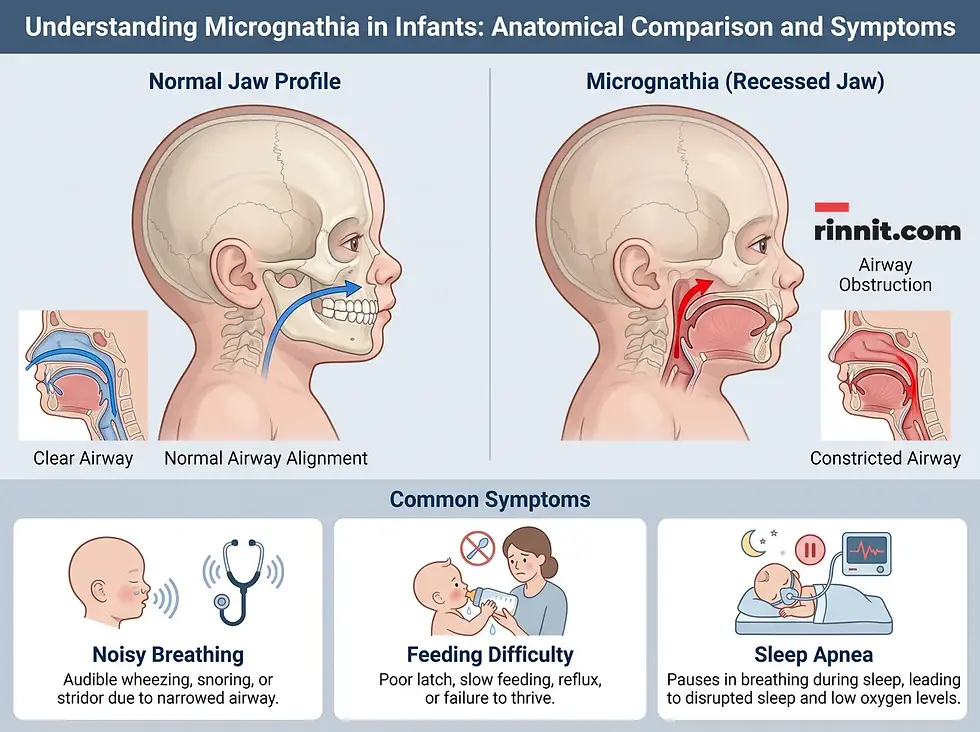
A normal jaw profile compared with micrognathia, where a recessed jaw can narrow the airway and cause noisy breathing, feeding difficulty, and sleep apnea.
What causes micrognathia, and what syndromes are associated with it?
Researchers link micrognathia to many genetic conditions and syndromes. Understanding the underlying cause helps the care team plan treatment. Common examples include [1].
Condition | Description |
Pierre Robin sequence | A small lower jaw with a tongue that falls back toward the throat and airway obstruction, often along with a cleft palate. |
Treacher Collins syndrome | A genetic condition that affects the development of the bones and other tissues of the face. |
Marfan syndrome | A connective tissue disorder that can affect many parts of the body. |
Trisomy 18 | A chromosomal condition that is often associated with a small lower jaw. |
Stickler syndrome | A genetic disorder that can cause distinct facial features and joint problems. |
Other conditions | Beckwith-Wiedemann syndrome, cri-du-chat syndrome, and cleft lip and palate are also linked to micrognathia. |
How is micrognathia diagnosed?
Sometimes a prenatal ultrasound shows signs of micrognathia, such as an underdeveloped jaw. Typically, though, healthcare providers diagnose the condition when the baby is born or very soon after. A provider examines your baby's face and mouth and will [1].
They may also order CT scans, X-rays, or a sleep study, and may refer you to a pediatric ENT for more tests and treatment [1].

Diagnosis starts with a physical exam and may include prenatal ultrasound, imaging, and a check for associated syndromes.
How is micrognathia managed and treated?
Micrognathia may go away on its own a year or so after birth as the lower jaw gets bigger. A provider may recommend treatment if the baby's symptoms are not better by 18 months. Most treatments work to fix the baby's airway so they can breathe more easily, and the plan depends on how the condition affects your child [1].
Nonsurgical Interventions
Your child's provider will try nonsurgical treatments before recommending surgery. The most common ones are [1].
Positional therapy: placing your baby on their side or tummy moves the tongue forward so it does not block the airway, but only when your baby's care team prescribes it, usually with monitoring; otherwise babies should always sleep on their backs [1].
Nasopharyngeal tube: a soft tube that goes into the baby's nose and the upper part of the throat to keep the tongue from falling back [1].
Positive airway pressure: a CPAP or BiPAP device worn during sleep that sends air through a mask over the nose to keep the airway open [1].
Surgical Treatments
Your child may need surgery to make sure the airway stays open. Options include [1].
Mandibular distraction osteogenesis (MDO): a surgery that makes the baby's jaw longer and opens the airway [1].
Tongue-lip adhesion: a temporary solution in which the surgeon uses sutures to connect the tongue to the lower lip so the tongue cannot fall into the airway; the sutures are removed after the lower jaw grows [1].
Tracheostomy: an opening made through the neck and into the airway so the baby can get air through a tube [1].
Surgery can be a scary experience for your baby and for you, and working with a child life specialist may help by providing emotional support before and after surgery [1].

Positional therapy, breathing aids, and surgical options such as jaw distraction are chosen according to how severely the airway is affected.
What is the long-term outlook for micrognathia?
Treatment, including surgery, may take care of micrognathia. However, children with this condition often have genetic syndromes that affect their health, so your baby may need other kinds of medical support even after treatment for micrognathia. If your child has been diagnosed, it can help to ask the provider why your baby has this condition, how severe it is, and whether treatment will be needed [1].
What is the bottom line on micrognathia?
Micrognathia can be challenging for babies and their parents, but there are many ways to manage its effects, from side-sleeping and breathing aids to surgery. Whether the jaw catches up on its own or needs correction, the goal is to make sure your child can breathe and feed safely. If your baby has a small lower jaw and noisy breathing or trouble feeding, talk to your child's pediatrician, who may refer you to a pediatric ENT.
Frequently Asked Questions
What is the medical term for a small lower jaw?
The medical terms are micrognathia and mandibular hypoplasia.
Can micrognathia be detected before birth?
Sometimes. A prenatal ultrasound can show signs such as an underdeveloped jaw, but providers typically diagnose micrognathia when the baby is born or very soon after.
Does a small jaw always require surgery?
No. Micrognathia may go away on its own as the baby grows, and nonsurgical treatments such as positioning, a nasopharyngeal tube, or positive airway pressure are tried before surgery.
How does micrognathia affect a baby's breathing?
A smaller jaw leaves less room for the tongue, which can be pushed back into the throat and block the airway, especially during sleep. It may lead to obstructive sleep apnea.
What is Pierre Robin sequence?
Pierre Robin sequence is a condition that combines a small lower jaw, a tongue that falls backward, and airway obstruction, often along with a cleft palate.
Can micrognathia cause feeding problems?
Yes. Babies with a small lower jaw may have difficulty feeding or nursing and may gain weight poorly.
What is mandibular distraction osteogenesis?
Mandibular distraction osteogenesis is a surgery that makes the baby's jaw longer and opens the airway.
Will my child grow out of micrognathia?
Micrognathia may go away on its own a year or so after birth as the lower jaw gets bigger. If symptoms are not better by 18 months, the provider may recommend treatment.
Is micrognathia a genetic condition?
Micrognathia is often linked to inherited conditions or syndromes such as Treacher Collins syndrome and Marfan syndrome, although a random genetic variation may also cause it.
What should I do if my baby has noisy breathing?
Talk to your child's pediatrician, especially if the lower jaw is small or underdeveloped and your baby has noisy breathing or difficulty feeding. Call 911 if your baby turns blue, has pauses in breathing, or is struggling hard to breathe. They may refer you to a pediatric ENT for evaluation.
Related Reading
Pierre Robin Syndrome: Symptoms, Causes, and Care Roadmap explains a condition where a small jaw causes breathing and feeding problems.
Retrognathia (Receding Chin): Symptoms, Causes, and Treatments compares a set-back lower jaw and the options to correct it.
What Is Cleft Lip and Cleft Palate? Symptoms, Causes, Diagnosis and Treatment explains cleft palate, which often occurs with a small lower jaw.
Corrective Jaw Surgery (Orthognathic Surgery): Procedure and Recovery describes jaw surgery used to correct jaw size and position.
References
Cleveland Clinic. Micrognathia. Cleveland Clinic. January 2, 2026. https://my.clevelandclinic.org/health/diseases/22882-micrognathia
Haas J, Yuen K, Farrokhyar F, et al. Non-operative interventions for Pierre-Robin sequence: a systematic review and meta-analysis. J Craniomaxillofac Surg. 2024;52(12):1422-1427. PMID 39256141. https://doi.org/10.1016/j.jcms.2024.08.008
Breik O, Tivey D, Umapathysivam K, Anderson P. Mandibular distraction osteogenesis for the management of upper airway obstruction in children with micrognathia: a systematic review. Int J Oral Maxillofac Surg. 2016;45(6):769-782. PMID 26867668. https://doi.org/10.1016/j.ijom.2016.01.009
Chocron Y, Barone N, Zammit D, Gilardino MS. Efficacy and complications of mandibular distraction osteogenesis for airway obstruction in the Robin sequence population: a comprehensive literature review. J Craniofac Surg. 2022;33(6):1739-1744. PMID 35258012. https://doi.org/10.1097/SCS.0000000000008611
Medical disclaimer
This article is for informational purposes only and is not a substitute for professional medical advice, diagnosis, or treatment. The clinical information in this guide reflects source material last reviewed in January 2026.



Comments