Understanding Meningococcal Disease: Symptoms, Causes, and Emergency Care

Updated: 3 days ago
Medically reviewed by Dr. Baraa Alnahhal, MD · Last reviewed: October 2026
Editorial note: This article is provided for educational purposes only. It is not medical advice. Always consult a qualified healthcare professional about your individual health situation.
Quick Answer: What Is Meningococcal Disease?
Meningococcal disease is a severe bacterial infection caused by Neisseria meningitidis that inflames the meninges or infects the bloodstream. [1] It spreads through close contact like kissing or sharing utensils. [1] Symptoms include fever, severe headache, stiff neck and a pinpoint or bruise-like rash. Because it can be rapidly fatal, immediate hospital treatment with IV antibiotics is required. Vaccination prevents it. [1]
What the research says
Vaccination has reshaped the disease worldwide. A review of global epidemiology notes that six of twelve recognized serogroups (A, B, C, W, X and Y) cause nearly all invasive cases, and that incidence has been declining across most of the world over the past two decades through immunization programs and secular trends. Meningococcal C conjugate vaccines were associated with rapid declines in group C disease, and a meningococcal A conjugate vaccine led to near-elimination of group A disease across the African meningitis belt (Parikh et al., J Infect, 2020 [2]).
Survivors can face lasting problems. A systematic review of 17 studies of survivors in high-income countries (from 1,884 citations screened) found that children with invasive meningococcal disease had a greater incidence of hearing loss and psychological disorders, including attention-deficit/hyperactivity disorder. The odds of death were significantly increased at hospital discharge and up to 30 years after disease, and quality of life was lower than in controls (Strifler et al., J Pediatric Infect Dis Soc, 2016 [3]).
Early symptoms are often nonspecific. A systematic review of serogroup W invasive disease reported wide ranges for fever (36-100% of cases), headache (7-50%), diarrhea (8-47%) and stiff neck (7-54%), with sepsis the most commonly reported manifestation (15-83%). Case fatality ranged from 8% to 40%, and 4-14% of survivors had long-term sequelae (Bertrand-Gerentes et al., Infect Dis Ther, 2023 [4]).
Emergency medical warning: Seek emergency medical attention immediately if you or a loved one has a sudden high fever, stiff neck and severe headache, especially with a dark pinpoint or bruise-like skin rash. Meningococcal disease can become fatal within hours without treatment.
What Is Meningococcal Disease?
Meningococcal disease is a rare and aggressive clinical infection triggered by the bacterium Neisseria meningitidis, also known as meningococcus. [1] This pathogen primarily targets the meninges—the three protective membranes surrounding the brain and spinal cord—and the bloodstream. In the United States, approximately 400 cases are reported annually, highlighting its rarity but not diminishing its clinical severity.
The infection is considered a medical emergency because it can become fatal within hours without appropriate intervention. The bacteria are categorized by their ability to cause systemic inflammation, leading to either meningitis (inflammation of the brain linings) or septicemia (blood poisoning). Because the bacteria do not survive long outside the human body, transmission requires direct contact with infected spit or mucus. [1]

What are the symptoms of meningococcal disease?
The symptoms of meningococcal disease often mimic those of the common cold or influenza in their early stages, making early detection challenging. [1] However, specific signs distinguish this bacterial infection from milder illnesses. A hallmark symptom is a stiff neck, which is often accompanied by a sudden high fever and a severe headache.
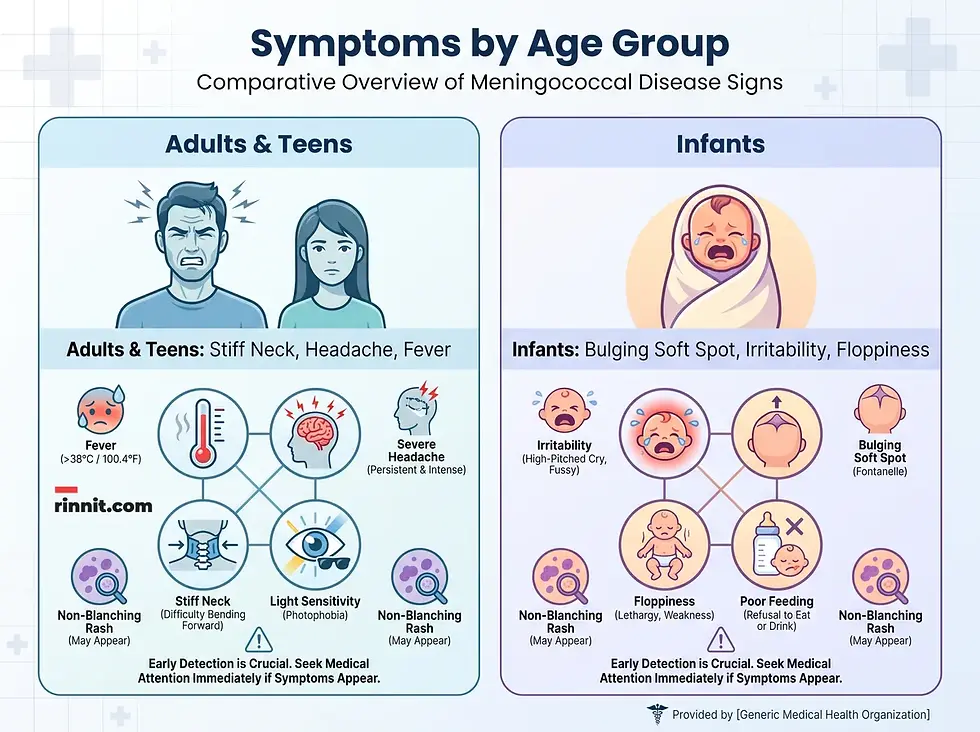
The presentation can differ significantly between age groups, particularly in infants who may not exhibit the classic signs seen in adults. The following table outlines the symptoms based on the affected individual:
Patient Group | Common Symptoms and Signs |
Adults & Teenagers | Severe headache, high fever, stiff neck, light sensitivity (photophobia), nausea, and confusion. |
Infants & Babies | Bulging soft spot (fontanelle), unexplained irritability, floppiness, poor feeding, and extreme fatigue. |
Systemic Signs | Diarrhea, joint and muscle pain, difficulty walking, and a dark pinpoint or bruise-like skin rash. [1] |
A distinctive skin rash is a critical warning sign. It may appear as small, dark red or purple pinpoints that do not fade when pressed, or as larger areas that resemble bruises. This indicates that the bacteria have entered the bloodstream and are damaging small blood vessels.
What causes meningococcal disease, and what are the risk factors?
The primary cause of this condition is the transmission of Neisseria meningitidis through close contact. Activities such as coughing, sneezing, kissing, or sharing eating utensils allow the bacteria to move from an infected individual to a new host. [1] While anyone can contract the disease, certain factors significantly increase an individual's vulnerability.
Risk factors are often linked to age, lifestyle, and underlying medical conditions. Infants under one year old, teenagers, and young adults are at the highest risk. Living in crowded environments, such as college dormitories or military barracks, facilitates the spread of the bacteria. [1] Additionally, individuals with spleen injuries, sickle cell disease, or those taking specific complement inhibitor medications are more susceptible to severe infection. [1]
What are the complications and long-term outlook of meningococcal disease?
Even with prompt medical care, meningococcal disease carries a high fatality rate, with approximately 10 to 15 out of every 100 infected individuals succumbing to the illness. [1] For survivors, the road to recovery can be long, often taking weeks or months of intensive care and rehabilitation.
About 20% of survivors experience permanent, life-altering complications. These can include:
Neurological Damage: Permanent brain or nerve damage affecting cognitive and motor functions.
Sensory Loss: Total hearing loss or deafness in one or both ears.
Organ Failure: Significant kidney damage requiring long-term management.
Physical Disability: Loss of limbs due to severe tissue death (gangrene) caused by blood vessel damage.
How is meningococcal disease diagnosed and treated?
Healthcare providers face challenges in diagnosing meningococcal disease because its initial symptoms overlap with viral infections. [1] If the condition is suspected, medical teams prioritize immediate testing, including blood cultures and a lumbar puncture (spinal tap) to analyze cerebrospinal fluid. [1] PCR tests may also be utilized if initial cultures are inconclusive. [1]
Treatment must begin immediately, often before a definitive diagnosis is confirmed. [1] The primary intervention is the administration of intravenous (IV) antibiotics, such as ceftriaxone or penicillin, typically for a duration of seven to 10 days. [1] Additional supportive treatments may include:
Corticosteroids: Used to reduce inflammation and potential damage to the nervous system.
IV Fluids: Administered to maintain hydration and stabilize blood pressure.
Oxygen Therapy: Provided to support respiratory function during severe illness.
Surgical Intervention: Necessary for removing dead or damaged skin and tissue. [1]

Conclusion
Meningococcal disease is a formidable bacterial threat that requires rapid recognition and emergency medical care. While the infection is rare, its potential for swift progression and permanent damage underscores the importance of public awareness and preventive measures. By understanding the symptoms and maintaining up-to-date vaccinations, individuals can significantly reduce their risk and improve the likelihood of a successful recovery if exposure occurs.
What should you do if you suspect meningococcal disease?
If you or a loved one exhibits a sudden high fever, stiff neck, and a severe headache, seek emergency medical attention immediately. Early intervention is the most critical factor in surviving meningococcal disease and preventing long-term complications. Consult with a healthcare professional to ensure your vaccinations are current and to discuss preventive strategies for high-risk environments.
Related reading: Understanding Meningitis: Symptoms, Causes, and Emergency Care | Understanding Meningococcemia: Symptoms, Risks, and Emergency Care
Sources: Cleveland Clinic — Meningococcal Disease | Parikh et al., 2020 | Strifler et al., 2016 | Bertrand-Gerentes et al., 2023
Frequently Asked Questions
1. What is meningococcal disease?
Meningococcal disease is a rare but very serious bacterial infection caused by Neisseria meningitidis that affects the brain linings and blood.
2. How does meningococcal disease spread?
The bacteria spread through close contact with infected spit or mucus, such as through kissing, coughing, or sharing utensils.
3. What are the first signs of meningococcal disease?
Early signs often include a sudden high fever, severe headache, and a stiff neck, which may be mistaken for the flu.
4. Is a rash always present in meningococcal disease?
No, but a dark pinpoint or bruise-like rash is a common and critical sign that the infection has entered the blood.
5. Who is at the highest risk for the infection?
Infants under one year old, teenagers, young adults, and people living in crowded settings like dorms are at higher risk.
6. How is meningococcal disease diagnosed?
Doctors use blood tests and a spinal tap to look for the specific bacteria in the blood or spinal fluid.
7. Can meningococcal disease be treated?
Yes, it is treated with emergency intravenous antibiotics, and treatment should start as soon as the infection is suspected.
8. Are there long-term effects of the disease?
Yes, about 20% of survivors face permanent issues like hearing loss, brain damage, kidney damage, or loss of limbs.
9. How can I prevent meningococcal disease?
Vaccination is the most effective prevention, along with good hygiene and avoiding close contact with sick individuals.
10. Can you get meningococcal disease more than once?
Yes, unlike many other infections, it is possible to contract meningococcal disease again even after a full recovery.
References
Cleveland Clinic. Meningococcal Disease. Cleveland Clinic. July 1, 2025. https://my.clevelandclinic.org/health/diseases/22442-meningococcal-disease
Parikh SR, Campbell H, Bettinger JA, et al. The everchanging epidemiology of meningococcal disease worldwide and the potential for prevention through vaccination. J Infect. 2020;81(4):483-498. PMID 32504737. https://doi.org/10.1016/j.jinf.2020.05.079
Strifler L, Morris SK, Dang V, et al. The health burden of invasive meningococcal disease: a systematic review. J Pediatric Infect Dis Soc. 2016;5(4):417-430. PMID 26501470. https://doi.org/10.1093/jpids/piv065
Bertrand-Gerentes I, Fanchon L, Coste F, et al. Range of clinical manifestations caused by invasive meningococcal disease due to serogroup W: a systematic review. Infect Dis Ther. 2023;12(10):2337-2351. PMID 37751017. https://doi.org/10.1007/s40121-023-00869-z
Medical disclaimer
The information provided in this article is for educational purposes only and should not be used as a substitute for professional medical advice, diagnosis, or treatment. Always seek the advice of your physician or other qualified health provider with any questions you may have regarding a medical condition. Never disregard professional medical advice or delay in seeking it because of something you have read here.



Comments