Understanding Fifth Metatarsal Fractures: Types, Recovery, and Treatment

Updated: 2 days ago
Medically reviewed by Dr. Baraa Alnahhal, MD · Last reviewed: October 2026
Quick Answer
A fifth metatarsal fracture is a break in the bone connecting the ankle to the little toe, caused by trauma, overuse or high arches. [1] It causes pain, swelling and bruising on the outside of the foot. [1] Treatment ranges from a cast or boot for six to eight weeks to surgery. [1] Most people return to activity within three to four months. [1]
What the research says
Jones fractures heal less reliably without surgery. A systematic review of 10 studies (998 patients; 787 treated conservatively, 211 surgically) found nonunion in 3.3% of surgical patients versus 11.6% of conservative patients (P = 0.04), and total complications in 8.5% versus 15.6% (P = 0.02) (Encinas et al., J Am Acad Orthop Surg, 2026 [2]).
In athletes, screw fixation brings faster, more reliable union. A meta-analysis of 22 studies (646 Jones fractures in athletes) reported a pooled union rate of 97.3% with operative treatment versus 71.4% with nonoperative treatment, and a time to union of 8.2 weeks with intramedullary screw fixation versus 13.7 weeks without surgery (Attia et al., Am J Sports Med, 2021 [3]).
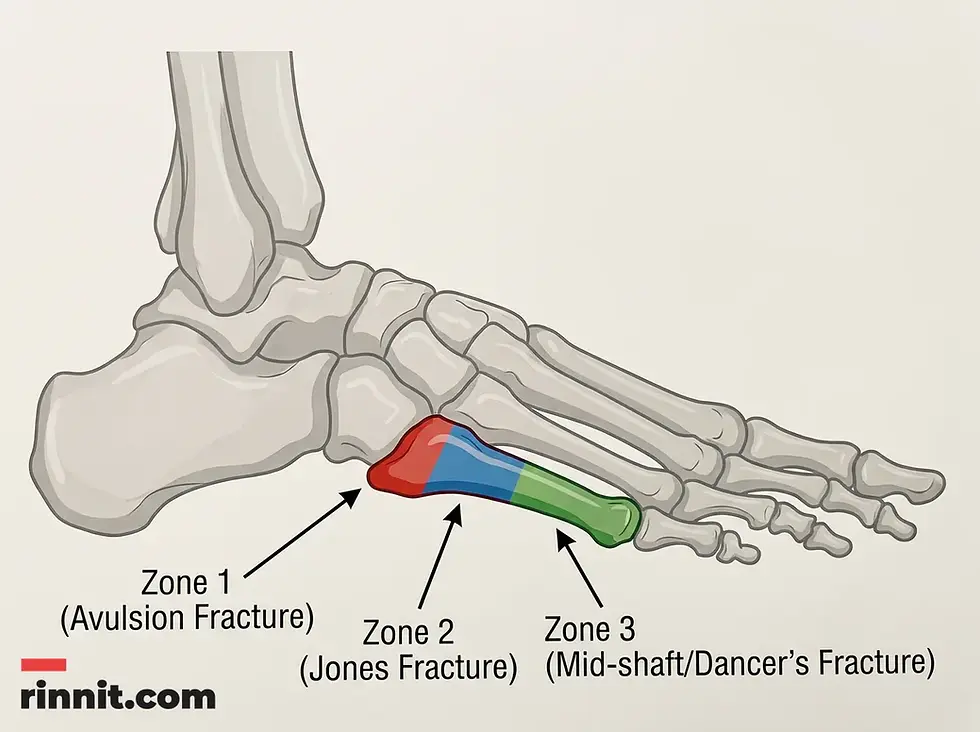
What is the anatomy of the fifth metatarsal, and how are its fractures classified?
The fifth metatarsal is the long bone situated on the lateral (outer) edge of the foot, serving as a critical connection between the ankle and the small toe. [1] Fractures of this bone are among the most prevalent foot injuries and are categorized into three distinct zones based on the location of the break. [1] This classification is vital because the blood supply varies across the bone, directly impacting how well and how quickly the injury heals. [1]
Fracture Zone | Common Name | Prevalence/Characteristics |
Zone 1 | Avulsion Fracture | 93% of cases; caused by a tendon or ligament pulling a small bone fragment away. [1] |
Zone 2 | Jones Fracture | Occurs in a low-blood-flow area; prone to healing difficulties; can be acute or stress-related. [1] |
Zone 3 | Mid-shaft/Dancer’s | Results from trauma or twisting [1]; Zone 3 is the upper shaft just beyond the Jones area and is usually a stress fracture; a dancer’s fracture is a twisting break further along the shaft toward the toe. |
What are the symptoms and main causes of fifth metatarsal fractures?
Trauma is the leading cause of fifth metatarsal fractures, often resulting from a direct blow to the foot or a sudden inversion injury where the ankle rolls inward. Individuals with high arches may be more susceptible due to increased pressure on the outer foot. [1] Overuse and repetitive stress are also common culprits, particularly in athletes or those with physically demanding occupations.
Symptoms typically manifest immediately following the injury, primarily localized to the outside of the foot. Patients often experience significant pain, tenderness, and visible bruising. [1] Swelling is common, and the discomfort usually makes walking or bearing weight difficult. [1] In some cases, a Jones fracture may develop gradually as a stress injury, presenting as worsening discomfort over time rather than a single traumatic event. [1]
How are fifth metatarsal fractures diagnosed?
To diagnose a fifth metatarsal fracture, healthcare providers perform a physical examination to identify the exact location of tenderness. [1] However, clinical suspicion must be confirmed through imaging to determine the fracture zone and the degree of displacement. X-rays are the primary tool for locating the break, though they may occasionally miss subtle Jones fractures in their early stages. [1]
If a healthcare provider suspects a Jones fracture that is not visible on a standard X-ray, or if more detail is required for surgical planning, advanced imaging may be ordered. [1] Computed tomography (CT) scans or magnetic resonance imaging (MRI) provide high-resolution views of the bone and surrounding soft tissues, ensuring that the blood supply and healing potential are accurately assessed.
Should a fifth metatarsal fracture be treated with immobilization or surgery?
The chosen treatment strategy depends on the fracture’s location, the patient’s activity level, and whether the bone fragments remain aligned. [1] For most Zone 1 avulsion fractures and non-displaced fractures in other zones, immobilization is the standard approach. [1] This involves stabilizing the foot in a cast, walking boot, or stiff-soled shoe for approximately six to eight weeks. [1]
Surgical intervention is typically reserved for displaced fractures (more than 3mm of separation) or for high-level athletes who require a faster, more stable recovery. [1] [3] During surgery, pins, screws, or plates are used to secure the bone. [1] In cases of poor healing, surgeons may utilize bone grafts or electrical bone healing stimulators to encourage new bone growth. [1]

What are recovery, rehabilitation and the long-term outlook for fifth metatarsal fractures?
Recovery from a fifth metatarsal fracture requires a period of strict weight-bearing restrictions. Weight-bearing rules depend on the fracture: most Zone 1 avulsion fractures can bear weight as comfort allows in a boot or stiff-soled shoe, while Jones fractures treated without surgery often need about six weeks with no weight on the foot. [1] Elevating the foot and applying ice for 20 minutes daily can significantly reduce swelling and pain during the initial healing phase. [1]
The long-term outlook for these fractures is generally positive, with most patients returning to their regular activities within three to four months. [1] Physical therapy is often recommended to restore mobility and strength to the foot and ankle. [1] However, complications such as blood clots, infection, or "nonunion" (where the bone fails to knit back together) can occur, particularly with Jones fractures due to the limited blood supply in Zone 2. [1] [2]

Conclusion
A fifth metatarsal fracture is a significant injury that requires accurate classification to ensure proper healing. While most cases respond well to conservative management like casting, the challenging nature of Jones fractures and displaced breaks often necessitates specialized surgical care. By following weight-bearing guidelines and engaging in physical therapy, individuals can successfully restore their mobility and return to their active lifestyles.
Clinical Alert: Seek immediate medical attention if you experience a fever, purple skin discoloration, or worsening numbness and tingling in the foot following a suspected fracture. [1]
This article provides general information and is not a substitute for professional medical advice. Always consult a qualified healthcare provider about a suspected fracture.
Frequently Asked Questions
What is the difference between a Jones fracture and a regular metatarsal break?
A Jones fracture occurs specifically in Zone 2 of the fifth metatarsal. [1] This area has a limited blood supply, which makes it much harder to heal than other metatarsal fractures and more prone to complications like nonunion. [1]
How long does it take to walk again after a fifth metatarsal fracture?
It depends on the fracture: most Zone 1 avulsion fractures can bear weight as comfort allows in a boot or stiff-soled shoe, while Jones fractures treated without surgery often need about six weeks with no weight on the foot. [1] Full return to walking and sports typically occurs between three and four months after the start of treatment. [1]
Can I treat a fifth metatarsal fracture without surgery?
Yes, many fifth metatarsal fractures, especially Zone 1 avulsion fractures, are treated successfully with immobilization in a cast or boot. [1] Surgery is usually only required if the bone is displaced by more than 3mm.
Why are high arches a risk factor for this injury?
High arches place excessive pressure on the outside of the foot. [1] This repetitive stress can lead to a fracture of the fifth metatarsal over time, even without a single traumatic event.
What are the signs that a fracture is not healing correctly?
Signs of poor healing (nonunion) include persistent pain, swelling, and an inability to bear weight after the expected recovery period. In these cases, surgery or a bone stimulator may be necessary.
Is a "dancer’s fracture" the same as a Jones fracture?
No. A dancer’s fracture is a twisting (spiral) break along the shaft of the bone toward the toe, whereas a Jones fracture is near the base of the bone in Zone 2, where blood supply is poor.
Should I quit smoking while my foot heals?
Yes. Using tobacco products can significantly slow down the bone healing process. [1] Quitting smoking is clinically recommended to improve recovery times for any bone fracture.
When is a bone graft needed for this fracture?
A bone graft may be used during surgery if the bone is severely damaged or if the fracture has failed to heal through other methods. It provides a scaffold for new bone growth.
Can an ankle sprain hide a metatarsal fracture?
Yes, Zone 1 avulsion fractures are often overlooked because their symptoms closely mimic those of a severe ankle sprain. [1] Any significant pain on the outside of the foot after a roll should be evaluated for a fracture.
What happens if a Jones fracture goes untreated?
An untreated Jones fracture may never heal due to the poor blood supply in that area. This can lead to chronic pain, permanent mobility issues, and the eventual need for complex surgery.
Are women more at risk for certain metatarsal fractures?
While anyone can sustain these injuries, women have been shown to have a higher rate of Zone 1 avulsion fractures and Zone 3 mid-shaft fractures compared to men. [1]
Content reviewed and produced following the Rinnit editorial framework. Last updated: October 8, 2026.
Related Reading
Foot X-Ray: What It Shows, Why It's Done, What to Expect and Results explains the imaging test commonly used to diagnose this condition in the foot and ankle.
References
Cleveland Clinic. 5th Metatarsal Fracture. Cleveland Clinic Health Library. Medically reviewed; last updated December 29, 2021. https://my.clevelandclinic.org/health/diseases/22247-fifth-metatarsal-fracture
Encinas R, Hall Kiriluk S, DePaolo S, et al. Clinical outcomes and complications of surgical and conservative treatment for Jones fractures: a systematic review. J Am Acad Orthop Surg. 2026;34(21):e3115-e3124. PMID 42319275. doi:10.5435/JAAOS-D-25-01516
Attia AK, Taha T, Kong G, et al. Return to play and fracture union after the surgical management of Jones fractures in athletes: a systematic review and meta-analysis. Am J Sports Med. 2021;49(12):3422-3436. PMID 33740393. doi:10.1177/0363546521990020



Comments