Understanding Apocrine Glands: Function, Location, and Health

Updated: 3 days ago
Medically reviewed by Dr. Baraa Alnahhal, MD · Last reviewed: October 2026
Quick Answer
Apocrine glands are specialized sweat glands located mainly in the armpits and genital regions that produce thick, oily sweat. [1] Unlike eccrine glands, which regulate temperature, they activate during puberty and respond to emotional stress or excitement, releasing secretions into hair follicles. [1] Variations of these glands also produce earwax and protective substances for the eyes. [1]
What the research says
Hidradenitis suppurativa, a disease of apocrine-gland-bearing skin, affects roughly 0.4% of people in studied populations. A systematic review and meta-regression of 16 studies from Western Europe, Scandinavia, the US and Australia found a pooled prevalence of 0.40% (95% CI 0.26% to 0.63%). Studies based on clinical samples found a higher prevalence (1.7%) than population-based studies (0.3%) (PubMed: Jfri et al., JAMA Dermatol, 2021 [2]).
Hidradenitis suppurativa goes beyond the skin. A clinical review reports an estimated prevalence of about 1% in most studied countries, typically starting in early adulthood, with nodules, abscesses and tunnels in the armpits, groin, buttocks and perianal area. Associated conditions include metabolic and cardiovascular disorders, and treatment options include antibiotics, TNF-blocking therapy, surgery and lifestyle changes (PubMed: Sabat et al., Nat Rev Dis Primers, 2020 [3]).
Fox-Fordyce disease is rare and mainly affects women after puberty. A clinical case series describes it as a rare chronic inflammatory disease of the apocrine glands that involves the armpit, areola, anogenital area and navel, and reports laser hair removal as a possible trigger. The evidence comes from case reports, so it cannot show how common the condition is (PubMed: Sammour et al., J Eur Acad Dermatol Venereol, 2016 [4]).
What are apocrine glands?
Apocrine glands are specialized structures within the skin that play a distinct role in the human body's exocrine system. Unlike common sweat glands that cover most of the body, apocrine glands are concentrated in specific regions and produce thicker secretions, including the oily sweat associated with emotional stress. [1] These glands serve various purposes depending on their location, contributing to earwax production and eye protection in addition to their role in emotional sweating. [1]
What are the anatomy and types of apocrine glands?
Apocrine glands are a specific type of exocrine gland, meaning they release substances through ducts to the surface of bodily tissues. Each gland consists of a large, coiled base called a secretory coil where substances are produced, and a narrow duct that carries the secretion to a nearby hair follicle. [1]
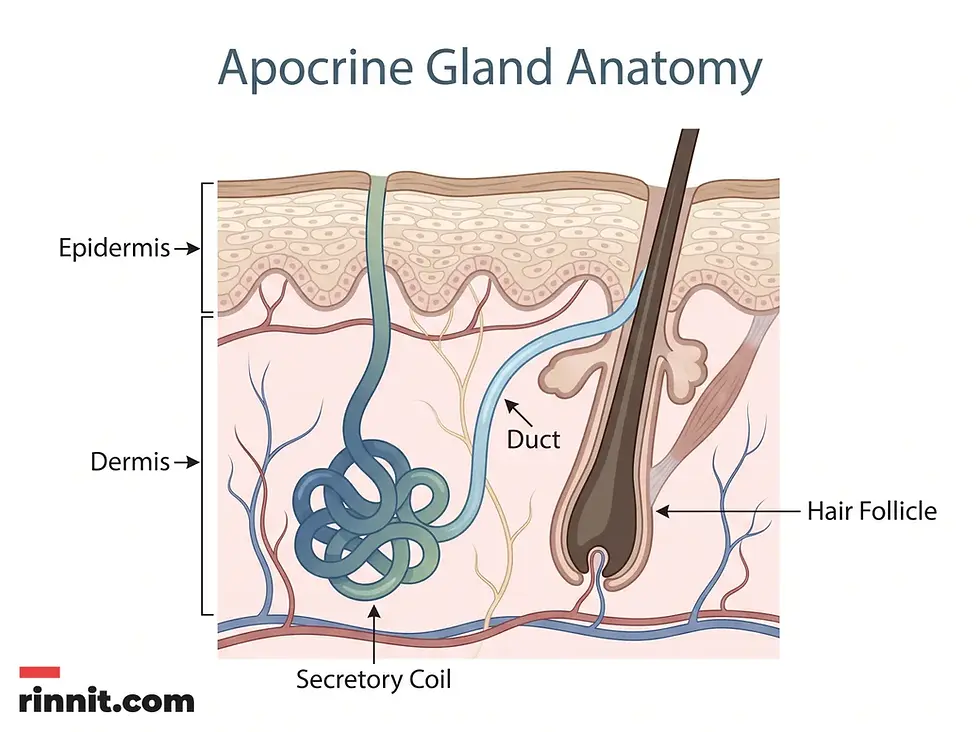
There are three primary types of apocrine glands classified by their location and specific function:
Apocrine Sweat Glands: Found mostly in the armpits and genital areas, these glands produce oily sweat. [1]
Moll’s Glands: Located on the eyelids along the eyelashes, these glands secrete substances that help protect the eyes from bacteria. [1]
Ceruminous Glands: Found in the outer ear canal, these work with sebaceous glands to produce earwax, which protects the ear from infection. [1]
Where are apocrine glands located, and when do they become active?
Apocrine sweat glands are not distributed evenly across the body. Instead, they are found in specific areas where hair follicles are abundant.
Location | Description |
Armpits (Axillae) | The most common site for apocrine sweat production. |
Genital and Anal Area | Specifically the perineum, located between the genitals and anus. [1] |
Areola | The darker skin surrounding the nipples. [1] |
Periumbilical Area | The region immediately surrounding the belly button. [1] |
Vermillion Border | The outer edges of the lips. [1] |
While apocrine glands are present at birth, they remain inactive until puberty, when hormonal changes trigger their function. [1] In contrast, Moll’s glands and ceruminous glands begin working immediately at birth to provide protection for the eyes and ears. [1]
What do apocrine glands do, and how do they differ from other glands?
The primary function of apocrine sweat glands is emotional sweating, which occurs during stress, anxiety, or excitement. This differs significantly from eccrine glands, which are the body's primary tool for thermoregulation. [1]

Feature | Apocrine Glands | Eccrine Glands |
Secretions | Thick, oily sweat. | Thin, watery sweat. |
Primary Trigger | Emotional stress or excitement. | Heat and physical exertion. |
Release Point | Into hair follicles. [1] | Directly onto the skin surface. |
Activation Time | At puberty. [1] | At birth. [1] |
Primary Goal | Emotional response (minor thermoregulation). [1] | Cooling the body (thermoregulation). [1] |
What conditions affect apocrine glands?
Conditions linked to apocrine glands include bromhidrosis (persistent body odor), Fox-Fordyce disease and hidradenitis suppurativa. [1] These issues can range from minor nuisances to chronic inflammatory conditions.

Bromhidrosis: This is the medical term for persistent body odor. It occurs when bacteria on the skin surface break down the thick sweat produced by apocrine glands, creating an unpleasant scent. [1]
Fox-Fordyce Disease (Apocrine Miliaria): A chronic condition where sweat becomes trapped within the apocrine glands, causing them to swell and leak into surrounding tissue, leading to itchy bumps and inflammation. [1]
Hidradenitis Suppurativa: An autoinflammatory condition that causes painful, recurring boils in areas where apocrine glands are present, such as the armpits and groin. [1] [3]
Conclusion
Apocrine glands are essential components of the skin's exocrine system, providing specialized secretions that protect the eyes, ears, and respond to emotional states. While they play a minor role in cooling the body, their activation at puberty marks a significant biological shift. Understanding their function and the conditions that affect them is key to maintaining skin health and managing issues like body odor or chronic inflammation.
If you experience persistent skin irritation, recurring painful boils, or unusual changes in body odor, consult a healthcare professional. A specialist can help identify if your symptoms are related to apocrine gland function and recommend appropriate management strategies or treatments.
Frequently Asked Questions
1. What is the main difference between apocrine and eccrine glands?
Apocrine glands produce thick, oily sweat in response to emotions and release it into hair follicles, primarily starting at puberty. Eccrine glands produce watery sweat for cooling the body, release it directly onto the skin, and are active from birth.
2. Where are apocrine sweat glands most commonly found?
Apocrine sweat glands are primarily concentrated in the armpits, the genital and anal regions, the area around the nipples (areola), and the skin surrounding the belly button.
3. Do apocrine glands produce hormones?
No, apocrine glands are exocrine glands, which release substances through ducts. Endocrine glands are responsible for secreting hormones directly into the bloodstream.
4. Why does apocrine sweat cause body odor?
Apocrine sweat itself is balanced and relatively odorless when first produced. However, when it reaches the skin's surface, bacteria break down the oily substances in the sweat, which creates the smell known as bromhidrosis.
5. What is emotional sweating?
Emotional sweating is the production of sweat triggered by strong feelings such as stress, anxiety, or excitement, rather than by heat or physical activity.
6. Are apocrine glands active in children?
Apocrine sweat glands typically do not become active until puberty. However, specialized apocrine glands like those in the eyelids and ear canal are active from birth.
7. What is Fox-Fordyce disease?
Fox-Fordyce disease, also known as apocrine miliaria, is a chronic condition where sweat is trapped inside the apocrine glands, leading to itchy bumps and inflammation in areas like the armpits.
8. Can apocrine glands help cool the body?
While they contribute a minor amount to thermoregulation, their role is insignificant compared to eccrine glands, which are the body's primary cooling mechanism.
9. What are ceruminous glands?
Ceruminous glands are a type of apocrine gland found in the ear canal. They produce a substance that, when combined with oil from sebaceous glands, forms earwax to protect the ear from infection.
10. What is hidradenitis suppurativa?
Hidradenitis suppurativa is a chronic inflammatory skin condition that causes painful, recurring boils to form in areas where apocrine glands are located.
Related Reading
Understanding Eccrine Glands: The Body's Natural Cooling System explains the other main sweat glands that cool the body.
Sweating and Body Odor: Symptoms, Causes, and Treatment covers why sweat can smell and ways to manage body odor.
Hidradenitis Suppurativa: Symptoms, Causes, and Treatment Options describes painful bumps that form in apocrine gland areas.
Understanding Sebaceous Glands: Function, Anatomy, and Skin Health explains the oil glands that share hair follicles with apocrine glands.
References
Cleveland Clinic. Apocrine Glands Function & Location. Cleveland Clinic. Aug. 22, 2024. https://my.clevelandclinic.org/health/body/apocrine-glands
Jfri A, Nassim D, O'Brien E, et al. Prevalence of hidradenitis suppurativa: a systematic review and meta-regression analysis. JAMA Dermatol. 2021;157(8):924-931. PMID 34037678. https://doi.org/10.1001/jamadermatol.2021.1677
Sabat R, Jemec GBE, Matusiak Ł, et al. Hidradenitis suppurativa. Nat Rev Dis Primers. 2020;6(1):18. PMID 32165620. https://doi.org/10.1038/s41572-020-0149-1
Sammour R, Nasser S, Debahy N, et al. Fox-Fordyce disease: an under-diagnosed adverse event of laser hair removal? J Eur Acad Dermatol Venereol. 2016;30(9):1578-1582. PMID 27135989. https://doi.org/10.1111/jdv.13680
Medical Disclaimer
This article is for informational purposes only and does not constitute medical advice. Always seek the advice of your physician or other qualified health provider with any questions you may have regarding a medical condition. Never disregard professional medical advice or delay in seeking it because of something you have read here.



Comments