Transforaminal Lumbar Interbody Fusion (TLIF)

Updated: 3 days ago
Medically reviewed by Dr. Baraa Alnahhal, MD · Last reviewed: October 2026
Transforaminal Lumbar Interbody Fusion (TLIF) is a surgical procedure designed to alleviate chronic lower back pain by fusing two or more vertebrae in the lumbar spine. [1] By replacing damaged intervertebral disks with bone grafts and stabilizing the area with screws and rods, TLIF reduces pressure on spinal nerves. [1] This procedure is commonly used for conditions like degenerative disk disease and spinal stenosis, offering a reliable path to long-term pain reduction and spinal stability.
Quick Answer
Transforaminal Lumbar Interbody Fusion (TLIF) is a spinal surgery that treats chronic lower back pain by joining vertebrae together. [1] Surgeons remove damaged disks that compress spinal nerves and insert bone grafts within a structural cage to promote new bone growth, stabilizing the spine and reducing nerve irritation. [1] Full recovery and complete bone fusion can take up to a year. [1]
What the research says
Minimally invasive TLIF shortens hospital stay and blood loss compared with open TLIF. An umbrella review that repooled 20 meta-analyses found minimally invasive TLIF was linked to a shorter length of stay and less blood loss (highly suggestive evidence), but a longer radiation exposure time (Jagtiani et al., Clin Spine Surg, 2024) [2].
Fusion and reoperation rates were equivalent between minimally invasive and open TLIF. In 19 studies (2,117 patients) of low-grade spondylolisthesis, fusion was equivalent (RR 1.13, 95% CI 0.74–1.74) and reoperation was similar (RR 0.72, 95% CI 0.46–1.14), while minimally invasive TLIF cut complications (RR 0.75, 95% CI 0.59–0.95) and hospital stay by 2.1 days (95% CI −2.92 to −1.24) (Patel et al., Spine Deform, 2026) [3].
TLIF fusion rates and adverse events are comparable to other interbody fusion routes. A systematic review of 21 studies (3,686 patients) found fusion rates were similar between stand-alone ALIF and posterior approaches such as TLIF and PLIF, with no significant difference in adverse events (Rathbone et al., Eur Spine J, 2023) [4].
What is transforaminal lumbar interbody fusion (TLIF) surgery?
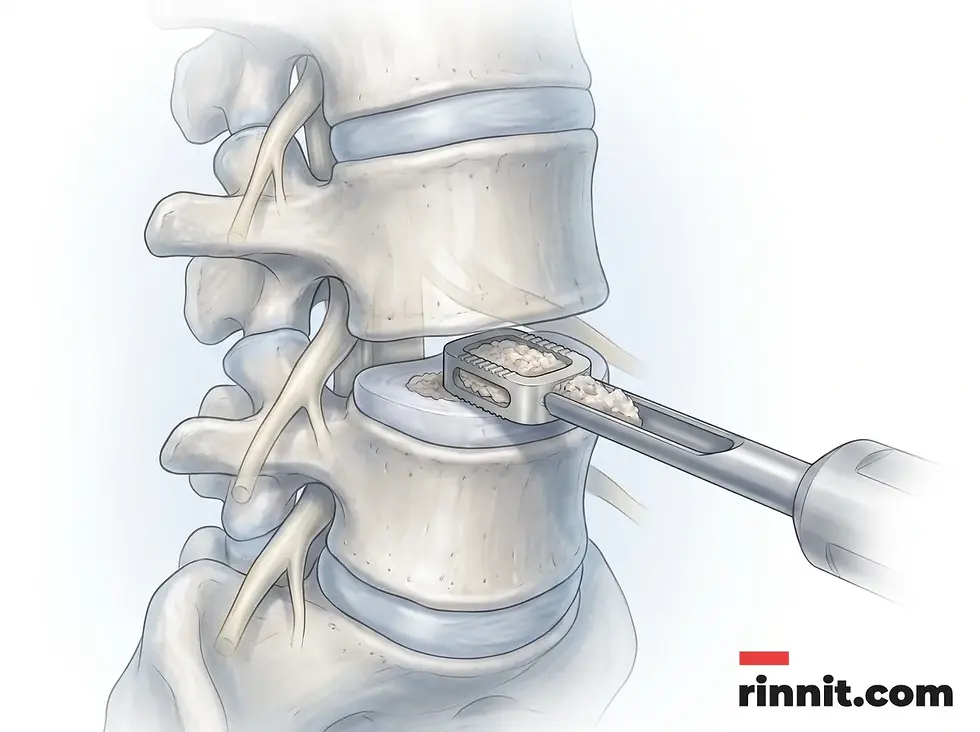
Transforaminal Lumbar Interbody Fusion (TLIF) is a refined technique within the broader category of spinal fusion surgeries. It specifically targets the lumbar region—the lower back—where intervertebral disks often suffer from wear or injury. These disks serve as cushions between the vertebrae; when they become damaged, they can protrude or collapse, placing direct pressure on the spinal nerves. [1] TLIF addresses this by removing the problematic disk material and creating a biological bridge of new bone between the adjacent vertebrae. [1]
While TLIF is a variation of the older Posterior Lumbar Interbody Fusion (PLIF) technique, it offers distinct advantages in how the surgeon accesses the spine. The “transforaminal” approach allows the surgeon to reach the disk space from the side of the spinal canal, which minimizes the need to move or retract the spinal nerves as extensively as other methods. This can reduce the risk of post-operative nerve irritation while still achieving a solid fusion.
Common Indications for TLIF
Surgeons typically recommend TLIF when conservative treatments—such as physical therapy, medication, or targeted injections—have failed to provide adequate relief for chronic back issues. [1] The procedure is effective for a range of structural spinal conditions.
Condition | Description |
Degenerative Disk Disease | Wear and tear of the intervertebral disks leading to pain and instability. [1] |
Spondylolisthesis | A condition where one vertebra slips forward over the bone below it. [1] |
Spinal Stenosis | Narrowing of the spaces within the spine, putting pressure on nerves. [1] |
Herniated Disks | Recurring instances where the soft center of a disk pushes through the exterior. [1] |
Scoliosis | Abnormal lateral curvature of the spine that causes functional impairment. [1] |
What happens during TLIF surgery?
The TLIF procedure generally takes between two and three hours to complete and is performed under general anesthesia. Patients are positioned face down to allow the surgical team access to the lower back. [1] The surgeon makes an incision a few inches to the side of the spine, rather than directly over the center, to facilitate the transforaminal approach. [1]
Once the spine is accessed, the surgeon separates the back muscles and removes the lamina—a small section of bone—and a facet joint to open the spinal canal. [1] The spinal nerve is gently moved aside to expose the damaged disk. [1] After the disk material is removed, the surgeon shaves a thin layer of bone from the vertebrae to create a receptive surface for the bone graft. [1] A structural spacer, often called a “cage,” is filled with a bone-grafting paste and placed between the vertebrae to maintain height and stimulate new bone growth. [1]

To ensure the spine remains stable while the biological fusion takes place, the surgeon installs a system of screws and rods. These internal fixation devices act as a temporary scaffold, holding the vertebrae in the correct alignment. [1] Over the following months, the bone graft material matures and eventually turns into solid bone, permanently joining the vertebrae together. [1]
What are recovery and the long-term outlook after TLIF surgery?
Recovery from a TLIF procedure is a gradual process that requires patience and adherence to a structured rehabilitation plan. Most patients spend three to four days in the hospital following surgery for monitoring and initial pain management. [1] While immediate surgical pain is common, the chronic nerve pain that necessitated the surgery often begins to improve shortly after the procedure.
The biological process of spinal fusion is slow. It can take up to a full year for the bone graft to completely fill the space and fuse the vertebrae into a single, solid unit. [1] During this time, patients must follow specific activity restrictions to avoid compromising the fusion.
Recovery Timeline and Restrictions
Adhering to post-operative guidelines is critical for a successful outcome. Daily walking is highly encouraged to promote circulation and healing, but strenuous activities must be avoided. [1]
Timeframe | Key Restrictions and Activities |
Weeks 1–4 | No bending at the waist, twisting the torso, or lifting heavy objects. No driving. [1] |
Weeks 4–6 | Continued avoidance of bending and twisting. Driving may begin with doctor approval. [1] |
Months 3–12 | Gradual return to more vigorous activities as fusion progresses. |
1 Year | Typical timeframe for full recovery and confirmed solid bone fusion. [1] |

Conclusion
TLIF surgery provides a highly effective solution for individuals suffering from chronic, debilitating lower back pain caused by structural spinal issues. By utilizing a side-access approach, it balances the need for robust spinal stabilization with the preservation of delicate nerve structures. While the recovery period is significant, the long-term benefits of restored stability and reduced pain make it a cornerstone of modern spinal care. If you are experiencing persistent back pain that interferes with your daily life, consult a specialist to determine if TLIF is the right path for your recovery.
Frequently Asked Questions
What is the main difference between TLIF and PLIF?
TLIF (Transforaminal Lumbar Interbody Fusion) accesses the spine from the side, while PLIF (Posterior Lumbar Interbody Fusion) accesses it directly from the back. The TLIF approach generally requires less nerve retraction, potentially reducing the risk of nerve irritation.
How long does the TLIF procedure take?
A typical TLIF surgery takes between two and three hours to perform, depending on the complexity of the patient's spinal condition and the number of levels being fused.
How long is the hospital stay after TLIF?
Most patients remain in the hospital for three to four days following the surgery to ensure proper pain management and to monitor for any immediate post-operative complications.
Can I drive after TLIF surgery?
Driving is strictly prohibited for the first two to four weeks. Between four and six weeks, you may be allowed to drive with your doctor's approval, provided you are no longer taking prescription pain medications.
Why must I stop smoking before TLIF surgery?
Nicotine significantly hinders the body's ability to grow new bone and heal surgical wounds. Smoking increases the risk of the fusion failing (non-union) and raises the likelihood of post-operative infections.
When can I return to work after TLIF?
Return to work depends on the nature of your job. Those with sedentary office roles may return in a few weeks, while those with physically demanding jobs may need several months of recovery.
What are the main risks of TLIF surgery?
As with any major surgery, risks include infection, excessive blood loss, and reactions to anesthesia. Specific to spinal surgery, there is a small risk of nerve damage or failure of the vertebrae to fuse properly.
Is walking allowed during recovery?
Yes, short daily walks are highly encouraged starting shortly after surgery. Walking helps prevent blood clots and promotes the healing process, though you must avoid strenuous exercise.
How long does full bone fusion take?
While you will feel better much sooner, the biological process of the vertebrae completely fusing together typically takes a full year.
How do I prepare for TLIF surgery?
Your care team reviews your medical history, may do blood tests, asks about all medicines and supplements, and encourages you to stop smoking because nicotine makes it harder for bone grafts to grow and wounds to heal. [1] About seven days before surgery, limit alcohol, stop NSAIDs and, only if your doctors tell you to, blood-thinning drugs, and arrange for someone to stay with you for the first day or two at home. [1] Stop eating and drinking 8 to 12 hours before surgery; if you must take certain medicines, you can take them with a sip of water. [1]
Does TLIF surgery hurt, and what anesthesia is used?
At the hospital, your anesthesiologist explains the type of anesthesia you will receive and what to expect as you recover from it. [1] After surgery, the recovery team checks your vital signs and gives you medicine for pain. [1] Bending, twisting, lifting or driving may hurt for several weeks, so contact your provider if you have more pain than expected. [1]
When should I call my healthcare provider?
You should contact your doctor immediately if you experience a fever over 101°F, redness or drainage at the incision site, uncontrolled pain, or sudden calf pain and swelling.
Related Reading
References
Cleveland Clinic. TLIF (Transforaminal Lumbar Interbody Fusion). Cleveland Clinic. Last updated September 16, 2024. https://my.clevelandclinic.org/health/procedures/transforaminal-lumbar-interbody-fusion-tlif
Jagtiani P, Karabacak M, Margetis K. Comparative Effectiveness of Open Versus Minimally Invasive Transforaminal Lumbar Interbody Fusion: An Umbrella Review of Meta-Analyses. Clin Spine Surg. 2024;37(6):E225-E238. PMID 38245811. https://doi.org/10.1097/BSD.0000000000001561
Patel S, Nischal SA, White GW, et al. Minimally invasive versus open transforaminal lumbar interbody fusion for low grade lumbar spondylolisthesis: a systematic review and meta-analysis. Spine Deform. 2026. PMID 42477285. https://doi.org/10.1007/s43390-026-01508-6
Rathbone J, Rackham M, Nielsen D, et al. A systematic review of anterior lumbar interbody fusion (ALIF) versus posterior lumbar interbody fusion (PLIF), transforaminal lumbar interbody fusion (TLIF), posterolateral lumbar fusion (PLF). Eur Spine J. 2023;32(6):1911-1926. PMID 37071155. https://doi.org/10.1007/s00586-023-07567-x
Medical disclaimer
The information provided in this article is for educational purposes only and should not be used as a substitute for professional medical advice, diagnosis, or treatment. Always seek the advice of your physician or other qualified health provider with any questions you may have regarding a medical condition.



Comments