Total Coronary Occlusion (CTO): The Complete Heart Artery Blockage Explained, From Symptoms to Treatment Success Rates

Updated: 2 days ago
Medically reviewed by Dr. Baraa Alnahhal, MD · Last reviewed: October 2026
Quick Answer
A chronic total occlusion (CTO) is a total blockage of a coronary artery that has lasted three or more months. It can cause chest pain, shortness of breath and fatigue, often worse with activity, or no symptoms. It mostly affects people with coronary artery disease. It is diagnosed with a coronary angiogram and treated with PCI or bypass surgery. [1]
What the research says
How common CTOs are. In the Canadian Multicenter CTO Registry, a CTO was found in 1,697 patients (18.4%) among those with significant coronary artery disease who had nonemergent angiography [4]. A review article notes that CTO prevalence among patients undergoing coronary angiography varies widely, from 18% to 52% [2].
How often PCI works. A meta-analysis of 65 studies (18,061 patients) found a pooled angiographic success rate of 77% (95% CI 74.3% to 79.6%) for CTO PCI, with death in 0.2%, myocardial infarction in 2.5%, and coronary perforation in 2.9% [5]. The included studies were published between 2000 and 2011, and the figure is lower than the "up to 86%" quoted in clinical summaries, so success depends on the study and the centre.
Does opening a CTO help symptoms? In the EuroCTO randomized trial (396 patients), PCI plus optimal medical therapy improved Seattle Angina Questionnaire scores more than medical therapy alone at 12 months (angina frequency +5.23, 95% CI 1.75 to 8.71; quality of life +6.62, 95% CI 1.78 to 11.46), and 71.6% of the PCI group were free of angina versus 57.8% [6].
Long-term survival. In a 10-year follow-up of the SYNTAX trial (460 of 1,800 patients had at least one total occlusion), whether the occlusion was reopened was not associated with 10-year all-cause mortality in either the PCI arm (29.9% vs 29.4%) or the CABG arm (28.0% vs 21.4%) [3]. This analysis looked at total occlusions in general, not only chronic ones, and did not compare PCI with CABG head to head.
What Is a Chronic Total Occlusion (CTO)?
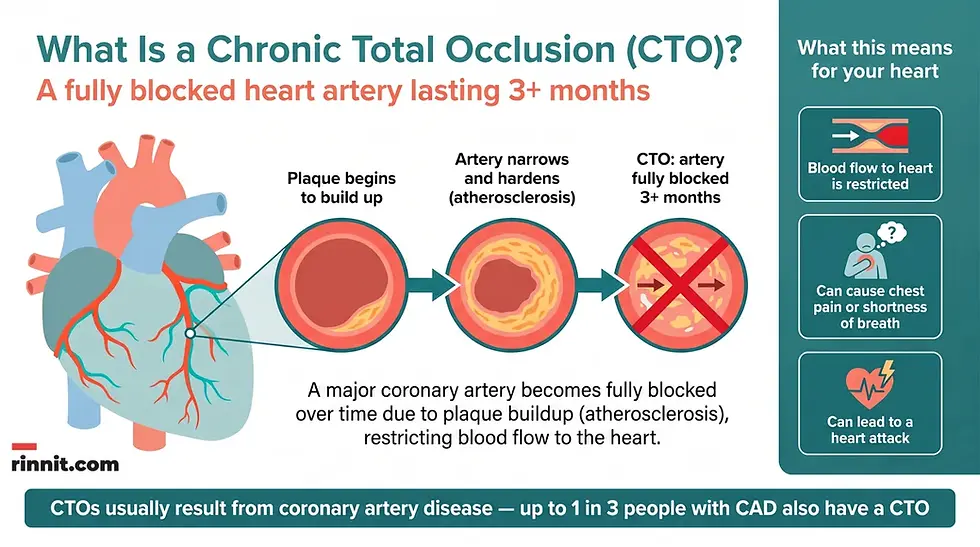
A chronic total occlusion (CTO) is a total blockage in one of your coronary arteries that lasts three or more months. Your coronary arteries are the blood vessels that carry blood to your heart.
When a CTO forms, it restricts blood flow to your heart. That reduced blood flow can lead to chest pain, shortness of breath, or a heart attack.
The blockage is usually the result of a fatty substance called plaque building up and narrowing your arteries. That buildup is called atherosclerosis, a process where arteries narrow and harden. When atherosclerosis happens in your coronary arteries specifically, it's called coronary artery disease.
You're more likely to develop a CTO if you have coronary artery disease (CAD).
Term | What It Means |
Coronary arteries | The blood vessels that carry blood to your heart |
Plaque | A fatty substance that builds up inside arteries |
Atherosclerosis | Plaque buildup that narrows and hardens arteries |
Chronic total occlusion (CTO) | A complete coronary artery blockage present for three or more months |
Coronary artery disease (CAD) | Atherosclerosis that happens in the coronary arteries |
How Common Is a CTO, and Who Gets It?
CTOs are more common in people who have coronary artery disease. In fact, up to 1 in 3 people with CAD also have a CTO [1].
Your risk is very similar to your risk for CAD. You are more likely to develop a CTO if you smoke or have other risk factors such as:
Risk Factor | Details |
Smoking | Listed as a primary risk factor in its own right |
BMI of 30 or higher | A body mass index of 30 or above raises risk |
Diabetes | Affects blood vessels throughout the body |
Family history of heart disease | Risk runs in some families |
High blood pressure (hypertension) | Puts extra strain on arteries |
High cholesterol (hyperlipidemia) | Feeds plaque buildup in artery walls |
History of heart attacks or coronary artery bypass surgery | Past heart problems raise future risk |
Inactive lifestyle | Lack of physical activity adds to risk |
CTOs are also more common as people get older. Cleveland Clinic lists the following figures by age group, without stating exactly which group of people the percentages describe [1]:
Age Group | Share Affected |
Under age 65 | About 37% |
Ages 65 to 79 | About 40% |
Older than 85 | About 41% |
It's worth knowing that the actual prevalence of CTOs could be higher than experts estimate. Some CTOs don't cause symptoms, so people may have a CTO without a formal diagnosis.

What Are the Symptoms of a Chronic Total Occlusion?
Chronic total occlusion (CTO) symptoms often worsen with exertion and ease with rest, though they can also occur at rest and some people have none.
Symptom | What You Might Notice |
Chest pain, tightness or pressure | The classic heart-related discomfort |
Dizziness | Feeling lightheaded or unsteady |
Fatigue | Unusual tiredness beyond normal |
Irregular heartbeat | Heartbeats that feel uneven |
Nausea | Feeling sick to your stomach |
Racing or rapid heartbeat | Heart beating faster than normal |
Shortness of breath (dyspnea) | Difficulty catching your breath |
Upper arm pain | Pain that travels up the arm |
How these symptoms behave matters. CTO symptoms often worsen when you exert yourself and lessen during rest. However, you may also experience symptoms while at rest. And some people have no symptoms at all, which is one reason the true number of CTOs may be higher than estimates.
What Causes a Chronic Total Occlusion?
Chronic total occlusions typically occur when a fatty substance called plaque builds up in one or more of your coronary arteries.
This plaque buildup, called atherosclerosis, leads to artery narrowing and hardening. When atherosclerosis occurs in your coronary arteries, it's called coronary artery disease.
In other words: a CTO is usually the end result of coronary artery disease progressing until one artery becomes fully blocked for three months or longer.
How Is a Chronic Total Occlusion Diagnosed?
Healthcare providers typically diagnose a chronic total occlusion using a coronary angiogram. During this procedure, your provider injects a contrast dye into your blood vessels. The dye highlights your blood vessels on an X-ray and shows how blood moves through your coronary arteries.
Your provider may also use additional tests:
Test | What It Checks |
Coronary angiogram | The main diagnostic tool: dye highlights blood vessels on an X-ray to show blood movement through coronary arteries |
Cardiac MRI | Looks at the anatomy and blood flow in your heart |
Cardiac stress test | Views how your heart responds to exercise |
Echocardiogram (echo) | Evaluates your heart walls and valves, and sees how blood flows through your heart |
Electrocardiogram (EKG) | Looks at the electrical signals and rhythm of your heart |
How Is a Chronic Total Occlusion Treated?
A CTO treatment plan typically focuses on lowering symptoms and reducing your risk of a heart-related event such as a heart attack. The treatment you need depends on how severe your symptoms are and whether you are already on a treatment plan for CAD.
Your provider may recommend one of two main options:
Treatment | What Happens |
Percutaneous coronary intervention (PCI) | Your provider inserts a small, hollow tube (catheter) through a blood vessel in your groin or wrist. They guide the catheter to your coronary artery, then inflate a small balloon in the artery to move plaque out of the way. They place a small mesh tube (stent) in the artery to keep it open and restore blood flow. |
Coronary artery bypass graft (CABG) | An open heart surgery in which your provider takes an artery or vein from elsewhere in your body and uses it to create a detour around your blocked coronary artery. |

What Is the Outlook for a Chronic Total Occlusion?
A chronic total occlusion is a serious condition, but treatment can help.
Some research has shown that PCI successfully treats a CTO in up to 86% of patients. Other studies have shown that CABG successfully treats the condition in around 60% of patients [1].
Both treatment options have high rates of successfully treating a CTO, and the goal of treatment is to manage symptoms.
What is the bottom line on total coronary occlusion (CTO)?
A chronic total occlusion (CTO) is a complete blockage of one of your coronary arteries that has been present for three months or longer. It restricts blood flow to your heart and can cause serious complications, including a heart attack. CTOs usually result from plaque buildup (atherosclerosis) and are strongly tied to coronary artery disease: up to 1 in 3 people with CAD also have a CTO. Risk rises with smoking, high BMI, diabetes, family history, high blood pressure, high cholesterol, prior heart attacks or bypass surgery, and an inactive lifestyle. Symptoms include chest pain, shortness of breath, fatigue, dizziness, nausea, arm pain, and irregular or racing heartbeat, often worse with exertion, but sometimes absent entirely. Diagnosis typically involves a coronary angiogram, supported by cardiac MRI, stress tests, echocardiograms, and EKGs. Treatment focuses on easing symptoms and reducing heart-attack risk through percutaneous coronary intervention (PCI), which succeeds in up to 86% of patients in some research, or coronary artery bypass graft (CABG) surgery, which succeeds in around 60%. If you have heart disease risk factors or symptoms like chest pain, a conversation with your healthcare provider is the right next step.
Clear, practical health guides. Visit Rinnit.com for plain-language health guides reviewed for accuracy, so when your health needs attention, you know what's happening, what to expect, and what questions to ask.
Frequently Asked Questions
What is a chronic total occlusion?
A chronic total occlusion (CTO) is a total blockage in one of your coronary arteries, the blood vessels that carry blood to your heart, lasting three or more months.
Why does a CTO happen?
CTOs typically occur when a fatty substance called plaque builds up in one or more coronary arteries. This buildup (atherosclerosis) narrows and hardens the artery until it becomes fully blocked.
Is a CTO the same as coronary artery disease?
Not exactly. Coronary artery disease (CAD) is the plaque buildup itself. A CTO is a fully blocked artery that has stayed blocked for at least three months. CTOs are more common in people who have CAD.
How common are CTOs?
Up to 1 in 3 people with coronary artery disease also have a CTO. In one Canadian registry, 18.4% of patients with significant coronary artery disease undergoing nonemergent angiography had a CTO.
Why might the actual number of CTOs be higher?
Some CTOs don't cause symptoms, so people may have a CTO without a formal diagnosis. The actual prevalence could be higher than experts estimate.
What are the symptoms?
Chest pain, tightness or pressure; dizziness; fatigue; irregular heartbeat; nausea; racing or rapid heartbeat; shortness of breath; and upper arm pain.
Do symptoms always appear with activity?
CTO symptoms often worsen with exertion and lessen during rest. However, you may also experience symptoms while at rest, or have no symptoms at all.
What are the risk factors?
Smoking, a body mass index (BMI) of 30 or higher, diabetes, family history of heart disease, high blood pressure, high cholesterol, a history of heart attacks or coronary artery bypass surgery, and an inactive lifestyle.
Can a CTO cause a heart attack?
Yes. A CTO restricts blood flow to your heart, which can lead to chest pain, shortness of breath, or a heart attack.
How is a CTO diagnosed?
Providers typically use a coronary angiogram, in which contrast dye highlights your blood vessels on an X-ray and shows how blood moves through your coronary arteries. Cardiac MRI, cardiac stress tests, echocardiograms, and EKGs may also be used.
What is a coronary angiogram?
A test in which your provider injects contrast dye into your blood vessels. The dye makes your blood vessels visible on an X-ray, showing how blood moves through your coronary arteries.
What is an echocardiogram?
An imaging test that evaluates your heart walls and valves and shows how blood flows through your heart.
What is a cardiac stress test?
A test that shows how your heart responds to exercise.
What does an EKG show?
An electrocardiogram (EKG) looks at the electrical signals and rhythm of your heart.
How is a CTO treated?
The two main treatments are percutaneous coronary intervention (PCI) and coronary artery bypass graft (CABG) surgery. Treatment focuses on lowering symptoms and reducing the risk of a heart-related event like a heart attack.
What happens during PCI?
Your provider inserts a small, hollow tube (catheter) through a blood vessel in your groin or wrist, guides it to your coronary artery, inflates a small balloon to move plaque out of the way, and places a small mesh tube (stent) to keep the artery open and restore blood flow.
What is CABG surgery?
Coronary artery bypass graft (CABG) is an open heart surgery in which your provider takes an artery or vein from elsewhere in your body and uses it to create a detour around your blocked coronary artery.
How successful is treatment?
Some research has shown PCI successfully treats a CTO in up to 86% of patients. Other studies have shown CABG successfully treats the condition in around 60% of patients. A meta-analysis of 65 studies reported a pooled PCI success rate of 77%, so results vary by study and centre.
Is a CTO serious?
Yes. A CTO is a serious condition, but treatment can help, and both PCI and CABG have high rates of successfully treating a CTO.
What questions should I ask my healthcare provider?
Ask about the early signs of a CTO, the tests you need for diagnosis, lifestyle changes that can reduce your chances of developing one, your treatment options, and the chances of developing a CTO again after treatment.
Can lifestyle changes reduce my risk?
Several CTO risk factors, including smoking, high BMI, diabetes, high blood pressure, high cholesterol, and an inactive lifestyle, can be addressed with your healthcare provider. Asking which lifestyle changes can reduce your chances of developing a CTO is one of the recommended questions to raise at your visit.
Related Reading
References
Cleveland Clinic. Chronic Total Occlusion: Symptoms and Treatment. Cleveland Clinic. Last updated August 3, 2022. https://my.clevelandclinic.org/health/diseases/17567-cad-total-coronary-occlusions
Bardají A, et al. Chronic total occlusion: To treat or not to treat. World J Cardiol. 2014;6(7):621-629. PMID 25068022. https://doi.org/10.4330/wjc.v6.i7.621
Kawashima H, et al. Mortality 10 Years After Percutaneous or Surgical Revascularization in Patients With Total Coronary Artery Occlusions. J Am Coll Cardiol. 2021;77(5):529-540. PMID 33538250. https://doi.org/10.1016/j.jacc.2020.11.055
Fefer P, et al. Current perspectives on coronary chronic total occlusions: the Canadian Multicenter Chronic Total Occlusions Registry. J Am Coll Cardiol. 2012;59(11):991-997. PMID 22402070. https://doi.org/10.1016/j.jacc.2011.12.007
Patel VG, et al. Angiographic success and procedural complications in patients undergoing percutaneous coronary chronic total occlusion interventions: a weighted meta-analysis of 18,061 patients from 65 studies. JACC Cardiovasc Interv. 2013;6(2):128-136. PMID 23352817. https://doi.org/10.1016/j.jcin.2012.10.011
Werner GS, et al. A randomized multicentre trial to compare revascularization with optimal medical therapy for the treatment of chronic total coronary occlusions. Eur Heart J. 2018;39(26):2484-2493. PMID 29722796. https://doi.org/10.1093/eurheartj/ehy220
Medical disclaimer
This article is for general informational purposes only and does not constitute medical advice, diagnosis, or treatment. Always seek the guidance of a physician or other qualified health provider with any questions you may have about a medical condition. Never disregard professional medical advice or delay seeking it because of something you read here. If you experience chest pain, shortness of breath, or any symptoms of a possible heart problem, seek emergency medical care immediately.



Comments