The Urachus: Understanding Fetal Development and Urachal Remnants

Updated: 3 days ago
Medically reviewed by Dr. Baraa Alnahhal, MD | Last reviewed: October 17, 2026

Quick Answer: What is the urachus?
The urachus is a fibrous tube that runs between the bladder and belly button in a developing fetus, helping drain fetal urine through the umbilical cord. [1] In most people it closes before birth and becomes the median umbilical ligament, but about 33% of adults retain some urachal tissue. [1] Unclosed remnants such as cysts can cause symptoms or infection. [1]
What the research says
Many children with urachal anomalies do not need surgery. In a retrospective cohort of 78 children with ultrasound-confirmed urachal anomalies, 35 (44.9%) had them excised; infection at presentation and a “urachal cyst” appearance on ultrasound made surgery more likely, and none of the excised anomalies was suspicious for cancer, leading the authors to conclude that prophylactic excision is not warranted (Abdulfattah et al., World Journal of Pediatric Surgery, 2025). [3]
Urachal cancer is very rare. A meta-analysis of registry-based studies estimated an incidence of 0.04 per 100,000 person-years (95% CI 0.03–0.05), with a median age at diagnosis of 60 years, and found that 86% of the tumors were adenocarcinomas (Olah et al., Urologic Oncology, 2024). [4]
When urachal cancer does occur, surgery that removes the whole tract is linked to better results. A systematic review of 1,901 cases from 50 studies estimated a 5-year overall survival of 51% (95% CI 49–54%) and tumor recurrence in 35% (95% CI 25–45%), and supported en-bloc resection with removal of the navel in localized disease (Suartz et al., International Braz J Urol, 2025). [5]
What role does the urachus play in fetal development?
During the first trimester of pregnancy, the urachus acts as a vital conduit, helping remove the fetus’s urine through the placenta by way of the umbilical cord. [1] As the fetus develops, its bladder moves toward the pelvis. [1] This movement stretches the urachus, which usually closes toward the end of the first trimester and becomes a small fibrous cord known as the median umbilical ligament. [1] This transformation is a standard part of development, and the urinary system is fully self-contained by birth.
Although the urachus is temporary for most people, its legacy remains in many adults. About 33% of adults still have some urachal tissue, and many never realize it because it usually causes no problems. [1] When the closure process is interrupted, however, structural abnormalities can result that may need medical attention. [1] The urachus can be anywhere from about 1 to 15 centimeters long (roughly 0.4 to 6 inches). [1]
Developmental Stage | State of the Urachus | Primary Function |
First Trimester | Open fibrous tube | Helps drain fetal urine toward the umbilical cord |
End of the First Trimester | Closing canal | Stretches as the bladder moves toward the pelvis and becomes a ligament |
At Birth | Closed cord | Present as the median umbilical ligament in most people |
Adulthood | Ligament (about 33% retain some urachal tissue) | Usually causes no problems |
What are the common urachal abnormalities and remnants?
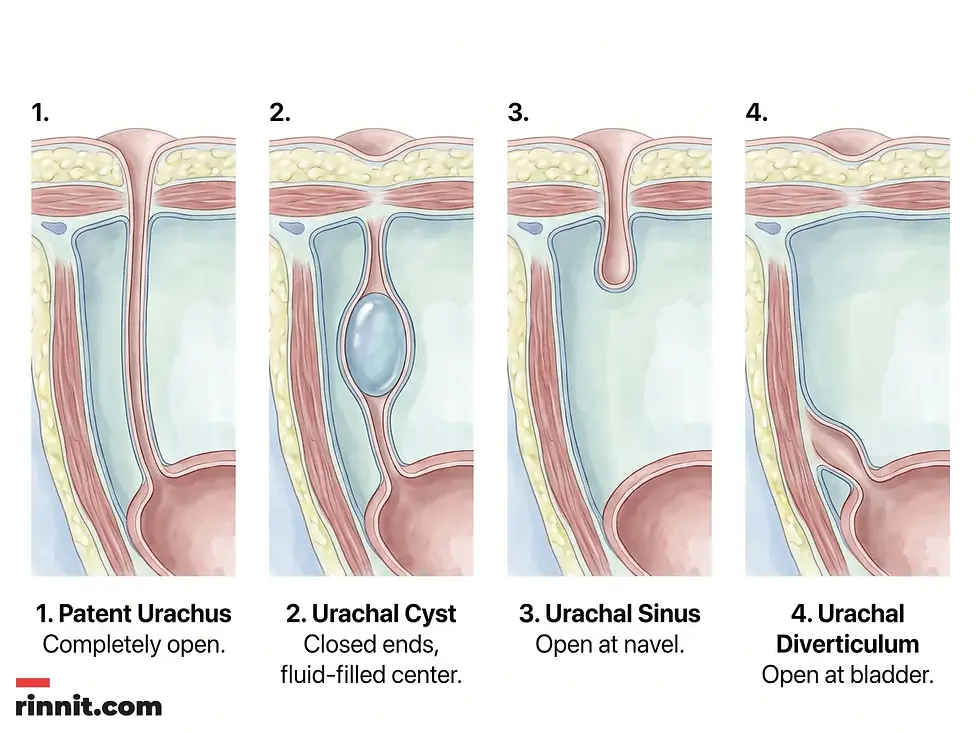
When the urachus does not close completely before birth, it leaves behind a urachal remnant, also called a urachal abnormality. [1] The types depend on which part of the canal stays open. A patent urachus is the most complete form, in which the entire canal stays open, which may cause urine to leak from the belly button or leave a wet, irritated, discolored area around the navel. [1]
Other forms include a urachal cyst, a pocket of tissue and fluid between the belly button and the bladder; a urachal sinus, which stays open near the belly button but closes at the bladder; and a diverticulum, which stays open near the bladder. [1] These usually cause no symptoms, but they can cause problems if they become infected or trap urine, leading to abdominal pain, cloudy or bloody fluid near the navel, or urinary tract infections. [1] In rare cases, urachal tissue can lead to urachal cancer, which most often appears in people who are 50 or older. [1]
Remnant Type | Description | Common Symptoms |
Patent Urachus | The entire canal remains open | Urine leakage from the navel, wet or irritated skin |
Urachal Cyst | A pocket of tissue and fluid between the navel and bladder | Usually none; abdominal pain and cloudy or bloody fluid near the navel if infected |
Urachal Sinus | Open at the navel but closed at the bladder | Usually none; discharge or bloody or cloudy fluid if infected |
Diverticulum | Open near the bladder | Usually none; urinary tract infections if urine gets trapped |
How are urachal remnants diagnosed and treated?
Diagnosing a urachal abnormality usually starts with a painless ultrasound, which lets providers see the tissues behind the navel. [1] An MRI may be added, and a voiding cystourethrogram (VCUG), an X-ray test with dye in the bladder, is useful if a bladder structure problem is also suspected. [1] If fluid is leaking at the belly button, it can be tested for urea or creatinine to confirm that it is urine. [1]
Treatment depends on the type and severity of the abnormality. Persistent wetness around the navel may be treated with chemical cauterization, and antibiotics are effective for infected cysts, which may sometimes need to be drained with a needle. [1] Surgery to remove the urachus and anything connected to it is often recommended for symptomatic or infected remnants, because leaving urachal tissue behind increases the risk of infections, bladder stones and, rarely, urachal cancer. [1] [2] Guidelines suggest that remnants that cause no symptoms can be managed conservatively. [2]
Treatment Method | Application | Expected Outcome |
Chemical Cauterization | Persistent wetness around the navel | Healing of the area, usually within a few days |
Antibiotics | Infected cysts or sinuses | Treatment of the bacterial infection |
Needle Drainage | Fluid-filled cysts in some cases | Relief of pressure and infection |
Surgical Removal | Persistent or symptomatic remnants | Removes the tissue and prevents future problems |

Conclusion
The urachus is a fascinating example of how fetal structures adapt and change as the body prepares for life outside the womb. Most people never give this small canal a second thought, yet it plays a foundational role in early development. For those who have urachal remnants, modern diagnostics and surgical techniques allow these abnormalities to be managed effectively.
Next Steps
If you or your child have unusual wetness, discharge, or persistent pain around the belly button, consult a healthcare professional. Early evaluation of urachal remnants can help prevent infections and other long-term health risks.
Frequently Asked Questions
What is the urachus?
The urachus is a fibrous tube in a fetus that connects the bladder to the belly button and helps drain urine.
Is the urachus the same as the belly button?
No. The belly button is where the umbilical cord attached, while the urachus is an internal tube.
What happens to the urachus after birth?
In most people it has already closed before birth and become a small fibrous cord called the median umbilical ligament.
Do adults have a urachus?
Most adults have the ligament, but about 33% still have some urachal tissue, and many never realize it because it usually causes no problems.
What is a patent urachus?
A patent urachus is a condition in which the urachal canal stays completely open, which may cause urine to leak from the belly button or leave a wet, irritated area around it.
Can urine leak from the belly button?
Yes. If a person has a patent urachus, urine can leak from the navel.
What is a urachal cyst?
A urachal cyst is a pocket of tissue and fluid that forms between the belly button and the bladder when the urachus does not close properly.
Are urachal abnormalities common?
Urachal abnormalities are rare. They are well described and treatable, and many cause no symptoms at all.
What are the symptoms of an infected urachal cyst?
A urachal cyst usually causes no symptoms, but an infection can cause abdominal pain and bloody or cloudy fluid near the belly button.
How is a urachal problem diagnosed?
Healthcare providers usually start with an ultrasound and may add an MRI. If wetness at the belly button is suspected to be urine, the fluid can be tested for urea or creatinine.
What is a VCUG test?
A voiding cystourethrogram is an X-ray test in which dye is placed in the bladder through the urinary system to show the bladder and the flow of urine. It is useful when a bladder structure problem is also suspected.
Can urachal tissue lead to cancer?
Urachal cancer is a rare type of bladder cancer that most often appears in people who are 50 or older and have urachal tissue.
What is chemical cauterization?
Chemical cauterization is a treatment for persistent wetness around the belly button in which a provider applies a small amount of a chemical, such as silver nitrate, to help the area heal, usually within a few days.
Is surgery always necessary for urachal remnants?
Not always. Surgery is often recommended for symptomatic or infected remnants to prevent infections, bladder stones and the small long-term risk of cancer, while guidelines suggest that remnants without symptoms can be managed conservatively.
Does the urachus exist in both males and females?
Yes. All fetuses have a urachus, regardless of sex.
Related Reading
What Is a Urachal Remnant? explains urachal cysts, sinuses and fistulas and how they are treated.
The Umbilical Cord: Function, Anatomy, and Newborn Care describes the umbilical cord and care of the cord stump.
Umbilical Hernia in Babies and Adults: When It Closes on Its Own and When Surgery Is Needed covers bulges at the belly button and when repair is needed.
What is an Umbilical Granuloma? explains a common moist lump at a newborn's belly button.
Sources
Cleveland Clinic. Urachus. Cleveland Clinic. Last updated November 15, 2024. https://my.clevelandclinic.org/health/body/16597-urachus
European Association of Urology. Rare Conditions in Childhood (EAU Guidelines on Paediatric Urology). Uroweb. Edn. presented at the EAU Annual Congress London 2026. https://uroweb.org/guidelines/paediatric-urology/chapter/rare-conditions-in-childhood
Abdulfattah S, Nadeem I, Parikh Y, et al. Management of urachal anomalies in children: insights from a retrospective cohort study. World J Pediatr Surg. 2025;8(1):e000977. PMID: 40129857. DOI: 10.1136/wjps-2024-000977
Olah C, Kubik A, Mátrai P, et al. Estimation of the incidence of urachal cancer: a systematic review and meta-analysis of registry-based studies. Urol Oncol. 2024;42(7):221.e1-221.e7. PMID: 38627107. DOI: 10.1016/j.urolonc.2024.03.011
Suartz CV, Martinez LM, Silvestre MHL, et al. Urachal carcinomas: a comprehensive systematic review and meta-analysis. Int Braz J Urol. 2025;51(3):e20240665. PMID: 39908206. DOI: 10.1590/S1677-5538.IBJU.2024.0665
Medical disclaimer
This information is for educational purposes only and does not constitute medical advice. Always consult a healthcare professional for diagnosis and treatment.



Comments