The Circle of Willis: Your Brain’s Vital Circulatory Fail-Safe

Updated: 2 days ago
Medically reviewed by Dr. Baraa Alnahhal, MD · Last reviewed: October 2026
Quick Answer
The Circle of Willis (CoW) is a pentagon-shaped structure of arteries at the base of the brain that acts as a roundabout for blood flow. [1] It connects the internal carotid artery pathway, which supplies the front, with the vertebral artery pathway, which supplies the back. [1] If an artery is blocked, blood can be rerouted, potentially limiting brain damage. [1]
What the research says
A complete circle is linked to better stroke outcomes. A systematic review of 11 studies (n = 4,643) found that the integrity of the circle of Willis plays a vital role in ischemic stroke outcome, especially when the distal internal carotid artery is blocked in a T-shaped pattern. (Širvinskas et al., Medicina, 2023) [2]
Gaps in the circle can raise surgical risk. In a single-center study of 51 patients with a blocked carotid artery on the opposite side, only 10 (19.6%) had a complete circle, and absence of both posterior communicating arteries predicted neurological events after carotid surgery (odds ratio 11.10, 95% CI 1.04–118.60). (Lengyel et al., Ann Vasc Surg, 2024) [3]
The basilar artery that feeds the back of the circle varies too. Pooling 31 articles, the classic bifurcation pattern had a pooled prevalence of 85.94%, and about 14% of people had a variation, most often non-furcation (8.95%) or trifurcation (7.05%). (Jayapala et al., Surg Radiol Anat, 2026) [4]
The human brain requires a constant, uninterrupted supply of oxygen-rich blood to function. To ensure this supply remains stable even in the event of an arterial blockage, the body utilizes a specialized circulatory structure known as the Circle of Willis. Located at the base of the brain, this arterial ring serves as a sophisticated fail-safe mechanism, protecting one of the body's most critical organs.
Where is the Circle of Willis, and what is its anatomy?
The Circle of Willis sits in the subarachnoid space, surrounding the stalk of the pituitary gland just below the hypothalamus. [1] It is named after Thomas Willis, the 17th-century anatomist who first detailed its structure. This pentagon-shaped loop connects the two primary systems that deliver blood to the brain: the internal carotid arteries (anterior circulation) and the vertebral arteries (posterior circulation). [1]
Feature | Description |
|---|---|
Shape | Ring or pentagon-shaped arterial loop. |
Location | Base of the brain, surrounding the pituitary stalk. |
Primary Pathways | Internal carotid and vertebral artery pathways. |
Common Names | Cerebral arterial circle, Willis polygon, Loop of Willis. [1] |
Variations | Incomplete structures (50–90% of adults) are common. [1] |
How does the Circle of Willis act as a circulatory fail-safe?
The Circle of Willis works like a traffic roundabout, letting blood take a detour to reach the brain if one of the major arteries is blocked. [1] The carotid and vertebral arteries are the major "highways" bringing blood to the brain. The smaller arteries within the Circle of Willis form the roundabout that allows these highways to exchange "traffic" or blood flow. If a "roadblock" occurs in one of the main highways, the roundabout provides a detour, ensuring blood still reaches its destination.
Condition | Role of the Circle of Willis |
|---|---|
Stroke | Provides a detour route to maintain blood flow to affected areas. |
Aneurysm | A common site for aneurysms; about 85% occur in the front (anterior) part of the circle. [1] |
Atherosclerosis | Compensates for narrowing in major supply arteries. |
Vasculitis | Helps manage blood distribution during vessel inflammation. |

What structural variations in the Circle of Willis matter clinically?
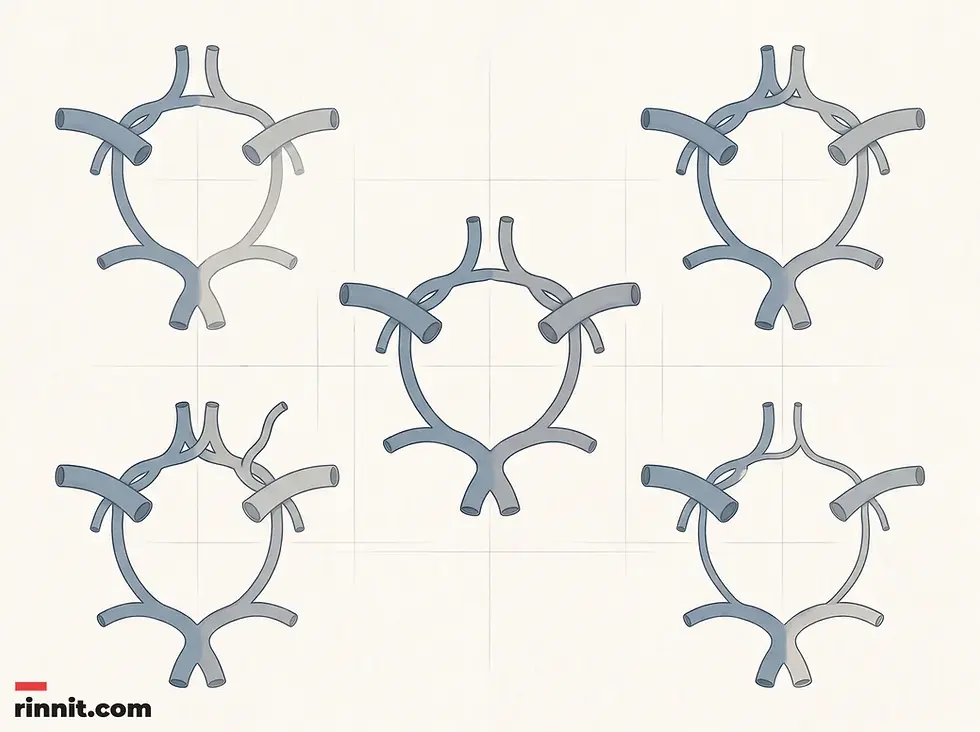
Interestingly, a perfectly complete Circle of Willis is found in less than half of the general population. [1] Most individuals have structural variations, such as fenestration (a vessel splitting and fusing) or duplication. [1] While these variations are natural and formed during fetal development, an incomplete circle may lack the full fail-safe benefits, potentially increasing the risk of severe effects during a stroke or other cerebrovascular events.
How can you protect the circulation in your Circle of Willis?
You cannot change the structure of your Circle of Willis, but managing cardiovascular risk factors is the most effective way to keep its arteries healthy. Managing cardiovascular risk factors is the most effective way to prevent cerebrovascular disease and ensure the brain's "roundabout" remains clear and functional.

Conclusion
The Circle of Willis is a testament to the body's remarkable ability to protect its most vital functions through redundancy. By serving as a circulatory fail-safe, this small but powerful structure provides a critical defense against brain injury. Understanding its role emphasizes the importance of cardiovascular health in maintaining a resilient and protected brain throughout life.
Next Steps for Health
Maintaining the health of your brain's blood vessels involves managing conditions like high blood pressure, high cholesterol, and diabetes. If you have a history of neurological issues or are at high risk for stroke, consult with a neurologist. Advanced imaging, such as a brain MRI or a cerebral angiogram, can be used to evaluate the structure and health of your Circle of Willis. [1]
Frequently Asked Questions
1. What is the Circle of Willis?
The Circle of Willis is a ring-shaped network of arteries at the base of the brain that connects major blood supply pathways.
2. Why is it called a "fail-safe"?
The Circle of Willis provides detour routes for blood flow if one of the brain's main arteries becomes blocked or damaged.
3. Where is it located?
The Circle of Willis sits at the base of the brain, surrounding the stalk of the pituitary gland.
4. Who is it named after?
The Circle of Willis is named after Thomas Willis, a 17th-century anatomist who studied the structure.
5. What are the two main blood pathways it connects?
The Circle of Willis connects the internal carotid artery pathway (front of brain) and the vertebral artery pathway (back of brain).
6. What does it look like?
The Circle of Willis is typically shaped like a ring or a pentagon.
7. Is a "complete" Circle of Willis common?
No, researchers estimate that less than half of the population has a perfectly complete circle.
8. What are common variations of the structure?
Variations include fenestration (splitting and fusing) and duplication of certain arteries.
9. Does an incomplete Circle of Willis mean I'm unhealthy?
Not necessarily; many people with incomplete structures are perfectly healthy, though they may have higher risks during a stroke.
10. What is the "anterior circulation"?
The "anterior circulation" refers to the front part of the Circle of Willis, where about 85% of brain aneurysms occur.
11. How does it help during a stroke?
The Circle of Willis allows blood from an unobstructed artery to reach brain tissue that has lost its primary supply.
12. What is Moyamoya disease?
Moyamoya disease is a rare condition involving the progressive narrowing of the arteries in the Circle of Willis.
13. Can I change the structure of my Circle of Willis?
No, the structure is naturally formed during fetal development.
14. How can I keep these arteries healthy?
By managing blood pressure, cholesterol, and diabetes, and avoiding smoking and excessive alcohol.
15. How is the Circle of Willis evaluated by doctors?
The Circle of Willis is typically checked using brain imaging tests like an MRI or a cerebral angiogram.
Related Reading
Brain Aneurysm: Symptoms, Causes, and Treatment explains bulging brain arteries, which often form in this circle.
Carotid Artery: Anatomy, Function, and Stroke Prevention describes the neck arteries that feed the circle of Willis.
Stroke: Symptoms, Causes, Diagnosis, and Treatment — A Complete Guide explains stroke warning signs and why fast treatment matters.
Cerebrovascular Disease: The Umbrella Term for Brain Blood Vessel Conditions That Can Cause Stroke covers conditions that affect blood flow to the brain.
References
Cleveland Clinic. Circle of Willis: What It Is, Anatomy, Function & Location. Cleveland Clinic. Last updated September 16, 2024. https://my.clevelandclinic.org/health/body/circle-of-willis
Širvinskas A, et al. Circle of Willis Configuration and Thrombus Localization Impact on Ischemic Stroke Patient Outcomes: A Systematic Review. Medicina. 2023;59(12). PMID 38138218. https://doi.org/10.3390/medicina59122115
Lengyel B, et al. The Circle of Willis Status Influences Neurological Complications of Carotid Endarterectomy with Contralateral Carotid Occlusion. Annals of Vascular Surgery. 2024;108:410-418. PMID 39009123. https://doi.org/10.1016/j.avsg.2024.05.021
Jayapala D, et al. Anatomic variations in basilar artery termination: a systematic review and meta-analysis with presentation of an illustrative case. Surgical and Radiologic Anatomy. 2026;48(1). PMID 42390637. https://doi.org/10.1007/s00276-026-03927-6
Medical disclaimer
This article is for informational purposes only and does not constitute medical advice. Consult a healthcare professional for diagnosis and treatment.



Comments