Symblepharon: Understanding Eyelid Adhesions and Eye Health

Updated: 2 days ago
Medically reviewed by Dr. Baraa Alnahhal, MD · Last reviewed: October 2026
Quick Answer
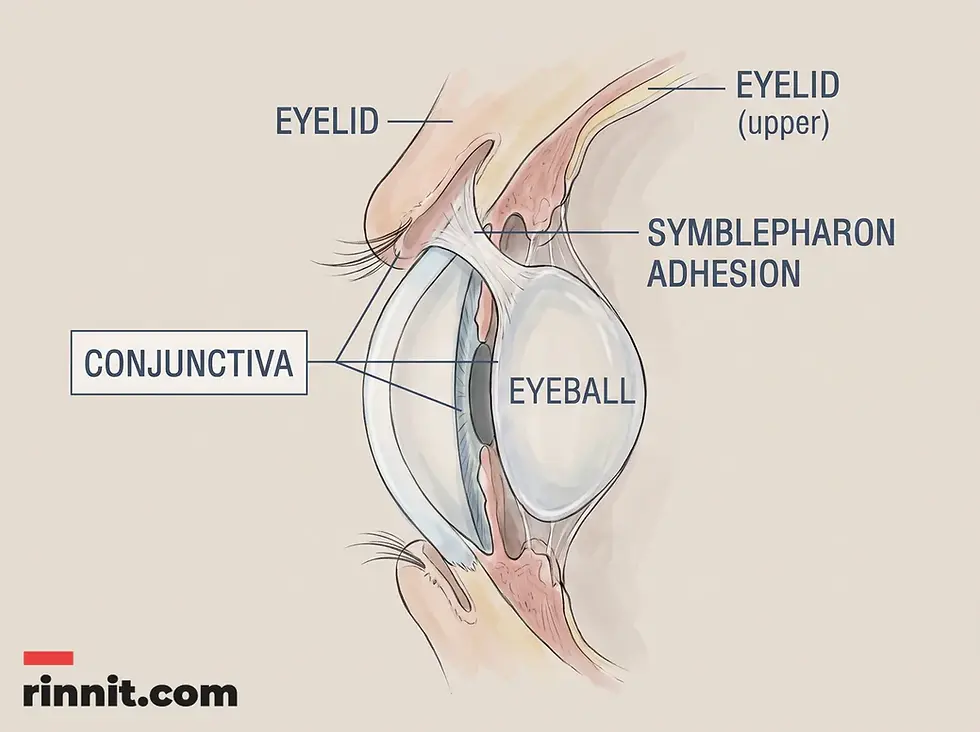
Symblepharon is an eye condition in which the conjunctiva lining the eyelid sticks to the conjunctiva covering the eyeball, usually after severe inflammation, infection or chemical burns. Signs include restricted eye movement, a drooping eyelid and a visible band of tissue. Treatment targets the cause with corticosteroids or antibiotics and sometimes surgery to release the scar tissue. [1]
What the research says
Amniotic membrane may not prevent symblepharon after burns. A Cochrane review of two trials (36 moderate burns and 92 severe burns) found uncertain evidence that applying an amniotic membrane in the first week after an eye burn reduces symblepharon. For moderate burns the risk ratio was 0.41 (95% CI 0.02–9.48), a very wide range that includes both benefit and harm; for severe burns there was no clear benefit (risk ratio 0.89, 95% CI 0.56–1.42) (Clare et al., Cochrane Database Syst Rev, 2022) [2].
The membrane is used to heal the surface without scarring. A 2023 review explains that amniotic membrane contains growth factors and anti-inflammatory and anti-angiogenic factors, has low immunogenicity, and promotes epithelial growth with less fibrosis; it is used in procedures such as symblepharon release (Gera et al., Indian J Ophthalmol, 2023) [3].
Scarring can still form after reconstruction. In a small case series of 12 patients who received super-thick amniotic grafts after eye-surface tumor removal, all grafts healed with complete epithelialization, but secondary symblepharon formed in 16.7% of cases (2 patients) after additional tumor treatment (Finger et al., Am J Ophthalmol, 2018) [4].
What Is Symblepharon?
Symblepharon occurs when the thin, clear membrane called the conjunctiva becomes so inflamed that its two layers, the one covering the white of the eye and the one lining the inside of the eyelid, stick together. At first this may involve temporary swelling, but as the tissue heals, permanent scar tissue can form and fuse the layers. [1]
The condition is often a complication of severe conjunctivitis (see our guide to pink eye). Depending on how much inflammation there was, a person may develop a single band of tissue or several adhesions, which can significantly affect how the eye moves and works.
What are the signs and symptoms of symblepharon?
In many cases symblepharon can be seen as a band of tissue connecting the eyelid to the eyeball. Some people have no symptoms at all, but even when the band is not obvious, the adhesion often causes noticeable problems.
Symptom | Description |
|---|---|
Restricted movement | The eyeball cannot move freely in all directions. |
Ptosis | The adhesion pulls the eyelid down, causing it to droop. |
Entropion | The eyelid turns inward toward the surface of the eye. |
Lagophthalmos | The eye cannot close completely, leading to exposure. |
Diplopia | Double vision caused by restriction of the eye muscles. |
Beyond these structural changes, people often have chronic irritation, including redness, light sensitivity, excessive tearing, and a persistent feeling of dryness. [1]
What are the common causes of symblepharon?
Symblepharon is mainly triggered by conditions that cause intense or long-lasting inflammation of the eye surface. When the protective membranes are damaged, they may fuse during healing.
Infections: certain viral and bacterial infections, such as ocular herpes or trachoma, can cause severe scarring. [1]
Chemical and physical injuries: chemical burns and complications after eye surgery are frequent triggers. [1]
Autoimmune disorders: chronic conditions such as Stevens-Johnson syndrome, mucous membrane pemphigoid, and graft-versus-host disease can cause progressive eye scarring. [1]
Medication reactions: in rare cases, an adverse reaction to certain eye medicines can trigger the inflammation that leads to symblepharon. [1]

How is symblepharon diagnosed?
A provider usually diagnoses symblepharon with a comprehensive eye exam. Numbing drops may be used for comfort while the location and extent of the adhesions are carefully inspected.
If the cause is not already known, more testing may be needed, such as eye swabs to look for infection or blood tests to screen for autoimmune disease. [1] Finding the root cause is essential to prevent further scarring and manage the condition.
How is symblepharon treated and managed?
The main goal is to treat the underlying inflammation and prevent new adhesions from forming. Prevention is usually easier than treating scar tissue that has already formed.
Medical Management
For active inflammation, providers may prescribe medicines depending on the cause:
In some cases a dressing made from amniotic membrane may be placed on the eye surface. It acts as a barrier that helps the tissue heal without sticking together, [1] [3] although the evidence for its use right after burns is still uncertain [2] (see the research above).
Surgical Intervention
If adhesions significantly affect vision or eye movement, surgery may be needed. How complex the procedure is depends on the severity of the scarring.
Surgical Method | Purpose |
|---|---|
Symblepharon release | Separating the tissue bands and removing scar tissue. |
Tissue grafting | Using tissue from other areas of the eye, the mouth, or amniotic membrane to replace damaged conjunctiva. |
Oculoplastic reconstruction | Rebuilding the eyelid lining or the eye surface to restore function. |

What is the long-term outlook for symblepharon?
The outlook depends on how severe the original injury was and how well treatment works. A mild case may resolve on its own, [1] and some cases clear completely with proper care. Others, especially those linked to chronic autoimmune disease, can involve repeat episodes and progressive scarring. [1] Early treatment is the most important factor in protecting vision and keeping the eye comfortable.
What are the next steps for symblepharon?
If you notice persistent eye redness, pain, or difficulty moving your eyelids, do not wait. Early evaluation can prevent complications such as symblepharon. Schedule an eye exam to protect your vision.
Frequently Asked Questions
1. Can symblepharon cause permanent vision loss?
Yes. If the adhesion attaches to the cornea or severely restricts eye movement, it can lead to vision loss.
2. Is symblepharon the same as pink eye?
No, but it can be a complication of severe or long-lasting pink eye (conjunctivitis).
3. What does symblepharon look like?
Symblepharon often looks like a fleshy band of tissue connecting the inner eyelid to the white of the eye.
4. Can chemical burns cause this condition?
Yes. Chemical burns are a common cause of the severe inflammation that leads to adhesions.
5. Is surgery always required?
Not always. Mild cases may need only medical management or may resolve on their own, but severe adhesions usually need surgical release.
6. Can symblepharon return after surgery?
Yes. In chronic conditions such as autoimmune disease, new adhesions can form even after successful surgery.
7. What is an amniotic membrane graft?
An amniotic membrane graft is a biological dressing or graft used in treatment or surgery to help the eye surface heal and reduce scarring.
8. Does symblepharon affect both eyes?
Symblepharon can affect one or both eyes, depending on the underlying cause.
9. Can eye drops prevent symblepharon?
Medicated eye drops that reduce inflammation may help prevent the tissues from sticking together, depending on the cause. Use only drops prescribed by your eye doctor.
10. What is lagophthalmos?
Lagophthalmos is the inability to close the eyelids completely, which can be caused by symblepharon pulling on the eyelid.
11. Is symblepharon painful?
The adhesions themselves may not be painful, but the underlying inflammation and eye irritation often are.
12. Can infections cause symblepharon?
Yes. Certain infections, such as ocular herpes or trachoma, are known triggers.
13. How is the condition diagnosed?
Symblepharon is diagnosed with an eye exam by a qualified eye care professional.
14. What is entropion?
Entropion is a condition in which the eyelid turns inward, which can be caused by the pulling force of a symblepharon.
15. Can symblepharon be prevented?
Often, yes. Promptly treating severe eye inflammation and injuries, and following your eye doctor's advice during healing, can reduce the risk.
Related Reading
Trusted External Resources
References
Cleveland Clinic. Symblepharon. Cleveland Clinic. Last updated July 1, 2024. https://my.clevelandclinic.org/health/diseases/symblepharon
Clare G, Bunce C, Tuft S. Amniotic membrane transplantation for acute ocular burns. Cochrane Database Syst Rev. 2022;9(9):CD009379. PMID 36047788. https://doi.org/10.1002/14651858.CD009379.pub3
Gera P, Kasturi N, Behera G, et al. Preparation and uses of amniotic membrane for ocular surface reconstruction. Indian J Ophthalmol. 2023;71(8):3119. PMID 37530302. https://doi.org/10.4103/IJO.IJO_674_23
Finger PT, Jain P, Mukkamala SK. Super-thick amniotic membrane graft for ocular surface reconstruction. Am J Ophthalmol. 2018;198:45-53. PMID 30312574. https://doi.org/10.1016/j.ajo.2018.09.035
Medical Disclaimer
This article is for informational purposes only and does not constitute medical advice. Always seek the advice of your physician or other qualified health provider with any questions you may have regarding a medical condition. Never disregard professional medical advice or delay in seeking it because of something you have read in this article.



Comments