Swimmer's Ear: Symptoms, Causes, and Treatment

Updated: 3 days ago
Medically reviewed by Dr. Baraa Alnahhal, MD · Last reviewed October 17, 2026

Quick Answer: What is swimmer's ear?
Swimmer's ear is an infection of the outer ear canal [4] that often starts when water stays in the ear or the canal skin is damaged [3] [4]. It causes itching and pain that worsens when the outer ear is pulled [3] [4], sometimes with muffled hearing [4]. See a doctor even for mild symptoms [4]. Treatment involves canal cleaning and prescription ear drops [5].
What the research says
According to PubMed, a CDC analysis of national ambulatory-care and emergency department data estimated 2.4 million US health-care visits for acute otitis externa in 2007 (8.1 per 1,000 population); rates were highest in children aged 5–9 years (18.6 per 1,000) and 10–14 years (15.8), 53% of visits were among adults aged 20 or older, and incidence peaked in summer (Estimated burden of acute otitis externa — United States, 2003–2007; MMWR 2011) [6].
A 2026 systematic review of clinical practice guidelines for otitis externa (6 identified, 4 meeting AGREE II quality criteria) found that key interventions centered on prevention (avoiding injury, keeping the ear canal dry, and timely cerumen management), patient education, comprehensive diagnostic assessment, and ear cleaning plus medication (Dillard et al., 2026; DOI) [7].
Key Facts at a Glance
Fact | Detail |
What it is | An infection of the outer ear canal, also called otitis externa [4] |
Most common cause | |
Other common cause | Damage to the thin canal skin from cotton swabs, fingernails, or ear devices [4] |
Main symptom | Ear pain that worsens when the outer ear is pulled or the tragus is pushed [4] |
Typical treatment | Canal cleaning plus prescription ear drops, with the ear kept dry [5] |
Outlook | Usually clears in days to a couple of weeks with prompt treatment |
What Swimmer's Ear Feels Like
The earliest sign is usually itching inside the ear canal. The pain may be mild at first and gets worse when the outer ear is pulled or when the small bump of cartilage in front of the ear, called the tragus, is pushed [4]. You may also notice fluid coming from the ear [3] [4].
The infection is typically grouped by how far it has progressed. Most cases are mild, but untreated infections keep worsening.
Stage | What happens |
Mild | Itching in the ear canal, slight redness, mild discomfort that worsens with pulling on the outer ear or pushing on the tragus, and fluid coming from the ear [4] |
Moderate | Itching gets worse, pain increases, the ear feels full, and partial blockage from swelling, fluid, and debris causes decreased or muffled hearing [4] |
Advanced | Severe pain that spreads to the face, neck, or side of the head; a completely blocked canal; redness and swelling of the outer ear; swollen lymph nodes in the neck; and fever [4] |
One important note about the skin signs: redness of the ear canal may be hard to see on Black and brown skin [4]. On darker skin, ear pain and draining fluid or pus are the signs to trust.
When to See a Doctor
Make an appointment for even mild symptoms [4]. Left alone, swimmer's ear keeps progressing through the stages above.
Seek urgent medical care, including an emergency visit, if the pain is severe or you develop a fever [4]. These are signs of an advanced infection that needs fast treatment.
How Swimmer's Ear Happens

The outer ear canal runs from the eardrum to the outside of the head. It is lined with a thin layer of skin that has natural defenses against infection.
A thin film lines the canal and keeps water out and bacteria from growing. Earwax, called cerumen, is part of this defense [3] [4]. It is a combination of a waxy film, dead skin, and debris that travels from inside the canal to the opening, keeping the canal clean. The outer ear around the opening also blocks things from entering [4].
Swimmer's ear happens when these defenses break down. Moisture staying in the canal gives bacteria an ideal place to grow [3] [4]. Contact with contaminated water introduces the bacteria. And damaged skin inside the canal gives them an entry point. The infection is usually caused by bacteria [4] [6]. Fungus or a virus are less common causes [4].
What Raises Your Risk
Swimmer's ear gets its name from swimming, but you do not need to swim to get it. Anything that leaves moisture in the canal or damages its skin raises the risk.
Risk factor | Why it raises the risk |
Water left in the ear canal | |
Contaminated water | Lakes, pools, and other water sources can carry the bacteria that start the infection [4] |
Cleaning the canal with cotton swabs, hairpins, or fingernails | These scratch and sore the thin skin lining the canal [4] |
Ear devices such as earbuds and hearing aids | They can cause tiny breaks in the canal skin [4] |
Eczema or other itchy skin conditions [4] | Irritated, broken skin is easier for bacteria to invade |
What Happens If It Goes Untreated
The most common complication is short-term hearing loss. The hearing sounds muffled while the canal is swollen or blocked, and it usually improves after the infection clears [4].
Some infections become chronic otitis externa, meaning symptoms last more than three months [4]. This tends to happen when treatment is difficult, for example because of a rare strain of bacteria, an allergic skin reaction, an allergy to the antibiotic in the ear drops, an underlying skin condition like dermatitis or psoriasis, or a combined bacterial and fungal infection [4].
Serious but rare complications include cellulitis, a deep skin and tissue infection [4], and early skull base osteomyelitis, in which the infection damages the cartilage of the outer ear and the bones at the base of the skull. Osteomyelitis causes severe, worsening pain and is most likely in older adults, people with diabetes, and people with weakened immune systems [4]. Very rarely, an advanced skull base infection can spread beyond the ear toward the brain and nerves, and it can be fatal [4].
How It Is Diagnosed
Swimmer's ear is usually diagnosed at an office visit [5]. The clinician asks about your symptoms and examines the ear.
The exam uses a lighted instrument called an otoscope. Through it, the ear canal may look red, swollen, and scaly, with flakes of skin and debris [5]. Remember that redness can be hard to see on Black and brown skin, so symptoms carry more weight in that case.
The eardrum, also called the tympanic membrane, is checked to make sure it is not torn or damaged [5]. If debris or swelling blocks the view, the canal is cleared first with a suction device or a small loop or scoop tool [5].
If the infection is not improving with treatment, the clinician may send a sample of the draining fluid or debris to a lab to check for bacteria or fungus [5]. A damaged or torn eardrum usually means a referral to an ear, nose, and throat specialist [5].
Diagnostic step | What it checks |
Office visit exam with an otoscope | Redness, swelling, scaling, and debris inside the canal [5] |
Eardrum check | Whether the tympanic membrane is torn or damaged [5] |
Canal clearing with suction or a loop tool | Allows the eardrum to be seen when debris blocks the view [5] |
Fluid or debris lab sample | Bacteria or fungus when the infection is not improving [5] |
Specialist referral | Ongoing problems or a damaged eardrum |
How Swimmer's Ear Is Treated
The goal of treatment is to stop the infection and let the ear canal heal.
Cleaning the canal first. Before drops will work, the discharge, earwax clumps, flaky skin, and debris must be cleared with a suction device or an ear curet [5]. Cleaning lets the drops reach all of the infected areas of the canal [5].
Ear drops are the main treatment. The prescribed mixture may contain any of the following, depending on the cause:
Using drops correctly makes a real difference. Warm the bottle in your hand first [5]. It helps to have someone else put the drops in. Lie on your side with the infected ear facing up for a few minutes afterward [5]. If you are putting drops in someone else's ear, pull the earlobe down and out.
If the canal is swollen shut. The clinician may place a small wick of cotton or gauze in the canal. The wick helps drain the ear and delivers the medicine past the blockage [5].
When ear drops are not enough. Advanced infections, or infections that do not improve with drops, may need oral antibiotics [5].
For pain. Over-the-counter pain medicine such as ibuprofen (Advil, Motrin IB), naproxen sodium (Aleve), or acetaminophen (Tylenol) [5] can help while the ear heals.
Keeping the ear dry during treatment. Do not swim or scuba dive [5]. Do not wear earplugs, hearing aids, or earbuds until pain and discharge have stopped [5]. When showering or bathing, place a cotton ball coated with petroleum jelly in the ear to keep water out [5].
Preventing Swimmer's Ear
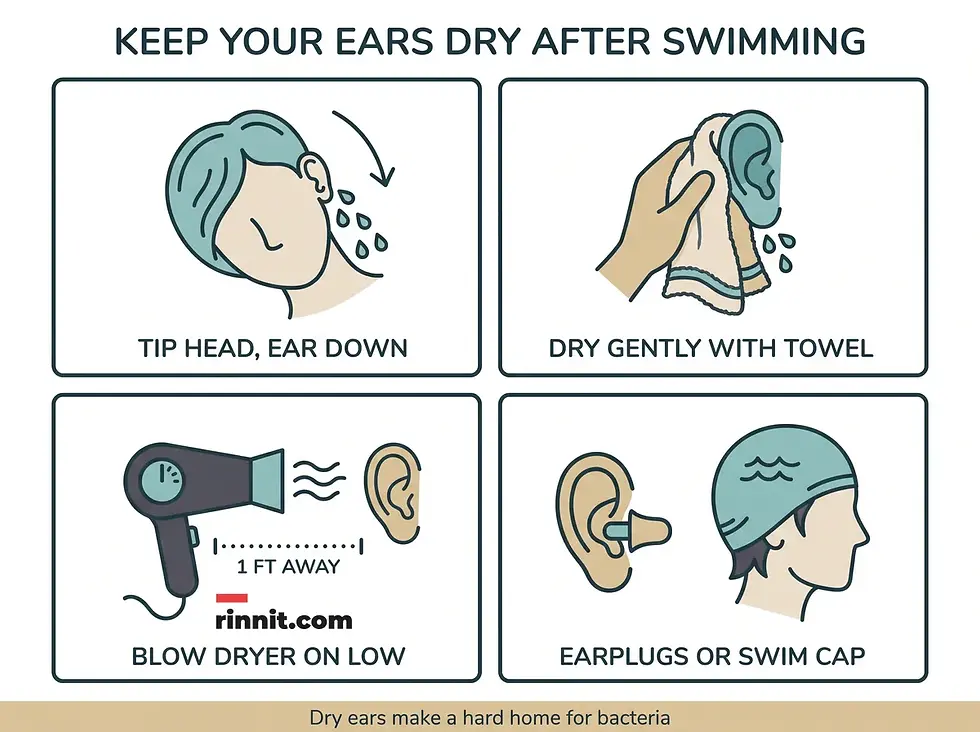
Dry your ears well. After swimming or bathing, tip your head from side to side with one ear down to drain it [3] [4]. Dry the outer ear gently with a soft towel [3] [4]. A blow dryer on its lowest setting, held at least one foot (about 0.3 meters) away [4], helps finish the job.
Consider a preventive drying solution. Only if you do not have a punctured eardrum [4], you can mix one part white vinegar with one part rubbing alcohol [4]. Put about one teaspoon (roughly 5 milliliters) in each ear before and after swimming, then let it drain out. The vinegar restores the ear's natural acid defenses while the alcohol helps dry the canal.
Swim wisely. Avoid lakes, rivers, or pools that have posted warnings about high bacteria levels [4]. Wearing earplugs or a swimming cap [3] [4] adds protection during the swim itself.
Keep chemicals out. Place cotton balls in your ears while using hair sprays or hair dyes [4].
Talk to a professional before swimming after a recent ear infection or ear surgery [4].
Never put objects in your ear [3] [4]. Do not scratch an itch or try to dig out earwax with a cotton swab, paper clip, or hairpin. These items push debris deeper into the canal and disturb or break the skin.
Earwax Care
Earwax slowly moves toward the opening of the canal on its own [4]. You can wash it away there with a damp cloth. Otherwise, earwax is best left alone — it is a defense, not a problem [3].
If earwax is excessive or blocking the canal, see a healthcare professional [4] or clean it at home using this approach:
Soften it. Using an eyedropper, place a few drops of baby oil, mineral oil, glycerin, or diluted hydrogen peroxide in the ear [4].
Irrigate gently. After a day or two, use a rubber-bulb syringe filled with warm water [4]. Tilt your head, pull the outer ear up and back to straighten the canal, and gently squirt the water. Then tip your head to drain.
Dry the ear. Use a towel or a blow dryer on the lowest setting.
Skip this at-home cleaning if you have ever had a punctured eardrum, ear surgery, or active ear drainage — see a professional instead.
Preparing for Your Appointment
Before your visit, write down a few things. List your symptoms and when they started, all medicines, vitamins, and supplements you take with their doses, any skin or medicine allergies, and the questions you want answered [5]. Good questions include what is causing your symptoms, the best treatment, when you can expect to improve, whether a follow-up visit is needed, and how to prevent it from coming back.
Be ready for the clinician's questions too. Expect to be asked whether you swim often or have swum lately and where, whether you have had swimmer's ear before, whether you use cotton swabs or ear devices such as earbuds or hearing aids, and whether you have had a recent ear exam or ear procedure [5].
Conclusion
Swimmer's ear is a common, treatable infection of the outer ear canal. It starts when moisture, bacteria, or small skin injuries overcome the ear's natural defenses. The pattern to remember is simple: itching and pain that worsens when the ear is touched, muffled hearing as the canal swells, and improvement within days once prescription ear drops begin and the ear stays dry.
The fastest path back to comfort is seeing a clinician early, keeping the ear dry during treatment, and avoiding cotton swabs and other objects inside the canal. If severe pain or fever develops, seek care right away.
FAQ
How do you know if you have swimmer's ear or just trapped water?
Trapped water usually drains on its own after tipping your head, while swimmer's ear keeps worsening. Signs of infection include itching inside the canal, pain that increases when the outer ear is pulled or the tragus is pushed, fluid draining from the ear, and muffled hearing as the canal swells.
Does swimmer's ear go away on its own?
Mild cases occasionally improve without treatment, but swimmer's ear usually progresses through mild, moderate, and advanced stages if it is not treated. Prescription ear drops typically clear the infection in days to a couple of weeks, and early treatment prevents complications.
Can swimmer's ear cause hearing loss?
Swimmer's ear can cause short-term hearing loss. A swollen or debris-filled canal makes sounds muffled or decreased. In most cases hearing returns to normal once the infection clears and the swelling goes down.
Is it OK to use cotton swabs to clean my ears?
No. Cotton swabs, hairpins, and fingernails scratch the thin skin lining the ear canal and push debris deeper. The ear is largely self-cleaning — earwax moves to the canal opening on its own and can be wiped away there with a damp cloth.
How do you treat swimmer's ear at home while waiting for care?
Keep the ear completely dry, do not swim or wear earbuds, and use over-the-counter pain medicine such as ibuprofen, naproxen sodium, or acetaminophen. Do not use leftover ear drops or place anything in the canal. See a clinician for the prescription drops that treat the infection itself.
Related Reading
Trusted External Resources
References
UpToDate. Acute otitis externa in adults: Pathogenesis, clinical features, and diagnosis. UpToDate. Accessed October 30, 2026. https://www.uptodate.com/contents/acute-otitis-externa-in-adults-pathogenesis-clinical-features-and-diagnosis
UpToDate. Acute otitis externa in adults: Treatment. UpToDate. Accessed October 30, 2026. https://www.uptodate.com/contents/acute-otitis-externa-in-adults-treatment
Centers for Disease Control and Prevention. Preventing Swimmer's Ear. Centers for Disease Control and Prevention. May 28, 2025. https://www.cdc.gov/healthy-swimming/prevention/preventing-swimmers-ear.html
Mayo Clinic Staff. Swimmer's ear - Symptoms & causes. Mayo Clinic. April 15, 2025. https://www.mayoclinic.org/diseases-conditions/swimmers-ear/symptoms-causes/syc-20351682
Mayo Clinic Staff. Swimmer's ear - Diagnosis & treatment. Mayo Clinic. April 15, 2025. https://www.mayoclinic.org/diseases-conditions/swimmers-ear/diagnosis-treatment/drc-20351688
Centers for Disease Control and Prevention. Estimated burden of acute otitis externa--United States, 2003-2007. MMWR Morb Mortal Wkly Rep. 2011;60(19):605-609. PMID 21597452. https://pubmed.ncbi.nlm.nih.gov/21597452/
Dillard LK, Mishra P, Chander Shekhar C, et al. A Systematic Review and Quality Assessment of Clinical Practice Guidelines for Otitis Externa to Support the WHO Package of Ear and Hearing Care Interventions. Otol Neurotol. 2026;47(8):938-946. PMID 42283198. https://doi.org/10.1097/MAO.0000000000004972
Medical disclaimer
This article is for educational content only and is not medical advice. Always consult a healthcare professional for diagnosis and treatment.



Comments