Subclavian Vein: Anatomy, Essential Functions, and Care

Updated: 3 days ago
Medically reviewed by Dr. Baraa Alnahhal, MD · Last reviewed: October 2026
The subclavian vein is a deep vein under the collarbone on each side of the body that carries oxygen-poor blood from the arm, head and neck back toward the heart. It receives blood from the axillary vein and drains into the brachiocephalic vein [1]. Providers use it for central lines and pacemaker wires, and it can develop clots such as deep vein thrombosis or effort thrombosis (Paget-Schroetter syndrome) [1].
Quick Answer: What is the subclavian vein?
The subclavian vein is a deep vein just below the collarbone on each side of the body that returns oxygen-poor blood from the arms, head and neck to the heart. Providers also use it for central lines and pacemaker wires. A clot here can cause deep vein thrombosis with arm swelling or heaviness; call 911 right away.
What the research says
The subclavian site had fewer infections and clots in ICU central lines, but more collapsed lungs. In a randomized trial of 3,471 catheters placed in 3,027 adult ICU patients, bloodstream infection or symptomatic DVT occurred at 1.5 per 1,000 catheter-days with the subclavian vein, versus 3.6 for the jugular and 4.6 for the femoral vein (hazard ratio 2.1 for jugular and 3.5 for femoral versus subclavian); pneumothorax needing a chest tube followed 1.5% of subclavian insertions versus 0.5% of jugular insertions (Parienti et al., New England Journal of Medicine, 2015 [2]).
Effort thrombosis responds well to early treatment. A review of Paget-Schroetter syndrome notes that the subclavian vein is vulnerable where it passes the first rib and collarbone, that catheter-directed clot removal is usually successful if started within 10 to 14 days, and that long-term success rates of 95% to 100% have been reported with decompression of the thoracic outlet, although randomized trials are lacking (Illig and Doyle, Journal of Vascular Surgery, 2010 [3]).
What is the anatomy and function of the subclavian vein?
Your subclavian veins help circulate blood through your upper body. Arteries carry oxygen-rich blood to your organs and tissues, while veins collect oxygen-poor blood that contains waste products and carry it back to your heart, where it picks up oxygen in the lungs and begins a new trip around the body. Like many veins, each subclavian vein runs parallel to an artery of the same name [1]. Picture two narrow one-way streets side by side: the subclavian artery carries blood away from your heart, and the subclavian vein carries blood toward it.
Each subclavian vein begins near the top of your ribcage, next to your shoulder, and forms an arch that curves back down toward your heart. Picture a letter "m" spread across your chest: the subclavian veins are the top peaks [1].
Segment | Role in the "m" arch |
Axillary veins | The outer edges of the "m"; collect blood from smaller veins in the arms and hands and lead up to the subclavian veins |
Subclavian veins | The top peaks; run just below the collarbone and drain into the brachiocephalic veins |
Brachiocephalic veins | The two curves in the middle of the "m"; receive blood from the subclavian veins |
Superior vena cava | The dip in the middle, where the brachiocephalic veins merge; the large vein that carries blood down into the heart |
Like other veins, the subclavian vein has three layers: the tunica adventitia (outer layer) gives it structure and shape, the tunica media (middle layer) contains smooth muscle cells that let the vein widen or narrow, and the tunica intima (inner layer) is a lining of smooth endothelial cells that lets blood move easily [1].
Which medical procedures use the subclavian vein?
Procedure | What it involves |
Central venous access ("central line") | A small catheter gives the body fluids or medicines. Over 5 million central lines are inserted each year in the U.S., especially in the ICU. Complications can include bleeding, infection, arrhythmia, venous thrombosis and pneumothorax |
Pacemaker wires | Providers may thread pacemaker wires through the subclavian vein, which must be done carefully to avoid complications |
What common conditions affect the subclavian vein?
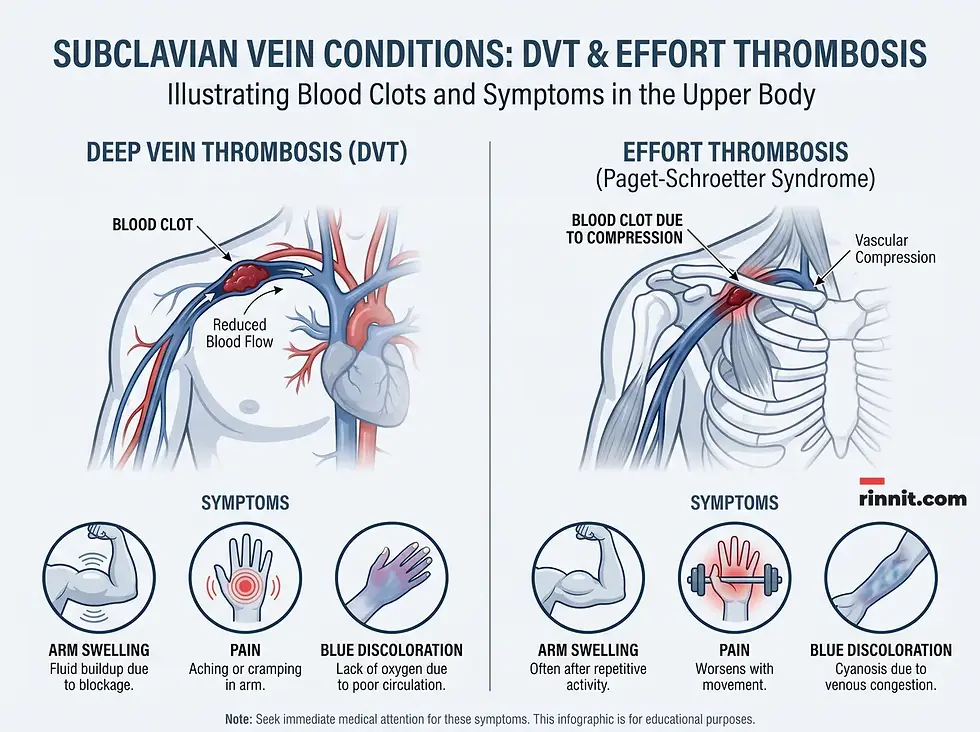
Deep vein thrombosis and axillary-subclavian vein thrombosis, also called Paget-Schroetter syndrome, are conditions that can block the subclavian vein and need emergency care [1].
Deep vein thrombosis (DVT): A blood clot can block the subclavian vein. DVT usually occurs in the legs, but it can happen in the upper body, including as a complication of a central venous catheter [1]. It is dangerous and can lead to a pulmonary embolism [1]. Symptoms are swelling, discomfort or heaviness in the arm. Call 911 if you have sudden shortness of breath, chest pain or cough up blood, which can be signs of a pulmonary embolism.
Axillary-subclavian vein thrombosis (Paget-Schroetter syndrome, or "effort thrombosis"): A rare form of DVT that affects about 3,000 to 6,000 people in the U.S. each year [1]. Most people are young (ages 15 to 45) and play sports or do heavy lifting, and repeated motions like lifting the arm over the head can trigger it [1]. Symptoms are arm swelling, pain and blue discoloration.
If you have symptoms of these conditions, call 911 right away. They are medical emergencies that need immediate care.
How can you keep your veins, including the subclavian vein, healthy?
Keeping your veins, including the subclavian vein, healthy means walking regularly, moving through the day, eating a heart-healthy diet, drinking water and reporting symptoms early.
Walk regularly: Aim for 30-minute walks at least five days a week [1].
Keep moving: Get up and move around throughout the day to keep your blood moving.
Eat a heart-healthy diet: This helps lower your blood pressure, cholesterol and weight [1].
Drink plenty of water.
Report symptoms early: If you develop any symptoms of vein problems, even small ones, call your provider. Catching problems early can help avoid serious problems later.
If you have a history of vein issues such as blood clots, talk with your healthcare provider about ways to lower your risk of future problems.
Conclusion
The subclavian vein carries blood from your upper body back toward your heart and is also a route for central lines and pacemaker wires. Knowing the warning signs of a clot, and keeping active, helps protect it.
Next step: If you notice swelling, heaviness, pain or a bluish color in an arm, call 911 right away, and if you have had clots before, talk with your healthcare provider about lowering your risk.
Frequently Asked Questions
What is the primary function of the subclavian vein?
The subclavian vein moves oxygen-poor blood from the upper body, including the arms, head and neck, back toward the heart.
Where exactly is the subclavian vein located?
You have one on each side of the body. Each runs just below the collarbone (clavicle), beginning near the top of the ribcage next to the shoulder and forming an arch that curves back down toward the heart.
What is a central line in the subclavian vein?
A central line, or central venous access, uses a small catheter placed in a large vein to give the body fluids or medicines. Providers insert over 5 million central lines each year in the U.S., especially in the ICU. Complications can include bleeding, infection, arrhythmia, venous thrombosis and pneumothorax (lung collapse).
What are the symptoms of a blood clot in the subclavian vein?
Symptoms of deep vein thrombosis (DVT) include swelling, discomfort or heaviness in the arm. Effort thrombosis can also cause pain and blue discoloration. Call 911 right away if you have these symptoms.
What is Paget-Schroetter syndrome?
Also called axillary-subclavian vein thrombosis or effort thrombosis, it is a rare form of DVT that affects about 3,000 to 6,000 people in the U.S. each year. Most people diagnosed are young (ages 15 to 45) and play sports or do heavy lifting, and repeated overhead arm motions can trigger it.
How does the subclavian vein connect to the heart?
The subclavian vein receives blood from the axillary vein and drains into the brachiocephalic vein. The two brachiocephalic veins merge to form the superior vena cava, the large vein that carries blood down into the heart.
Can a subclavian vein blockage be dangerous?
Yes. A blood clot that blocks the vein can cause deep vein thrombosis, which can lead to a pulmonary embolism. These are medical emergencies that need immediate care.
What can cause a clot in the subclavian vein?
A clot can happen as a complication of a central venous catheter. In effort thrombosis, repeated motions such as lifting the arm over the head can trigger it.
Is the subclavian vein the same as the subclavian artery?
No. They run side by side like two one-way streets: the artery carries blood away from the heart and the vein carries blood toward it.
How can I keep my veins healthy?
Aim for 30-minute walks at least five days a week, move around throughout the day, eat a heart-healthy diet, drink plenty of water, and call your provider about any vein symptoms, even small ones.
Related Reading
Axillo-Subclavian Vein Thrombosis: The Blood Clot Condition That Strikes Active People — and How It's Treated explains blood clots in the arm and subclavian veins and their treatment.
Central Venous Catheter (Central Line): Types, Procedure, Risks and Care describes central lines, which are often placed in the subclavian vein.
Deep Vein Thrombosis (DVT): Symptoms, Causes, Diagnosis & Treatment — Complete Guide covers the signs, causes and treatment of deep vein blood clots.
Venous Thromboembolism: Understanding DVT and Pulmonary Embolism explains how vein clots can travel to the lungs and cause harm.
References
Cleveland Clinic. Subclavian Vein. Cleveland Clinic. Last updated August 3, 2022. https://my.clevelandclinic.org/health/body/23941-subclavian-vein
Parienti JJ, Mongardon N, Mégarbane B, et al. Intravascular complications of central venous catheterization by insertion site. New England Journal of Medicine. 2015;373(13):1220-1229. PMID 26398070. https://doi.org/10.1056/NEJMoa1500964
Illig KA, Doyle AJ. A comprehensive review of Paget-Schroetter syndrome. Journal of Vascular Surgery. 2010;51(6):1538-1547. PMID 20304578. https://doi.org/10.1016/j.jvs.2009.12.022
Medical disclaimer
The information provided in this article is for educational purposes only and should not be used as a substitute for professional medical advice, diagnosis, or treatment. Always seek the advice of your physician or other qualified health provider with any questions you may have regarding a medical condition.



Comments