Rotationplasty: A Limb Salvage Alternative to Amputation

Updated: 3 days ago
Medically reviewed by Dr. Baraa Alnahhal, MD · Last reviewed: October 2026
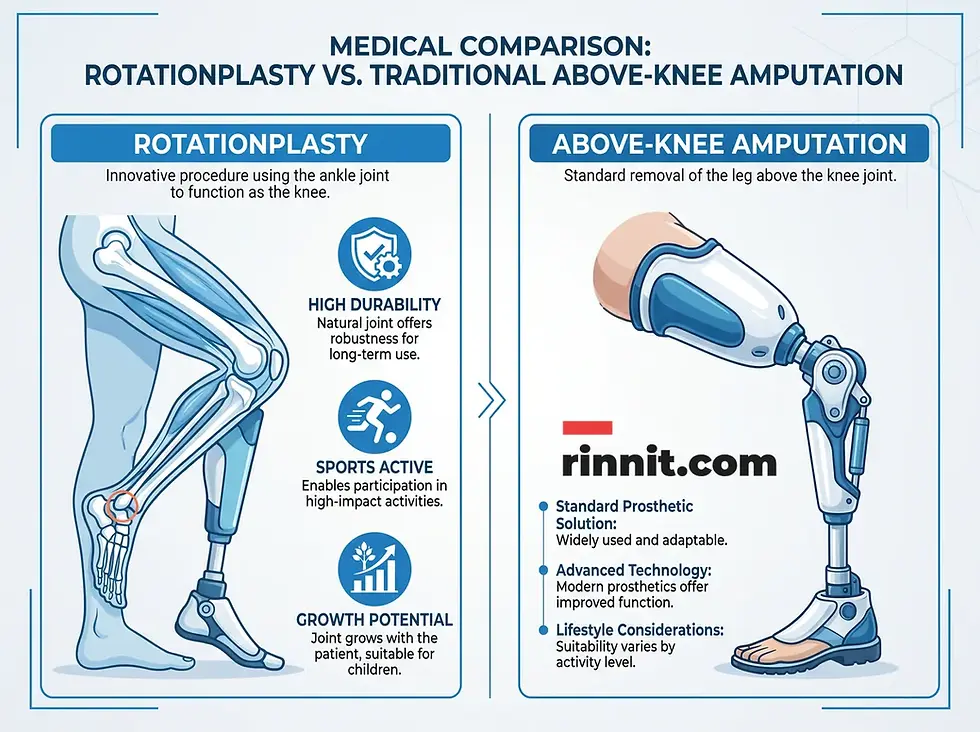
Rotationplasty is a limb salvage procedure that removes the diseased middle part of a leg, usually due to bone cancer, and reattaches the lower leg rotated 180 degrees. [1] This rotation allows the ankle joint to function as a new knee joint [1] [3], providing superior durability and mobility compared with traditional above-knee amputations. While the physical appearance requires psychological adjustment, the procedure enables patients, especially children, to return to high-impact sports and active lifestyles. [1]
Quick Answer: What is rotationplasty?
Rotationplasty is a surgical technique used mainly for bone tumors near the knee, in which the lower leg is rotated 180 degrees before reattachment so the ankle works like a knee. [1] [3] This new joint can power a prosthetic limb. [1] It offers better long-term durability and function than above-knee amputation, and many patients return to running and sports. [1]
What the research says
After 20+ years, quality of life was better after rotationplasty than after amputation. In a comparison of 39 patients followed for a mean of 36 years after rotationplasty or above-knee amputation for sarcoma, revision-free survival at 20 years did not differ significantly (86% vs 67%; p = 0.27) and activity scores were similar (median UCLA score 6 vs 5; p = 0.18), but the rotationplasty group had less pain and a higher EuroQol index (0.92 vs 0.81; p = 0.01) (Hobusch et al., Clinical Orthopaedics and Related Research, 2025) [2].
Function and satisfaction compare favorably, with appearance as the main drawback. A review of the technique reports that gait analysis and functional outcome studies show favorable results compared with above-knee amputation, that patient satisfaction is higher than with other limb salvage procedures, and that the primary drawback is patient acceptance of the limb's appearance (Gupta et al., Journal of the American Academy of Orthopaedic Surgeons, 2012) [3].
How does rotationplasty work?
Rotationplasty is a complex limb salvage procedure designed to preserve as much leg function as possible when the knee joint must be removed. This surgery is most frequently performed to treat malignant bone tumors like osteosarcoma or Ewing sarcoma [1], particularly in children and adolescents whose bones are still growing.
The defining characteristic of the procedure is the 180-degree rotation of the lower leg (shin, ankle, and foot) before it is reattached to the remaining thigh bone (femur). [1] Because the ankle joint naturally bends backward, rotating it 180 degrees allows it to function as a forward-bending knee joint. The surgeon connects the tibia (shin bone) directly to the femur, using plates, screws, or rods to stabilize the connection until the bones fuse into a single, solid structure. [1]

Who is a candidate for rotationplasty, and when is it used?
Rotationplasty is mainly used for bone cancer but may also treat severe congenital defects, traumatic injuries or persistent infections. [1] Children are often the best candidates because their reconstructed leg can grow alongside their healthy leg [1], maintaining symmetry throughout development.
Indication Category | Common Conditions | Primary Goal |
Malignant Tumors | Osteosarcoma, Ewing Sarcoma | Complete tumor removal with limb preservation |
Congenital Defects | Congenital Femoral Deficiency (CFD) | Establishing a functional joint for prosthetic use |
Trauma/Infection | Severe fractures, persistent leg infections | Salvaging a limb when the knee is unsalvageable |
What are the benefits of rotationplasty over traditional amputation?
Rotationplasty offers several functional advantages over a standard above-knee amputation. By using the patient's own ankle as a knee joint, the procedure provides a biological solution that is more durable and responsive than mechanical prosthetic knees.
Superior Mobility: The functional 'new knee' allows for a more natural gait and better control over a prosthetic limb. [1]
High Durability: Patients can often return to high-impact activities, including running and jumping [1], which are difficult with traditional above-knee prosthetics.
Avoidance of Phantom Pain: Because the patient's own nerves and blood vessels stay intact, the risk of phantom limb pain is reduced compared with amputation. [1] [2]
Growth Potential: In pediatric cases, the reattached limb continues to grow, helping the patient maintain balance and mobility as they age.
What happens during rotationplasty surgery and recovery?
The surgery is a major undertaking, typically lasting between four and ten hours. [1] Following the procedure, patients usually spend one to two days in the intensive care unit (ICU), followed by several more days in hospital recovery. [1]
Preparation: A physical exam checks hip and ankle motion and confirms the sciatic nerve is working well, while imaging (X-rays, MRI, CT) helps plan the surgery. [1]
Excision: The diseased or damaged portion of the leg is removed, ensuring clear margins in cancer cases. [1]
Rotation and Reattachment: The lower limb is rotated 180 degrees and the tibia is secured to the femur. [1]
Stabilization: Plates and screws or a rod hold the bones in place while they heal and grow together. [1]
It may take three to six months for the bones to fully heal, and longer if chemotherapy is needed. [1] During this time, a wheelchair or crutches may be needed. [1] Once the incision has healed and the swelling has gone down, a prosthesis is fitted, and physical therapy trains the brain and muscles to use the ankle as a knee. [1] Most people can walk without aid after three to six months, and within six to twelve months they should be able to return to any activity they wish, including high-impact sports. [1]
What are the risks and complications of rotationplasty?
As with any major surgery, rotationplasty carries specific risks. The most critical concern is loss of blood flow (ischemia) to the rotated limb, caused by a blood clot or a failed connection between blood vessels. [1] Other surgical risks include compartment syndrome and nerve injury, while recovery complications can include infection, delayed fusing of the tibia and femur, and imperfect joint alignment. [1] Additionally, the unique physical appearance of the leg requires significant psychological preparation and support for both the patient and their family.
Conclusion and Next Steps
Rotationplasty represents a remarkable advancement in limb salvage surgery, offering a path back to an active lifestyle for those facing the loss of a knee joint. By creatively repurposing the ankle, this procedure provides a level of functionality and durability that traditional amputations often cannot match. For patients and families willing to navigate the psychological adjustment, it offers a strong opportunity to run, play, and live without the limitations of a standard prosthetic knee.
Next step: If you or a loved one are considering limb salvage options, consult with a specialized surgical team experienced in rotationplasty to determine if this procedure is the right choice for your long-term mobility goals.
Frequently Asked Questions
What is the main goal of rotationplasty?
The primary goal is to preserve a functional, durable limb by using the patient's own ankle joint to replace a removed knee joint, allowing for better prosthetic control and activity levels.
How does the ankle work as a knee?
Because the ankle naturally bends backward, rotating the leg 180 degrees aligns the ankle's movement with the forward-bending motion required for a functional knee.
Is rotationplasty only for children?
While most common in children due to their growth potential, rotationplasty can be performed on adults who prioritize high physical activity and durability over cosmetic appearance.
Can you run after rotationplasty?
Yes, one of the greatest benefits of the procedure is that it often allows patients to return to high-impact sports, including running, jumping, and competitive athletics.
How long does the surgery take?
Rotationplasty is a complex procedure that typically requires between four and ten hours in the operating room, followed by one to two days in the intensive care unit.
What are the most common reasons for this surgery?
The most frequent indication is bone cancer near the knee, such as osteosarcoma, but it can also treat congenital limb differences or severe traumatic injuries.
What is the biggest challenge of rotationplasty?
Beyond the surgical recovery, the biggest challenge is often the psychological adjustment to the leg's unique appearance, where the foot points backward when not wearing a prosthesis.
How long is the recovery period?
The bones may take three to six months to fully heal. Most people can walk without aid after three to six months and return to any activity within six to twelve months, with dedicated physical therapy.
Does the rotated leg continue to grow?
In children, the reattached lower leg typically continues to grow, which helps maintain limb length and functional symmetry as the child matures.
Is rotationplasty a common procedure?
No, it is a specialized and relatively uncommon surgery. It is essential to seek care at a medical center with specific expertise in complex limb salvage techniques.
How do I prepare for rotationplasty?
Preparation includes a physical exam to check hip and ankle motion and confirm the sciatic nerve works well, imaging such as X-rays, MRI or CT to plan the surgery, and education on recovery and rehabilitation. It is also important to have realistic expectations about how the leg will look afterward [1].
Does rotationplasty hurt, and what anesthesia is used?
You receive general anesthesia, which puts you to sleep so you do not feel pain during the surgery. Because the patient's own nerves stay connected, the risk of phantom limb pain is lower than after amputation [1].
Related Reading
References
Cleveland Clinic. Rotationplasty. Cleveland Clinic. May 13, 2024. https://my.clevelandclinic.org/health/procedures/rotationplasty
Hobusch GM, Hofer C, Doering K, et al. Is rotationplasty still a reasonable reconstruction option for patients with a femoral bone sarcoma? A comparative study of patients with a minimum of 20 years of follow-up after rotationplasty and lower extremity amputation. Clinical Orthopaedics and Related Research. 2025;483(10):1910-1921. PMID 40258173. https://doi.org/10.1097/CORR.0000000000003495
Gupta SK, Alassaf N, Harrop AR, et al. Principles of rotationplasty. The Journal of the American Academy of Orthopaedic Surgeons. 2012;20(10):657-667. PMID 23027695. https://doi.org/10.5435/JAAOS-20-10-657
Medical disclaimer
The information provided in this article is for educational purposes only and should not be used as a substitute for professional medical advice, diagnosis, or treatment. Always seek the advice of your physician or other qualified health provider with any questions you may have regarding a medical condition.



Comments