Rat-Bite Fever Guide: Recognizing the Signs of a Serious Infection

Updated: 2 days ago
Medically reviewed by Dr. Baraa Alnahhal, MD · Last reviewed: October 2026
Definition: Rat-bite fever (RBF) is a rare but potentially serious bacterial infection primarily spread through contact with infected rats or rodents.
Transmission: Through bites, scratches, or exposure to animal secretions such as saliva, urine, and feces.
Symptoms: Vary by the type of bacteria but commonly include fever, headache, joint pain, and skin rashes.
Outlook: RBF can be fatal if left untreated, but it is highly curable with early diagnosis and a full course of antibiotics.
Quick Answer
Rat-bite fever is a rare bacterial disease spread to humans through the bite or scratch of an infected rodent or contact with its saliva, urine or feces. It is caused by Streptobacillus moniliformis or Spirillum minus. Common symptoms include fever, joint pain and a rash on the hands and feet. Early antibiotic treatment is essential to prevent serious complications. [1]
What the research says
Rat-bite fever is easy to miss, and a delayed diagnosis can cause harm. A systematic review of 20 European case reports (2000 to 2021) found that in 17 cases the index patient's condition was recognized as an infectious syndrome, and timely antibiotics prevented an unfavorable outcome in all of them. In the other 3 cases, the first diagnoses were autoimmune arthritis, gout and a viral syndrome. Because antibiotics were delayed, one patient suffered persistent harm and the other two had prolonged illness (Coessens and De Laere, Acta Clin Belg, 2022).
The classic triad of fever, rash and arthritis is often incomplete. A review of 45 published case reports of bone and joint infection after contact with a rat or its secretions found that the rat-bite fever triad was incomplete in over half of cases, mainly because rash was infrequent in adults. Patients did not mention rodent exposure on admission in a third of cases, which suggests the disease may be underdiagnosed (Giraudon et al., Front Med, 2024).
With treatment, outcomes are good. In a case series of 11 patients with rat-bite fever on Vancouver Island (2010 to 2016), all presented with fever and all were successfully treated with penicillin, ceftriaxone or doxycycline. Seven were hospitalized, and there were no deaths or significant morbidity (Hryciw et al., Can Commun Dis Rep, 2018).
What is rat-bite fever?
Rat-bite fever (RBF) is a rare systemic infection caused by specific bacteria carried by rats and other rodents. While individual cases are uncommon, the infection can be severe or even fatal without prompt medical intervention. In the United States, an estimated 20,000 to 40,000 rat bites occur annually, with approximately 10% of these leading to the development of RBF. Because it is not a reportable condition to public health authorities, the actual number of annual cases may be higher than current estimates. [1]
There are two primary forms of the disease, determined by the specific bacteria involved. Streptobacillus moniliformis is the most prevalent cause in the United States, while Spirillum minus is more common in Asia. Both types of bacteria reside in the mouths and upper respiratory tracts of healthy-appearing rodents, meaning an animal does not need to look sick to transmit the disease.
Feature | Streptobacillary RBF (U.S. Type) | Spirillary RBF (Asia Type) |
Bacterial Cause | Streptobacillus moniliformis | Spirillum minus |
Incubation Period | 3 to 10 days after exposure | 7 to 21 days after exposure |
Key Symptoms | Fever, headache, joint/muscle pain, rash | Recurrent fever, swollen lymph nodes, lesions |
Transmission Method | Bites, scratches, ingestion (milk) | Bites, scratches |
How is rat-bite fever transmitted, and who is at risk?
Humans typically contract rat-bite fever through direct physical contact with an infected animal. This most commonly occurs through a bite or scratch, but transmission can also happen if a person touches a contaminated surface and then touches their eyes, nose, mouth, or an open wound. Ingestion of food or water contaminated with rodent secretions can lead to a specific form known as Haverhill fever. [1]
While anyone who interacts with rodents is at risk, certain groups face a higher probability of exposure. This includes pet owners, animal researchers, pet store employees, and individuals living in areas with known rodent infestations. Those with weakened immune systems are also at a higher risk of developing severe complications from the infection.

What are the symptoms of rat-bite fever?
Symptoms of rat-bite fever generally appear within a few days to three weeks after exposure. For the streptobacillary form common in the U.S., patients often experience a sudden onset of fever, chills, headache, and vomiting. A hallmark sign is a flat or bumpy skin rash that typically develops around the hands and feet. Joint and muscle pain are also frequent complaints.
The spirillary form, more common in Asia, presents slightly differently. The fever may go away and return multiple times (recurrent fever). Additionally, the original bite site may swell or develop a visible skin lesion, and the surrounding lymph nodes often become enlarged. If left untreated, the bacteria can spread through the bloodstream, leading to serious infections in the heart, lungs, liver, or brain. [1]

How is rat-bite fever diagnosed and treated?
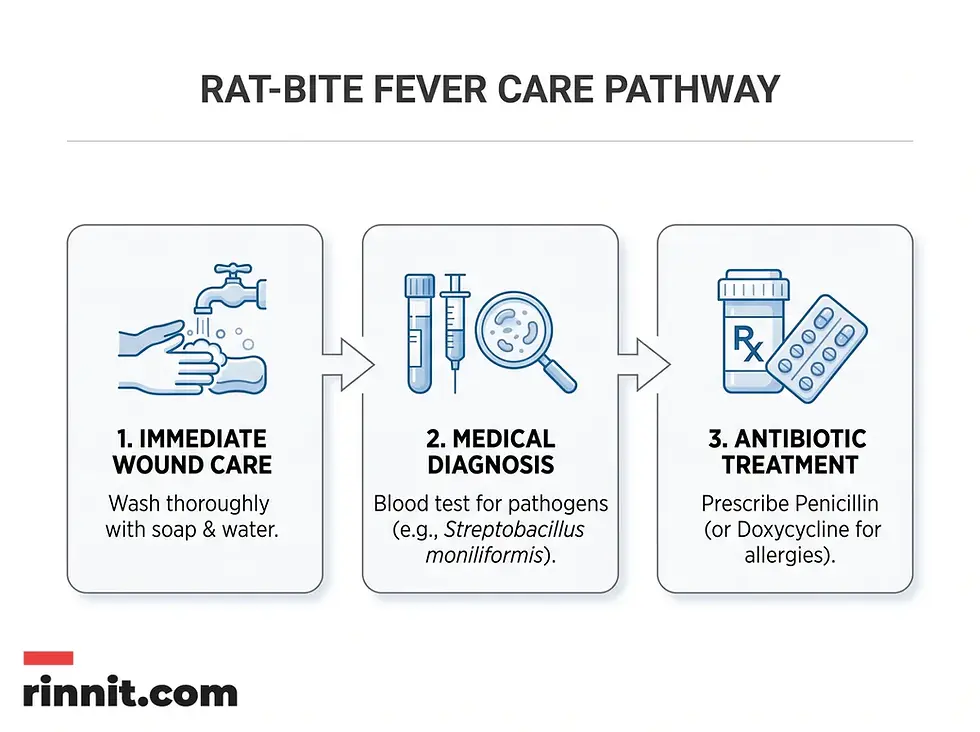
Early diagnosis is the most critical factor in ensuring a full recovery. A healthcare provider will typically diagnose RBF by reviewing the patient's history of animal contact and performing a physical exam. To confirm the presence of the bacteria, they may order blood tests or analyze fluid samples taken from swollen joints.
Immediate First Aid and Medical Care
If a rodent bite or scratch occurs, the wound should be washed immediately with clean water and antibacterial soap. Applying an antibiotic ointment and covering the area with a clean bandage can help prevent initial infection. However, it is essential to seek professional medical care as soon as possible.
Treatment primarily involves a course of antibiotics, such as penicillin or doxycycline, which may be administered for up to two weeks. Most patients begin to feel significantly better within a few days of starting treatment. It is vital to complete the entire course of antibiotics to ensure the infection does not return in a more resistant form. [1]
How can rat-bite fever be prevented?
The most effective way to prevent rat-bite fever is to avoid contact with wild rodents and their environments. For those who must interact with rodents, wearing protective gear such as rubber gloves and masks while cleaning cages or droppings is recommended. Sanitizing surfaces with disinfectants and sealing entry points in the home can also reduce the risk of infestation and subsequent exposure.
Conclusion
Rat-bite fever is a serious but manageable condition. By understanding the risks associated with rodent contact and recognizing the early symptoms of infection, individuals can take proactive steps to protect their health. With prompt medical attention and appropriate antibiotic therapy, the vast majority of patients achieve a full and lasting recovery.
Frequently Asked Questions
What is the mortality rate for rat-bite fever?
Without proper treatment, rat-bite fever has a mortality rate of approximately 10%. However, this risk is significantly reduced with early diagnosis and appropriate antibiotic therapy. [1]
Can I get rat-bite fever without being bitten?
Yes. You can contract the infection through scratches, contact with a rodent's saliva, urine, or feces, or by touching contaminated surfaces. Ingesting food or water contaminated by rodent secretions can also cause the disease. [1]
What does a rat-bite fever rash look like?
The rash is typically flat or bumpy and most often appears on the hands and feet. It usually develops within a few days of the initial fever and is a key diagnostic sign for the streptobacillary form of the disease. [1]
How long does it take for symptoms to appear?
Symptoms usually appear between 3 and 10 days for the streptobacillary type (U.S.) and 7 to 21 days for the spirillary type (Asia). However, onset can vary depending on the individual and the level of exposure. [1]
Is rat-bite fever contagious between people?
No. Rat-bite fever is not known to be contagious among humans. It is only spread through direct or indirect contact with infected rodents and their secretions. [1]
What animals besides rats carry the bacteria?
In addition to rats, other rodents such as mice, squirrels, gerbils, and guinea pigs can carry the bacteria. There have also been rare reports of transmission from dogs, cats, and other domestic animals. [1]
What is Haverhill fever?
Haverhill fever is a specific form of streptobacillary rat-bite fever that occurs after ingesting food or drinks (most commonly unpasteurized milk) that have been contaminated with the Streptobacillus moniliformis bacteria. [1]
How is rat-bite fever treated?
The primary treatment is a course of antibiotics, such as penicillin, amoxicillin, or doxycycline, typically lasting for up to two weeks. It is crucial to finish the entire prescription to prevent the infection from returning. [1]
Can rat-bite fever cause long-term damage?
Most people recover fully without lasting effects if treated early. However, untreated infections can spread to the heart, lungs, liver, or brain, leading to serious complications like meningitis or endocarditis. [1]
What should I do right after a rat bite or scratch?
Wash the wound right away with soap and clean water, apply an antibiotic ointment and cover it with a clean bandage. Then contact a healthcare provider, and seek care promptly if fever, rash or joint pain develops in the following days or weeks.
Related Reading
Understanding Leptospirosis: Risks, Symptoms, and Prevention covers another bacterial infection spread through rodent urine.
Hantavirus Pulmonary Syndrome: What It Is, Why It Happens, and How It's Treated explains a serious lung illness spread by rodent droppings and urine.
Endocarditis: Symptoms, Causes, Types, Diagnosis, Treatment and When to Seek Emergency Care — What You Need to Know describes heart valve infection, a rare complication of rat-bite fever.
Tetanus (Lockjaw): Symptoms, Causes, Treatment, and Vaccination Guide explains the infection that bite and scratch wounds can also spread.
References
Cleveland Clinic. Rat-Bite Fever. Cleveland Clinic Health Library. Accessed October 11, 2026. https://my.clevelandclinic.org/health/diseases/25153-rat-bite-fever
Coessens M, De Laere E. Rat bite fever: a case report review. Acta Clin Belg. 2022;77(5):883-888. PMID: 34672901. DOI: https://doi.org/10.1080/17843286.2021.1992940
Giraudon E, Larranaga Lapique E, Wallemacq S, et al. Septic arthritis complicating Streptobacillus moniliformis rat bite fever: a case report and review of its pathophysiology and diagnosis. Front Med (Lausanne). 2024;11:1345354. PMID: 39267964. DOI: https://doi.org/10.3389/fmed.2024.1345354
Hryciw BN, Wright CP, Tan K. Rat bite fever on Vancouver Island: 2010-2016. Can Commun Dis Rep. 2018;44(9):215-219. PMID: 31015812. DOI: https://doi.org/10.14745/ccdr.v44i09a05
Medical disclaimer
This article is for informational purposes only and is not a substitute for professional medical advice, diagnosis, or treatment. Always seek the advice of your physician or other qualified health provider with any questions you may have about a medical condition.



Comments