Hantavirus Pulmonary Syndrome: What It Is, Why It Happens, and How It's Treated

Updated: 2 days ago
Medically reviewed by Dr. Baraa Alnahhal, MD · Last reviewed: October 2026
Quick Answer
Hantavirus pulmonary syndrome is a disease people typically get by breathing dust contaminated with the waste of infected mice or rats. Flu-like symptoms usually appear 1 to 8 weeks after exposure, then the virus can rapidly attack the lungs. About 4 in 10 people who develop it do not survive. There is no specific cure; treatment is intensive hospital support. [1]
What the research says
ECMO can rescue patients who would otherwise likely die. Among 38 patients with severe hantavirus cardiopulmonary syndrome and a predicted mortality of 100%, 23 (60.5%) survived with ECMO support, and all survivors recovered completely (Dietl et al., J Thorac Cardiovasc Surg, 2008).
Early intensive care improves survival; ribavirin has not helped. A clinical review reported an overall mortality of about 35% for almost all strains, noted that early recognition and transfer to intensive care improve survival, and found that ribavirin does not appear to reduce mortality (Chang et al., Semin Respir Crit Care Med, 2007).
What Is Hantavirus Pulmonary Syndrome?
Hantavirus pulmonary syndrome (HPS) is a rare but extremely dangerous viral infection that primarily attacks the respiratory system. It belongs to a group of zoonotic viruses, meaning they are transmitted from animals—specifically rodents—to humans. While the virus does not typically make the rodents sick, it causes severe inflammation in human lungs, leading to fluid buildup and a life-threatening drop in oxygen levels.
In the United States, HPS is most commonly caused by the Sin Nombre virus, which is carried by deer mice. Other parts of the world, such as South America, deal with the Andes virus, which is unique because it can occasionally spread from person to person through close contact. Regardless of the specific strain, any suspected hantavirus infection is considered a medical emergency.
Feature | Hantavirus Pulmonary Syndrome (HPS) | Hemorrhagic Fever with Renal Syndrome (HFRS) |
Primary Target | Lungs and Heart | Kidneys and Blood Vessels |
Primary Region | North and South America | Europe and Asia |
Key Symptoms | Severe breathing distress, dry cough | Bleeding, kidney failure, rash |
Fatality Rate | Approximately 40% [3] | Varies by strain (often lower than HPS) |
How Does Hantavirus Spread?
The most common way humans contract hantavirus is through a process called aerosolization. This occurs when dried rodent urine, droppings, or nesting materials are disturbed, causing viral particles to become airborne. When a person breathes in this contaminated dust, the virus enters the respiratory tract. Activities like sweeping or vacuuming a shed, barn, or attic that has been infested with mice are high-risk behaviors.
While inhalation is the primary route, the virus can also spread through direct contact. This includes being bitten or scratched by an infected rodent, eating food contaminated by rodent waste, or touching a contaminated surface and then touching your eyes, nose, or mouth. In the U.S., there is no evidence of the virus spreading between humans; however, close contact transmission has been documented with the Andes strain in South America.
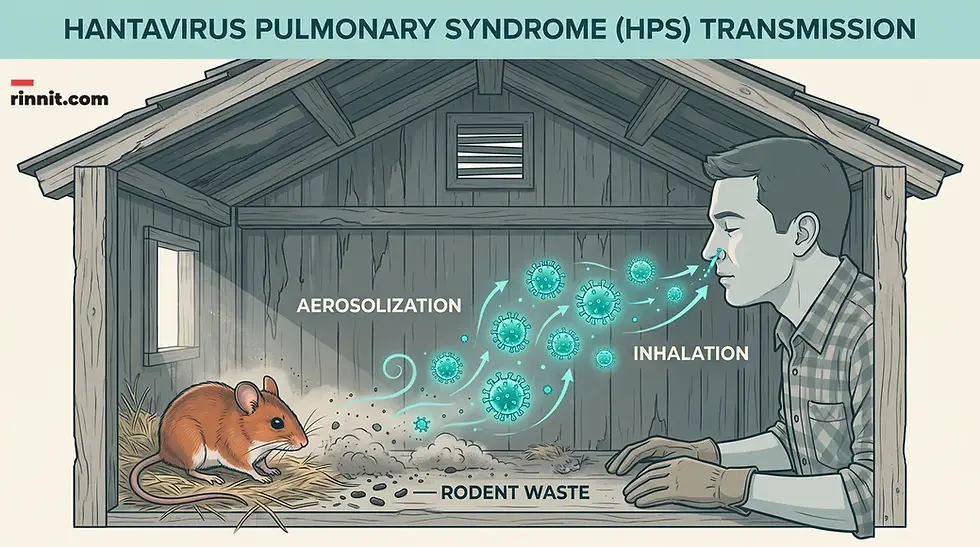
Common Rodent Carriers
Deer Mice: The most common carrier in the western United States.
White-Footed Mice: Found throughout the eastern and central U.S.
Rice Rats and Cotton Rats: Common in the southeastern U.S.
Voles: Various species in Europe and Asia.
What Are the Symptoms of Hantavirus?
Hantavirus symptoms typically appear in two distinct phases. The first phase, known as the prodromal stage, usually begins 1 to 8 weeks after exposure. During this time, the illness is easily mistaken for the flu or other common viral infections.
Early Symptoms (Days 1–5)
High Fever and Chills: Sudden onset of temperature spikes.
Muscle Aches: Intense pain in the large muscle groups, including the thighs, hips, and back.
Digestive Issues: Nausea, vomiting, diarrhea, and abdominal pain.
Fatigue and Dizziness: Profound tiredness and lightheadedness.
Late Symptoms (Days 4–10)
As the virus begins to affect the lungs, the condition worsens rapidly. This transition can happen in a matter of hours, leading to what is known as the cardiopulmonary phase.
Severe Shortness of Breath: Feeling as though you cannot get enough air.
Dry Cough: A persistent cough that does not produce mucus.
Rapid Heartbeat: The heart struggles to pump oxygenated blood.
Chest Tightness: A feeling of intense pressure in the chest.

How Is Hantavirus Diagnosed and Treated?
Diagnosing hantavirus can be challenging because the early symptoms are so non-specific. Doctors rely heavily on a patient's history of potential rodent exposure. If HPS is suspected, a blood test is performed to look for specific hantavirus antibodies or the presence of the virus's genetic material through PCR testing.
Treatment in the Hospital
Because there is no antiviral medication that cures HPS, treatment is purely supportive. Patients are almost always admitted to an Intensive Care Unit (ICU) where their vital functions can be monitored and supported.
Oxygen Therapy: Providing high-flow oxygen to maintain blood levels.
Mechanical Ventilation: Using a breathing machine to do the work for the lungs.
IV Fluids and Vasopressors: Managing hydration and using medication to keep blood pressure from dropping to dangerous levels.
ECMO: In the most severe cases, an Extracorporeal Membrane Oxygenation machine may be used to temporarily take over the function of the heart and lungs, allowing the body time to recover.
How Can You Prevent Hantavirus?
Prevention is the most effective way to stay safe from hantavirus. Since there is no vaccine, reducing your risk involves minimizing contact with rodents and cleaning up infested areas safely.
Safe Cleaning Practices
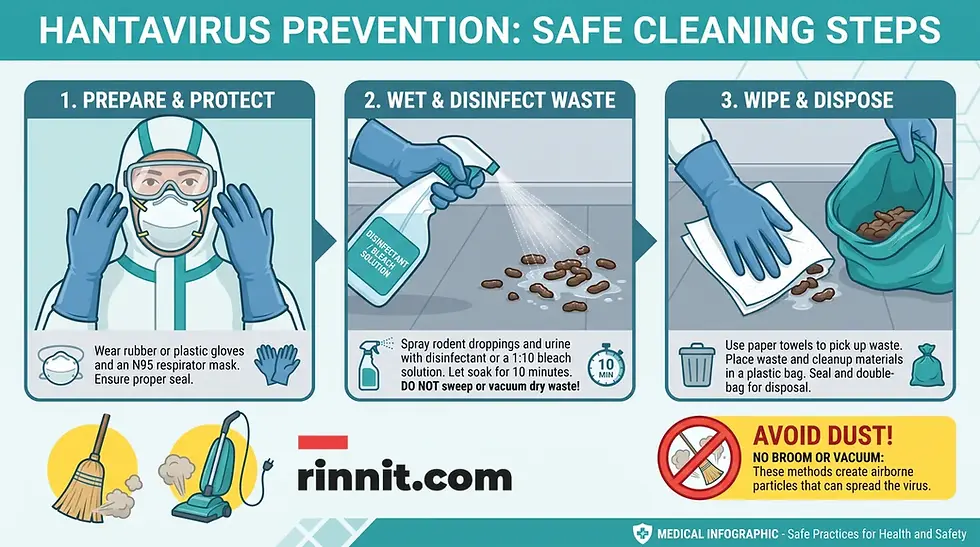
If you must clean an area where rodents have been, never sweep or vacuum, as this kicks up contaminated dust. Instead, follow these “wet cleaning” steps:
Ventilate: Open doors and windows for at least 30 minutes before starting.
Protective Gear: Wear rubber gloves and a high-quality respirator mask (like an N95).
Disinfect: Spray the area thoroughly with a bleach solution (1 part bleach to 10 parts water) or a commercial disinfectant.
Soak: Let the disinfectant sit for at least five minutes to kill the virus.
Wipe: Use paper towels to pick up the waste, then double-bag and dispose of it.
Final Clean: Mop or sponge the entire area with disinfectant.
Conclusion
Hantavirus pulmonary syndrome is a formidable disease, but it is also rare. By understanding how the virus spreads and recognizing the early warning signs—especially after being in rodent-prone environments—you can take the necessary steps to protect yourself and seek help when it matters most.
Emergency Alert: If you develop a fever and muscle aches after cleaning a shed, barn, or attic, seek emergency medical care immediately. Tell the provider about your potential rodent exposure.
Frequently Asked Questions
Q: How long can hantavirus live outside the body?
A: The virus typically survives for a few days at room temperature but can live longer in cool, moist environments. Disinfectants kill it quickly.
Q: Can pets like cats or dogs get hantavirus?
A: There is no evidence that domestic pets like cats or dogs become sick from hantavirus or spread it to humans, though they may bring infected rodents into the home.
Q: Is there a vaccine for hantavirus?
A: Currently, there is no FDA-approved vaccine for hantavirus pulmonary syndrome in the United States.
Q: Can you get hantavirus from a house mouse?
A: While the common house mouse is not a primary carrier of the Sin Nombre virus, it is best to treat all wild rodent droppings as potentially hazardous.
Q: Where is hantavirus most common in the U.S.?
A: Most cases occur in the southwestern states, including Arizona, New Mexico, Colorado, and California.
Q: Can hantavirus spread through water?
A: Hantavirus is not known to spread through municipal water systems, but drinking water contaminated with rodent waste in the wild is a risk.
Q: Does hand sanitizer kill hantavirus?
A: Alcohol-based hand sanitizers are effective at killing the virus on your hands, but thorough washing with soap and water is preferred.
Q: What is the survival rate for hantavirus?
A: The survival rate is approximately 60%, provided the patient receives intensive medical support early in the illness. [3]
Q: Can hantavirus be cured with antibiotics?
A: No, antibiotics only kill bacteria. Since hantavirus is a virus, antibiotics are ineffective.
Q: Are there long-term effects of surviving hantavirus?
A: Most survivors recover fully, though some may experience lingering fatigue or reduced lung function for a period after discharge.
Q: How many cases of hantavirus occur each year?
A: In the U.S., there are typically between 20 and 50 cases reported annually.
Q: Can you get hantavirus from touching a live mouse?
A: Yes, if the mouse bites you or if you touch its waste and then touch your face.
Q: Is hantavirus the same as the plague?
A: No, the plague is caused by bacteria (Yersinia pestis) and is usually spread by fleas, whereas hantavirus is a viral infection spread by rodent waste.
Q: Should I move out of my house if I find a mouse?
A: No, but you should take steps to seal entry points and safely clean any droppings following the wet-cleaning protocol.
Q: Does sunlight kill hantavirus?
A: Yes, ultraviolet (UV) light from the sun can deactivate the virus over time.
Related Reading
Understanding Leptospirosis: Risks, Symptoms, and Prevention covers another infection people can catch from rodents and contaminated water.
Mechanical Ventilation: How a Ventilator Works, Types, Risks and Recovery explains how a ventilator supports breathing during severe lung illness.
ECMO (Extracorporeal Membrane Oxygenation): How It Works, Types, Risks, and Recovery describes the life-support machine used when the heart and lungs fail.
Pneumonia: Complete Guide to Symptoms, Causes, and Treatment explains lung infections, their symptoms and how they are treated.
Sources
Cleveland Clinic. Hantavirus. Cleveland Clinic. May 28, 2026. https://my.clevelandclinic.org/health/diseases/17897-hantavirus-pulmonary-syndrome
Centers for Disease Control and Prevention. About Hantavirus. CDC. May 13, 2024. https://www.cdc.gov/hantavirus/about/index.html
Van Hook CJ. Hantavirus Pulmonary Syndrome—The 25th Anniversary of the Four Corners Outbreak. Emerg Infect Dis. 2018;24(11):2056-2060. PMCID PMC6199996. https://doi.org/10.3201/eid2411.180381
Chang B, et al. Hantavirus cardiopulmonary syndrome. Semin Respir Crit Care Med. 2007;28(2):193-200. PMID 17458773. https://doi.org/10.1055/s-2007-976491
Dietl CA, et al. Extracorporeal membrane oxygenation support improves survival of patients with severe Hantavirus cardiopulmonary syndrome. J Thorac Cardiovasc Surg. 2008;135(3):579-84. PMID 18329474. https://doi.org/10.1016/j.jtcvs.2007.11.020
Medical disclaimer
The information provided in this guide is for educational purposes only and should not be used as a substitute for professional medical advice, diagnosis, or treatment. Hantavirus pulmonary syndrome is a medical emergency. If you suspect you have been exposed and are showing symptoms, seek immediate care at an emergency department.



Comments