Pulled Calf Muscle: What It Is, How to Treat It, and When to Get Help

Updated: 3 days ago
Medically reviewed by Dr. Baraa Alnahhal, MD · Last reviewed: October 2026
Quick Answer
A pulled calf muscle is an overstretched calf muscle, ranging from mild strain to a partial or complete tear [1] [4]. Symptoms include sudden calf pain, swelling, bruising and trouble flexing the foot [1]. It is common in athletes over 40 in stop-and-go sports [1] [4]. First-line treatment is rest, ice for 20 minutes every two hours, compression and elevation [1].
What the research says
Age and a previous calf strain are the strongest risk factors. A systematic review of 10 studies, covering 5,397 athletes and 518 calf or lower leg muscle injuries, found that increasing age and a previous calf strain were the strongest predictors of a future calf injury. Height, weight, gender, and side dominance showed no clear association, and the authors note that the overall evidence is limited. (Green and Pizzari, Br J Sports Med, 2017) [3]
A calf-pull can hide a blood clot. In an ultrasound study of 141 people referred with a clinical diagnosis of "tennis leg," the medial gastrocnemius muscle was ruptured in 94 (66.7%), and a deep vein thrombosis (DVT) was found on its own in 14 (9.9%). (Delgado et al., Radiology, 2002) [6]
Most calf strains are treated without surgery. A clinical review reports that nonoperative treatment is effective for most calf strains in athletes, that MRI and ultrasound help confirm the location and grade of the injury, and that surgery is rarely needed and may be considered for severe grade III ruptures or complications. (Meek et al., JBJS Rev, 2022) [5]
What Is a Calf Strain?
A calf strain, or pulled calf muscle, occurs when you overstretch a muscle in your calf [1]. Your calf muscles sit in your lower leg behind your shin bone (tibia) and extend from the base of your thigh down to your heel. They help you flex and bend your foot, ankle, and knee [1]. A strained calf muscle can cause pain and prevent you from running, jumping, and doing other activities [1].
Most calf injuries are mild, but a severe calf strain can result in a partially or completely torn calf muscle [1]. Whether you have a mild or severe injury, you should see a healthcare provider as soon as possible [1]. Early diagnosis and treatment will get you back to participating in the sports and activities you love sooner [1].

What Are the Symptoms of a Calf Strain?
Calf strain symptoms may include bruising on your calf muscle, difficulty tensing your calf muscles or standing on your toes, muscle pain when flexing your ankle or pointing your toes, difficulty bending your knee, a snapping or popping sensation in your calf, sudden calf muscle pain, and swelling in your calf muscle [1].
Most people with a strained calf muscle say they can't continue with their activity immediately following an injury [1].
Symptom | What it feels or looks like |
Sudden calf muscle pain [1] | Sharp pain that appears quickly during activity |
A pop felt inside the calf at the moment of injury | |
Calf muscle looks or feels puffed up | |
Bruising | |
Trouble standing on your toes [1] | Difficulty tensing calf muscles or rising onto toes |
Pain when flexing your ankle [1] | Pain when pointing your toes or bending your ankle |
Difficulty bending your knee [1] | Knee is harder to bend than usual |
What Causes a Pulled Calf Muscle?
Calf strains usually occur when someone suddenly moves or overstretches their calf after standing still [1]. Quick pivots, jumps, or abrupt stops can cause strains [1]. This injury is especially common when your toes get forced upward (toward your body) and your ankle pulls your calf muscles down too quickly [1] [4].
Who Is Most at Risk?
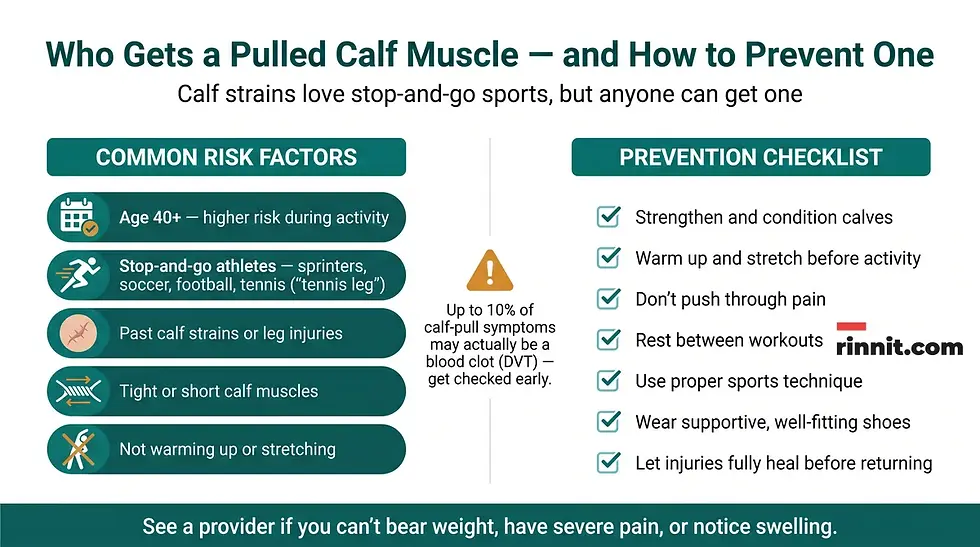
Anyone can get a pulled calf muscle. But these strains are more common in athletes who perform lots of stop-and-go movements with quick bursts of speed [1]. Sprinters, football players, soccer players, and tennis players are prone to strained calf muscles [1]. Sometimes, the injury is called "tennis leg." [1] [4]
Risk factor | Why it raises your risk |
Age | |
Lack of conditioning | |
Medical history | |
Muscle quality | |
Sex | Some studies suggest males are more likely to get calf injuries [1] |
What Complications Can a Pulled Calf Cause?
Depending on the severity of your condition, complications of a pulled calf muscle may include chronic pain, compartment syndrome, deep vein thrombosis (DVT), reinjury, and scar tissue [1] [4].
How Do Doctors Diagnose a Calf Strain?
A healthcare provider will perform a physical exam and review your symptoms [1] [4]. It's important to describe in detail how you got the injury and how your calf felt immediately after the injury [1]. This information can help your healthcare provider make a diagnosis.
You may need imaging exams to rule out other conditions that cause lower leg pain, like Achilles tendon ruptures or deep vein thrombosis (DVT) [1] [4]. Research shows that up to 10% of people with symptoms of calf pulls have DVT, which can be a life-threatening condition [1] [4].
Your healthcare provider may request an ultrasound to check for blood clots around your calf muscles, and an MRI to assess for rupture [1] [5] [4].
How Do You Heal a Calf Strain Quickly?
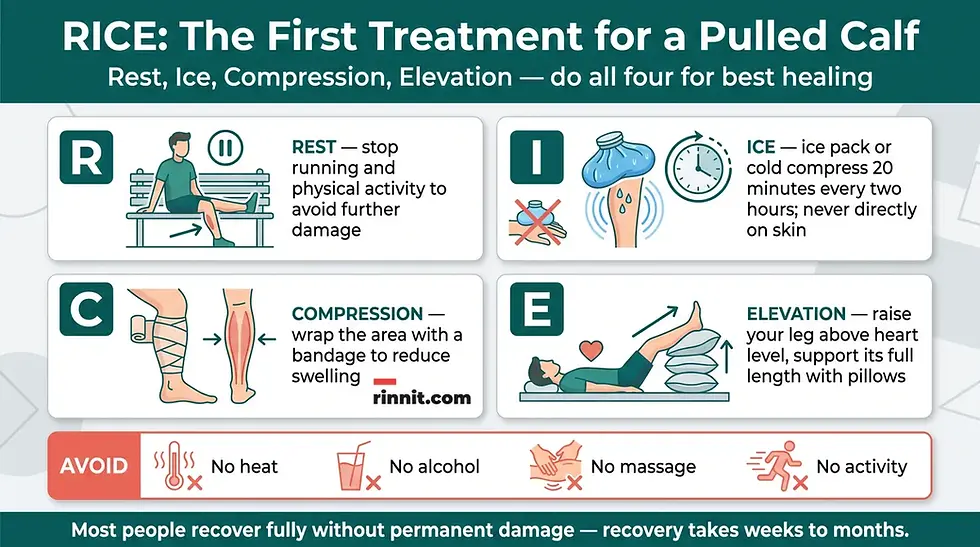
Pulled calf muscle treatment usually includes RICE, which stands for rest, ice, compression, and elevation [1] [4].
Rest. Stop running or physical activity to avoid further damaging your calf muscle [1].
Ice. Apply an ice pack or cold compress for 20 minutes every two hours [1]. Don't apply ice directly to your skin [1].
Compression. Reduce swelling and fluid buildup by applying a compression bandage or wrap to the injured area [1].
Elevation. Lift your leg into an elevated position, preferably above the level of your heart [1]. Support the entire length of your leg with pillows, blankets, or cushions [1].
You can perform RICE at home, but it's always good to check in with your healthcare provider about any special instructions [1].
Once your provider diagnoses your injury, they may recommend additional calf strain treatment, including pain relievers, physical therapy, and a soft cast or boot to keep your lower leg from moving [1] [4].
How Long Does Recovery Take?
Most people recover fully from pulled calf muscles without any permanent damage [1]. Ask your healthcare provider when you can gradually start to do light activities again. Depending on the severity of your injury, it may be several weeks or even months before you can return to full activities [1].
Once you've had a calf muscle strain, you have a higher risk for future strains in that area [1] [5]. Reduce your risk of reinjury by allowing your injury to fully heal before getting back to normal activities [1].
Can a Pulled Calf Muscle Be Prevented?
You can reduce your risk of a pulled calf muscle by keeping your calf muscles strong and conditioned, not pushing through the pain, resting and recovering between workouts, stretching routinely, using proper technique when playing sports, warming up and stretching your calf muscles before physical activity, and wearing supportive footwear that fits properly [1].
When Should I See My Healthcare Provider?
You should contact your provider if you are unable to walk or bear weight on your leg, can't bend or flex your foot, ankle, or knee, have severe pain in your calf, or notice swelling in your lower leg, foot, or ankle [1].
Because calf-pull symptoms can overlap with deep vein thrombosis — a blood clot that can be life-threatening [1] — don't wait to get checked. Early diagnosis and treatment get you back on your feet sooner.
Conclusion
A pulled calf muscle is one of the most common injuries for athletes [1], but it can happen to anyone — usually during a quick pivot, jump, or abrupt stop [1]. The good news: most people recover fully with no permanent damage [1]. Start with RICE at home, avoid heat, alcohol, massage, and activity while healing, and see a healthcare provider early to confirm it's a strain and not something more serious like a blood clot or tendon rupture. With proper rest and gradual return to activity, you can be back to the sports and activities you love.
Looking for clear answers on everyday health questions? Browse hundreds of plain-language guides at Rinnit.com.
Frequently Asked Questions
What is a pulled calf muscle?
It is a calf strain — an overstretching of a muscle in the back of your lower leg [1]. It can range from mild to a partial or complete tear [1] [4].
What causes a pulled calf muscle?
Sudden movement or overstretching of the calf after standing still [1]. Quick pivots, jumps, and abrupt stops are common triggers, especially when your toes get forced upward and your ankle pulls the calf down too quickly [1] [4].
What does a pulled calf feel like?
Sudden calf pain, often with a snapping or popping sensation, swelling, bruising, and trouble flexing your foot, ankle, or knee or standing on your toes [1].
Who is most likely to get a calf strain?
Anyone, but especially athletes who do stop-and-go movements with quick bursts of speed — sprinters, football players, soccer players, and tennis players [1]. People over 40 and those with tight or short calf muscles are at higher risk [1].
Why is it sometimes called "tennis leg"?
The tennis serve posture fully straightens the knee and bends the ankle upward, so tennis players are especially prone to calf strains — hence the nickname [4].
What should I do right after pulling my calf?
Use RICE: rest (stop activity), ice (20 minutes every two hours, never directly on skin), compression (a bandage or wrap), and elevation (leg raised above heart level) [1].
How long does a pulled calf take to heal?
Depending on severity, several weeks or even months before returning to full activities [1]. Most people recover fully without permanent damage [1].
What should I avoid while my calf heals?
Applying heat to the injured area, drinking alcohol, massaging your calf, and walking or doing physical activity [1].
Do I need to see a doctor for a pulled calf?
Yes — even for mild injuries, seeing a healthcare provider early gets you back to activity sooner [1], and it rules out more serious conditions [4].
Why would a doctor order an ultrasound or MRI?
An ultrasound checks for blood clots around the calf, and an MRI assesses for rupture [1] [4]. These tests also rule out Achilles tendon ruptures [1] [4], which can mimic a calf strain.
Can a pulled calf actually be a blood clot?
Yes — research shows up to 10% of people with calf-pull symptoms have deep vein thrombosis (DVT), which can be life-threatening [1] [4]. That's why early evaluation matters.
What treatments might a provider recommend beyond RICE?
Pain relievers, physical therapy, and sometimes a soft cast or boot to keep the lower leg from moving [1] [4].
Can I pull my calf again after healing?
Yes — once you've had a strain, you have a higher risk of future strains in that area [1] [5]. Let it fully heal before returning to normal activities [1].
How can I prevent a calf strain?
Keep calves strong and conditioned, warm up and stretch before activity, don't push through pain, rest between workouts, use proper sports technique, and wear supportive, well-fitting footwear [1].
When should I get urgent help for calf pain?
If you can't walk or bear weight on your leg, can't bend or flex your foot, ankle, or knee, have severe calf pain, or notice swelling in your lower leg, foot, or ankle [1] — contact a provider right away.
Related Reading
References
Cleveland Clinic. Calf Strain (Pulled Calf Muscle). Cleveland Clinic. Updated April 3, 2025. https://my.clevelandclinic.org/health/diseases/21558-pulled-calf-muscle
Green B, et al. The Assessment, Management and Prevention of Calf Muscle Strain Injuries: A Qualitative Study of the Practices and Perspectives of 20 Expert Sports Clinicians. Sports Med Open. 2022;8(1):10. PMID 35032233. https://doi.org/10.1186/s40798-021-00364-0
Green B, et al. Calf muscle strain injuries in sport: a systematic review of risk factors for injury. Br J Sports Med. 2017;51(16):1189-1194. PMID 28259848. https://doi.org/10.1136/bjsports-2016-097177
Hsu D, et al. Gastrocnemius Strain. StatPearls. Treasure Island (FL): StatPearls Publishing; updated August 14, 2023. PMID 30521187. https://pubmed.ncbi.nlm.nih.gov/30521187/
Meek WM, et al. Calf Strain in Athletes. JBJS Rev. 2022;10(3):e21.00183. PMID 35316243. https://doi.org/10.2106/JBJS.RVW.21.00183
Delgado GJ, et al. Tennis leg: clinical US study of 141 patients and anatomic investigation of four cadavers with MR imaging and US. Radiology. 2002;224(1):112-119. PMID 12091669. https://doi.org/10.1148/radiol.2241011067
Medical disclaimer
This article is for general informational purposes only and is not a substitute for professional medical advice, diagnosis, or treatment. Always seek the advice of your physician or other qualified health provider with any questions about a medical condition. Never disregard professional medical advice or delay seeking care because of something you have read here.



Comments