Primary Cough Headache: Why Coughing Triggers Head Pain, and What Treatment Can — and Can't — Do

Updated: 2 days ago
Medically reviewed by Dr. Baraa Alnahhal, MD · Last reviewed: October 2026
Quick Answer
A primary cough headache is a sudden, sharp head pain triggered during or just after coughing, sneezing or straining, usually lasting seconds to minutes. [1] Its cause is unknown, but it is usually harmless and can be reduced with prevention medicines such as indomethacin. [1] [2] Secondary cough headaches come from brain problems, so any first-time cough headache needs medical evaluation. [1]
What the research says
Cough headache is common among people who come to a clinic because of a cough. In a study of 679 patients referred to a Chinese respiratory clinic for cough, 122 (18.0%) were diagnosed with cough headache. Ages 31–50 carried about double the risk (OR 2.0), and the risk rose with cough severity (moderate OR 2.3, severe OR 3.3). In the previous year, 30.3% of those with cough headache had tension-type headache and 10.7% had migraine (PubMed: Zhang et al., Cephalalgia, 2021) [3].
Indomethacin seems the most effective preventive, and imaging is essential. Clinical reviews describe cough headache as an uncommon diagnosis that can occur in primary and secondary forms, stress that secondary causes must be ruled out with imaging, and report that indomethacin seems the most effective preventive, with beta blockers and other options considered when it is not tolerated (PubMed: Bahra, J Neurol, 2020 [4]; Nandyala & Zhang, Curr Pain Headache Rep, 2023) [5].
What Is a Cough Headache?
A cough headache is head pain triggered by coughing and other types of straining. The trigger is not limited to coughing. Sneezing, blowing your nose, laughing, crying, singing, bending over, and having a bowel movement can all set one off. [1]
Cough headaches are fairly uncommon, and doctors divide them into two types with very different outlooks. Primary cough headaches are usually harmless, are caused only by coughing, and get better quickly without treatment. Secondary cough headaches can be triggered by a cough but are caused by problems with the brain or the structures near the brain and spine, and they can be more serious. [1]
A primary cough headache is diagnosed only after a provider has ruled out possible causes other than coughing. [1] That is why imaging matters even when the pain seems brief and harmless.
Anyone who experiences a cough headache for the first time should see a health care provider. The provider can determine whether a cough or something else caused the pain. [1]
What are the symptoms of a primary cough headache?
Cough headaches have a distinctive pattern. They begin suddenly with or just after coughing or other straining, and they usually affect both sides of the head. Many people feel the pain most strongly in the back of the head. [1]
Symptom feature | What to expect |
Onset | Sudden, beginning with or just after coughing or straining |
Duration | A few seconds to a few minutes; some attacks last up to two hours |
Pain quality | Sharp, stabbing, splitting, or "bursting" pain |
Location | Usually both sides of the head; often worse in the back of the head |
After-effects | The sharp pain may be followed by a dull, aching pain lasting for hours |
It is important to separate a true cough headache from other head pain. A cough headache only happens right after coughing. If you already had a headache when you coughed, the pain is not a cough headache. For example, people with migraine often find that their headaches get worse when they cough — this is normal for migraine and is not a cough headache. [1]
Secondary cough headaches often present with only a cough headache, but they may also come with warning signs that point to a brain problem rather than a harmless trigger. [1]
Warning signs suggesting a secondary (serious) cough headache |
Longer-lasting headaches |
Dizziness |
Unsteadiness |
Fainting |
Ringing in the ears or hearing loss |
Blurred vision or double vision |
Tremor |

What Causes a Cough Headache?
The two types have very different explanations. For primary cough headaches, the cause is unknown. For secondary cough headaches, the cough is just the trigger — the real problem lies inside the skull or spine. [1]
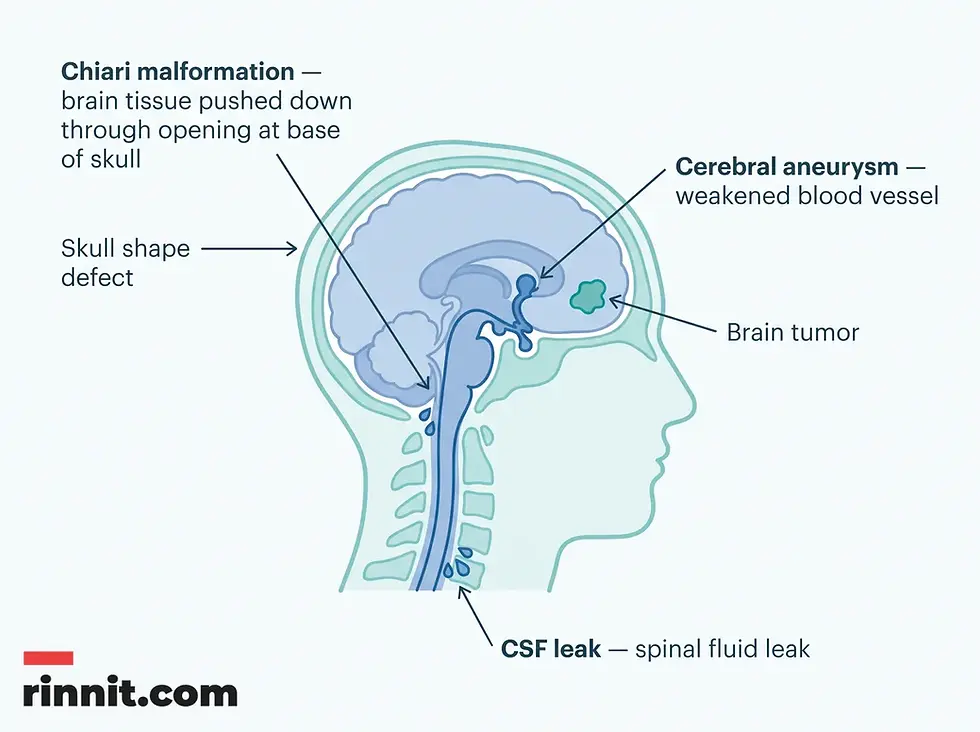
Secondary cough headaches may be caused by a defect in the shape of the skull, or by a defect in the cerebellum — the part of the brain that controls balance. This second problem can happen when part of the brain is forced through the opening at the base of the skull, called the foramen magnum, where only the spinal cord should be. Some of these defects are called Chiari malformations. [1]
Other known causes of secondary cough headaches include a weakness in one of the blood vessels in the brain (a cerebral aneurysm), a brain tumor, and a spontaneous cerebrospinal fluid (CSF) leak. [1]
A CSF leak deserves special attention. Sometimes what first looks like a cough headache is actually caused by spinal fluid leaking out. Coughing or straining triggers the headache, but the underlying cause is the leak itself. This is one of the key reasons why a new cough headache always deserves a medical check. [1]
What are the risk factors for cough headaches?
Risk factors for cough headaches vary widely based on the type and cause of the headache. [1] For the primary type, no specific risk factors have been established beyond the trigger itself. For the secondary type, risk depends entirely on the underlying condition — whether that is a Chiari malformation, an aneurysm, a tumor, or a spinal fluid leak.
When should you see a doctor about a cough headache?
Consult your doctor or health care provider if you experience sudden headaches after coughing. This is especially important if the headaches are new, frequent, or severe, or if you have any other troubling signs or symptoms such as imbalance or blurred or double vision. Call 911 or go to the emergency room for a sudden, severe 'worst ever' headache, or a headache with a stiff neck, fainting, confusion, weakness or trouble speaking, because these can signal bleeding in the brain. [1]
Even a brief, harmless-sounding attack counts. Because a primary cough headache can only be diagnosed after other causes are ruled out, the first episode — and any change in pattern — should be evaluated. [1]
How are cough headaches diagnosed?
Your doctor may recommend brain-imaging tests to rule out other possible causes for your headaches. [2] These tests are the main difference between confirming a harmless primary type and catching a serious secondary type.
Diagnostic test | How it works | What it looks for |
MRI (magnetic resonance imaging) | A magnetic field and radio waves create cross-sectional images of structures within the head | Problems that may be causing the cough headache |
CT scan (computerized tomography) | A computer combines X-ray images from a unit that rotates around your body to create cross-sectional images of the brain and head | Structural problems such as defects or masses |
Lumbar puncture (spinal tap) | Used rarely; the provider removes some of the fluid that surrounds the brain and spinal cord | Pressure problems and fluid leaks |
How are primary and secondary cough headaches treated?
Treatment differs completely depending on which type you have. For a primary cough headache, the goal is prevention — daily medication to help prevent or reduce the pain. For a secondary cough headache, the goal is fixing the underlying problem, and that usually means surgery. [2]
Treatment approach | Primary cough headache | Secondary cough headache |
Main strategy | Daily preventive medication | Surgery to fix the underlying problem |
Indomethacin (Indocin) | Yes — an anti-inflammatory drug | Preventive medications usually don't help |
Propranolol (Inderal LA) | Yes — relaxes blood vessels and reduces blood pressure | Preventive medications usually don't help |
Acetazolamide | Yes — a diuretic that reduces spinal fluid, which can reduce pressure inside the skull | Preventive medications usually don't help |
Other medications | Methysergide, naproxen sodium (Aleve), methylergonovine, intravenous dihydroergotamine (D.H.E. 45), phenelzine (Nardil) | Preventive medications usually don't help |
Surgery | Rarely needed | Often needed to fix the underlying problem |
A word of caution: responding to medication does not necessarily mean you have a primary cough headache. [2] Only imaging and follow-up can confirm the diagnosis.
How can you prevent cough headaches?
After talking with your provider, you can take steps to prevent the actions that trigger your cough headaches — whether that is coughing, sneezing, or straining while using the toilet. These measures may help reduce the number of headaches you experience. [1]
Preventive step | How it helps |
Treating conditions that cause coughing | Addresses bronchitis or other lung infections that set off attacks |
Avoiding medications that cause coughing as a side effect | Removes a drug-driven trigger |
Getting an annual flu shot | Reduces the chance of respiratory infections that cause coughing |
Using stool softeners | Avoids constipation and the straining that comes with it |
Minimizing heavy lifting or bending for long periods | Reduces strain-triggered attacks |
While these steps may help prevent a cough headache, any headache related to coughing or straining should always be checked by your provider. [1]

Conclusion: Brief Pain, Serious First Check
A primary cough headache is one of the briefest head pains there is — a sudden burst of pain that fades in seconds or minutes. For people with a history of them, daily prevention medicine can dramatically reduce how often they strike.
But the same trigger can mask something far more serious. A Chiari malformation, an aneurysm, a tumor, or a spinal fluid leak can all announce themselves through what looks like an ordinary cough headache. That is why the most important step is also the simplest: have every first cough headache checked.
If coughing, sneezing, or straining keeps giving you sudden head pain, schedule an evaluation with a healthcare provider today.
Further reading: National Institute of Neurological Disorders and Stroke — Headache Information · American Migraine Foundation · American Headache Society
Frequently Asked Questions
1. What is a primary cough headache?
A primary cough headache is a sudden head pain triggered by coughing, sneezing, laughing, or other straining. It usually affects both sides of the head, lasts a few seconds to a few minutes, and is typically harmless. It is diagnosed only after imaging rules out brain or spine problems. [1] [2]
2. Why does coughing cause my head to hurt?
Coughing and other straining briefly change pressure in and around the brain. In most primary cough headaches the exact mechanism is unknown, but the trigger is the strain itself, not the illness causing the cough.
3. How long does a cough headache last?
Most last a few seconds to a few minutes, though some can last up to two hours. The sharp pain may be followed by a dull, aching pain that continues for hours. [1]
4. Are cough headaches dangerous?
The primary type is usually harmless and resolves without treatment. The secondary type can be serious because it is caused by brain or spine problems such as Chiari malformations, aneurysms, tumors, or spinal fluid leaks. Imaging tells the difference. [1]
5. What causes primary cough headaches?
The cause of primary cough headaches is unknown. They are diagnosed only after other causes have been ruled out with brain imaging. [1] [2]
6. What causes secondary cough headaches?
Secondary cough headaches come from problems with the brain or nearby structures: skull shape defects, Chiari malformations, cerebral aneurysms, brain tumors, or spontaneous cerebrospinal fluid leaks. [1]
7. How are cough headaches diagnosed?
Doctors use brain imaging — MRI or CT scans — to rule out other causes, and rarely a spinal tap (lumbar puncture) to check fluid pressure and leaks.
8. How are primary cough headaches treated?
With daily preventive medication rather than pain relievers taken during attacks. Options include indomethacin, propranolol, and acetazolamide, plus several other medicines. [2]
9. Do primary cough headaches go away on their own?
Yes — they are usually harmless, occur only with coughing or straining, and get better quickly without treatment. [1] Daily medication can help prevent or reduce the pain. [2]
10. How can I prevent cough headaches?
Work with your provider to reduce triggers: treat cough-causing conditions like bronchitis, avoid medications that cause coughing, get an annual flu shot, use stool softeners to avoid straining, and minimize prolonged heavy lifting or bending. [1]
Related Reading
Chiari Malformation: Types, Symptoms, Causes, Diagnosis & Treatment Guide explains the brain condition doctors rule out in cough headaches.
Headache After a Workout? What Exercise Headaches Mean covers headaches triggered by physical effort and when to worry.
Brain MRI: Why It's Done, How to Prepare and What to Expect describes the scan used to check for causes of cough headaches.
Chronic Cough: Causes, Symptoms, Diagnosis, and Treatment (2026 Guide) explains common causes of a lasting cough and how to treat it.
References
Mayo Clinic Staff. Cough headaches: Symptoms and causes. Mayo Clinic. May 17, 2022. https://www.mayoclinic.org/diseases-conditions/primary-cough-headaches/symptoms-causes/syc-20371200
Mayo Clinic Staff. Cough headaches: Diagnosis and treatment. Mayo Clinic. May 17, 2022. https://www.mayoclinic.org/diseases-conditions/primary-cough-headaches/diagnosis-treatment/drc-20371204
Zhang Y, Zhao X, Wang Y, et al. Prevalence and characteristics of cough headache in a Chinese respiratory clinic. Cephalalgia. 2021;41(3):366-374. doi:10.1177/0333102420970187. PMID: 33175591.
Bahra A. Other primary headaches — thunderclap-, cough-, exertional-, and sexual headache. J Neurol. 2020;267(5):1554-1566. doi:10.1007/s00415-020-09728-0. PMID: 32130497.
Nandyala A, Zhang N. Primary cough headache. Curr Pain Headache Rep. 2023;27(11):679-684. doi:10.1007/s11916-023-01171-w. PMID: 37747622.
Medical Disclaimer
This article is for informational purposes only and does not constitute medical advice. Always seek the advice of your physician or other qualified health provider with any questions you may have regarding a medical condition. Never disregard professional medical advice or delay in seeking it because of something you have read here.



Comments