Phalen's Test: What It Is, Why It's Done, How It's Performed and Results

Updated: 2 days ago
Written and medically reviewed by Dr. Baraa Alnahhal, MD · Last reviewed: November 2026 · How we review
Quick Answer: What is Phalen's test?
Phalen's test is a quick physical exam used to check for carpal tunnel syndrome. You press the backs of your hands together and hold the position for one minute, which puts pressure on the median nerve. Tingling or numbness in the fingers or hand is a positive result, though imaging or nerve tests may be needed to confirm it. [1]
What the research says
Phalen's test has moderate accuracy when used on its own. A 2023 systematic review of 31 studies pooled 7 studies (604 patients) and found Phalen's test had a sensitivity of 57% and a specificity of 67%, while Tinel's sign had 45% sensitivity and 78% specificity. (Dabbagh et al., Physical Therapy, 2023) [2]
Compared with nerve testing, Phalen's test is a useful screening step. A 2022 meta-analysis of 37 studies, including 6,361 wrists tested with Phalen's test against electrodiagnosis, found a pooled diagnostic odds ratio of 7.23 for Phalen's test and 5.31 for Tinel's test, and the authors judged both to have good screening accuracy. (Núñez de Arenas-Arroyo et al., Journal of Orthopaedic and Sports Physical Therapy, 2022) [3]
Phalen's test is the most studied clinical test for carpal tunnel. An earlier systematic review of 60 studies estimated an overall sensitivity of 68% and specificity of 73% for Phalen's test, compared with 50% and 77% for Tinel's sign. (MacDermid and Wessel, Journal of Hand Therapy, 2004) [4]
Key takeaways
Phalen's test, also called Phalen's sign or Phalen's maneuver, is a simple in-office exam for carpal tunnel syndrome. [1]
You hold your wrists bent with the backs of your hands touching for about one minute, while your provider watches and guides you. [1]
Tingling or numbness in your fingers or hand during the test is a positive result and suggests carpal tunnel syndrome. [1]
A negative result does not fully rule out carpal tunnel syndrome, so your provider looks at your symptoms and the rest of the exam too. [1]
The test needs no preparation or special equipment and has no known risks, though it may cause brief discomfort. [1]
Your provider may follow up with imaging or nerve tests, such as an MRI, ultrasound or electromyogram (EMG). [1]
What is Phalen's test?

Phalen's test is a quick, equipment-free part of a hand and wrist exam.
Phalen's test is a physical exam that helps your provider find signs of carpal tunnel syndrome. It is also known as Phalen's sign or Phalen's maneuver. [1]
The test does not need any special tools, and you do not need a separate appointment for it. Your provider can do it during a regular office visit. [1]
You do the hand and wrist movements yourself. Your provider shows you the right positions and watches while you hold them. [1]
The carpal tunnel and the median nerve
The carpal tunnel is a narrow passage in your wrist formed by small wrist bones. Tendons, ligaments and the median nerve all pass through it. [1]
Carpal tunnel syndrome happens when something irritates or squeezes the median nerve inside this tunnel. [1]
Why is Phalen's test done?
The positions used in Phalen's test place light pressure on the median nerve at your wrist. If the nerve is already irritated, this pressure can bring on symptoms. [1]
Your provider may suggest the test if you have: [1]
Feeling tingling or numbness during the test usually points to carpal tunnel syndrome. Your provider may still order imaging to confirm the diagnosis or look for irritation inside your wrist. [1]
How is Phalen's test performed?
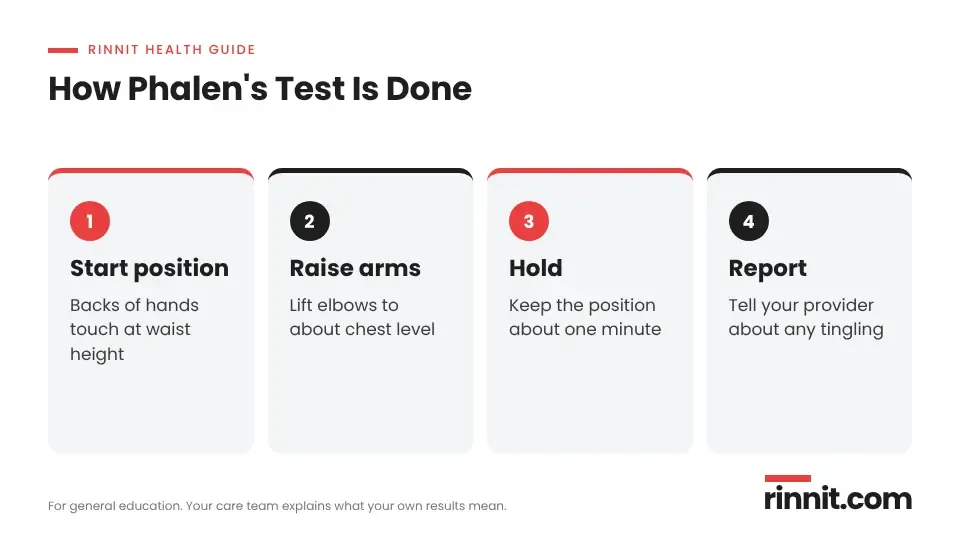
Your provider guides you through each position and asks what you feel.
Your provider will guide you through a few simple steps: [1]
Hold your hands near your waist with the backs of your hands pressed together. [1]
Lift your arms until your elbows are at about chest height, keeping the backs of your hands touching. [1]
Stay in this position for about one minute. [1]
Tell your provider if you feel tingling in your fingers or along the sides of your hand. [1]
Reverse Phalen's test
The reverse Phalen's test also checks for carpal tunnel symptoms, using the opposite wrist position. You press your palms together with your elbows pointing out at chest height, then lower your hands toward your stomach and hold for about one minute. [1]
Your provider may use one version or both. [1]
Feature | Phalen's test | Reverse Phalen's test |
Hand position | Backs of hands pressed together | Palms pressed together |
Arm position | Elbows raised to about chest level | Elbows pointed out at chest height, hands lowered toward stomach |
Time held | About one minute | About one minute |
What it looks for | Tingling or numbness in the hand or fingers | Tingling or numbness in the hand or fingers |
Sources: [1]
Preparing for the test and what to expect
You do not need to do anything to prepare for Phalen's test. If you notice new symptoms in your wrist, hand or fingers, it is a good idea to see a provider. [1]
During the test, try to hold the positions for as long as your provider asks. If you have carpal tunnel syndrome, you may feel some tingling or mild discomfort, but strong pain is not expected. [1]
Are there any risks?
There are no known risks to either Phalen's test or the reverse Phalen's test. [1]
You may feel short-lived pain or discomfort while holding the position. You can stop at any time if it becomes too uncomfortable. [1]
What do Phalen's test results mean?
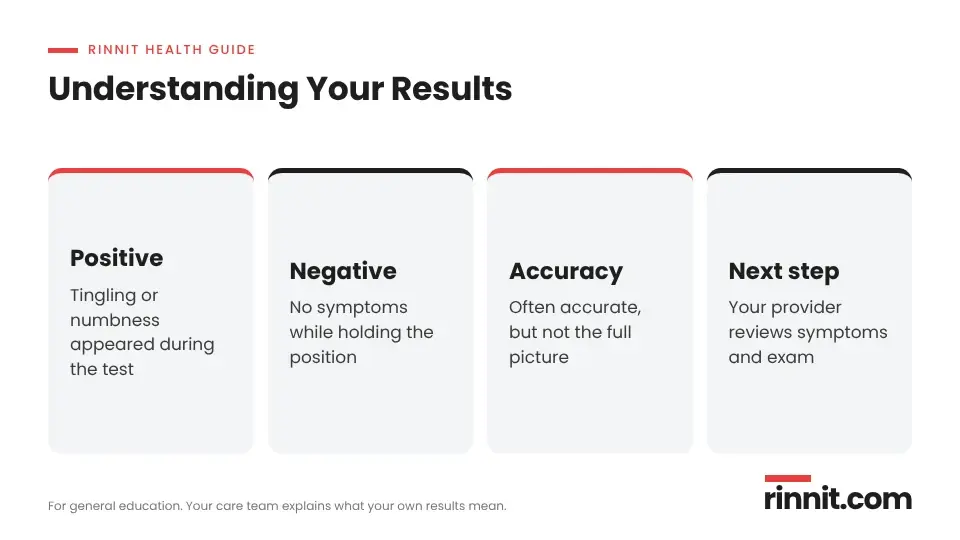
A Phalen's test result is one piece of your overall hand exam.
Your provider reads the result based on what you feel while holding the position. [1]
Result | What happened | What it may mean |
Positive | You felt carpal tunnel symptoms, such as tingling or numbness, during the test | Carpal tunnel syndrome is likely, and more tests may confirm it |
Negative | You held the position without carpal tunnel symptoms | Carpal tunnel syndrome is less likely, but it is not ruled out |
Sources: [1]
How accurate is Phalen's test?
Phalen's test is only moderately accurate on its own. Pooled studies found it picks up roughly 57% to 68% of people with carpal tunnel syndrome. [1]
Still, a negative result does not mean you definitely do not have carpal tunnel syndrome. The test is only one part of your physical exam. [1]
Be sure to tell your provider about all of your symptoms and how strong they feel, since this helps them reach the right diagnosis. [1]
Phalen's test vs. Tinel's sign
Your provider may check both Phalen's test and Tinel's sign during the same exam. Both look for signs of nerve compression, but they work in different ways. [1]
Phalen's test: You hold hand and wrist positions that bring on numbness or tingling if you have carpal tunnel syndrome. [1]
Tinel's sign: Your provider gently taps over the nerve, usually the median nerve at your wrist. A tingling or pins-and-needles feeling suggests carpal tunnel syndrome or another type of nerve compression. [1]
What happens after Phalen's test?
Depending on your result and symptoms, your provider may order more tests, such as: [1]
If you are diagnosed with carpal tunnel syndrome, your provider will suggest a treatment plan. If surgery is needed, you may be referred to an orthopaedic surgeon. [1]
Conclusion
Phalen's test is a fast, simple way for your provider to check for carpal tunnel syndrome. It takes about a minute, needs no preparation and has no known risks. [1]
A positive result points toward carpal tunnel syndrome, while a negative result does not fully rule it out. If you have new wrist pain or tingling and numbness in your hand or fingers, talk with your provider about an exam. [1]
Keep learning: Read our carpal tunnel syndrome guide. For more background, see the MedlinePlus carpal tunnel syndrome page.
FAQ
What is Phalen's test?
Phalen's test is a quick office exam that checks for carpal tunnel syndrome by holding your wrists bent with the backs of your hands together for about a minute.
Why would my provider do Phalen's test?
Your provider may use it if you have wrist pain or tingling, numbness or other symptoms in your hand or fingers that could point to carpal tunnel syndrome.
How does Phalen's test work?
Bending your wrists this way puts gentle pressure on the median nerve. If the nerve is irritated, the pressure can bring on tingling or numbness.
Does Phalen's test hurt?
It should not cause strong pain. You may feel some tingling or mild discomfort, and you can stop if it becomes too uncomfortable.
Do I need to prepare for Phalen's test?
No preparation is needed. Your provider can do the test during a regular visit, and no special equipment is used.
How long does Phalen's test take?
You hold the position for about one minute, so the whole test usually takes just a few minutes.
What does a positive Phalen's test mean?
A positive result means you felt carpal tunnel symptoms, such as tingling or numbness, during the test. This suggests carpal tunnel syndrome.
Can I have carpal tunnel syndrome with a negative Phalen's test?
Yes. A negative result makes carpal tunnel syndrome less likely, but it does not rule it out, so your provider also considers your symptoms and exam.
Are there any risks to Phalen's test?
There are no known risks. Any discomfort you feel while holding the position should be brief.
What happens after Phalen's test?
Your provider may order an MRI, ultrasound or EMG to confirm the diagnosis, then suggest treatment if you have carpal tunnel syndrome.
Related Reading
Carpal Tunnel Syndrome: Symptoms, Causes, Diagnosis and Treatment explains the condition Phalen's test checks for, along with its causes and treatment options.
References
Cleveland Clinic. Phalen's Test: What It Is & How It's Performed. Cleveland Clinic. Last updated July 18, 2023. https://my.clevelandclinic.org/health/diagnostics/25133-phalens-test
Dabbagh A, MacDermid JC, Yong J, et al. Diagnostic Test Accuracy of Provocative Maneuvers for the Diagnosis of Carpal Tunnel Syndrome: A Systematic Review and Meta-Analysis. Phys Ther. 2023;103(6):pzad029. PMID 37366626. https://doi.org/10.1093/ptj/pzad029
Núñez de Arenas-Arroyo S, Cavero-Redondo I, Torres-Costoso A, et al. Accuracy of the Most Common Provocation Tests for Diagnosing Carpal Tunnel Syndrome: A Systematic Review With Meta-analysis. J Orthop Sports Phys Ther. 2022;52(8):522-531. PMID 35722757. https://doi.org/10.2519/jospt.2022.10828
MacDermid JC, Wessel J. Clinical diagnosis of carpal tunnel syndrome: a systematic review. J Hand Ther. 2004;17(2):309-319. PMID 15162113. https://doi.org/10.1197/j.jht.2004.02.015
Medical disclaimer
This article is for general education only and does not replace advice from a qualified healthcare professional. Talk to your doctor about your own diagnosis and treatment, and seek emergency care right away for severe or sudden symptoms.



Comments